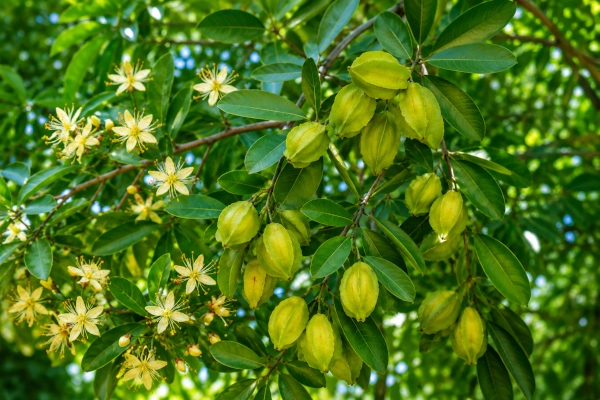
Botanical name: Terminalia arjuna (Roxb. ex DC.) Wight & Arn.
Family: Combretaceae
Sanskrit name: Arjuna
English names: Arjuna tree, Arjun tree
Principal Ayurvedic part used: Stem bark
Among the great medicinal trees of Ayurveda, Arjuna holds a particularly distinguished place. Its pale bark has been used for centuries in formulations associated with the heart, circulation, wounds, bleeding conditions and tissue repair. The tree is so strongly linked with Hridroga, the Ayurvedic category of heart disorders, that Arjuna has become almost synonymous with traditional Ayurvedic cardiovascular support.
Modern botany recognises the species as Terminalia arjuna (Roxb. ex DC.) Wight & Arn., a member of the Combretaceae family. Royal Botanic Gardens, Kew records its native range from the Indian subcontinent into Myanmar. The Ministry of Ayush’s e-Charak database specifically identifies the bark as the principal medicinal raw material obtained from Terminalia arjuna.
Arjuna is therefore an important example of a classical Ayurvedic medicine that has also attracted sustained modern cardiovascular research.
Arjuna in Ayurveda
Ayurvedic Dravyaguna describes Arjuna primarily through its strong Kashaya Rasa, or astringent taste. Its qualities are traditionally given as Laghu, meaning light, and Ruksha, meaning dry. Its Virya is Sheeta, or cooling, while its Vipaka is Katu, meaning that its post-digestive effect is considered pungent.
This combination helps explain several of its classical applications. An astringent substance tends to contract and stabilise tissues. A cooling substance can be useful where excessive heat and Pitta are involved. Its dryness also makes it relevant where excessive Kapha, moisture or secretions dominate.
Traditional Ayurvedic interpretations therefore commonly regard Arjuna as particularly useful in conditions involving Kapha and Pitta, although treatment still depends upon the patient’s individual Dosha state rather than the name of the herb alone.
Arjuna as a Hridya Dravya
Arjuna’s best-known traditional identity is Hridya, a term indicating an affinity for and supportive action toward the heart.
CCRAS, the Central Council for Research in Ayurvedic Sciences, lists Arjuna among medicinal plants used in the Ayurvedic context of Hridroga, or cardiovascular disorders. This association has continued into modern Ayurvedic practice, where Arjuna bark appears in several formulations intended for cardiovascular support.
The concept of Hridya is broader than the modern idea of a single “heart tonic.” Ayurveda views Hridaya as a vital centre connected with circulation, vitality and several physiological and psychological functions.
For this reason, traditional use of Arjuna should not be reduced to the claim that it simply “strengthens the heart.” Its role must be understood within the wider Ayurvedic assessment of Dosha, Dhatu, Agni and the nature of the patient’s condition.
Arjuna and Hridroga
Ayurveda recognises different patterns of Hridroga according to Dosha. CCRAS describes Vatika, Paittika and Kaphaja presentations with different symptom patterns rather than treating every heart disorder as one condition.
Arjuna entered this tradition as one of the important plant medicines associated with cardiovascular care.
Modern clinical research has added considerable interest to this traditional reputation. A double-blind crossover trial published in 2002 studied Arjuna bark extract in people with chronic stable angina. Participants experienced reduced angina frequency and improved treadmill exercise parameters compared with placebo.
These findings are encouraging, but they should not be interpreted as evidence that Arjuna can replace modern cardiovascular treatment.
What Modern Cardiovascular Research Shows
Terminalia arjuna has become one of the more extensively studied Ayurvedic cardiovascular plants. Researchers have examined it in experimental models and small clinical studies involving angina, heart failure, hypertension, endothelial function and lipid metabolism.
A systematic review of Arjuna in chronic stable angina concluded that the available studies suggested possible benefit, but the evidence base was limited by the number and quality of trials.
This distinction is important. A herb can have genuine pharmacological activity without having the same level of clinical evidence as an approved cardiovascular medicine.
Reviews of Arjuna research have repeatedly called for larger, well-designed and chemically standardised clinical trials before firm conclusions can be made about its role in preventing or treating cardiovascular disease.
Research in Chronic Heart Failure
Arjuna has also been examined in chronic heart failure.
A randomised controlled clinical study investigated a water extract of Terminalia arjuna stem bark as an additional treatment in patients with chronic heart failure. More recent systematic research continues to include this trial when evaluating plant-derived interventions for heart failure.
Such studies are scientifically important because they move beyond laboratory experiments into human clinical research.
However, heart failure is a serious medical condition. Arjuna should never be started, stopped or substituted for prescribed heart medicines without the involvement of a qualified physician.
India Continues to Research Arjuna
Interest in Arjuna is not confined to older research.
CCRAS currently lists an ongoing randomised, double-blind, placebo-controlled trial investigating Arjuna for primary chronic venous disease. The study examines clinical outcomes, quality of life and haemodynamic parameters.
NARIP at Cheruthuruthy has also documented research involving Arjuna in chronic venous disease.
This continuing work is significant because it represents an effort to examine a classical Ayurvedic medicine using modern clinical research methods rather than relying solely on traditional reputation.
The Chemistry Within Arjuna Bark
Modern phytochemical studies have identified several groups of compounds within Arjuna bark.
These include triterpenoids, flavonoids, tannins, glycosides and plant sterols. Compounds investigated include arjunolic acid, arjunic acid, arjunetin and several related molecules.
Researchers have associated some of these compounds with antioxidant and cardiovascular effects in experimental systems.
However, it is important not to confuse an isolated laboratory effect with a proven therapeutic outcome in humans. Whole Arjuna bark contains numerous compounds that may interact, while extracts prepared by different manufacturers can vary considerably.
Standardisation remains one of the major challenges in translating traditional herbal medicines into reproducible clinical treatments.
Arjuna and Oxidative Stress
A large portion of modern Arjuna research concerns oxidative stress.
Experimental studies suggest that constituents of Arjuna bark can influence oxidative pathways and may protect tissues under certain laboratory conditions. Reviews have therefore described antioxidant activity as one possible contributor to its observed cardiovascular effects.
This provides an interesting scientific parallel to its long traditional use.
Yet the word “antioxidant” is often overused in herbal marketing. Demonstrating antioxidant activity in a laboratory does not establish that a plant prevents heart attacks, reverses arterial disease or extends life.
Clinical outcomes require clinical evidence.
Arjuna and Cholesterol Research
Researchers have also examined Arjuna for possible effects on blood lipids and atherosclerosis.
Experimental and clinical reviews report hypolipidaemic and antiatherogenic activity in some studies. However, the strength of evidence varies considerably according to the extract, patient population and research design.
Arjuna should therefore not be described as a replacement for statins or other medically indicated cholesterol-lowering therapies.
For someone with elevated LDL cholesterol or established cardiovascular disease, treatment decisions should be based on overall cardiovascular risk and appropriate medical assessment.
Arjuna and Blood Pressure
Some experimental and clinical research has examined Arjuna in relation to blood pressure and vascular function.
Reviews describe hypotensive and vascular effects in experimental models, and Arjuna has appeared in small human studies involving cardiovascular disorders.
The evidence does not justify using Arjuna bark as a self-prescribed treatment for hypertension.
Blood pressure can be elevated without producing obvious symptoms, yet uncontrolled hypertension can damage the heart, kidneys, brain and blood vessels. Anyone with hypertension should continue prescribed treatment unless their physician specifically changes it.
Arjuna for Rakta and Bleeding Conditions
Arjuna’s powerful Kashaya Rasa gives it another important Ayurvedic identity.
Astringent substances are traditionally associated with Stambhana, or checking excessive flow. Arjuna is therefore described in Ayurvedic teaching references as useful in conditions involving bleeding and disturbed Rakta.
Its traditional haemostatic reputation also explains some of its external applications.
However, unexplained internal bleeding, blood in the stool, coughing blood, heavy menstrual bleeding or persistent bleeding from any source requires medical investigation. Astringent herbal medicines should never delay the diagnosis of potentially serious disease.
Arjuna and Wound Healing
Ayurvedic tradition also associates Arjuna with Vrana, or wounds.
Its Kashaya character makes this association understandable. Astringent drugs traditionally help dry excessive secretions and support tissue contraction. Ayurvedic teaching references therefore include external applications of the bark in wound care.
Modern studies have explored antioxidant, antimicrobial and wound-related properties of Terminalia arjuna, although much of this evidence remains experimental.
Fresh bark powder or homemade preparations should not be applied casually to deep, infected or non-healing wounds. Such wounds require appropriate cleaning, infection control and medical assessment.
Arjuna and Bhagna — The Tradition of Fracture Healing
One of the more fascinating classical associations of Arjuna involves Bhagna, the Ayurvedic category concerned with fractures and traumatic bone injuries.
Traditional Dravyaguna references describe Arjuna as useful in supporting the union of fractured tissue. The bark was historically used both internally and externally within broader Ayurvedic approaches to injury management.
This should not be interpreted as evidence that Arjuna bark can set or heal a broken bone by itself.
Modern fractures require proper imaging, alignment and immobilisation. Some fractures need surgical fixation. Traditional supportive medicines, when appropriately used, belong alongside proper orthopaedic care rather than in place of it.
The Importance of Kashaya Rasa
To understand Arjuna, it is necessary to understand Kashaya Rasa.
Astringency creates the familiar drying and puckering sensation felt in the mouth after tasting certain barks or unripe fruits. Ayurveda associates this taste with contraction, drying and stabilising actions.
Arjuna’s strong Kashaya character helps explain its traditional relationship with bleeding, wounds, excessive secretions and certain Pitta-Kapha conditions.
However, excessive use of strongly astringent substances may be unsuitable for people already experiencing pronounced dryness or constipation. This illustrates why Ayurveda does not select medicines merely by matching one symptom with one herb.
Arjuna Is Cooling, Not Heating
Despite its powerful medicinal reputation, Arjuna is traditionally described as Sheeta Virya, or cooling in potency.
This separates it from several other cardiovascular herbs that possess stronger heating characteristics.
Its Sheeta nature, together with Kashaya Rasa, contributes to its traditional use where heat, Pitta or Rakta disturbance accompanies the condition.
Ayurveda nevertheless assesses the complete profile of the individual. A cooling herb may still have drying qualities, and its overall action cannot be determined through Virya alone.
Traditional Arjuna Ksheerapaka
One of the best-known traditional ways of using Arjuna is Ksheerapaka, in which the bark is processed with milk.
Ayurvedic traditions have long combined medicinal plants with different Anupanas and processing media to modify their action and improve suitability. Arjuna preparations with milk became particularly associated with nourishing cardiovascular applications and physical weakness. Traditional Ayurvedic references continue to describe Arjuna milk preparations as part of its therapeutic use.
This is not a recommendation for people with heart disease to prepare Arjuna milk at home.
A patient taking anticoagulants, blood-pressure medicines, anti-anginal drugs, heart-failure medicines or other cardiovascular treatments should seek professional advice before adding concentrated herbal preparations.
Arjunarishta and Classical Formulations
Arjuna also appears in traditional compound preparations, the best known being Arjunarishta.
Arjunarishta is a fermented Ayurvedic formulation built around Arjuna bark and traditionally used in cardiovascular and weakness-related contexts. Other classical preparations also incorporate Arjuna according to the therapeutic purpose.
The existence of a classical formulation does not mean that every person with chest discomfort should take it.
Chest pain can signal a heart attack, pulmonary embolism, aortic disease or other emergencies. New, severe or unexplained chest pain requires urgent medical assessment.
Bark Is the Principal Medicinal Part
Although researchers have investigated several parts of the tree, stem bark remains the principal Ayurvedic medicinal material. The Ministry of Ayush specifically lists bark as the medicinal raw material for Terminalia arjuna.
This is important because medicinal claims concerning bark cannot automatically be transferred to the leaves or fruits.
Different plant parts possess different concentrations of tannins, triterpenoids and other compounds. Traditional medicine generally recognised these distinctions rather than treating the whole tree as pharmacologically identical.
The Arjuna Tree
Arjuna is a substantial tree rather than a small medicinal herb. Kew places its native range across India and neighbouring parts of South Asia into Myanmar and identifies it as a tropical tree species.
Its pale trunk and spreading crown give mature trees a distinctive appearance. The bark has become the economically important medicinal portion because of its extensive Ayurvedic use.
Because bark harvesting directly affects the living trunk, medicinal demand also raises questions about responsible cultivation and harvesting. A valuable medicinal tree must remain alive if the tradition surrounding it is to remain sustainable.
Ayurveda and the Meaning of Hridya
Modern descriptions frequently call Arjuna a “natural heart medicine.” Ayurveda provides a more precise and less sensational way of understanding it.
The classical concept of Hridya does not mean that one plant can treat every cardiovascular disorder. Heart disease itself includes many different conditions, from coronary artery disease and arrhythmias to valve disease and heart failure.
Ayurveda likewise distinguishes Hridroga according to its clinical presentation and Dosha involvement. CCRAS’s educational material reflects this differentiated approach rather than presenting heart disease as a single entity.
Arjuna’s traditional reputation is therefore best understood as a strong affinity for cardiovascular and Rakta-related therapeutic contexts.
Traditional Knowledge Meets Clinical Research
Arjuna is particularly interesting because it has progressed further into clinical investigation than many medicinal plants.
Small clinical studies have produced encouraging findings in chronic stable angina and other cardiovascular conditions. Experimental research has identified plausible antioxidant, vascular and myocardial mechanisms.
At the same time, systematic reviews have highlighted weaknesses in the evidence, including small study populations, limited standardisation and the need for stronger trial methodology.
Both facts can be true at the same time.
Traditional knowledge can point toward a genuinely useful medicinal plant, while modern science can still require better evidence before defining exactly how that plant should be used in contemporary clinical medicine.
Who Should Be Particularly Careful With Arjuna?
Arjuna deserves greater caution than an ordinary culinary herb because people often seek it specifically for serious cardiovascular problems.
Anyone with heart disease, arrhythmia, heart failure, hypertension or a history of heart attack should discuss Arjuna with their treating physician and qualified Ayurvedic practitioner before taking concentrated preparations. Existing reviews describe promising cardiovascular activity but also emphasise that long-term safety and definitive clinical roles remain insufficiently established.
The same caution applies to people taking multiple cardiovascular medicines. Adding an active herbal preparation to a complex treatment regimen should be done deliberately rather than experimentally.
Pregnant or breastfeeding women, children and people with major chronic illnesses should also avoid unsupervised medicinal use.
Arjuna Is Not an Emergency Treatment
This point deserves special emphasis because of Arjuna’s association with the heart.
Arjuna should never be used as a home response to sudden chest pain, severe breathlessness, fainting, cold sweating or symptoms suggesting a heart attack.
Traditional cardiovascular support and emergency cardiovascular medicine are completely different situations.
A medicinal plant can have an important role within Ayurveda without becoming a substitute for emergency diagnosis, ECG testing, cardiac biomarkers, imaging or life-saving intervention.
Arjuna and the Future of Ayurvedic Research
Arjuna provides a useful model for the future development of evidence-based Ayurvedic research.
It has a clearly identified botanical source. The medicinal part is well established. Classical indications are extensively documented. Important phytochemicals have been characterised, and human trials already exist.
The next step is not to make larger claims. It is to conduct larger, rigorously designed and standardised clinical studies that define appropriate extracts, doses, safety parameters and patient groups.
The fact that CCRAS continues controlled clinical research involving Arjuna demonstrates that this process remains active.
Conclusion
Arjuna, or Terminalia arjuna, is one of Ayurveda’s most celebrated medicinal trees. Its identity rests above all on its Kashaya Rasa, Sheeta Virya and traditional Hridya action. Ayurveda has used its bark in contexts involving Hridroga, Rakta, wounds, bleeding and tissue repair.
Modern science has found enough cardiovascular activity to make Arjuna a serious subject of research rather than merely a historical curiosity. Human studies involving chronic stable angina and heart failure have produced encouraging results, while experimental research has identified antioxidant, vascular and myocardial effects.
Yet the evidence also calls for restraint. Reviews continue to note limitations in trial quality, extract standardisation and long-term safety information.
Arjuna therefore deserves neither exaggerated claims nor dismissal.
Its true significance lies in the remarkable continuity between classical Ayurvedic observation and modern cardiovascular investigation. Long before modern laboratories began examining its tannins, flavonoids and triterpenoids, Ayurveda had already identified the bark of this great tree as a distinctive Dravya associated with Hridaya.
Today, Arjuna offers an opportunity to study that traditional knowledge with greater scientific precision while preserving the Ayurvedic principle that medicine must always be matched to the individual rather than used simply because a herb has become famous.
References
The accepted botanical identity and native distribution of Terminalia arjuna are documented by Royal Botanic Gardens, Kew — Plants of the World Online. The Ministry of Ayush e-Charak medicinal-plant database identifies Arjuna bark as its principal medicinal raw material.
The Central Council for Research in Ayurvedic Sciences includes Arjuna among medicinal plants associated with Hridroga and currently lists clinical research involving Arjuna in chronic venous disease.
Modern cardiovascular evidence includes the double-blind clinical study of Arjuna in chronic stable angina, systematic assessment of the available angina research and broader reviews of its cardiovascular pharmacology and limitations.
Health Disclaimer
This article is intended solely for educational and informational purposes. It describes traditional Ayurvedic knowledge and findings from published scientific research. It is not medical advice and should not be used to diagnose, prevent or treat cardiovascular or other diseases.
Arjuna is a pharmacologically active medicinal plant. People with heart disease, hypertension, arrhythmias, heart failure or other chronic illnesses should not self-medicate with Arjuna bark, extracts, powders, Arjunarishta or concentrated preparations. Herbal products should not replace medicines prescribed by a qualified physician.
Anyone experiencing chest pain, severe breathlessness, fainting, sudden weakness or other possible symptoms of a cardiovascular emergency should seek immediate medical care rather than attempting herbal treatment.
Pregnant women, breastfeeding mothers, children and people taking prescription medicines should use medicinal Arjuna only after appropriate professional advice.
You may also like
-
Warm Water in Ayurveda: When and Why It Is Recommended
-
Women Make Up 43% of India’s Ayush Workforce as Sector Supports 17.6 Lakh Livelihoods
-
Sunfox Technologies Raises $7 Million to Take India-Built Spandan ECG Platform Global
-
Ayurveda on Fasting: When Restraint Supports Digestion
-
Zydus and MSN Launch First Generic Riociguat in US Pulmonary Hypertension Market
:%20Ayurveda’s%20Celebrated%20Hridya%20Tree%20for%20the%20Heart,%20Rakta%20and%20Tissue%20Strength)