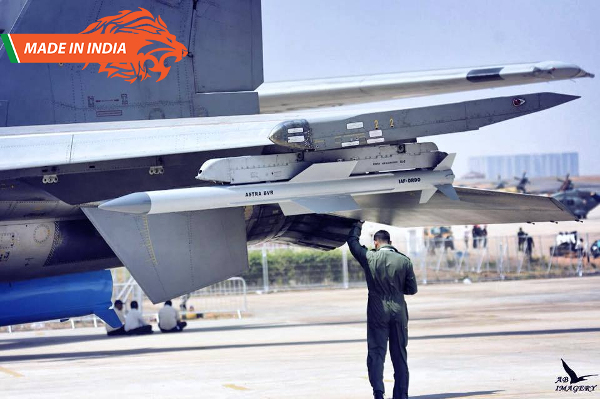
India is reportedly preparing to begin integration trials of the indigenous Astra Mk1 and Astra Mk2 beyond-visual-range air-to-air missiles on the Rafale fighter from around 2028, marking an important step toward expanding the use of Indian-developed weapons across the Indian Air Force’s frontline combat fleet.
The programme is expected to involve Dassault Aviation, the Rafale manufacturer, with technical support associated with the aircraft’s mission and weapon-management architecture. Thales, which supplies major Rafale systems including the RBE2 AESA radar, has also been linked in defence reporting to the proposed integration effort, although the precise division of responsibilities has not been publicly detailed.
Astra integration on Rafale already has an established industrial foundation. In October 2022, Bharat Dynamics Limited and Dassault Aviation signed a memorandum of understanding covering the integration of Indian weapon systems, including Astra, on the Rafale platform. The agreement created a formal basis for adapting indigenous missiles to the French fighter.
The reported 2028 programme is expected to progress through simulation, software validation and interface testing before moving to captive-carriage, separation and eventual live-firing trials. Integrating a new air-to-air missile requires far more than mechanically attaching the weapon to the aircraft, as the missile must communicate reliably with the fighter’s radar, mission computer, fire-control system and cockpit displays.
The Astra Mk1 is already entering wider operational service with the Indian Air Force and has been integrated with the Su-30MKI. Its addition to Rafale would reduce dependence on imported air-to-air weapons and create greater commonality across different fighter fleets.
The more advanced Astra Mk2 is intended to provide substantially greater engagement range and improved performance against manoeuvring aerial targets. Its future integration on Rafale would extend the fighter’s indigenous beyond-visual-range strike capability and give the IAF additional flexibility in weapons sourcing.
Rafale currently relies on the Meteor as its principal long-range air-to-air missile, alongside the MICA family. Astra is not expected simply to replace these weapons. Instead, the indigenous missile could provide the IAF with a complementary capability while improving inventory depth and reducing exposure to overseas supply constraints.
The integration effort also carries wider significance for India’s weapons-development ecosystem. Modern combat aircraft are increasingly defined by software and open weapon interfaces, making access to integration data critical for countries seeking to field indigenous missiles. India has therefore been pushing for greater freedom to integrate locally developed weapons on future fighter acquisitions.
Recent discussions surrounding additional Rafale procurement have also highlighted the importance of securing the necessary interface documentation to allow Indian missiles and precision weapons to be added without requiring unrestricted access to proprietary French source code.
If the reported schedule holds, integration trials could begin around 2028, followed by a progressive test campaign before operational clearance. The timeline remains indicative rather than officially fixed, as neither the Ministry of Defence nor the Indian Air Force has publicly announced a formal schedule for Astra Mk1 or Mk2 trials on Rafale.
Even so, the programme reflects a clear long-term direction: combining a high-end imported fighter platform with an increasingly indigenous weapons inventory. Successful Astra integration would give the Rafale a stronger Indian weapons component while advancing the broader objective of building greater strategic autonomy in combat aviation.
You may also like
-
DRDO Advances Indigenous Submarine AIP System as ₹1,990 Crore Kalvari-Class Integration Programme Progresses
-
Paras Defence Clarifies Guardian-1 Counter-Drone Partnership with US Firm Powerus Amid Pakistan Deal Concerns
-
India’s Defence Procurement Approvals Cross ₹1.62 Lakh Crore as Indigenous Manufacturing Gains Momentum
-
India Targets 10% of Global 6G Patents and Standards, Pushes Indigenous Telecom Technologies
-
India Demonstrates Maritime Rescue Capabilities at SAREX-2026 with Observers from 30 Countries
