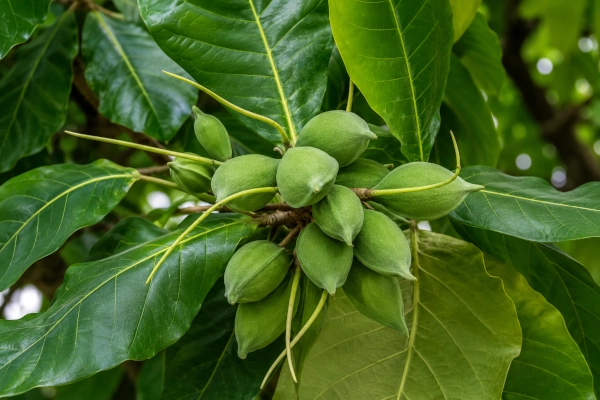
The broad-canopied Indian almond tree is familiar across coastal India, tropical gardens and roadside avenues. Its large leaves often turn yellow, orange or deep red before falling, while its distinctive oval fruits contain an edible kernel that gives the tree its common name.
Botanically known as Terminalia catappa L., Jangli Badam belongs to the Combretaceae family. Royal Botanic Gardens, Kew recognises it as an accepted species with a natural range extending across tropical and subtropical Asia, parts of the western Indian Ocean, the Pacific and northern Australia. It is now cultivated widely throughout the tropics for shade, food and several traditional uses.
In India, the tree is commonly called Jangli Badam or Desi Badam in several regions. The Kerala State Medicinal Plants Board records the Sanskrit name Inguda, the Hindi name Jangli Badam, the Tamil name Nattuvadumai and Malayalam names Badam and Thalli-thenga.
Jangli Badam deserves an important clarification within an Ayurveda series. Unlike classical drugs such as Arjuna, Haritaki or Bibhitaki, Terminalia catappa does not have the same uniformly established identity across the principal classical Ayurvedic texts. The Kerala State Medicinal Plants Board specifically places its documented medicinal applications under folk medicine, although Ayurvedic teaching institutions and later Indian herbal literature also discuss the plant under names such as Inguda and Jangli Badam.
It is therefore best understood as an Indian traditional medicinal and food tree with connections to regional Ayurvedic practice, rather than assigning it an unsupported classical profile.
The Indian Almond Tree
Terminalia catappa develops into a substantial tropical tree with a wide, spreading crown. Its branches often form characteristic horizontal tiers, giving younger trees a distinctive pagoda-like appearance. The large, leathery leaves gather toward the ends of branches and create dense shade beneath mature trees.
The flowers are small and comparatively inconspicuous. They are generally white to yellowish-green and appear in elongated spikes or racemes. The fruit develops as a compressed drupe that begins green and gradually becomes yellow, reddish or brownish as it matures. A single hard stone lies within the fruit, protecting the edible seed.
One of the tree’s most attractive features appears before leaf fall. Its foliage can change from green to yellow, orange, pinkish-red or reddish-brown. This seasonal colour change gives Jangli Badam an ornamental value unusual among many tropical avenue trees.
Jangli Badam Is Not the Commercial Almond
Despite its common name, Indian almond is not the same plant as the commercial almond, Prunus dulcis.
The familiar almond sold as a dry fruit belongs to the rose family, Rosaceae. Jangli Badam belongs to the Combretaceae and is botanically closer to other Terminalia species.
The name “almond” arose because the mature fruit contains an edible seed with a mild nut-like flavour. The resemblance is culinary rather than botanical. The kernel can be eaten after the mature fruit is opened, although extracting it from the hard fruit can require considerable effort.
This distinction is important in medicinal writing. Nutritional and clinical research involving ordinary almonds cannot automatically be applied to Terminalia catappa.
Jangli Badam, Inguda and the Ayurvedic Question
The Sanskrit name Inguda is recorded for Terminalia catappa by the Kerala State Medicinal Plants Board and by an Ayurvedic teaching institution.
However, botanical identification of Sanskrit medicinal names can sometimes vary between regions and historical sources. For that reason, it is safer to anchor the present article to the confirmed botanical species Terminalia catappa rather than assume that every classical reference to a similar traditional name necessarily refers to this exact tree.
The Kerala medicinal-plant database records the leaves as the principal traditionally used part and describes their application in folk medicine for skin disorders, diarrhoea and fever.
Other Indian herbal teaching sources document traditional applications of the leaves, bark, root bark, fruit and kernel. These include digestive complaints, cough, jaundice, skin conditions and externally applied preparations. Such information represents traditional practice rather than proof of clinical effectiveness.
A Strongly Astringent Medicinal Character
One feature repeatedly associated with Jangli Badam is astringency.
Leaves, bark and fruits contain significant quantities of tannins and other polyphenolic compounds. Traditional applications for diarrhoea, dysentery, wounds and excessive secretions are consistent with the contracting and drying effects commonly associated with tannin-rich plant materials.
Within an Ayurvedic framework, astringency corresponds broadly with Kashaya Rasa. However, because a reliable and uniform classical Rasa-Guna-Virya-Vipaka profile for Terminalia catappa is not as firmly established as it is for major classical drugs, it would be inappropriate to manufacture a full Ayurvedic pharmacological profile merely to fit the plant into a modern template.
The safer approach is to describe the traditional actions that have actually been documented.
Traditional Use of the Leaves
The leaves are among the most widely used parts of Jangli Badam in traditional medicine.
The Kerala State Medicinal Plants Board records leaf preparations for diarrhoea, fever and external treatment of several skin conditions. It specifically notes the traditional use of leaf plaster on affected skin.
Other traditional records describe leaf preparations for indigestion, cough and jaundice. Heated leaves have also been applied externally to swollen or painful areas in some regional practices.
These uses show the breadth of ethnomedicinal knowledge surrounding the tree. They should not, however, be interpreted as instructions for self-treatment.
Jaundice can result from liver disease, obstruction of bile flow, infection or other serious conditions. Persistent diarrhoea can lead to dangerous dehydration, while chronic skin lesions may require proper diagnosis.
Jangli Badam and Digestive Disorders
Traditional medicinal use of Terminalia catappa frequently centres on the digestive tract.
Leaves and bark have historically been used in preparations associated with diarrhoea and dysentery. The high tannin content of the plant provides a plausible biochemical explanation for its traditional astringent action.
The bark and root bark have also been used traditionally for stomach complaints, while some regional practices employ young leaves for indigestion or abdominal discomfort.
Modern research has identified antimicrobial and antioxidant activity in extracts of Terminalia catappa. However, these findings come predominantly from laboratory studies rather than large human clinical trials.
A bacterial intestinal infection therefore should not be treated by assuming that a laboratory antimicrobial result makes a homemade leaf decoction equivalent to an antimicrobial medicine.
Traditional Skin and Wound Applications
Jangli Badam also has a substantial history of external use.
The Kerala medicinal-plant database records crushed-leaf preparations for traditional treatment of skin disorders and wounds. Other herbal records describe the bark as being applied externally in some regional systems for sores and fungal skin conditions.
Modern studies provide some support for continued scientific investigation. Researchers have detected antibacterial and antifungal activity in leaf extracts, including activity against selected Candida species and other microorganisms under laboratory conditions.
Laboratory activity is not the same as clinical treatment. Serious fungal infection, infected wounds, diabetic ulcers and chronic skin lesions require medical evaluation.
Homemade plant paste should never be placed casually on deep or infected wounds because contamination can worsen the condition.
The Red Leaves and Their Traditional Importance
The red and brown leaves that fall from mature Jangli Badam trees have attracted considerable traditional and scientific interest.
As leaves age, their chemical composition changes. They remain rich in tannins and other polyphenolic substances, and traditional systems in several tropical regions have deliberately used mature or fallen leaves.
This feature has also made dried Indian almond leaves popular in aquarium keeping. They release tannins and other organic substances into water as they decompose.
That aquarium use should not be confused with human medicinal safety. A leaf suitable for conditioning aquarium water is not automatically suitable for preparing an internal herbal medicine.
Modern Phytochemistry of Terminalia catappa
Modern research has identified a complex mixture of plant compounds within Jangli Badam.
The leaves contain numerous tannins, flavonoids, phenolic compounds and related phytochemicals. Studies have identified chemical groups associated with antioxidant and antimicrobial activity.
Hydrolysable tannins and ellagitannins are especially prominent in research on the species. Other studies have reported flavonoids and related phenolic molecules.
These compounds may help explain some traditional applications, but phytochemical richness does not automatically establish therapeutic effectiveness in humans.
A plant extract demonstrating antioxidant activity in a laboratory may behave very differently when consumed, metabolised and eliminated by the human body.
Antioxidant Research
Antioxidant activity is among the most consistently reported experimental properties of Terminalia catappa.
Studies of leaf extracts have demonstrated the ability to interact with oxidative processes under laboratory conditions. The activity is generally linked to the plant’s polyphenols, flavonoids and tannins.
This has led researchers to investigate the plant in relation to inflammation, metabolic disorders and tissue protection.
Yet the term “antioxidant” should be handled carefully. Antioxidant activity in a laboratory does not prove that a plant prevents ageing, cancer, heart disease or other chronic disorders.
Such claims require human clinical trials.
Anti-Inflammatory Research
Modern researchers have also explored the anti-inflammatory potential of Jangli Badam.
Laboratory and animal investigations suggest that selected leaf and fruit extracts can influence inflammatory pathways. Reviews of the plant describe anti-inflammatory activity alongside antioxidant, antimicrobial and metabolic effects.
This experimental evidence offers an interesting parallel with traditional external applications for swollen or painful areas.
However, there is currently insufficient evidence to describe Terminalia catappa as a clinically proven treatment for arthritis or another inflammatory disorder.
Inflammation can arise from injury, infection, autoimmune disease and many other causes. The underlying condition matters more than the presence of a plant compound with experimental anti-inflammatory activity.
Research on Blood Sugar
Traditional medicine in several regions has used Jangli Badam in connection with diabetes. Modern researchers have consequently investigated possible effects on glucose metabolism.
Animal and laboratory studies have produced findings that justify further investigation, but these studies do not establish Jangli Badam leaf tea or extract as a treatment for diabetes.
People with diabetes should not substitute Terminalia catappa preparations for prescribed medicines, glucose monitoring or appropriate dietary care.
Concentrated plant extracts may also interact with existing medicines. Such combinations should be approached cautiously.
Research on Lipids and Cardiovascular Health
Fruit extracts of Terminalia catappa have been investigated experimentally for possible effects on blood lipids and atherosclerosis-related markers.
A 2023 animal study reported favourable changes in several lipid-related indices after treatment with fruit extracts. The authors regarded the results as evidence of potentially useful bioactive molecules requiring further study.
This is promising preclinical research, not evidence that eating Indian almond fruit or taking extracts prevents cardiovascular disease in humans.
The distinction is particularly important because cardiovascular disease requires interventions supported by strong human evidence.
Traditional Use for the Liver and Jaundice
Traditional records from several countries describe the use of Jangli Badam leaves in preparations associated with jaundice and liver complaints.
Experimental researchers have therefore investigated possible hepatoprotective activity.
Such research remains insufficient to justify treating jaundice or liver disease with homemade preparations. Jaundice itself is a clinical sign rather than a single disease and can indicate hepatitis, gallstone obstruction, drug toxicity or other potentially serious conditions.
Medical assessment is essential when yellowing of the skin or eyes develops.
The Edible Fruit and Kernel
Jangli Badam is unusual among medicinal trees because it also provides food.
The mature fruit contains a single edible seed. Indian herbal references describe the kernel as having an almond-like taste, which explains the tree’s familiar English and Hindi names.
The kernel contains fats, protein and other nutrients and has attracted growing interest as an underutilised tropical food resource. Modern scientific reviews are examining both the nutritional composition and possible food-industry applications of the fruit and seed.
The edible kernel should still be treated as a food rather than as a medicinal cure. Its nutrient content does not establish therapeutic effects against specific diseases.
Food and Medicine Are Not the Same Dose
Jangli Badam demonstrates an important principle that also appears throughout Ayurveda.
Eating an edible kernel as food is not equivalent to swallowing a concentrated leaf or bark extract. Different plant parts contain different compounds and can have very different safety profiles.
This distinction becomes especially important when internet discussions describe a plant as “natural” and therefore assume that every part can be consumed freely.
Traditional medical systems rarely operated on that assumption. Plant part, preparation, dose and condition all mattered.
Bark and Root Bark in Traditional Medicine
The bark has been used in several regional medical traditions as an astringent preparation for digestive and skin-related conditions.
Traditional records describe bark and root-bark preparations for diarrhoea, sores, abscesses and other complaints.
Because bark contains concentrated plant compounds, it should not be treated as casually as an edible fruit.
Removing bark from a living tree can also damage the plant. Sustainable medicinal use therefore requires careful harvesting rather than stripping bark indiscriminately from avenue or wild trees.
Modern Antimicrobial Research
Scientific studies have repeatedly examined Terminalia catappa against bacteria and fungi.
A 2017 study identified antifungal activity from leaf-derived fractions against several Candida organisms. More recent research has continued to investigate the plant against bacterial clinical isolates and dermatophytes.
These experiments help identify possible future pharmaceutical leads.
They do not mean that infections should be treated with leaves collected from a roadside tree. Extract concentration, purification, dosage and human safety all need to be established before laboratory findings can become clinical therapies.
Why Jangli Badam Leaves Attract Scientific Interest
Part of the scientific interest in Jangli Badam arises from the large amount of leaf material a mature tree produces.
The leaves are easy to collect, contain several classes of biologically active compounds and have a long record of traditional use. Researchers can therefore investigate a renewable plant material without relying solely on destructive root harvesting.
This creates an interesting meeting point between ethnobotany and modern pharmacology.
Traditional use provides clues about which plants deserve investigation. Laboratory science can then determine which compounds are present and whether observed effects survive rigorous testing.
Safety Requires More Attention
The popularity of medicinal plants often grows faster than the evidence concerning their safety.
A 2023 toxicological study specifically examined aqueous Terminalia catappa leaf extract in pregnant rats. Researchers observed changes involving liver and kidney tissue at higher experimental doses and also found effects on uterine contraction. They concluded that the extract should be approached cautiously in pregnancy.
Animal studies cannot predict every effect in humans, but such findings provide a clear reason to avoid assuming that concentrated Jangli Badam preparations are harmless during pregnancy.
Pregnant women should therefore avoid medicinal use of leaf, bark or concentrated extracts unless specifically advised by an appropriately qualified healthcare professional.
Jangli Badam and Pregnancy
Traditional herbal use during pregnancy deserves special caution because a preparation can affect both maternal physiology and uterine function.
The available animal toxicology evidence does not support casual medicinal consumption of Terminalia catappa leaf extracts during pregnancy.
This concern applies to medicinal extracts rather than occasional exposure to the ordinary environment around the tree. It also should not be interpreted as evidence that every form of the plant is dangerous.
The key message is simple: concentrated medicinal use during pregnancy requires evidence and professional guidance.
Cultivation and Ecological Value
Jangli Badam is particularly suited to tropical environments.
It tolerates coastal conditions well and commonly grows near beaches, river mouths and tropical lowlands. Its broad crown provides excellent shade, which explains its widespread use along roads, in parks and around institutions.
The fruit can also travel by water, helping the species spread through coastal environments. Its ability to tolerate tropical shorelines contributed to its distribution throughout islands and coastal regions.
As an avenue tree, its medicinal and nutritional identity therefore exists alongside an equally important ecological and ornamental role.
A Tree of Many Uses
Jangli Badam has been valued for far more than medicine.
Its broad canopy provides shade. Its kernel is edible. Its leaves and bark have entered regional medical traditions, while its wood and other plant materials have had practical uses in several tropical cultures. Kew records the species as having food, medicinal, environmental and social applications.
This versatility helps explain why the tree travelled widely through tropical societies.
It also illustrates how traditional communities rarely divided useful plants into rigid categories. A single tree might simultaneously provide food, medicine, timber, shade and cultural value.
A Necessary Distinction From Arjuna and Other Terminalia Species
Jangli Badam belongs to the same genus as several highly important Ayurvedic trees, but these species should never be confused.
Terminalia arjuna provides Arjuna bark, one of Ayurveda’s major traditional Hridya drugs. Terminalia chebula is Haritaki, while Terminalia bellirica is Bibhitaki. Their medicinal identities and classical uses are distinct.
Terminalia catappa is another species entirely.
The shared genus does not make their medicinal properties interchangeable. Herbal identification must always begin with the correct botanical species.
Traditional Knowledge Without Exaggeration
Jangli Badam offers a useful example of how traditional plant knowledge should be presented responsibly.
There is genuine documentation of medicinal use. There is also meaningful modern research into its tannins, flavonoids, antioxidant activity and antimicrobial effects.
At the same time, evidence from test tubes and animals should not be transformed into claims that Jangli Badam cures diabetes, liver disease, cancer or infection.
Traditional knowledge deserves greater respect when it is described accurately rather than inflated into promises it never made.
Jangli Badam in the Dharmakshethra Ayurveda Series
Within an Ayurvedic medicinal-plant series, Jangli Badam occupies a slightly different position from plants such as Ashwagandha, Arjuna or Haritaki.
Its importance lies strongly in regional Indian medicine, folk practice, ethnobotany and food tradition. The State Medicinal Plants Board of Kerala explicitly records its traditional medicinal use while classifying the documented system as folk medicine.
Ayurvedic teaching literature also recognises the plant and gives Sanskrit names including Inguda.
Acknowledging both facts allows us to preserve traditional knowledge without falsely claiming a classical textual status that requires stronger documentation.
Conclusion
Jangli Badam, or Terminalia catappa, is far more than a tropical shade tree. Its spreading branches, colourful leaves and almond-like edible kernels have made it familiar across India, while generations of traditional healers have used its leaves, bark, fruit and other parts for a variety of purposes.
Modern research has identified tannins, flavonoids and other phytochemicals that help explain why the species continues to attract scientific attention. Experimental studies have explored antioxidant, anti-inflammatory, antimicrobial and metabolic effects. Much of that work, however, remains preclinical.
Its greatest lesson may therefore lie in balance.
Traditional medicine gives researchers valuable clues. Modern science can test those clues. Neither requires exaggerated claims.
Jangli Badam deserves recognition as a valuable Indian traditional medicinal, nutritional and ecological tree, while its precise place within classical Ayurveda should be described carefully.
The broad tropical tree that shades an Indian roadside can thus be viewed through several lenses at once: as food, as folk medicine, as a botanical resource and as a subject of continuing scientific investigation.
References
The botanical identity, accepted taxonomic status and broad geographical range of Terminalia catappa are documented by Royal Botanic Gardens, Kew — Plants of the World Online.
The State Medicinal Plants Board, Kerala records Indian vernacular names including Jangli Badam and the Sanskrit name Inguda. It also documents traditional leaf use and classifies the recorded medicinal system as folk medicine.
Botanical description and broader Indian traditional-use information have been cross-checked against the Dravyaguna teaching material of Shri Dhanwantry Ayurvedic College and Hospital.
Modern phytochemical and pharmacological discussion is supported by peer-reviewed research examining Terminalia catappa leaves, fruits and extracts, including studies of antioxidant, antimicrobial and other experimental biological activities.
Safety guidance concerning pregnancy is based on a published toxicological study of aqueous Terminalia catappa leaf extract in pregnant animals.
Health Disclaimer
This article is intended solely for educational and informational purposes. It discusses traditional medicinal practices, ethnobotanical knowledge and published scientific research. It is not medical advice and should not be used to diagnose, prevent or treat disease.
Traditional uses of Terminalia catappa should not be interpreted as clinically proven treatments. Concentrated leaf, bark, root or fruit extracts may produce effects very different from ordinary food use of the edible kernel.
Pregnant women should avoid medicinal use of Jangli Badam extracts without professional guidance because animal research has raised safety concerns regarding concentrated leaf preparations during pregnancy.
Anyone taking medicines for diabetes, hypertension, liver disease or another chronic condition should consult an appropriate healthcare professional before using concentrated herbal preparations.
Do not use Jangli Badam as a substitute for prescribed treatment, and do not apply homemade preparations to serious wounds or infections.
You may also like
-
Ayurveda on Cold Foods and Iced Drinks: Why Food Temperature Matters for Digestion
-
Serum Institute of India-Manufactured Ebola Vaccine Enters Clinical Trial in Uganda
-
Ayurveda and Hydration: How Much Water Should We Really Drink?
-
Warm Water in Ayurveda: When and Why It Is Recommended
-
Women Make Up 43% of India’s Ayush Workforce as Sector Supports 17.6 Lakh Livelihoods
:%20Indian%20Almond%20in%20Traditional%20Medicine,%20Nutrition%20and%20Tropical%20Healing)