
The Abhiras were one of the most widely dispersed peoples mentioned in the geographical traditions of ancient Bharat. Their name occurs repeatedly in the Mahabharata, while later literary, geographical, inscriptional and Greco-Roman sources place communities identified as Abhiras across a remarkably broad zone extending from the Sarasvati and Indus regions through Rajasthan and Gujarat to Saurashtra, the northern Konkan and northern Maharashtra.
Abhira can therefore be placed broadly within western and southern Bharat, particularly across parts of modern Gujarat, Rajasthan, Sindh and the northern Konkan. However, unlike compact kingdoms such as Matsya, Chedi or Surasena, Abhira should not be represented as a single territory with permanently fixed borders. The Mahabharata itself appears to know Abhira communities in more than one geographical setting, while later historical evidence records their gradual expansion southward.
This makes Abhira especially interesting. The name represents not merely a kingdom but a people whose settlements, political influence and geographical associations changed substantially over time.
Where Was Ancient Abhira?
There is no single modern state that corresponds perfectly with ancient Abhira territory. The safest reconstruction places major Abhira settlements across the western regions of the Indian subcontinent, particularly around Rajasthan, Gujarat, Sindh and eventually northern Maharashtra and the northern Konkan.
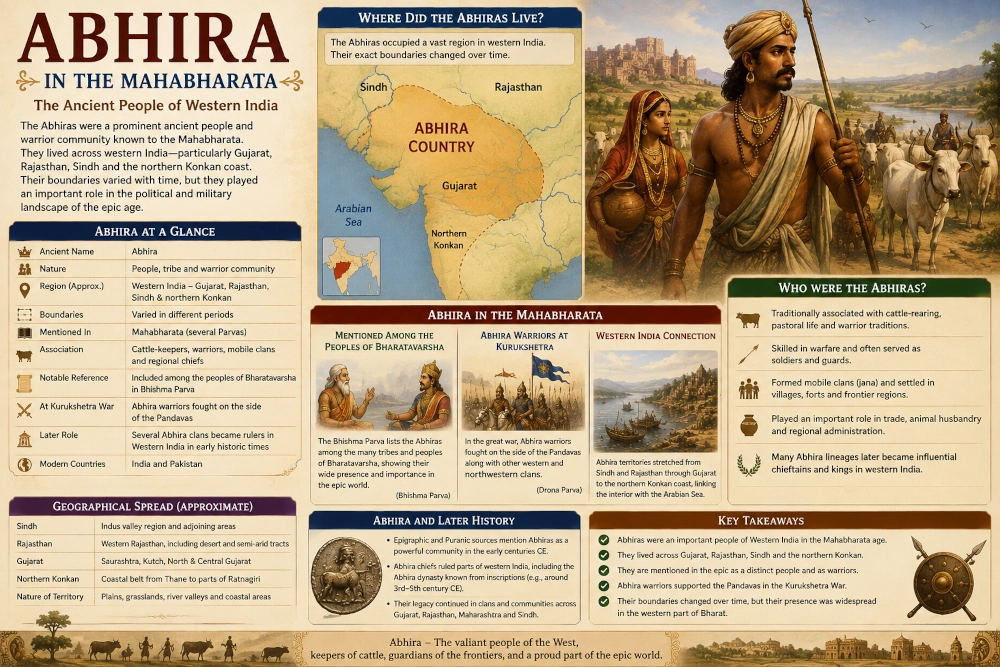
Mahabharata traditions associate some Abhiras with the Sarasvati and Sindhu regions. Historical geographical studies consequently place early Abhira settlements in areas extending from western Rajasthan towards Sindh. Other traditions connect them with the seacoast and western India. The Maharashtra State Gazetteer notes that the epic preserves references to Abhiras along the Sarasvati and in the north-west before later evidence shows their expansion towards western and southern India.
By the early centuries of the Common Era, Greco-Roman geographical traditions recognised a territory called Abiria or Aberia, generally associated with the lower Indus, western Rajasthan, Gujarat or the region between Sindh and Saurashtra. Later Abhira political power became particularly visible in northern Maharashtra and the Nashik region.
The most useful geographical identification for map is therefore:
Abhira — western India, especially Gujarat, Rajasthan, Sindh and the northern Konkan, with boundaries varying considerably across different periods.
Today this ancient geographical sphere lies within both India and Pakistan.
Abhira at a Glance
| Feature | Identification |
|---|---|
| Ancient Name | Abhira / Ābhīra |
| People | Abhiras |
| Broader Region | Western and Southern Bharat |
| Principal Geographical Zone | Western India and north-western Deccan |
| Major Associations | Rajasthan, Gujarat, Sindh, Saurashtra, northern Konkan and northern Maharashtra |
| Ancient River Associations | Sarasvati and Sindhu |
| Western Maritime Association | Arabian Sea coast |
| Later Historical Centre | Nashik and northern Maharashtra |
| Modern Countries | India and Pakistan |
| Mahabharata Status | A people or tribal community occurring in several passages rather than a securely bounded single kingdom |
| Traditional Occupation | Strongly associated in later tradition with pastoralism and cattle keeping |
| Historical Greek Name | Abiria / Aberia |
| Boundary Certainty | Low; settlements and political centres shifted over time |
The Abhiras in the Mahabharata
The Abhiras are much more securely attested in the Mahabharata than several other regional names in this series.
In the Bhishma Parva’s long description of the peoples and regions of Bharatavarsha, the Abhiras are explicitly included among the communities inhabiting the subcontinent. They occur alongside peoples such as the Vahikas, Vatadhanas and Aparantas, demonstrating that the epic’s geographical tradition regarded them as a recognised people of ancient Bharat.
Other passages associate Abhiras with the region of the Sarasvati. One geographical tradition preserved in the epic describes Abhiras near the place called Vinasana, where the Sarasvati was believed to disappear beneath the earth. Ancient geographical scholarship has consequently associated at least one branch of the Abhiras with western Rajasthan and the lower or disappearing Sarasvati zone.
The Sabha Parva also preserves traditions concerning Abhira communities encountered during the Pandavas’ campaigns and those who later brought tribute to Yudhishthira. These passages demonstrate that the Abhiras were already incorporated into the epic’s political geography rather than appearing only in later historical literature.
Nakula and the Abhiras
One of the important Mahabharata references to the Abhiras occurs in connection with Nakula’s western campaign.
Before Yudhishthira’s Rajasuya sacrifice, the Pandava brothers travelled in different directions to establish political supremacy and obtain tribute from surrounding rulers and peoples. Nakula was assigned the western direction.
During this campaign, traditions associated with the Sabha Parva place Abhira communities near the Sarasvati and Sindhu regions among the western peoples encountered by Nakula. This fits the broader geographical pattern connecting the early Abhiras with western Rajasthan, Sindh and the north-western frontier of ancient Bharat.
The episode is important because it provides a direct connection between the Abhiras and the political geography of the Pandava period.
It also cautions against restricting ancient Abhira territory entirely to Gujarat or Maharashtra. At least part of the epic tradition places them considerably farther north-west.
The Abhiras Bring Tribute to Yudhishthira
The Sabha Parva contains another important reference when different kings, peoples and communities arrive at Yudhishthira’s court bearing tribute.
Abhiras appear among these groups, indicating that they belonged to the wider network of peoples brought within the political influence of the Pandavas during the Rajasuya period.
Their appearance in this context does not necessarily mean that every Abhira settlement was ruled by a single Abhira monarch. Ancient peoples often occupied several regions and could be organised through local chiefs, pastoral groups or smaller political units.
This may explain why the Abhiras appear repeatedly in geographical lists without possessing the kind of clearly defined royal genealogy associated with kingdoms such as Magadha, Chedi or Matsya.
Abhiras at Kurukshetra
The Mahabharata also places Abhiras within the military world of the Kurukshetra War.
Traditional indexes of the epic identify Abhiras among the forces incorporated into one of Drona’s battle formations. Their presence illustrates that Abhira warriors participated in the wider military networks of northern and western India rather than remaining geographically isolated pastoral communities.
Unfortunately, the epic does not provide enough consistent information to reconstruct a single Abhira ruler, capital or political alignment throughout the war.
This again suggests that Abhira was fundamentally an ethnogeographical designation, referring to communities distributed across several territories.
The Sarasvati and Vinasana
One of the strongest geographical clues concerning the epic Abhiras is their association with the Sarasvati River.
In the Shalya Parva, during the description of sacred places along the Sarasvati, the text refers to Vinasana, the place where the river was believed to disappear. The Abhiras are connected with the population of this region in the epic tradition. The Maharashtra State Gazetteer similarly notes the connection between Abhiras, the Sarasvati and Vinasana.
The precise historical course of the Sarasvati described in the epic remains debated, and ancient texts sometimes preserve multiple geographical traditions under the same river name.
Nevertheless, this reference strongly suggests an important Abhira presence somewhere in the north-western zone of ancient Bharat, particularly around western Rajasthan and adjoining areas.
For our geographical reconstruction, this should be represented as an early Abhira zone, not necessarily as the entire Abhira homeland throughout history.
The Abhiras and the Sindhu Region
Other ancient geographical traditions place the Abhiras close to the Indus or Sindhu.
Later writers associated a territory called Abiria with the lower Indus region. Ptolemy’s geographical traditions place Abiria in or near Sindh, while other ancient descriptions locate Abhira territory between the lower Indus and Saurashtra.
This strengthens the connection between the Abhiras and the broad western corridor stretching from Sindh through Rajasthan towards Gujarat.
Sindh was historically connected with Kachchha and Saurashtra through desert, riverine and coastal routes. Groups inhabiting these regions could therefore move gradually between the lower Indus, Rajasthan, Kachchha and Gujarat.
Such mobility is particularly plausible for communities associated with pastoralism and cattle herding.
Abiria in Greek and Roman Geography
The Abhiras are unusual among the peoples of the Mahabharata because a recognisable version of their name appears in classical Mediterranean geographical literature.
The Periplus of the Erythraean Sea, a commercial guide to Indian Ocean navigation produced during the early centuries of the Common Era, refers to a region usually rendered as Abiria or Aberia.
Ptolemy also records a geographical name connected with Abiria.
Although scholars have differed regarding its precise boundaries, the region is generally located somewhere between the lower Indus valley, western Rajasthan, Gujarat and Saurashtra.
This evidence is several centuries later than the period traditionally associated with the Mahabharata, so it cannot be used to draw the epic-era boundary directly.
It nevertheless demonstrates that the name Abhira survived as a recognised geographical identity in western India.
Abhira and Saurashtra
Saurashtra became one of the major regions associated with the Abhiras in later historical tradition.
The Kathiawar peninsula offered extensive grazing lands, coastal routes and connections towards Kachchha, Sindh, mainland Gujarat and the Arabian Sea.
Purāṇic traditions sometimes associate Abhiras with Saurashtra and neighbouring western regions, while historical evidence shows Abhira military figures serving under the Western Kshatrapas who ruled large portions of Gujarat and western India.
The relationship between the Abhiras and Saurashtra should not be interpreted as proving that all of Saurashtra constituted a single Abhira kingdom during the Mahabharata period.
Instead, it demonstrates the gradual spread and growing political influence of Abhira communities in western India.
Abhira and Rajasthan
Rajasthan forms another major component of Abhira geography.
The Sarasvati-Vinasana tradition points towards the north-western and desert regions, while later historical reconstructions identify Abhira settlements across western and southern Rajasthan.
This location provides a geographical bridge between the north-western Abhiras associated with the Sarasvati and Sindhu and the later populations documented in Gujarat.
The Aravalli ranges, Thar Desert and the corridors leading towards Kachchha and Saurashtra would all have influenced the movement of communities across this landscape.
For our map, Rajasthan should therefore form an important part of the broad Abhira distribution zone rather than being treated merely as a neighbouring territory.
Abhira and Gujarat
Gujarat eventually became one of the strongest geographical associations of the Abhiras.
Ancient geographical scholarship places Abhira settlements in different parts of Gujarat, particularly towards Saurashtra, Kachchha and the mainland regions adjoining the western coast.
Some older geographical works even use the name Abhira for regions around the lower Narmada and southern Gujarat, although such identifications probably belong to different historical periods.
This variation demonstrates why Abhira cannot be mapped with a single fixed boundary.
The geographical name expanded and shifted as Abhira communities migrated, entered military service and established political influence over new territories.
Abhira and Kachchha
Kachchha occupied an important geographical position between Sindh and Saurashtra and therefore lies naturally within the wider Abhira sphere.
Ancient geographical studies have connected eastern Kachchha with communities preserving traditions linked to the Abhiras.
The region’s semi-arid environment was also suitable for pastoral economies, making movement between Rajasthan, Sindh, Kachchha and Saurashtra relatively natural for communities dependent upon cattle.
Kachchha should consequently appear prominently on any map illustrating the wider Abhira distribution.
Abhira and the Northern Konkan
One of the most important later developments in Abhira history was their expansion towards the northern Konkan and northern Maharashtra.
Historical geographers record Abhira influence extending southward from Gujarat into the coastal and upland regions around the northern Konkan and Nashik.
The Konkan coast connected Gujarat with the ports of western Maharashtra, while passes through the Sahyadri ranges led inland towards Nashik and the upper Godavari valley.
The Abhiras therefore became part of the same strategic geographical network linking Saurashtra, Bharukachchha, Aparanta, Surparaka and Nasikya.
This southern expansion became politically significant during the centuries following the Satavahana period.
The Abhiras in Nashik and Northern Maharashtra
By the early centuries CE, Abhira power had become especially visible in northern Maharashtra.
The Nashik inscriptions preserve evidence concerning an Abhira ruler named Ishvarasena, generally associated with the third century CE. The Maharashtra State Gazetteer treats this period as an important phase in the emergence of Abhira political authority in Maharashtra.
This historical Abhira kingdom developed many centuries after the events traditionally associated with the Mahabharata.
It must therefore be distinguished carefully from the Abhiras described in the epic.
However, the Nashik evidence demonstrates the remarkable geographical expansion of the Abhira name from the north-west into the northern Deccan.
The Abhiras and the Yadavas
The Abhiras became strongly associated in later cultural tradition with pastoral life, cattle keeping and the wider Krishna-Yadava world.
Because Krishna’s childhood traditions centre upon cowherd communities, later scholars and traditions frequently explored connections between the Abhiras, Gopas, Yadavas and pastoral groups of western India.
These relationships are historically complex and should not be reduced to a simple claim that every Abhira was a Yadava or every Yadava was an Abhira.
What can be said safely is that the Abhiras became deeply integrated into the pastoral cultural environment associated with Krishna traditions in western India.
This association is particularly interesting because the Mahabharata’s final major encounter with the Abhiras occurs immediately after the destruction of Krishna’s own Yadava clan.
Arjuna and the Abhiras After the Destruction of Dwaraka
The most dramatic appearance of the Abhiras in the Mahabharata occurs not during the Kurukshetra War but near the end of the epic.
After the destruction of the Yadavas and the departure of Krishna, Arjuna travelled to Dwaraka and began escorting the surviving women, children and elderly members of the Vrishni and Andhaka families towards safer territory.
The Mausala Parva states that Arjuna eventually reached the country of the five waters, generally associated with Punjab. There, groups identified in the text as Abhiras attacked the vulnerable procession.
Arjuna attempted to defend the refugees, but something extraordinary occurred. The great warrior who had fought Bhishma, Karna and countless other champions at Kurukshetra found that his former power had deserted him.
He could no longer summon his celestial weapons as before. His strength and mastery of the Gandiva appeared diminished, and the attackers succeeded in carrying away many members of the procession.
The episode symbolises the end of an age.
Why Arjuna Could Not Defeat the Abhiras
The encounter with the Abhiras is not presented simply as an ordinary military defeat.
Arjuna gradually understands that the power which had sustained him during the great events of the Mahabharata belonged to a divine purpose that had now been completed.
Krishna had departed from the world.
The Yadava dynasty had destroyed itself.
The age of the great heroes was ending.
Arjuna’s inability to wield his celestial weapons therefore represents the withdrawal of the extraordinary power associated with the previous age.
The Abhira attack becomes the setting through which the epic demonstrates that even the greatest human warrior cannot overcome Time.
The episode consequently gives the Abhiras a remarkable place in the final chapters of the Mahabharata.
Were the Abhiras a Kingdom or a People?
For mapping purposes, this distinction is extremely important.
The Mahabharata generally presents the Abhiras as a people, although later historical periods certainly saw Abhira rulers and kingdoms.
Ancient Indian geographical terminology did not always distinguish neatly between ethnic groups, political territories and kingdoms. A region could acquire the name of the people inhabiting it, while the same people could later migrate and establish settlements elsewhere.
This appears to have happened with the Abhiras.
The name therefore occurs across a very large geographical area.
Rather than drawing one rigid Abhira kingdom, our map should illustrate a principal Abhira geographical zone and acknowledge that Abhira communities were present in several different parts of western and north-western Bharat.
Abhira and Southern Bharat
Abhira can be included under Southern Bharat because a substantial part of its best-known later geographical sphere extended across Gujarat, Saurashtra, the northern Konkan and the northern Deccan.
However, the Mahabharata evidence shows that the Abhiras cannot be regarded as exclusively southern.
Important epic traditions place them farther north-west around the Sarasvati, Sindhu and Punjab regions. The Bhishma Parva itself includes the Abhiras within the wider enumeration of the peoples of Bharatavarsha rather than confining them to one clearly bounded southern kingdom.
The best interpretation is therefore that the Abhiras were a mobile and expanding western people whose geographical centre shifted southward across time.
Abhira and Its Neighbouring Regions
The broad Abhira sphere overlapped or bordered numerous ancient regions.
Towards the north and north-east lay the Sarasvati country, Matsya and parts of Rajasthan. To the west lay Sindhu and Sauvira. To the south-west were Kachchha and Saurashtra, while Anarta occupied parts of mainland Gujarat.
Farther south lay Lata and Bharukachchha around southern Gujarat and the lower Narmada.
Along the western coast were Aparanta and Surparaka, while beyond the Sahyadri ranges lay Nasikya and the northern Deccan.
Because the Abhiras were distributed across this enormous region at different periods, some degree of geographical overlap is unavoidable.
Abhira and Aparanta
Aparanta, broadly associated with the northern Konkan and parts of India’s western coastline, became closely connected with the southward expansion of the Abhiras.
Historical studies associate later Abhira political power with both the Nashik country and sections of the northern Konkan.
The relationship between Abhira and Aparanta again demonstrates the difference between an ethnic name and a territorial name.
Aparanta described a geographical region, while Abhira described a people who could inhabit or govern portions of that region.
The two names could therefore overlap without being identical.
Pastoral Life and the Geography of the Abhiras
The enduring association of the Abhiras with cattle keeping provides one possible explanation for their broad geographical distribution.
Pastoral communities often required access to extensive grazing grounds and seasonal routes. Western India contains enormous stretches of semi-arid grassland extending across Sindh, Rajasthan, Kachchha, Saurashtra and Gujarat.
These landscapes naturally encouraged mobility.
The movement of Abhira communities southward towards the Narmada, northern Konkan and Deccan may therefore have involved not only military and political expansion but also older traditions of pastoral migration.
This helps explain why the same ethnic name appears in widely separated geographical contexts.
Historical Abhira Political Power
During the early centuries CE, the Abhiras became more than a widely distributed community.
Abhira military officers appear in inscriptions connected with the Western Kshatrapas. One important inscription from Gujarat refers to Rudrabhuti, an Abhira who served as a military commander under the Kshatrapas.
Later, Abhira rulers established independent authority in portions of western India and northern Maharashtra.
The rise of Ishvarasena in the Nashik region represents one of the clearest expressions of this political transformation.
The pastoral and military communities known from earlier traditions had thus become rulers of organised territories.
Ancient Abhira and Modern Geography
| Ancient Region or Reference | Modern Association |
|---|---|
| Sarasvati Abhiras | Western Rajasthan and adjoining north-western region |
| Sindhu-associated Abhiras | Sindh and lower Indus sphere |
| Abiria | Lower Indus–western Rajasthan–Gujarat sphere, approximate |
| Kachchha Abhiras | Kutch region of Gujarat |
| Saurashtra Abhiras | Kathiawar peninsula |
| Gujarat Abhiras | Western and mainland Gujarat |
| Aparanta-associated Abhiras | Northern Konkan |
| Nashik Abhiras | Northern Maharashtra |
| Modern Countries | India and Pakistan |
Abhira’s Place in the Mahabharata World
Abhira occupies an unusual position in the Mahabharata geographical landscape.
Unlike Magadha, Chedi or Matsya, the Abhiras are not remembered principally through a famous royal dynasty.
Instead, they appear as a widespread people.
They are associated with the Sarasvati country, encountered within the political expansion of the Pandavas, included among the peoples of Bharatavarsha and remembered again in the final destruction of the Yadava world.
Their geographical history continued long after the epic period.
The name Abhira appeared in foreign geographical accounts, inscriptions and Purāṇic traditions. Abhira military commanders served powerful western Indian dynasties, and eventually Abhira rulers established their own political authority in parts of the northern Deccan.
Few peoples in the Mahabharata geographical tradition demonstrate such extensive movement across the western subcontinent.
The Legacy of the Abhiras
The Abhiras illustrate the fluid nature of ancient Indian geography.
Political kingdoms could rise and disappear, but communities frequently travelled across them. Tribal and ethnic identities could survive even as their geographical centres shifted.
The Abhiras appear to have followed precisely such a pattern.
Epic traditions preserve them in the north-west around the Sarasvati and Punjab sphere. Classical geographical accounts know Abiria around the lower Indus and western India. Later traditions associate the Abhiras strongly with Rajasthan, Gujarat, Kachchha and Saurashtra. Historical inscriptions finally reveal Abhira political power extending into the northern Konkan and the Nashik region.
Their story therefore connects the deserts of Rajasthan, the plains of Sindh, the grazing lands of Kachchha and Saurashtra, the ports of Gujarat and the mountain gateways of the northern Deccan.
The Abhiras were not confined by a single boundary.
They were one of the great mobile peoples of western ancient Bharat.
And in the Mahabharata, they appear both during the rise of Pandava power and at the extraordinary moment when Arjuna discovered that the age of the heroes had finally come to an end.
Abhira — western India, particularly Gujarat, Rajasthan, Sindh and the northern Konkan; boundaries varied — India and Pakistan.
You may also like
-
Sindhu: The Indus Kingdom of Jayadratha in the Mahabharata
-
Kuninda or Kulinda: The Himalayan Realm of the Mahabharata in Uttarakhand and Himachal Pradesh
-
Durga versus Mahishasura: Weapons, Battlefield Tactics and the Triumph of Shakti
-
Kuluta: The Kullu Valley Kingdom of the Mahabharata
-
Trigarta: The Kangra–Jalandhar Kingdom of the Mahabharata
