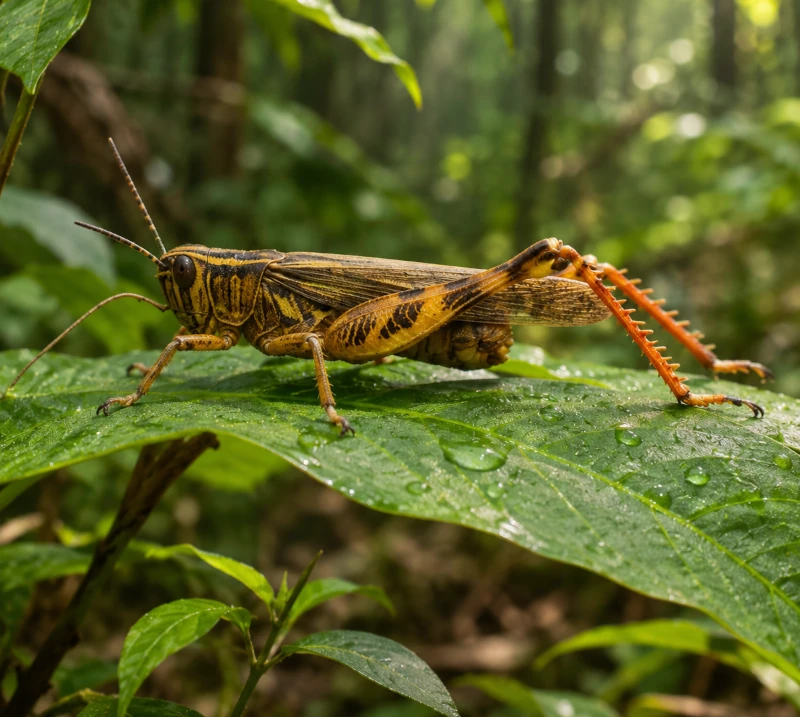
An international team of researchers involving scientists from the Zoological Survey of India (ZSI) has identified a previously undocumented grasshopper species in Nagaland’s Peren district. Scientifically named Heteracris jalukie, the species represents the first documented occurrence of the genus Heteracris in Northeast India. The discovery highlights the region’s remarkable insect diversity and the importance of continued scientific exploration within the Indo-Burma biodiversity hotspot.
Discovery in Nagaland’s Bamboo Forests
The specimens were collected in August 2024 from vegetation bordering a moist forest characterised by extensive bamboo growth in Jalukie B village. Subsequent taxonomic investigations were undertaken at the Zoological Survey of India’s North Eastern Regional Centre in Shillong. The species was named Heteracris jalukie in recognition of the locality where it was discovered.
Distinctive Physical Characteristics
The newly described grasshopper is distinguished by its reddish-orange hind legs and clear, fully developed wings lacking prominent dark markings. Researchers also identified distinctive anatomical features in its male reproductive structures, providing important evidence for differentiating it from related species. These characteristics enabled the research team to establish its identity as a species previously unknown to science.
Expanding the Known Distribution of Heteracris
Before this discovery, three recognised species belonging to the genus Heteracris had been documented in India. The identification of Heteracris jalukie increases this number to four and extends the known geographical distribution of the genus into Northeast India. This finding provides additional scientific evidence of the region’s rich and incompletely documented insect fauna.
International Scientific Collaboration
The research involved Amlanjyoti Gautam, Jennifer Lyngdoh, Rajnish Ranjan, Jeanne Agrippine Yetchom Fondjo and Martin Husemann. Participating institutions included the Zoological Survey of India’s regional centres in Shillong and Patna, Germany’s State Museum of Natural History Karlsruhe and the Karlsruhe Institute of Technology. The findings have been reported in the scientific journal Contributions to Entomology.
Importance of Documenting Northeast India’s Insect Biodiversity
Insects constitute an essential component of terrestrial ecosystems, contributing to nutrient cycling, vegetation dynamics and ecological food webs. However, their diversity remains comparatively underdocumented in many forest ecosystems, particularly in geographically complex and biologically rich regions. Discoveries such as Heteracris jalukie demonstrate the importance of systematic field surveys, taxonomic investigations and scientific documentation.
Understanding the geographical distribution and habitat associations of individual insect species can also provide valuable information for biodiversity conservation. Continued research can help establish ecological baselines against which future environmental changes may be assessed.
Strengthening India’s Biodiversity Knowledge
The discovery of Heteracris jalukie adds another important species to India’s documented natural heritage while highlighting Nagaland’s potential for further biodiversity exploration. It also demonstrates the contribution of regional scientific institutions and international research partnerships to advancing taxonomic knowledge. Continued investment in biodiversity surveys and natural habitat conservation will be instrumental in documenting and safeguarding Northeast India’s remarkable biological wealth.
Source: Hub Network, 26 November 2026, reporting research published in Contributions to Entomology.
You may also like
-
Three Uncommon Bird Sightings Highlight Tripura’s Sukhsagar Wetland Biodiversity
-
Wild Asian Elephants Reestablish Resident Population in Madhya Pradesh’s Bandhavgarh Forest Landscape
-
Indian Researchers Discover Two New Cave-Dwelling Gecko Species in Meghalaya
-
Endangered Ganges River Dolphin Sighted in Arunachal Pradesh’s Siang River System
-
Great Nicobar Records 889 Leatherback Turtle Nests During 2025–26 Nesting Season
