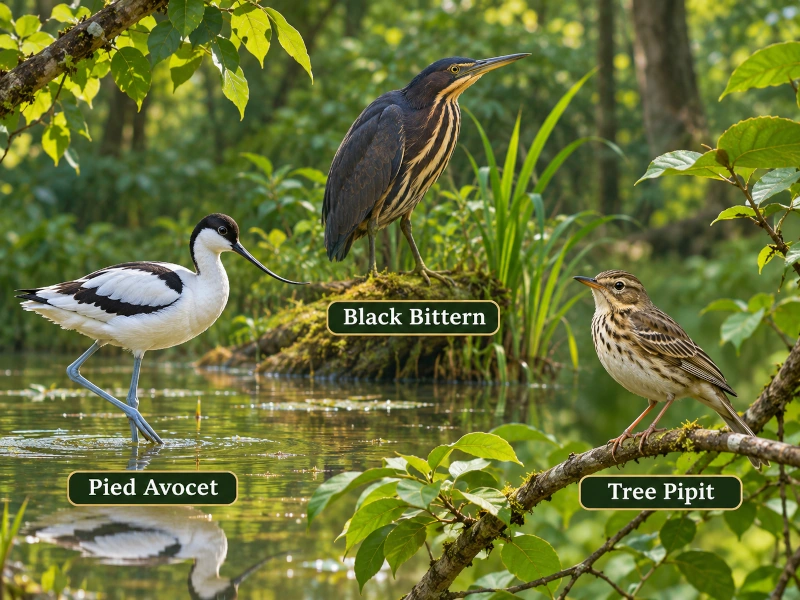
Birdwatchers have documented three notable bird species at Sukhsagar Wetland near Udaipur in the Gomati district of Tripura, drawing renewed attention to the ecological significance of the region’s freshwater habitats. The sightings of the Pied Avocet (Recurvirostra avosetta), Black Bittern (Ixobrychus flavicollis) and Tree Pipit (Anthus trivialis) were made during October and November 2026 and reported on 26 November. Photographic and video documentation collected by local birdwatchers provides valuable material for further ornithological research and biodiversity assessment.
Although observers have suggested that the sightings could represent previously undocumented records in Tripura, existing ornithological databases already include these species in the state’s bird checklist. The observations nevertheless remain noteworthy for documenting their occurrence at Sukhsagar Wetland and strengthening understanding of the region’s avian diversity.
Pied Avocet: A Distinctive Shallow-Water Specialist
The Pied Avocet was observed on 14 November 2026 in the central waters of Sukhsagar Wetland, where a group of local birdwatchers documented its presence through photographs and video footage. The species belongs to the family Recurvirostridae and is distinguished by its contrasting black-and-white feathers, elongated legs and slender bill that curves upwards towards the tip. These physical characteristics make it one of the more recognisable wading birds found across suitable wetland habitats.
The Pied Avocet feeds primarily on small aquatic invertebrates, using lateral movements of its specialised bill to collect prey from shallow water and soft sediments. Its occurrence at Sukhsagar provides an opportunity to investigate the availability of suitable feeding habitats for visiting waterbirds. Maintaining natural water levels and productive shallow-water environments is important for supporting species with such specialised feeding requirements.
Black Bittern: An Elusive Wetland Bird
The Black Bittern was recorded at Sukhsagar on 20 October 2026, adding another noteworthy observation to the wetland’s recent biodiversity documentation. A member of the heron family, Ardeidae, the species is characterised by its dark upperparts, contrasting neck markings and preference for concealed habitats. Its secretive behaviour and tendency to remain close to dense vegetation can make field observations particularly challenging.
The Black Bittern typically occupies freshwater marshes, densely vegetated water margins and other habitats offering adequate cover and feeding opportunities. It feeds on fish, amphibians and various aquatic invertebrates, contributing to the ecological interactions that sustain wetland ecosystems. Its documented occurrence reinforces the importance of conserving aquatic vegetation and undisturbed sections of freshwater habitats.
Tree Pipit: A Long-Distance Migratory Visitor
The Tree Pipit represents a different ecological component of Sukhsagar’s avian diversity. Belonging to the family Motacillidae, the species is a small migratory passerine characterised by brown upperparts and prominent streaking across its breast. Its appearance can resemble that of other pipit species, making careful photographic documentation and expert identification particularly important.
The Tree Pipit breeds across substantial parts of Europe and Asia and migrates to warmer regions, including Africa and the Indian subcontinent, during the non-breeding season. It generally occupies open grasslands, woodland margins and habitats containing scattered trees. Its reported presence at Sukhsagar highlights the potential importance of the terrestrial habitats surrounding the wetland, alongside the aquatic ecosystem itself.
Conservation Status of the Three Species
All three birds are classified as Least Concern on the International Union for Conservation of Nature Red List. This classification reflects their global conservation status and does not necessarily indicate their abundance or frequency of occurrence within individual Indian states. Species that remain relatively widespread globally may still be uncommon or infrequently documented within particular geographical regions.
| Common Name | Scientific Name | IUCN Status |
|---|---|---|
| Pied Avocet | Recurvirostra avosetta | Least Concern |
| Black Bittern | Ixobrychus flavicollis | Least Concern |
| Tree Pipit | Anthus trivialis | Least Concern |
The documentation of locally uncommon birds can contribute to a better understanding of species distribution, seasonal movements and habitat preferences. Systematic recording of such observations is particularly valuable in regions where historical ornithological surveys have been limited.
Sukhsagar Wetland as an Important Biodiversity Habitat
Situated near Udaipur, Sukhsagar Wetland forms part of Tripura’s diverse freshwater landscape. Its combination of open water, marshland, aquatic vegetation and adjoining terrestrial habitats provides different ecological niches for resident and migratory birds. The availability of these varied habitats can influence the diversity of species using the wetland throughout the year.
Sukhsagar has previously featured in published ornithological research, including observations documented in the journal Indian BIRDS. Such records demonstrate the value of sustained field surveys in improving scientific understanding of Tripura’s bird diversity. Continued monitoring could help establish seasonal patterns of bird occurrence and identify habitats requiring greater conservation attention.
Citizen Science and Ornithological Research
The recent sightings highlight the contribution of local birdwatchers to biodiversity documentation. Photographs, video recordings, observation dates and detailed habitat information can provide valuable evidence for ornithologists studying species distribution and migratory behaviour. Citizen science initiatives complement institutional research by expanding the geographical and temporal coverage of wildlife observations.
The scientific significance of unusual sightings depends on accurate species identification and comparison with existing records. Submitting documented observations to recognised ornithological databases and encouraging independent expert assessment can help establish their regional importance. Such practices are essential for maintaining the reliability of biodiversity records and avoiding erroneous claims of first-time discoveries.
Strengthening Wetland Conservation in Northeastern India
Freshwater wetlands provide essential ecological services, including water regulation, nutrient cycling and habitat support for numerous aquatic and terrestrial species. They also provide feeding and resting opportunities for migratory birds travelling across regional and international landscapes. Protecting their ecological integrity requires attention to water quality, natural vegetation, hydrological connectivity and human-induced disturbances.
The recent bird sightings at Sukhsagar offer an opportunity to strengthen public awareness of wetland conservation in Tripura. Regular biodiversity surveys, responsible birdwatching and collaboration between local communities, researchers and conservation authorities can contribute to a more comprehensive understanding of the region’s natural heritage.
The documentation of the Pied Avocet, Black Bittern and Tree Pipit adds to the growing body of observations highlighting Sukhsagar’s ecological importance. Through scientific monitoring and sustained habitat protection, the wetland can continue to support avian biodiversity while contributing to ornithological research and responsible nature-based tourism in northeastern India.
References
- Tripura Times — Three Rare Bird Species Reported at Sukhsagar Wetland, Opening New Chapter in Tripura’s Avian Biodiversity, 26 November 2026.
- Tripura Chronicle — Sukhsagar Wetland Draws Birdwatchers’ Attention with Three Potential First-Time Bird Records in Tripura, 26 November 2026.
- State of India’s Birds — Black Bittern, Tripura Species Factsheet.
- BUBO Birding — Checklist of the Birds of Tripura.
- Indian BIRDS — Volume 21, Number 2, 24 June 2025.
You may also like
-
Wild Asian Elephants Reestablish Resident Population in Madhya Pradesh’s Bandhavgarh Forest Landscape
-
Indian Researchers Discover Two New Cave-Dwelling Gecko Species in Meghalaya
-
Endangered Ganges River Dolphin Sighted in Arunachal Pradesh’s Siang River System
-
Great Nicobar Records 889 Leatherback Turtle Nests During 2025–26 Nesting Season
-
Rare Daurian Starling Returns to Kerala’s Punchakkari Wetlands
