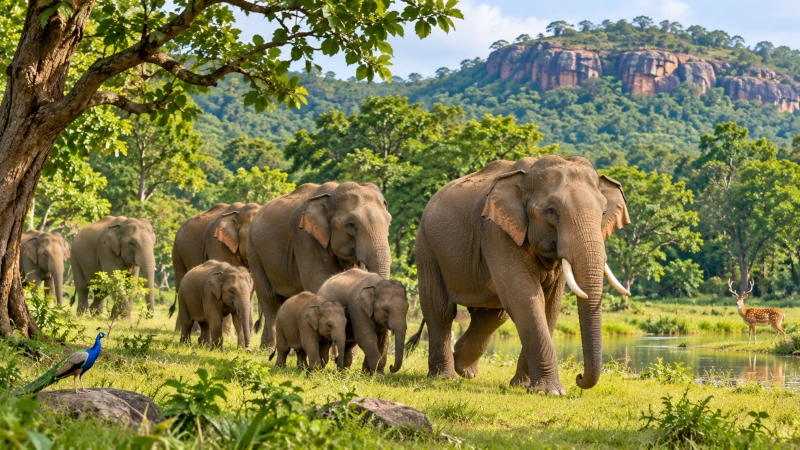
Bandhavgarh Tiger Reserve in Madhya Pradesh, internationally renowned for its Bengal tiger population, is emerging as an important habitat for wild Asian elephants (Elephas maximus). Approximately 50–70 wild elephants are estimated to inhabit Bandhavgarh and adjoining forest landscapes, including Sanjay-Dubri Tiger Reserve and the Bansagar backwater region of Shahdol. The latest assessment, reported on 26 November 2026, highlights a remarkable ecological development involving the natural recolonisation of forests from which resident elephant populations had disappeared more than a century ago.
Natural Recolonisation of Central Indian Forests
The return of wild elephants to Bandhavgarh gained momentum in 2018 when a herd migrated from neighbouring Chhattisgarh into Madhya Pradesh. The elephants entered the protected forest landscape through the Shahdol forest corridor and Panpatha buffer range before establishing a sustained presence within Bandhavgarh. Unlike earlier instances of temporary elephant movements, this migration resulted in the establishment of a resident population.
A study published in a quarterly journal of the Ministry of Environment, Forest and Climate Change documents the arrival of approximately 40 elephants from Chhattisgarh in 2018. Their settlement represents a significant instance of natural wildlife recolonisation, occurring without a planned conservation translocation programme. The development highlights the ecological importance of interconnected forest landscapes in facilitating the natural movement and dispersal of large mammals.
From Tiger Territory to a Shared Wildlife Habitat
Bandhavgarh has traditionally been recognised as one of India’s important tiger conservation landscapes, supporting diverse populations of mammals, birds, reptiles and other wildlife. The establishment of a resident elephant population introduces another significant ecological dimension to the protected area. The presence of both tigers and elephants within the broader landscape increases the importance of conservation strategies that accommodate the requirements of multiple large mammal species.
Elephants influence forest ecosystems through their feeding behaviour, movement patterns and role in seed dispersal. Their activities can contribute to vegetation regeneration, nutrient cycling and the development of natural openings within forest habitats. The long-term presence of elephants in Bandhavgarh therefore provides opportunities to study ecological interactions between large herbivores, vegetation and other wildlife within Central India’s forest ecosystems.
The Importance of Interconnected Forest Landscapes
The movement of elephants between Chhattisgarh and Madhya Pradesh demonstrates the significance of maintaining ecological connectivity beyond the administrative boundaries of individual protected areas. Elephants require extensive landscapes to access food, water and suitable seasonal habitats. Forest corridors connecting protected areas and adjoining territorial forests can facilitate these movements while reducing habitat isolation.
The broader Bandhavgarh–Sanjay-Dubri landscape has become increasingly relevant to elephant conservation in Central India. Protecting its ecological connectivity will require coordinated management across forest divisions and neighbouring states, particularly in areas where wildlife habitats intersect with agricultural land and infrastructure. Understanding these movement patterns can help conservation authorities identify important habitats and develop appropriate landscape-level management strategies.
Scientific Monitoring and Elephant Conservation
The Madhya Pradesh Forest Department has undertaken elephant monitoring initiatives with technical assistance from organisations including the Wildlife Institute of India and WWF-India. According to Bandhavgarh Tiger Reserve Field Director Dr. Anupam Sahay, radio-collaring of an elephant associated with conflict incidents was undertaken in November 2024. Such monitoring can provide valuable information on animal movements, habitat utilisation and interactions with human settlements.
Scientific research into elephant ecology is particularly important in regions where resident populations have become established relatively recently. Understanding seasonal movements, social behaviour, population dynamics and resource requirements can support evidence-based conservation planning. Long-term monitoring can also help authorities assess whether the expanding elephant population has access to sufficient and suitable habitat.
Addressing Human–Elephant Conflict
The natural return of elephants presents both conservation opportunities and management challenges for communities living near forest habitats. As elephants move across extensive landscapes, they may enter agricultural fields and residential areas, resulting in crop damage, property losses and risks to human safety. Effective conflict mitigation is therefore essential for ensuring the long-term coexistence of elephants and local communities.
The Wildlife Trust of India has worked with the Madhya Pradesh Forest Department to strengthen community-based conflict mitigation initiatives around Bandhavgarh. These efforts include community awareness, capacity building and encouraging safe responses to elephant movements. Timely compensation, early-warning mechanisms and community participation will remain important components of a sustainable approach to elephant conservation.
Conservation Beyond Individual Species
The Asian elephant is classified as Endangered on the International Union for Conservation of Nature (IUCN) Red List and receives the highest level of statutory wildlife protection in India under the Wild Life (Protection) Act, 1972. Its conservation requires extensive and ecologically connected habitats that accommodate the species’ complex social behaviour and substantial resource requirements. The protection of such landscapes can also benefit numerous other species sharing the same ecosystems.
The emergence of a resident elephant population in Bandhavgarh reinforces the importance of conservation strategies that extend beyond individual flagship species. While tiger conservation has historically shaped the management of the reserve, the return of elephants creates additional requirements for habitat protection, scientific research and community engagement. Integrating these considerations can contribute to more comprehensive biodiversity conservation across Central India.
A Remarkable Chapter in India’s Wildlife Conservation
The natural recolonisation of Bandhavgarh by wild Asian elephants represents an important chapter in India’s contemporary ecological history. The establishment of a resident population following decades of absence demonstrates the capacity of wildlife to expand into suitable habitats when ecological connectivity permits such movement. It also underscores the importance of managing forests as interconnected landscapes rather than isolated protected areas.
The long-term success of elephant conservation in Madhya Pradesh will depend on habitat protection, scientific monitoring, interstate coordination and the active participation of local communities. By combining these approaches, Bandhavgarh can continue to develop as an important habitat for both tigers and elephants while supporting the broader biodiversity of Central India. The return of these magnificent animals offers a valuable opportunity to strengthen wildlife conservation through coexistence and landscape-level ecological management.
References
- The Hitavada — BTR Emerging as Vital Habitat for Wild Elephants in MP, 26 November 2026.
- Ministry of Environment, Forest and Climate Change — Colonization of Elephants in Bandhavgarh Tiger Reserve, Quarterly Journal, Volume 4, Issue 2.
- Madhya Pradesh Forest Department — Tiger Conservation Plan for Bandhavgarh Tiger Reserve.
- Wildlife Trust of India — Assistance to Reduce Human–Wildlife Conflict for Elephants in Bandhavgarh Tiger Reserve, Madhya Pradesh.
- Comptroller and Auditor General of India — Report on Wildlife Conservation and Sustainable Management of Wildlife Habitats in Madhya Pradesh, Report No. 1 of 2022.
- International Union for Conservation of Nature — Red List of Threatened Species, Elephas maximus.
You may also like
-
Three Uncommon Bird Sightings Highlight Tripura’s Sukhsagar Wetland Biodiversity
-
Indian Researchers Discover Two New Cave-Dwelling Gecko Species in Meghalaya
-
Endangered Ganges River Dolphin Sighted in Arunachal Pradesh’s Siang River System
-
Great Nicobar Records 889 Leatherback Turtle Nests During 2025–26 Nesting Season
-
Rare Daurian Starling Returns to Kerala’s Punchakkari Wetlands
