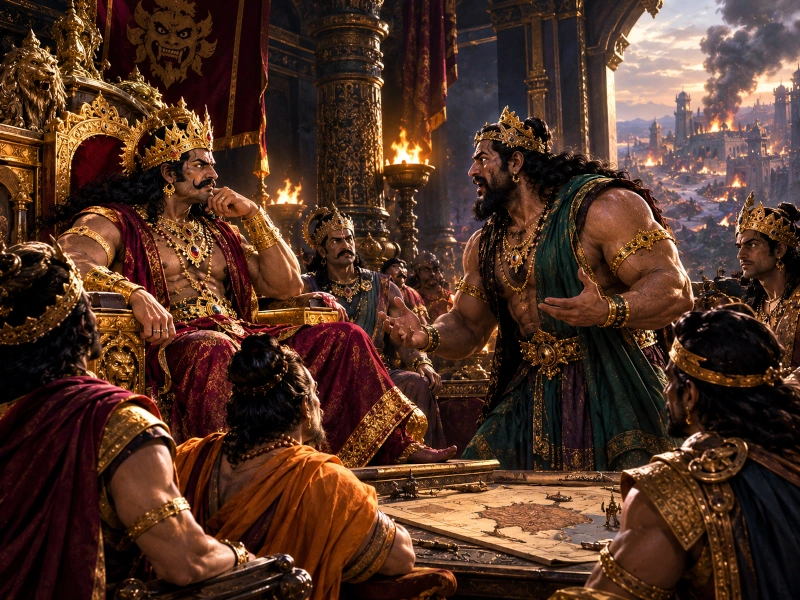
Ramayana Diplomacy Series | Vālmīki Rāmāyaṇa | Yuddha Kāṇḍa, Sargas 63–64
Introduction: The Conflict Between Loyalty and Strategic Judgment
The Vālmīki Rāmāyaṇa contains several remarkable examinations of political leadership, military responsibility and the relationship between rulers and their advisers. Among these, the conversation between Kumbhakarṇa and Rāvaṇa during the war in Laṅkā offers a particularly important study of strategic realism, political accountability and the difficult choices confronting military commanders when their leaders have already committed serious errors.
Described primarily in Yuddha Kāṇḍa, Sarga 63, the episode occurs at a critical moment in the conflict between Rāma’s forces and the armies of Laṅkā. Rāvaṇa has suffered a series of military reverses, several prominent Rākṣasa commanders have been killed, and the king himself has experienced defeat on the battlefield. The war that he initiated through the abduction of Sītā has now developed into a direct threat to his kingdom.
Kumbhakarṇa, Rāvaṇa’s immensely powerful younger brother, is awakened and summoned to assist in defending Laṅkā. Unlike many of the king’s advisers, he does not immediately respond with unquestioning praise or assurances of victory. Instead, he confronts Rāvaṇa with the consequences of his earlier decisions and explains why the crisis could have been avoided through proper consultation and adherence to the principles of statecraft.
Yet Kumbhakarṇa ultimately promises to fight for his brother, even though he recognises the political failures that have brought Laṅkā to the brink of destruction.
The central strategic significance of this episode lies in the tension between a commander’s responsibility to provide honest advice and his obligation to defend a political authority whose decisions he considers fundamentally mistaken.
The narrative also demonstrates that identifying a strategic error does not automatically produce the institutional or political conditions necessary to correct it. By the time Kumbhakarṇa delivers his warning, the consequences of Rāvaṇa’s actions have already become deeply entangled with the military survival of Laṅkā.
The Military Crisis: Laṅkā Faces the Consequences of War
The circumstances surrounding Kumbhakarṇa’s appearance are essential to understanding the significance of his counsel. Rāma’s army has crossed the ocean, reached Laṅkā and established a direct military threat to the kingdom. The formidable geographical barrier that Rāvaṇa had relied upon for protection has been overcome, while several of his commanders have already fallen in battle.
The situation deteriorates further when Rāvaṇa personally enters the battlefield and suffers defeat at the hands of Rāma. Although his life is spared, the encounter demonstrates that even Laṅkā’s ruler cannot rely upon his extraordinary military abilities to secure victory.
The war has consequently reached a stage where the kingdom’s leadership must confront the difference between its original expectations and the actual performance of its forces.
Rāvaṇa had initiated the crisis believing that his power, fortifications and military commanders would protect him from the consequences of abducting Sītā. The subsequent campaign reveals the limitations of these assumptions.
The first strategic lesson is that military reverses must be examined as evidence of weaknesses in the original political and operational assessments rather than dismissed as temporary failures of battlefield performance.
Rāvaṇa’s decision to summon Kumbhakarṇa reflects the seriousness of the situation. The king now requires the intervention of one of his most powerful warriors to confront an adversary whose capabilities he had previously underestimated.
The decision also exposes a recurring weakness in Rāvaṇa’s leadership. Instead of correcting the political decision that caused the conflict, he seeks additional military strength to manage its consequences.
Kumbhakarṇa’s First Warning: The Consequences Were Foreseeable
When Kumbhakarṇa hears Rāvaṇa’s account of the military situation, he does not treat the developments as unexpected. He reminds his brother that the dangers now confronting Laṅkā had already been identified during earlier consultations.
Kumbhakarṇa explains that the consequences of Rāvaṇa’s actions were foreseeable and that the king had disregarded the warnings of those who genuinely wished to protect him.
The criticism is particularly significant because it distinguishes an unavoidable military setback from a crisis created by defective political judgment. Kumbhakarṇa does not suggest that Laṅkā has been defeated because its warriors lack courage. Instead, he identifies the original decision-making process as the source of the kingdom’s present difficulties.
Rāvaṇa had acted without adequately considering the strength of his adversary, the consequences of provoking him and the alternatives available before undertaking the abduction of Sītā.
The fundamental strategic principle emerging from Kumbhakarṇa’s warning is that political leaders must be held responsible not merely for the decisions they make but also for their failure to evaluate consequences that were reasonably foreseeable.
This distinction remains important in modern military affairs. Governments may encounter unforeseen developments during warfare, but they must also account for failures arising from inadequate planning, rejected intelligence and the dismissal of informed advice.
Kumbhakarṇa’s criticism demonstrates that the responsibility for military failure cannot always be transferred to commanders on the battlefield. When the original political objective is unsound, even extraordinary military capabilities may prove insufficient to secure a favourable outcome.
The Importance of Timing in Political and Military Decisions
One of the most important elements of Kumbhakarṇa’s counsel concerns the proper sequence of political decisions.
He criticises Rāvaṇa for undertaking actions at the wrong time and for failing to distinguish between measures that should precede a decision and those that should follow it.
Kumbhakarṇa explains that a ruler who performs duties in an improper sequence, without considering the circumstances in which they must be undertaken, exposes himself to failure. His argument reflects the importance of timing, preparation and the orderly application of political judgment.
The abduction of Sītā provides the clearest example of this failure. Rāvaṇa acted first and sought extensive strategic assistance only after his decision had generated a major conflict.
The opportunity for preventive diplomacy had existed before the abduction. Once Rāma’s army reached Laṅkā, however, the military and political consequences became far more difficult to contain.
The strategic significance of Kumbhakarṇa’s argument is that the timing of consultation can be as important as the quality of the advice received. A warning delivered after an irreversible action may explain the danger without providing an effective means of preventing it.
Military planning depends upon the proper ordering of objectives, intelligence assessments, diplomatic initiatives and operational preparations. Reversing this sequence can create situations in which military forces are compelled to pursue objectives that have not been adequately examined.
Kumbhakarṇa recognises that Rāvaṇa’s mistake was not simply the choice of an undesirable objective. It was also the failure to follow the process necessary for responsible statecraft.
Dharma, Artha and Kāma: The Foundations of Political Judgment
Kumbhakarṇa’s counsel moves beyond immediate military concerns into the broader principles governing political leadership.
He discusses the importance of Dharma, Artha and Kāma, the three major objectives of human activity frequently examined in classical Indian political and ethical thought.
Dharma concerns righteous conduct and the obligations governing individual and social behaviour. Artha concerns material prosperity, political power and the practical interests associated with maintaining a stable kingdom. Kāma concerns desire and the pursuit of personal enjoyment.
Kumbhakarṇa explains that a capable ruler must understand how these objectives are to be pursued according to their proper circumstances and relative importance.
The significance of this argument becomes clear when applied to Rāvaṇa’s conduct. The king’s desire for Sītā has overridden his responsibilities towards the kingdom and has placed its political and military security in danger.
Rāvaṇa has effectively subordinated the interests of Laṅkā to his personal wishes.
The central political lesson is that personal desire becomes a strategic danger when a ruler allows it to supersede the moral obligations and material interests of the state.
Kumbhakarṇa’s argument reflects an understanding that political power cannot be exercised responsibly when important decisions are determined exclusively by personal preferences.
The ruler’s obligations extend beyond the satisfaction of individual desires. They include protecting the population, preserving the kingdom’s resources and preventing unnecessary conflicts that could threaten its survival.
Effective statecraft requires political leadership to balance moral responsibility, material security and personal ambition, ensuring that the pursuit of individual objectives does not undermine the welfare of the kingdom.
The Role of Ministers: Why Independent Advice Matters
Kumbhakarṇa also discusses the importance of consultation with ministers who understand political affairs and possess the knowledge necessary to evaluate complex decisions.
He warns against advisers who speak confidently without understanding the principles of administration, practical affairs or the consequences of their recommendations.
His criticism is directed at the wider failures of Rāvaṇa’s political establishment. Earlier consultations had produced extravagant assurances of military victory, while warnings concerning Rāma’s strength and the dangers of confrontation had been dismissed.
Kumbhakarṇa recognises that advisers who seek to please the ruler can become dangerous when their recommendations encourage policies that expose the kingdom to unnecessary risks.
He also warns about the possibility of ministers who appear loyal while acting against the ruler’s interests, including those influenced by hostile powers.
The strategic significance of this warning is that political leaders must evaluate advisers according to their knowledge, integrity and demonstrated judgment rather than their willingness to express agreement.
The existence of a council cannot guarantee sound governance if its members lack independence or if the ruler refuses to examine competing assessments.
Kumbhakarṇa’s argument therefore places responsibility upon both ministers and political leadership. Advisers must possess the courage to provide accurate assessments, while rulers must create conditions in which such advice can influence policy.
The most valuable counsellor is not necessarily the one who promises success, but the one who identifies the risks that political leadership may be reluctant to acknowledge.
The episode also demonstrates the importance of distinguishing genuine loyalty from flattery. An adviser may oppose a decision precisely because he wishes to protect the ruler and the kingdom from its consequences.
Vibhīṣaṇa’s Earlier Warning: Advice Rejected Before the Crisis
Kumbhakarṇa specifically acknowledges the value of the advice previously offered by Vibhīṣaṇa.
Before the war intensified, Vibhīṣaṇa had repeatedly urged Rāvaṇa to return Sītā to Rāma and avoid a confrontation that could destroy Laṅkā. His counsel emphasised the extraordinary capabilities of Rāma and the dangers of continuing a conflict that served no essential interest of the kingdom.
Rāvaṇa rejected these warnings and ultimately drove Vibhīṣaṇa from Laṅkā.
Kumbhakarṇa’s recognition of Vibhīṣaṇa’s advice is particularly significant because it confirms that the concerns expressed by the younger brother were not isolated objections. Another powerful member of the ruling family also understood that Rāvaṇa’s political decisions had created a dangerous military situation.
The brothers differ, however, in their responses to the crisis.
Vibhīṣaṇa concludes that remaining with Rāvaṇa would mean supporting an unjustifiable course of action and therefore seeks refuge with Rāma. Kumbhakarṇa, despite recognising the same underlying failures, chooses to remain loyal to his brother and participate in the defence of Laṅkā.
The diplomatic significance of this contrast lies in the different responsibilities that advisers may recognise when political authority refuses to correct a dangerous decision.
Vibhīṣaṇa places Dharma and the rejection of Rāvaṇa’s conduct above continued allegiance to the king. Kumbhakarṇa emphasises his obligations arising from kinship, loyalty and the immediate military crisis facing his brother.
The Rāmāyaṇa consequently presents two different responses to the failure of political leadership, each revealing important questions concerning loyalty, duty and the limits of obedience.
Rāvaṇa’s Response: Rejecting Criticism During a Crisis
Rāvaṇa reacts angrily to Kumbhakarṇa’s criticism.
Rather than continuing the discussion concerning the original causes of the war, he argues that past mistakes cannot now be undone and insists that attention must be directed towards the immediate military situation.
Rāvaṇa’s response contains a practical observation: once a crisis has developed, rulers must determine how to address the circumstances confronting them.
However, his argument also avoids the deeper question raised by Kumbhakarṇa. The original decision has not merely produced an unfortunate result. It continues to shape the political objective for which Laṅkā is fighting.
The distinction is important because acknowledging a mistake without reconsidering the policy responsible for it may leave the central problem unresolved.
The strategic weakness in Rāvaṇa’s response is that he treats the consequences of his earlier decision as a military emergency while refusing to reconsider the political objective that continues to sustain the conflict.
A state facing an unfavourable war must certainly examine its immediate military requirements. Yet effective crisis management also requires political leaders to determine whether the objectives that initiated the conflict remain achievable, necessary or worth the anticipated cost.
Rāvaṇa does not undertake such a reassessment.
Instead, he asks Kumbhakarṇa to demonstrate his loyalty through military action.
Kumbhakarṇa’s Decision: Loyalty Despite Strategic Disagreement
The most revealing moment in the episode occurs when Kumbhakarṇa changes his tone.
Having criticised Rāvaṇa’s decisions, he recognises his brother’s anger and distress. He begins speaking more gently and assures the king that he will confront the approaching enemy.
Kumbhakarṇa promises to fight Rāma, Lakṣmaṇa, Sugrīva and the Vānara forces. He expresses confidence in his extraordinary physical strength and declares his willingness to engage even the most powerful adversaries.
His response demonstrates a profound contradiction.
Kumbhakarṇa understands that Rāvaṇa’s conduct has created the crisis and that earlier warnings should have been accepted. Nevertheless, he remains determined to defend his brother through military action.
The central military dilemma is that a commander may recognise the strategic failure of a political decision while continuing to regard participation in the resulting conflict as an obligation arising from loyalty and duty.
Kumbhakarṇa’s decision also reveals the limits of personal courage as a remedy for political miscalculation.
His extraordinary strength may influence individual battles, but it cannot remove the original cause of the war. Nor can his willingness to sacrifice himself guarantee that Laṅkā will achieve a sustainable political outcome.
Military courage can sustain an army during a crisis, but it cannot by itself transform an unsound political objective into a viable national strategy.
This distinction is essential to understanding the tragedy of Kumbhakarṇa’s position. He possesses the intelligence to recognise the errors that produced the war, yet chooses to confront their consequences primarily through military force.
Mahodara’s Intervention: A Different Form of Strategic Calculation
Sarga 64 introduces another perspective through Mahodara, one of Rāvaṇa’s advisers.
Mahodara challenges Kumbhakarṇa’s criticism and defends the king’s conduct. He questions whether the pursuit of desire should necessarily be condemned and argues against Kumbhakarṇa’s proposal to confront Rāma single-handedly.
Unlike some of the earlier ministers who confidently promised victory, Mahodara acknowledges the danger posed by Rāma. He refers to Rāma’s previous battlefield achievements and questions whether Kumbhakarṇa can defeat such an adversary without adequate support.
This recognition introduces an element of military realism into Mahodara’s argument.
However, his proposed solution differs fundamentally from Kumbhakarṇa’s advice concerning responsible statecraft.
Mahodara suggests an elaborate deception intended to convince Sītā that Rāma and Lakṣmaṇa have been killed. He proposes that a selected group of Rākṣasa warriors publicly announce their departure for battle, return with fabricated evidence of victory and spread the false news throughout Laṅkā.
The objective is to destroy Sītā’s hope of rescue and persuade her to submit to Rāvaṇa’s wishes.
Mahodara’s proposal illustrates how tactical ingenuity can be directed towards preserving a flawed political objective rather than correcting the strategic mistake that created the crisis.
The plan relies upon misinformation, psychological pressure and the manipulation of perceptions.
Although it attempts to avoid a direct confrontation with Rāma, it does not resolve the underlying dispute. The deception would neither eliminate Rāma’s military capabilities nor remove his determination to recover Sītā.
The fundamental strategic weakness of Mahodara’s proposal is that it seeks to manipulate the immediate situation without addressing the political cause of the war.
The contrast between Kumbhakarṇa and Mahodara is therefore significant. Kumbhakarṇa criticises the original decision but promises military support, while Mahodara offers a scheme intended to preserve the king’s objective through deception.
Neither approach ultimately provides the diplomatic resolution that Vibhīṣaṇa had recommended.
Diplomatic Significance: The Difference Between Loyalty to a Ruler and Loyalty to the State
Kumbhakarṇa’s dilemma raises an enduring question in political and military affairs: to whom does a commander’s ultimate responsibility belong?
The episode presents several overlapping obligations. Kumbhakarṇa is Rāvaṇa’s brother, a powerful member of Laṅkā’s ruling establishment and a formidable warrior expected to defend the kingdom.
His personal loyalty to Rāvaṇa is therefore closely connected with his position within the political and military structure of Laṅkā.
Yet the crisis confronting the kingdom originates in a decision that Kumbhakarṇa himself recognises as mistaken.
This creates a distinction between defending the ruler, protecting the kingdom and supporting the political objective responsible for the conflict.
The central diplomatic principle is that loyalty to political leadership must be distinguished from the wider responsibility to protect the state and its people from the consequences of avoidable strategic errors.
Kumbhakarṇa attempts to reconcile these responsibilities by criticising Rāvaṇa while promising to fight on his behalf.
His decision illustrates the difficulty of maintaining independent strategic judgment once a political crisis has developed into a major war.
The episode also demonstrates why the responsibility of military advisers cannot be limited to expressing their objections after a decision has been made.
The most effective contribution of a military adviser may occur before the commencement of hostilities, when informed criticism can prevent political leaders from committing their forces to an unnecessary conflict.
Once warfare begins, personal loyalty, institutional obligations and battlefield emergencies can make reconsideration considerably more difficult.
Modern Strategic Parallel: The Cuban Missile Crisis and the Importance of Political-Military Deliberation
A useful modern comparison can be found in the Cuban Missile Crisis of October 1962, when the United States and the Soviet Union confronted the possibility of direct military conflict following the discovery of Soviet nuclear missiles in Cuba.
President John F. Kennedy faced competing recommendations from senior advisers concerning the appropriate American response. The options included air strikes against the missile installations, a possible invasion of Cuba and a naval quarantine intended to prevent additional offensive military equipment from reaching the island.
The deliberations involved military commanders, intelligence specialists, diplomatic officials and political advisers. Participants differed in their assessments of the available options and the risks associated with escalation.
Kennedy ultimately selected a naval quarantine as the initial public response while diplomatic exchanges continued. The crisis was subsequently resolved through negotiations involving Soviet missile withdrawal, American assurances against invading Cuba and a confidential understanding concerning American missiles in Turkey.
The comparison with Kumbhakarṇa’s counsel is not based upon identical historical circumstances. The Cuban Missile Crisis involved nuclear deterrence, superpower rivalry and international diplomacy, while the Rāmāyaṇa episode concerns a kingdom already engaged in war following Rāvaṇa’s abduction of Sītā.
Nevertheless, both episodes illustrate the importance of allowing military and political advisers to examine strategic alternatives before decisions become irreversible.
The principal lesson is that political leaders must distinguish between the courage of their military commanders and the wisdom of the political objectives for which those commanders may be ordered to fight.
Military institutions may possess the capability and willingness to execute dangerous operations, but political leadership remains responsible for evaluating whether those operations serve a necessary and achievable strategic purpose.
Kumbhakarṇa’s counsel demonstrates the consequences of failing to undertake that evaluation before committing the kingdom to conflict.
Strategic Lessons for Modern Political and Military Leadership
Kumbhakarṇa’s warnings contain several principles that remain relevant to contemporary political administration, military command and national security decision-making.
The first concerns the relationship between foresight and political responsibility. Kumbhakarṇa reminds Rāvaṇa that the consequences now confronting Laṅkā had been anticipated by experienced advisers. Strategic leadership requires decision-makers to examine foreseeable risks before undertaking actions whose consequences may threaten the security of the state.
The second concerns the timing of consultation. Rāvaṇa acted before adequately considering the military and political implications of his decision. Consultation must precede consequential action, because advice offered after a crisis has developed may no longer provide the same opportunities for preventing conflict.
The third concerns the independence of advisers. Kumbhakarṇa criticises ministers who lack knowledge, offer misleading assurances or allow improper considerations to influence their recommendations. An effective council must be composed of knowledgeable advisers whose primary responsibility is to communicate accurate assessments rather than satisfy the expectations of political leadership.
The fourth concerns the distinction between strategic objectives and military capabilities. Kumbhakarṇa possesses extraordinary strength and is willing to confront Rāma, but his personal abilities cannot eliminate the political mistakes responsible for the war. The availability of powerful military forces does not justify their employment unless the underlying political objective is necessary, realistic and consistent with national interests.
The fifth concerns the management of military crises. Rāvaṇa argues that earlier errors should be set aside in favour of addressing the immediate emergency. Although urgent action may be necessary, the political assumptions sustaining the conflict must also be reconsidered. Effective crisis management requires leaders to address both the immediate military danger and the underlying decisions that continue to generate it.
The sixth concerns the use of deception. Mahodara’s proposal demonstrates how psychological manipulation may be employed to achieve limited objectives without direct confrontation. However, his plan does not remove the causes of the conflict. Deception can influence perceptions and produce temporary tactical advantages, but it cannot guarantee strategic success when the fundamental political objective remains unsound.
Finally, the episode illustrates the tension between personal loyalty and public responsibility. Kumbhakarṇa’s devotion to Rāvaṇa leads him to fight despite his recognition of the king’s mistakes. The highest responsibility of strategic leadership is to ensure that loyalty, courage and military capability serve the long-term welfare of the state rather than merely preserve the decisions or prestige of an individual ruler.
Conclusion: The Tragedy of Correct Advice Given Too Late
Kumbhakarṇa’s counsel to Rāvaṇa represents one of the most significant examinations of strategic realism and political loyalty in the Vālmīki Rāmāyaṇa.
Unlike advisers who respond to danger with unquestioning assurances of victory, Kumbhakarṇa openly recognises the errors that have brought Laṅkā into a devastating conflict. He criticises Rāvaṇa’s failure to consult experienced ministers, his disregard of proper political procedure and his rejection of earlier warnings concerning the consequences of abducting Sītā.
His observations demonstrate a sophisticated understanding of statecraft, particularly the importance of timing, informed consultation, political responsibility and the proper relationship between personal desire and the interests of the kingdom.
Yet Kumbhakarṇa ultimately promises to fight for his brother.
This decision reveals the tragic limitation of strategic advice when political leadership has already committed the state to a dangerous course of action. Kumbhakarṇa can identify the errors responsible for the crisis, but his loyalty prevents him from pursuing the alternative chosen by Vibhīṣaṇa.
His subsequent death in battle, narrated in Sarga 67, demonstrates the human and military consequences of a conflict whose origins he had correctly criticised.
The enduring strategic lesson is that courage and loyalty, however admirable in themselves, cannot substitute for sound political judgment. A commander may fight with extraordinary determination, yet the sacrifice may prove futile when the political objective remains fundamentally mistaken.
The episode also demonstrates that rulers must distinguish between advisers who genuinely protect their interests and those who merely reinforce their existing assumptions. Kumbhakarṇa’s criticism arose from concern for Rāvaṇa, while Mahodara’s alternative sought to preserve the king’s wishes through deception rather than resolve the conflict.
The greatest responsibility of political leadership is not simply to command powerful armies, but to ensure that those armies are never committed to unnecessary wars through arrogance, personal ambition or the rejection of informed counsel.
Through Kumbhakarṇa’s warnings, the Rāmāyaṇa preserves a timeless principle of statecraft: the duty of an adviser is to speak the truth before disaster occurs, while the duty of a ruler is to possess the wisdom to act upon that truth before military sacrifice becomes unavoidable.
The lasting value of this episode lies in its recognition that responsible leadership must combine strategic foresight, moral judgment, informed consultation and the courage to correct earlier mistakes.
A kingdom is best served not when its commanders are willing to die for every decision of their ruler, but when its political institutions possess the wisdom to prevent those commanders from being sacrificed for decisions that should never have been made.
Scriptural References: Vālmīki Rāmāyaṇa, Yuddha Kāṇḍa, Sarga 63, particularly Kumbhakarṇa’s criticism of Rāvaṇa’s earlier decisions, his discussion of Dharma, Artha and Kāma, his warnings concerning improper advisers, his acknowledgement of Vibhīṣaṇa’s counsel and his eventual commitment to battle. Sarga 64 records Mahodara’s criticism of Kumbhakarṇa and his proposal to deceive Sītā through a fabricated report of Rāma’s death. The consequences of Kumbhakarṇa’s decision are narrated in Sargas 65–67.
You may also like
-
Russia Praises India’s BRICS Presidency, Highlights 400 Events in 2026
-
India and Portugal Review Bilateral Cooperation at Sixth Foreign Office Consultations in New Delhi
-
India and Japan Sign Letter of Intent to Enable Japanese Military Live-Fire Training in India
-
India and Japan Expand Defence Manufacturing Partnership, Accelerate UNICORN Naval Stealth Technology Cooperation
-
India and Indonesia Review Trade Cooperation, Market Access and Investment Opportunities at New Delhi Meeting
