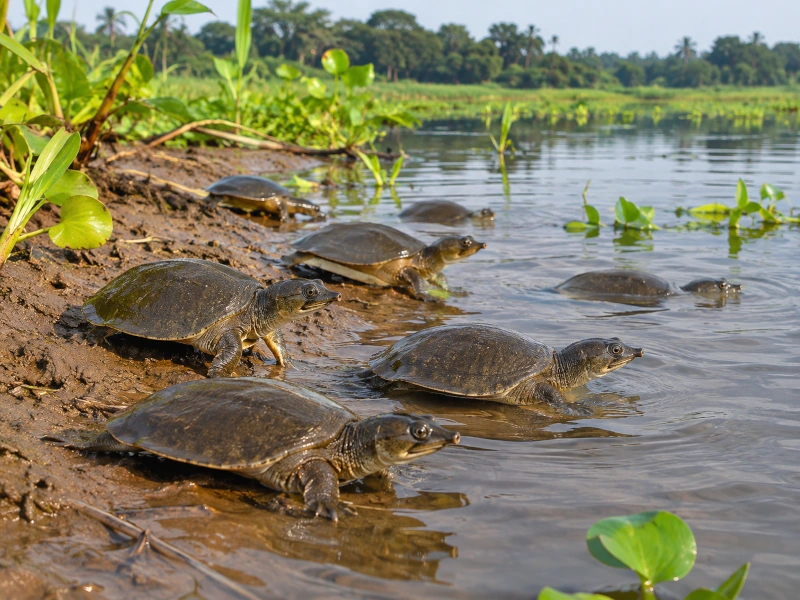
In an important step towards the conservation of one of India’s rarest freshwater turtle species, 240 hatchlings of the critically endangered Black Softshell Turtle (Nilssonia nigricans) were released into Roumari Beel, a protected wetland in Assam’s Biswanath district, on November 7, 2026. The release forms part of a long-term conservation and recovery programme aimed at restoring populations of a species once considered extinct in the wild.
The initiative was undertaken by the Wildlife Survival Alliance Foundation India (WSAFI) in collaboration with the Biswanath Wildlife Division, Kaziranga Tiger Reserve and the Assam Forest Department. Assam Environment and Forest Minister Jayanta Malla Baruah highlighted the conservation achievement on November 13, emphasising the importance of cooperation between government authorities, conservation organisations and local communities.
Recovering a Species Once Considered Extinct in the Wild
The Black Softshell Turtle, locally known as Bormuria Kaso, is among India’s most threatened freshwater turtles. The species was previously classified as Extinct in the Wild before subsequent conservation assessments recognised surviving populations and placed it in the Critically Endangered category.
Historically associated with freshwater habitats in northeastern India, the species has survived largely through captive populations and traditional protection practices, particularly in temple ponds in Assam.
The survival of the Black Softshell Turtle demonstrates the importance of traditional community conservation practices in protecting species that have become exceptionally rare in their natural habitats.
The protected populations maintained at religious institutions have provided an important foundation for modern conservation programmes involving captive breeding, artificial incubation, scientific rearing and reintroduction into suitable natural habitats.
Nagshankar Temple Plays an Important Role in Conservation
The Nagshankar Temple in Assam has emerged as an important centre for the conservation of the Black Softshell Turtle. The temple pond has traditionally provided protection to freshwater turtles, allowing the species to survive in an environment where hunting and deliberate disturbance have been restricted through local religious practices.
Under the ongoing conservation programme, turtle eggs are collected from the banks of the temple pond during the nesting season, generally in March and April. These eggs are transferred to controlled incubation facilities at Biswanath Ghat, where they are protected from predators and environmental disturbances.
The artificial incubation process is designed to improve hatching success, particularly by reducing the loss of eggs to predators such as mongooses.
Hatchlings generally emerge during July and August and are subsequently transferred to specialised rearing facilities. They are maintained under supervised conditions for approximately three months and provided with suitable freshwater fish to support their growth.
This approach allows conservation workers to increase the size and physical condition of young turtles before releasing them into protected natural habitats.
Roumari Beel Provides a Protected Freshwater Habitat
Roumari Beel, situated within the jurisdiction of the Biswanath Wildlife Division, was selected as the release location for the latest group of 240 hatchlings.
The wetland provides a freshwater environment where the young turtles can establish themselves under conservation monitoring. The release represents the final stage of a coordinated process involving egg collection, incubation, hatchling care and habitat selection.
Unlike programmes that depend exclusively on maintaining captive populations, the Black Softshell Turtle recovery initiative includes the reintroduction of young animals into natural freshwater ecosystems.
The release of captive-reared hatchlings into protected wetlands is an important component of efforts to rebuild self-sustaining populations of the species in the wild.
However, the successful release of hatchlings does not by itself establish long-term recovery. Their survival, growth and eventual reproduction in natural habitats remain important measures of the programme’s conservation outcomes.
More Than 1,000 Hatchlings Released Since 2021
The latest release builds upon several years of conservation activities undertaken by the Wildlife Survival Alliance Foundation India and its partners.
According to reports associated with the programme, more than 1,000 Black Softshell Turtle hatchlings have been released into natural habitats since 2021.
During the current breeding season, more than 300 hatchlings have emerged across conservation project sites in Assam and Tripura.
The programme combines traditional conservation practices with modern wildlife management techniques, including artificial incubation, controlled rearing, habitat assessment and post-release monitoring.
The involvement of forest authorities and conservation specialists has enabled the initiative to expand beyond the protection of turtles within temple ponds towards the recovery of populations in natural freshwater habitats.
Importance of Black Softshell Turtles in Wetland Ecosystems
Freshwater turtles perform important ecological functions within rivers, lakes, wetlands and other aquatic environments.
Softshell turtles are known to consume a variety of aquatic organisms and organic material, including animal remains. Through scavenging, they contribute to the natural recycling of nutrients and organic matter within freshwater ecosystems.
Because of this ecological function, softshell turtles are sometimes described as the scavengers or vultures of wetlands.
Their conservation therefore involves not only protecting a rare reptile species but also maintaining the ecological processes supported by freshwater biodiversity.
Healthy wetlands provide habitats for fish, amphibians, aquatic reptiles, birds and numerous invertebrates. Protecting these environments is important for sustaining the ecological interactions upon which freshwater species depend.
Community Participation Strengthens Conservation Efforts
An important feature of the Black Softshell Turtle recovery programme is its integration of community participation with scientific conservation.
The traditional protection of turtles at Nagshankar Temple and Hayagriva Madhava Temple has contributed to the survival of the species over many generations.
Conservation organisations have worked with local communities to build upon these practices while introducing scientific methods for breeding, incubation and reintroduction.
The programme has also supported alternative livelihood initiatives involving local women. A community group known as Kaso Sakhi produces handwoven Assamese gamosas featuring turtle motifs, linking traditional handicrafts with awareness of freshwater wildlife conservation.
These activities provide opportunities for community participation in conservation while supporting supplementary sources of livelihood.
The programme illustrates how traditional wildlife protection, scientific breeding techniques and local community involvement can operate together in efforts to recover critically endangered species.
A Step Towards Restoring Assam’s Freshwater Biodiversity
The release of 240 Black Softshell Turtle hatchlings into Roumari Beel represents another milestone in the ongoing recovery programme for Nilssonia nigricans.
The initiative has brought together Assam’s forest authorities, conservation organisations, temple institutions and local communities to protect a species that once faced the possibility of disappearing from natural habitats.
Continued habitat protection, monitoring of released turtles, successful breeding and community involvement will remain essential for evaluating the long-term effectiveness of the programme.
With more than 1,000 hatchlings released since 2021, Assam’s Black Softshell Turtle conservation initiative demonstrates the contribution of sustained breeding and reintroduction programmes to efforts to restore critically endangered freshwater wildlife.
You may also like
-
Golden Rattlepod Flowers Transform Munnar’s Yellapetty Hills into a Sea of Yellow
-
Scientists Discover New Scorpion Species in Odisha’s Similipal Tiger Reserve
-
Rare Bird Sightings in Maharashtra Highlight Rich Biodiversity of Melghat Forests and Navi Mumbai Wetlands
-
Gujarat to Receive Four Great Indian Bustards from Rajasthan in Major Conservation Initiative
-
Indian Scientists Discover New Begonia Species in Arunachal Pradesh’s Siang Valley
