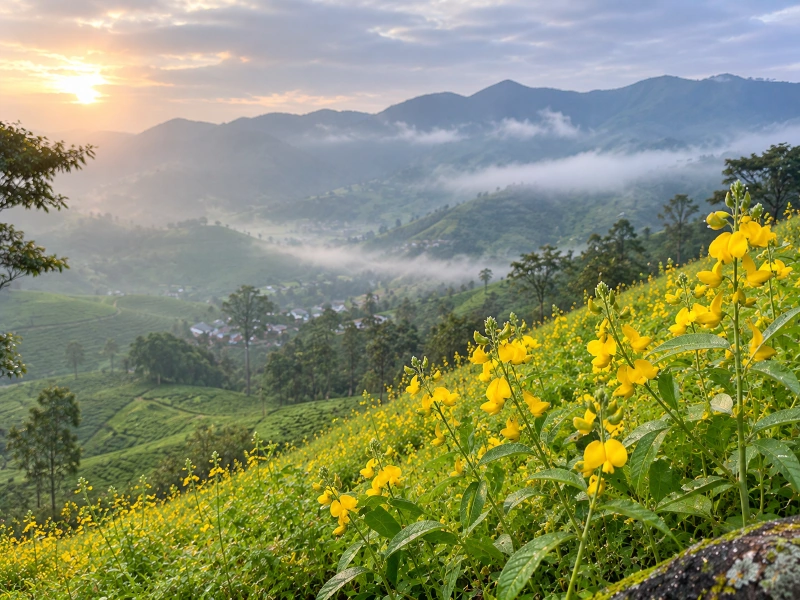
The picturesque hills of Munnar in Kerala’s Idukki district have acquired a striking golden appearance as extensive stretches of Rattlepod flowers bloom across the grasslands and slopes of Yellapetty. The flowering of the plant, locally known as Kilukilukki, has transformed parts of the highland landscape into a carpet of bright yellow blossoms, attracting tourists, photographers and nature enthusiasts to the region.
The flowering has been observed along the Munnar–Vattavada road, particularly around Yellapetty, where the yellow flowers stand out against the surrounding green hills, grasslands and tea plantations. Reports published during the first half of November 2026 describe extensive flowering across approximately 50 acres of land associated with Kanan Devan Hills Plantations.
The flowering has added another seasonal attraction to Munnar, a destination already renowned for its mist-covered mountains, tea gardens and the spectacular flowering of Neelakurinji. Unlike the celebrated Neelakurinji, which follows a distinctive mass-flowering cycle, Rattlepod is a more regularly flowering plant that can produce extensive displays under favourable growing conditions.
Rattlepod Flowers Cover the Yellapetty Grasslands
Yellapetty, situated along the scenic route connecting Munnar with Vattavada, has emerged as a popular destination for visitors seeking to experience the extensive yellow flowering. The area is characterised by rolling hills, grasslands, streams and agricultural landscapes that form part of the distinctive high-altitude environment of the southern Western Ghats.
The flowering plants have spread their yellow blossoms across the slopes, creating a striking contrast with the surrounding vegetation. The display is especially noticeable where large groups of plants grow together, producing dense clusters of flowers that give the landscape its golden appearance.
The flowering area lies within land associated with Kanan Devan Hills Plantations, and local reports indicate that visitors have been arriving to photograph the flowers and explore the surrounding landscape. The presence of nearby streams, waterfalls and traditional thatched structures has further contributed to the area’s appeal.
Yellapetty is located approximately 24 kilometres from Munnar town along the route towards Vattavada. The location is accessible to travellers visiting Mattupetty, Kundala Dam and Top Station, making it part of one of the region’s established scenic travel corridors.
The Botanical Identity of Kilukilukki
The flowering plant has been identified as Crotalaria retusa, a species belonging to the Fabaceae family, commonly known as the pea or legume family. It is widely recognised by the English names Rattlepod, Common Rattlepod and Rattlebox, while the Malayalam name Kilukilukki refers to the characteristic sound produced by its mature seed pods.
The plant is an erect herb or undershrub with simple leaves and conspicuous yellow flowers arranged in clusters towards the ends of its branches. The flowers possess the characteristic structure associated with many members of the legume family, with distinct petals forming an attractive yellow blossom.
According to botanical records maintained by the Indian Institute of Science, Crotalaria retusa produces yellow flowers, sometimes showing reddish or purplish markings. The plant occurs in open habitats, including grasslands, scrub vegetation, forest margins and disturbed ground.
The Botanical Survey of India has also documented the species in Indian floristic studies, describing its distinctive yellow flowers, elongated pods and herbaceous to shrubby growth habit.
Although the species is distributed across several regions of India, its extensive flowering at Yellapetty has attracted attention because of the density of the blossoms and their visual impact on the highland landscape.
Why the Plant Is Called Rattlepod
One of the most distinctive characteristics of Crotalaria retusa is the sound produced by its mature seed pods. After flowering, the plant develops elongated pods containing multiple seeds. As the pods mature and dry, the seeds become loose within the hardened structures.
When the dried pods are shaken or moved by the wind, the seeds strike the inner walls and produce a rattling sound. This natural characteristic gives the plant its English name, Rattlepod, and its Malayalam name, Kilukilukki, which evokes the sound of a small rattle.
The botanical genus Crotalaria also derives its name from a word associated with rattling, reflecting the seed-pod characteristic found among members of the group.
The combination of bright flowers and unusual seed pods makes Rattlepod a distinctive component of the vegetation in habitats where it grows.
A Flowering Plant Found Across Tropical Regions
Crotalaria retusa is distributed across tropical and subtropical regions and is recognised as an accepted species by the Royal Botanic Gardens, Kew. Its native distribution includes parts of Africa, tropical Asia and northern Australia.
In India, botanical records document its occurrence in several states, including Kerala, Karnataka, Tamil Nadu, Andhra Pradesh and Odisha. The plant is commonly associated with open environments where sufficient sunlight allows it to grow and flower.
The species is capable of flowering during an extended seasonal period, although the precise timing varies according to local environmental conditions.
The Indian Institute of Science’s botanical records identify flowering and fruiting periods extending across several months, reflecting the plant’s adaptability to different climatic regions.
The extensive flowering currently visible at Yellapetty is therefore best understood as a concentrated seasonal display rather than an independently established rare botanical event.
Rattlepod and the Ecology of Flowering Landscapes
As a member of the Fabaceae family, Rattlepod belongs to a large group of flowering plants that includes many ecologically important herbs, shrubs and trees.
Its brightly coloured flowers provide floral resources that can attract insect visitors, including pollinators. Flowering plants in open habitats contribute to interactions between vegetation and insects, supporting ecological processes associated with pollination and plant reproduction.
The extensive yellow flowering at Yellapetty illustrates how seasonal changes in vegetation can significantly alter the appearance of a landscape. Plants that may remain relatively inconspicuous during their vegetative growth become highly visible when large numbers flower simultaneously.
However, the ecological effects of the current flowering have not been established through a published site-specific scientific assessment. Its influence on local pollinator populations, surrounding plant communities and grassland ecology would require dedicated field observations.
The plant also contains naturally occurring chemical compounds that can be toxic to livestock and other animals if consumed in sufficient quantities. Its attractive appearance should therefore not be interpreted as evidence that it is suitable for consumption or medicinal use without scientific evaluation.
A New Seasonal Attraction Along the Munnar–Vattavada Route
The flowering has brought renewed attention to Yellapetty, which lies along one of Munnar’s most scenic highland routes. Visitors travelling towards Vattavada encounter a landscape characterised by tea plantations, mountain slopes, grasslands and changing vegetation.
The yellow Rattlepod flowers have created an additional attraction for travellers interested in landscape photography, botanical observations and nature tourism. Their extensive distribution across the slopes provides a distinctive visual experience during the current flowering period.
Unlike landscaped ornamental gardens, the attraction derives much of its appeal from the naturalistic appearance of flowering plants spread across open terrain.
The location has also attracted visitors seeking photographs among the blossoms. However, increased visitor activity makes it important to prevent trampling, uprooting and damage to the flowering vegetation.
Maintaining the landscape’s visual appeal depends on responsible access and the protection of the plants and surrounding habitats.
Munnar’s Remarkable Flowering Landscapes
Munnar and the surrounding highlands of the Western Ghats are renowned for their distinctive vegetation and seasonal flowering displays. The region’s grasslands, shola forests and mountain habitats support diverse plant communities adapted to variations in altitude, temperature and rainfall.
Among the region’s most celebrated botanical attractions is Neelakurinji, particularly Strobilanthes kunthiana, which is known for its approximately 12-year mass-flowering cycle. Its flowering can transform large stretches of mountain slopes into shades of blue and purple.
The Rattlepod flowering at Yellapetty offers a different visual experience, with yellow blossoms dominating parts of the landscape. While both displays attract attention because of their striking colours, they represent different botanical phenomena.
Neelakurinji’s synchronised flowering is associated with a specialised reproductive cycle, whereas Rattlepod is capable of flowering more regularly under suitable environmental conditions.
The current yellow flowering therefore highlights another aspect of the seasonal botanical diversity that contributes to Munnar’s reputation as a destination for nature enthusiasts.
Preserving the Beauty of Yellapetty’s Golden Flowers
The extensive flowering of Rattlepod across Yellapetty has created one of the most visually striking seasonal landscapes reported from the Munnar region in November 2026.
The golden-yellow flowers, spreading across the slopes against a backdrop of green hills and mist-covered highlands, demonstrate how common flowering plants can produce remarkable landscape-scale displays when growing in large concentrations.
The phenomenon has also brought attention to Crotalaria retusa, a species whose botanical characteristics, distribution and distinctive rattling seed pods are documented in India’s scientific floristic literature.
As visitors continue to explore the flowering areas, protecting the plants and avoiding damage to the surrounding vegetation will be important for preserving the landscape.
The flowering at Yellapetty offers an opportunity to appreciate the botanical diversity of the Western Ghats and the seasonal transformations that make Munnar one of Kerala’s distinctive natural destinations.
You may also like
-
Scientists Discover New Scorpion Species in Odisha’s Similipal Tiger Reserve
-
Rare Bird Sightings in Maharashtra Highlight Rich Biodiversity of Melghat Forests and Navi Mumbai Wetlands
-
Gujarat to Receive Four Great Indian Bustards from Rajasthan in Major Conservation Initiative
-
Indian Scientists Discover New Begonia Species in Arunachal Pradesh’s Siang Valley
-
Wildlife Institute of India Study Reveals How Lightning Helps Andaman Mangrove Forests Regenerate
