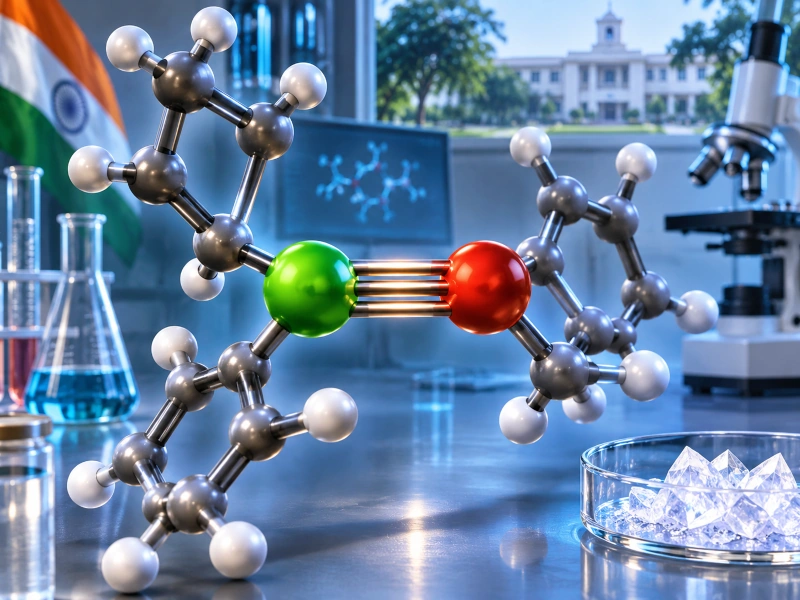
Scientists from Tezpur University in Assam have contributed to an important international breakthrough in molecular chemistry, helping researchers overcome a scientific challenge that had remained unresolved for more than six decades. An international research team has successfully synthesised and isolated three stable oxoborane molecules, a class of chemical compounds containing an unusual triple bond between boron and oxygen that scientists had long considered too unstable to isolate under ordinary laboratory conditions.
The research was conducted through a collaboration between Germany’s University of Würzburg and India’s Tezpur University. The experimental investigations were led by Professor Holger Braunschweig and his team at the University of Würzburg, while Professor Ashwini K. Phukan and his research group at Tezpur University contributed computational chemistry expertise to understand the structure, bonding and unusual stability of the newly isolated molecules.
The findings were published in the international scientific journal Nature Chemistry on 27 October 2026 under the title Synthesis and Isolation of Stable Oxoboranes. The discovery represents an advance in fundamental chemical research and demonstrates the growing contribution of Indian scientists to international investigations involving complex molecular structures.
A Chemical Challenge That Persisted for More Than 60 Years
Oxoboranes are unusual molecules containing a triple bond between boron and oxygen atoms. Although triple bonds are well established in several chemical compounds, forming and stabilising such a bond between boron and oxygen has presented considerable difficulties for chemists.
Boron is an electron-deficient element whose chemical bonding behaviour differs from that of many other elements. The formation of a boron–oxygen triple bond creates a highly reactive molecular arrangement that scientists have struggled to stabilise sufficiently for detailed laboratory investigation.
Since the early 1960s, researchers have attempted to synthesise oxoboranes and investigate their unusual bonding characteristics. Earlier experiments provided evidence for these molecules under specialised conditions, including gas-phase studies and matrix-isolation experiments conducted at very low temperatures.
However, obtaining oxoboranes as stable, isolable substances under ordinary laboratory conditions remained a major challenge.
The newly published research demonstrates that appropriately designed oxoborane molecules can remain stable as crystalline solids at room temperature, allowing scientists to investigate their chemical structures and properties directly.
Unexpected Laboratory Reaction Leads to Breakthrough
The discovery emerged during experimental investigations involving a highly reactive boron-containing compound known as diboracumulene.
Researchers at the University of Würzburg were studying the chemical behaviour of this compound when they observed unexpected reactions with carbonyl-containing substances, including ketones.
Two doctoral researchers, Lukas Lubczyk and Christian Markl, contributed to the experimental work that revealed the formation of unusual reaction products.
Further examination showed that the reactions had produced oxoboranes, compounds that researchers had spent decades attempting to prepare in stable form.
The result was particularly surprising because the reactions generated the elusive molecules under comparatively mild experimental conditions rather than requiring the extreme environments previously associated with their observation.
The research team successfully prepared three different oxoboranes, demonstrating that the synthetic approach could be applied to more than one molecular structure.
Most importantly, the resulting compounds remained stable as crystalline solids at room temperature, allowing their structures and bonding characteristics to be investigated using experimental and theoretical methods.
Tezpur University Provides Critical Computational Chemistry Expertise
The contribution from Tezpur University involved computational investigations that helped explain the properties of the newly synthesised molecules.
Professor Ashwini K. Phukan and Mudit Jain of the Department of Chemical Sciences at Tezpur University participated in the international research collaboration, bringing expertise in theoretical and computational chemistry.
Computational chemistry uses mathematical models and computer-based calculations to investigate molecular structures, chemical bonds, electronic arrangements and reaction behaviour.
In this investigation, computational methods complemented the experimental findings by helping researchers understand the unusual bonding and stability of the newly isolated oxoboranes.
Such calculations are particularly valuable when examining highly reactive chemical species whose behaviour may differ from established expectations.
By combining experimental observations with theoretical analysis, the international team was able to develop a more comprehensive understanding of why the newly prepared molecules could exist as stable compounds.
The participation of Tezpur University demonstrates the important role of advanced computational research in modern chemistry, where theoretical investigations frequently work alongside laboratory experiments to explain complex molecular phenomena.
Researchers Identify Exceptionally Strong Boron–Oxygen Bonds
One of the most significant findings concerns the unusual strength and short length of the boron–oxygen bonds within the newly isolated molecules.
According to the research paper, the compounds contain boron–oxygen bonds measuring approximately 1.208 to 1.217 ångströms, reflecting their exceptionally short bonding distances.
An ångström is a unit commonly used in atomic and molecular measurements, equivalent to one ten-billionth of a metre.
The observed bonding characteristics provide important evidence about the electronic structure of these unusual molecules and help explain their chemical behaviour.
The combination of experimental measurements and computational calculations enabled the researchers to examine the molecular structures and develop an explanation for their unexpected stability.
These findings contribute to a deeper understanding of chemical bonding involving boron, an element whose unusual electronic properties have made it an important subject of research in inorganic and molecular chemistry.
International Collaboration Strengthens Fundamental Chemical Research
The discovery reflects the growing importance of international scientific cooperation in addressing complex research challenges.
The experimental work undertaken at the University of Würzburg was complemented by computational investigations conducted through Tezpur University’s research collaboration.
The study brought together researchers with expertise in synthetic chemistry, molecular characterisation and theoretical calculations, allowing different scientific approaches to contribute to a common research objective.
The project received financial support from the German Research Foundation, the German Academic Exchange Service and India’s Department of Science and Technology.
India’s participation through Tezpur University highlights the capabilities of Indian research institutions in specialised areas of theoretical chemistry and computational molecular science.
Such collaborations allow researchers to combine scientific expertise, advanced laboratory facilities and computational resources across national boundaries.
Discovery Opens New Directions in Molecular Chemistry
The successful isolation of stable oxoboranes creates opportunities for further investigations into unusual chemical bonds and highly reactive molecular species.
The research team has demonstrated that compounds previously considered too unstable for conventional isolation can, under suitable chemical conditions, be prepared and studied in stable form.
This finding may encourage chemists to reconsider established assumptions about the stability of other unusual molecular structures.
The University of Würzburg researchers are now investigating whether the approach can be extended to produce additional oxoboranes and other difficult-to-isolate chemical compounds.
Understanding the bonding behaviour of these molecules could also contribute to broader developments in main-group chemistry, a field concerned with the chemical properties and reactions of elements outside the transition-metal groups.
Although the discovery represents an important advance in fundamental chemistry, practical industrial applications have not yet been established. Its immediate significance lies in expanding scientific understanding and creating new opportunities for molecular research.
Indian Researchers Contribute to a Long-Standing Scientific Breakthrough
The contribution of Tezpur University to the successful isolation of oxoboranes demonstrates the importance of Indian participation in advanced international research programmes.
Professor Ashwini K. Phukan and his research group’s computational investigations helped complement the experimental achievements of their German collaborators, contributing to the scientific understanding of molecules that had challenged researchers for more than six decades.
The work also illustrates how sophisticated theoretical research can make important contributions to experimental discoveries, even when the primary laboratory investigations are conducted at institutions in other countries.
For India’s scientific community, the development highlights the capabilities of universities and research institutions outside the country’s largest metropolitan centres to participate in internationally significant research.
The successful synthesis and isolation of stable oxoboranes marks an important milestone in molecular chemistry, demonstrating how experimental innovation, computational analysis and international scientific cooperation can overcome long-standing challenges in fundamental research.
You may also like
-
Aṅgada’s Mission to Laṅkā: Rāma’s Final Diplomatic Initiative Before War
-
Shiva Destroys Tripura: The Three Flying Fortresses and the Strategy of a Single Decisive Strike
-
The Immunity of Diplomatic Envoys: Vibhīṣaṇa’s Defence of Hanumān Before Rāvaṇa
-
Andhaka’s War Against Shiva: The Battle of Endless Regeneration and Strategic Adaptation
-
Tārā’s Diplomacy: How Wise Counsel Prevented a Political Crisis Between Allies
