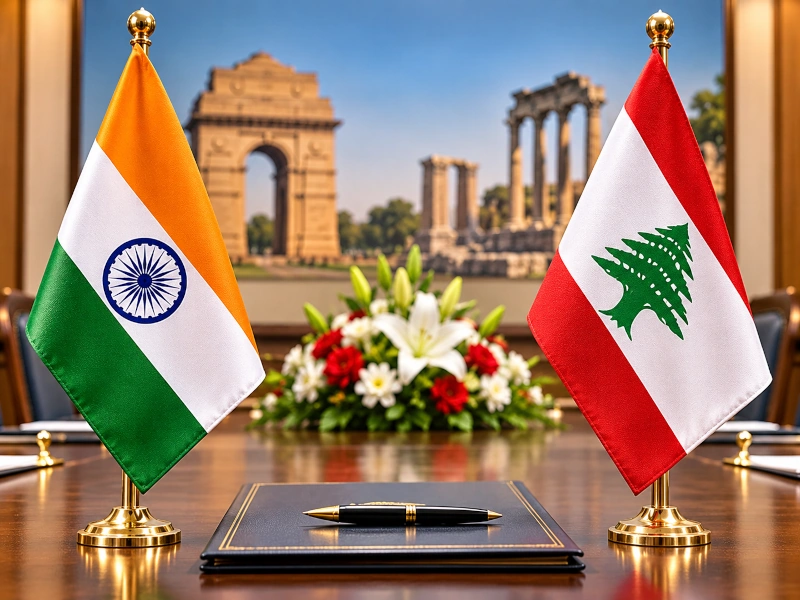
India and Lebanon have taken an important step towards strengthening bilateral cooperation, holding Foreign Office Consultations in New Delhi on 9 November 2026, with a focus on expanding trade, investment, digital public infrastructure and pharmaceuticals. The discussions reflected the growing interest of both countries in developing stronger economic and strategic ties while building upon more than seven decades of diplomatic relations.
The consultations were co-chaired by Sripriya Ranganathan, Secretary (Consular, Passport, Visa and Overseas Indian Affairs) in India’s Ministry of External Affairs, and Abdel Sattar Issa, Secretary-General of Lebanon’s Ministry of Foreign Affairs and Emigrants. The two delegations reviewed bilateral relations across political, security, economic and socio-cultural dimensions and identified priority areas for future cooperation.
Described by Akashvani News as the first India–Lebanon Foreign Office Consultations, the meeting represents an effort to provide greater structure to bilateral diplomatic engagement. India and Lebanon have maintained diplomatic contacts for decades, including foreign-office-level discussions in 1998, and the latest consultations provide an opportunity to strengthen cooperation in sectors of mutual economic and developmental importance.
Trade and Investment Identified as Priority Areas
Expanding trade and investment emerged as a central theme of the consultations, with both countries recognising opportunities to deepen commercial engagement and encourage greater participation by businesses.
India and Lebanon maintain an established trading relationship encompassing chemicals, machinery, textiles, precious stones, metals and manufactured products. Indian exporters have traditionally supplied a variety of industrial and consumer goods to the Lebanese market, while Lebanese enterprises have participated in commercial activities and investment partnerships in India.
According to figures published by the Embassy of India in Beirut, bilateral merchandise trade reached approximately $456 million during the financial year 2023–24. Indian exports accounted for $344 million, while imports from Lebanon stood at $112 million.
The identification of trade and investment as priority areas provides opportunities to expand business connections, diversify traded products and encourage greater commercial engagement between Indian and Lebanese companies.
India’s expanding manufacturing capabilities, particularly in pharmaceuticals, engineering products, chemicals and consumer goods, offer avenues for increasing exports to Lebanon. Lebanese businesses, meanwhile, can explore partnerships in India’s growing industrial and services sectors.
Digital Public Infrastructure Opens New Opportunities
Digital public infrastructure was specifically identified as an important area for future bilateral cooperation, reflecting India’s expanding international engagement in digital governance and technology-enabled public services.
India has developed extensive digital infrastructure through initiatives such as Aadhaar, Unified Payments Interface and DigiLocker. These platforms have helped expand financial inclusion, improve access to public services and facilitate digital transactions across a large population.
India’s experience in developing and implementing digital public infrastructure offers a foundation for technical cooperation with countries seeking to modernise administrative systems and improve the accessibility of public services.
For Lebanon, cooperation in this sector could provide opportunities to examine digital payment systems, identity-based service delivery, electronic governance and technology-driven administrative reforms.
The inclusion of digital public infrastructure among the priorities discussed in New Delhi highlights the growing role of India’s digital capabilities in its international development and technology partnerships.
Pharmaceuticals and Healthcare Cooperation
Pharmaceuticals constituted another major area identified for strengthening India–Lebanon economic cooperation.
India is one of the world’s leading producers of generic medicines and supplies pharmaceutical products to numerous international markets. Its manufacturing capabilities encompass essential medicines, vaccines, active pharmaceutical ingredients and a wide range of therapeutic formulations.
The pharmaceutical sector provides opportunities for Indian manufacturers to strengthen commercial relationships with Lebanese importers, healthcare institutions and pharmaceutical distributors.
Improved cooperation could support the availability of competitively priced medicines and encourage commercial partnerships involving pharmaceutical manufacturing equipment, healthcare products and associated technologies.
India and Lebanon already possess experience in healthcare-related cooperation. In January and February 2023, an Indian-supported Jaipur Foot artificial limb fitment camp was organised at Rafik Hariri University Hospital in Beirut, where 322 artificial limbs were provided to 294 beneficiaries.
The initiative demonstrated India’s ability to combine technical expertise with humanitarian assistance, establishing a foundation for broader healthcare engagement between the two countries.
Strengthening Political and Security Cooperation
The Foreign Office Consultations also reviewed the political and security dimensions of bilateral relations, reflecting the importance of maintaining regular diplomatic engagement amid developments in West Asia.
India has longstanding relations with Lebanon and has consistently maintained diplomatic engagement with the country through periods of regional instability.
Diplomatic relations were formally established in 1954, and India continued operating its Embassy in Beirut throughout Lebanon’s civil war between 1975 and 1990. This uninterrupted diplomatic presence helped preserve bilateral communication during one of the most challenging periods in Lebanon’s modern history.
The latest consultations offered an opportunity for both governments to review their political relationship, exchange assessments of regional developments and discuss matters of international concern.
The two delegations also examined regional and global issues of mutual interest, continuing the tradition of diplomatic engagement between India and Lebanon on international affairs.
India’s Longstanding Contribution to Peacekeeping in Lebanon
India’s relationship with Lebanon includes an important security and humanitarian dimension through its participation in the United Nations Interim Force in Lebanon (UNIFIL).
Indian Army personnel have served in UNIFIL since November 1998, contributing to international peacekeeping efforts in southern Lebanon. The Indian contingent has undertaken operational responsibilities associated with maintaining stability and supporting the United Nations peacekeeping mandate.
Beyond its operational duties, Indian peacekeepers have participated in community-oriented activities and humanitarian initiatives intended to improve relations with local populations.
India’s longstanding participation in UNIFIL reflects its wider commitment to United Nations peacekeeping operations and international cooperation in conflict-affected regions.
This history provides an additional dimension to India–Lebanon relations, extending bilateral engagement beyond conventional diplomacy and commercial exchanges.
Humanitarian Assistance and Development Cooperation
India has also supported Lebanon through humanitarian assistance and development initiatives, particularly during periods of economic difficulty and national emergencies.
Following the devastating Beirut port explosion in August 2020, India dispatched approximately 58 metric tonnes of humanitarian assistance, including medical supplies, food and other relief materials.
India has also contributed to humanitarian response funds and supported development-oriented initiatives through its Quick Impact Projects programme.
These projects have included improvements to community facilities, environmental conservation activities and infrastructure supporting local communities.
Such initiatives demonstrate the practical dimension of India’s diplomatic engagement, combining development assistance with people-oriented cooperation.
Education, Training and Capacity Building
Educational exchanges and professional training constitute another established component of India–Lebanon relations.
Under the Indian Technical and Economic Cooperation programme, India has provided training opportunities to Lebanese officials and professionals in areas related to governance, public administration, technical skills and institutional development.
An Embassy of India briefing published in May 2024 recorded the allocation of 75 civilian training slots and 21 defence training slots for Lebanese participants under the programme.
India and Lebanon have also maintained educational cooperation through institutional agreements and academic exchanges.
A student exchange agreement between the University of Delhi and Lebanese University was signed in March 2021, providing an institutional foundation for academic engagement.
Although the latest consultations specifically highlighted economic, digital and pharmaceutical cooperation, the existing educational relationship offers further opportunities for collaboration in skills development, research and professional training.
Seven Decades of India–Lebanon Diplomatic Relations
India and Lebanon established diplomatic relations in 1954 and have maintained regular engagement across political, commercial and cultural spheres.
The relationship has been supported by longstanding historical connections, cultural exchanges and cooperation in international institutions.
India’s diplomatic presence in Lebanon has continued through successive periods of political and economic difficulty, while the two countries have developed institutional agreements covering civil aviation, taxation, education and cultural cooperation.
The Embassy of India in Beirut has also organised commercial outreach programmes and business seminars to encourage investment and strengthen engagement between enterprises.
Cultural connections, including Indian cinema, music, cuisine and yoga, have contributed to people-to-people relations, complementing formal diplomatic and commercial ties.
The latest Foreign Office Consultations build upon this established relationship while identifying new opportunities in emerging sectors.
A New Phase in India–Lebanon Cooperation
The Foreign Office Consultations held on 9 November 2026 represent a renewed effort to expand India–Lebanon relations through economic cooperation, technological engagement and sustained diplomatic dialogue.
The identification of digital public infrastructure, pharmaceuticals, trade and investment as priority sectors provides a practical direction for future engagement.
For India, stronger cooperation with Lebanon supports its broader diplomatic and commercial relationships with West Asia while creating opportunities for Indian manufacturers, pharmaceutical companies and technology enterprises.
For Lebanon, India’s industrial capabilities, affordable pharmaceutical production, digital infrastructure experience and technical training programmes offer opportunities for economic and institutional cooperation.
By building upon their longstanding diplomatic relationship and identifying sectors with clear development potential, India and Lebanon are laying the groundwork for a more diversified partnership encompassing commerce, technology, healthcare, education and international cooperation.
You may also like
-
PM Modi Reaffirms India’s Support for Peaceful Resolution of Ukraine Conflict in Talks with Zelenskyy
-
INS Surat Arrives in Oman for Naseem Al Bahr 2026, Strengthening India’s Maritime Security Partnership
-
India and EU Conclude Horizon Europe Negotiations, Opening New Opportunities for Scientific Research
-
Tārā’s Diplomacy: How Wise Counsel Prevented a Political Crisis Between Allies
-
Hanumān in Rāvaṇa’s Court: Courage, Strategic Messaging and the Responsibilities of an Envoy
