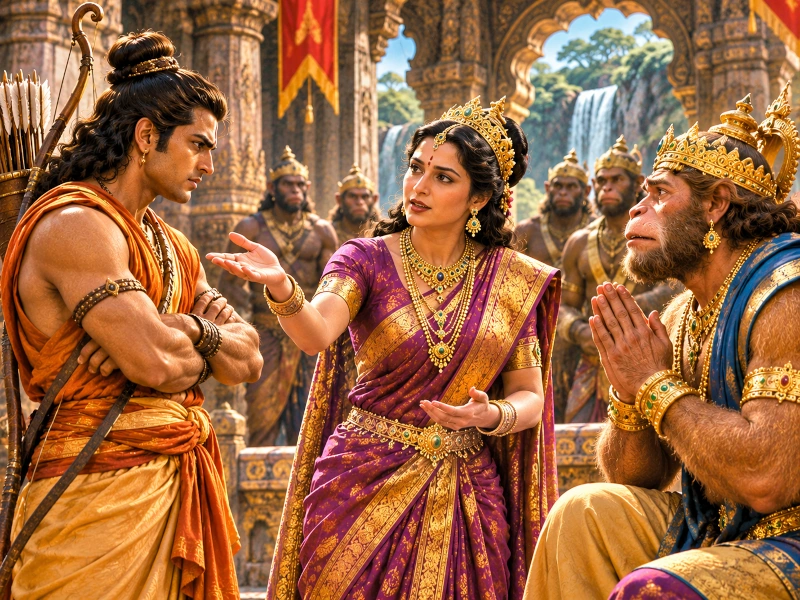
Ramayana Diplomacy Series | Diplomatic Missions and Envoys | Kiṣkindhā Kāṇḍa, Sargas 33–35
Diplomatic crises do not always arise from conflicting strategic interests. Sometimes, they emerge between allies who share common objectives but disagree over the fulfilment of commitments, the pace of implementation or the conduct of their respective leaders. Such disagreements can become particularly dangerous when political grievances are accompanied by personal anger, wounded trust and threats of retaliation. Preventing these disputes from escalating requires individuals capable of understanding the concerns of both sides while preserving the larger relationship.
One of the most instructive examples of such diplomacy appears in the Kiṣkindhā Kāṇḍa of Vālmīki’s Rāmāyaṇa, when Tārā intervenes to pacify an angry Lakṣmaṇa who has arrived in Kiṣkindhā to confront Sugrīva. Her intervention, described in Sargas 33–35, combines persuasion, political intelligence, acknowledgment of legitimate grievances and the ability to offer practical assurances. At a moment when an important alliance faces the danger of a serious confrontation, Tārā demonstrates how wise counsel can transform hostility into an opportunity to restore cooperation.
The Political Crisis: An Alliance Under Strain
The political relationship between Rāma and Sugrīva had been established through an agreement based on mutual assistance. Sugrīva required Rāma’s support to regain the kingdom of Kiṣkindhā from his elder brother Vāli, while Rāma needed Sugrīva’s assistance in locating Sītā, who had been abducted by Rāvaṇa. Their alliance combined personal trust with clearly defined strategic objectives, making its success dependent upon both parties fulfilling their respective commitments.
Rāma honoured his undertaking by defeating Vāli and facilitating Sugrīva’s restoration to the throne. However, after recovering his kingdom, Sugrīva became occupied with royal pleasures and the comforts of his restored position. Although the monsoon initially provided a legitimate reason for postponing military operations, the delay continued to trouble Rāma as the appropriate season for undertaking the search approached.
Rāma’s concern was understandable because the alliance had been established primarily to facilitate Sītā’s recovery. Sugrīva’s apparent inattention created doubts about whether he remained sufficiently committed to that objective. Lakṣmaṇa, deeply distressed by his brother’s suffering and angered by Sugrīva’s conduct, was consequently sent to Kiṣkindhā to remind the Vānara king of his obligations.
The resulting situation presented a serious political danger. Sugrīva owed his restored kingship to Rāma’s intervention, while Rāma continued to depend upon Sugrīva’s resources, warriors and knowledge of distant territories. A confrontation between them could therefore undermine the interests of both parties, making the preservation of their relationship a matter of strategic necessity.
Lakṣmaṇa’s Arrival: When Diplomatic Pressure Threatens to Escalate
In Sarga 33, Lakṣmaṇa enters Kiṣkindhā carrying his bow and displaying unmistakable anger. The Vānara warriors guarding the city recognise his formidable reputation and are reluctant to obstruct him. His presence creates anxiety within the kingdom, transforming what might otherwise have been a routine diplomatic visit into an urgent political confrontation.
As Lakṣmaṇa approaches the royal chambers, he becomes increasingly disturbed by the signs of luxury and enjoyment surrounding Sugrīva’s court. The contrast between Rāma’s suffering and Sugrīva’s apparent indulgence intensifies his anger. When he sounds his bowstring, the noise communicates his displeasure so forcefully that Sugrīva becomes alarmed.
Sugrīva immediately recognises the danger of the situation. Although uncertain about the precise cause of Lakṣmaṇa’s anger, he understands that the younger prince would not have arrived in such a condition without a serious grievance. Rather than confronting Lakṣmaṇa directly while his anger remains intense, Sugrīva turns to Tārā for assistance.
This decision marks the beginning of Tārā’s diplomatic mission. Sugrīva asks her to approach Lakṣmaṇa, determine the reason for his displeasure and use conciliatory language to calm him. He hopes that her presence and judgment will create the conditions for a more productive conversation.
The episode illustrates a fundamental principle of crisis management: when direct communication between political leaders risks producing an immediate confrontation, a trusted intermediary can help restore the conditions necessary for meaningful dialogue.
Why Tārā Was the Right Diplomatic Intermediary
Tārā was not an inexperienced member of the royal household suddenly entrusted with a difficult political responsibility. Earlier in the Kiṣkindhā Kāṇḍa, she had demonstrated considerable political judgment by warning Vāli against hastily confronting Sugrīva after the latter returned to challenge him. She recognised that Sugrīva’s renewed confidence suggested the involvement of powerful allies and urged Vāli to examine the changed political circumstances before acting.
Although Vāli rejected her advice, the episode established Tārā’s ability to interpret political developments, evaluate military risks and anticipate the consequences of decisions taken in anger. Her judgment extended beyond immediate appearances to the broader strategic circumstances influencing the behaviour of rival rulers.
Following Vāli’s death, Tārā remained an influential figure within Kiṣkindhā’s political establishment. Her understanding of the kingdom’s internal affairs, the circumstances of Sugrīva’s restoration and the importance of Rāma’s assistance placed her in a strong position to address the emerging crisis.
Tārā also possessed an advantage that an ordinary messenger might have lacked. She understood the emotional dimensions of the dispute as well as its political implications. She could recognise Sugrīva’s shortcomings without abandoning his interests, while acknowledging Lakṣmaṇa’s concerns without treating him as an enemy.
Sugrīva’s decision to seek her assistance therefore reflects more than a desire to calm an angry visitor. It represents reliance upon a politically perceptive adviser capable of protecting the kingdom’s interests through persuasion rather than confrontation.
The First Diplomatic Move: Allowing the Grievance to Be Heard
Tārā approaches Lakṣmaṇa respectfully and begins by seeking to understand the cause of his anger. Rather than immediately defending Sugrīva or challenging Lakṣmaṇa‘s behaviour, she creates an opportunity for him to express his dissatisfaction.
This approach is important because Lakṣmaṇa’s anger arises from a genuine concern about Sugrīva’s obligations. Dismissing his complaint would only reinforce the impression that Kiṣkindhā had become indifferent to Rāma’s suffering. By allowing the grievance to be articulated, Tārā acknowledges that the dispute requires a serious response.
Lakṣmaṇa explains that Sugrīva has failed to demonstrate adequate gratitude towards the person responsible for restoring his kingdom. He condemns the neglect of friendship and the failure to fulfil promises, particularly when such neglect prolongs the suffering of a trusted ally.
Tārā’s diplomatic skill lies in recognising that this criticism cannot be answered merely by asserting Sugrīva’s authority as king. The central issue is not the dignity of the Vānara throne, but the credibility of a political commitment that has not produced the expected results.
By engaging with the substance of Lakṣmaṇa’s complaint, she moves the encounter away from a contest of personal authority and towards a discussion of responsibility, intention and corrective action.
Acknowledging Fault Without Destroying Political Trust
One of the most significant features of Tārā’s intervention is her ability to distinguish Sugrīva’s lapse in judgment from deliberate betrayal of Rāma.
She does not attempt to portray Sugrīva as entirely blameless. Instead, she acknowledges the powerful influence of pleasure and the distractions that followed his restoration to kingship. Her explanation recognises that Sugrīva has allowed his personal circumstances to interfere with the attention expected of him.
However, Tārā also argues that such conduct should not automatically be interpreted as evidence that Sugrīva has abandoned his friendship with Rāma. She asks Lakṣmaṇa to recognise the difference between a temporary failure of discipline and a conscious decision to violate an alliance.
This distinction is central to effective diplomacy. Political relationships can become unstable when every delay or administrative failure is interpreted as an act of hostility. An intermediary must therefore establish whether the underlying disagreement reflects incompatible interests or a remediable failure in conduct.
Tārā’s argument is not that Sugrīva’s position exempts him from responsibility. Rather, she maintains that the lapse can be corrected because the fundamental political relationship remains intact.
Her intervention creates space for accountability without requiring Sugrīva’s humiliation or the destruction of the partnership. By separating the ruler’s conduct from his continuing obligations, she offers a route through which both sides can preserve their dignity while returning to the common objective.
Turning Reassurance into Concrete Strategic Information
Tārā’s diplomacy becomes especially effective in Sarga 35, where she moves beyond conciliatory language and provides information about the military preparations underway in Kiṣkindhā.
She explains that confronting Rāvaṇa requires considerable military strength because the ruler of Laṅkā commands powerful forces. The search for Sītā and any subsequent military expedition therefore demand the mobilisation of Vānara warriors from different regions.
Tārā informs Lakṣmaṇa that Sugrīva has already initiated the process of assembling these forces. Her explanation challenges the assumption that the absence of visible action necessarily means complete inactivity.
This is a decisive element of her diplomatic strategy. Personal reassurance may temporarily reduce anger, but credible information about actual preparations provides a stronger basis for restoring political confidence. Tārā does not simply ask Lakṣmaṇa to trust Sugrīva; she explains the military requirements of the mission and identifies the steps being taken to meet them.
The distinction between inactivity and preparation is particularly important in military alliances. Mobilising forces, coordinating commanders and assembling the resources necessary for an expedition often require considerable time. If these activities are not communicated to an ally, even legitimate preparations may be mistaken for indifference or unwillingness.
Through her explanation, Tārā converts the discussion from a dispute over intentions into an examination of operational readiness. She helps Lakṣmaṇa understand that the alliance still possesses the capacity to fulfil its original purpose.
Preserving the Dignity of Both Parties
Diplomatic negotiations often fail when one side believes that accepting a compromise would amount to surrendering its honour or political standing. Tārā avoids creating such a dilemma by maintaining respect for both Lakṣmaṇa and Sugrīva.
She recognises Lakṣmaṇa’s position as Rāma’s representative and acknowledges the legitimacy of the concerns he raises. At the same time, she reminds him that Sugrīva remains the ruler of the Vānara kingdom and a friend whose cooperation is essential to Rāma’s mission.
In Sarga 35, Tārā specifically appeals to Lakṣmaṇa to moderate the harshness of his language towards Sugrīva. Her intervention is significant because it does not deny the grievance; instead, it questions whether continued verbal severity will help achieve the desired result.
The ability to distinguish firmness from unnecessary humiliation is an important quality in diplomacy. A ruler who is publicly shamed may become more concerned with defending his authority than fulfilling the original agreement. By protecting Sugrīva’s dignity while acknowledging his responsibilities, Tārā reduces the likelihood that the dispute will develop into a confrontation over prestige.
Her approach also preserves Lakṣmaṇa’s standing. He does not need to withdraw his criticism or abandon Rāma’s interests. The explanation offered by Tārā enables him to move towards reconciliation without appearing to disregard the commitments he was sent to enforce.
The resulting diplomatic balance allows both parties to retain their essential positions while creating room for renewed cooperation.
Tārā as a Political Adviser Rather Than a Passive Messenger
Tārā’s conduct demonstrates the difference between simply conveying a message and exercising independent diplomatic judgment.
A messenger may communicate the instructions of a ruler without interpreting their broader implications. Tārā, however, evaluates the emotional condition of Lakṣmaṇa, understands the political vulnerability of Sugrīva and constructs an argument designed to protect the alliance.
Her intervention involves several interconnected judgments. She recognises that Lakṣmaṇa’s anger must be addressed rather than ignored, that Sugrīva’s conduct cannot be defended without qualification, and that the explanation of military preparations offers the strongest basis for restoring confidence.
She also chooses an approach appropriate to the circumstances. Confronting Lakṣmaṇa with threats would have intensified the crisis, while excessive submission could have weakened Sugrīva’s political authority. Tārā instead adopts a combination of respectful engagement, acknowledgment, persuasion and practical explanation.
These qualities place her intervention within the broader tradition of diplomatic statecraft. She acts not merely as a representative of the royal household, but as an adviser whose political understanding helps prevent the interests of the state from being compromised by the conduct of its ruler.
Her example demonstrates that influence within political institutions is not confined to the person formally occupying the throne. Wise counsel can become decisive when rulers are distracted, emotionally unsettled or unable to evaluate a developing crisis objectively.
The Importance of Emotional Intelligence in Diplomacy
Tārā’s intervention also illustrates the importance of understanding how emotions influence political decision-making. Lakṣmaṇa’s anger is rooted in loyalty to Rāma, concern for Sītā and frustration with Sugrīva’s apparent negligence. These emotions cannot simply be dismissed because they arise from the moral and strategic commitments underlying the alliance.
Tārā therefore avoids treating Lakṣmaṇa’s anger as an irrational obstacle. She recognises the circumstances that produced it and responds through arguments directed towards his underlying concerns. Her effort is not merely to silence his criticism, but to demonstrate that the alliance can still fulfil the purpose for which it was established.
This approach allows the emotional intensity of the encounter to diminish without requiring either side to deny the seriousness of the issue. Lakṣmaṇa can continue to insist upon Rāma’s interests, while Sugrīva is given an opportunity to correct his conduct and demonstrate his continuing commitment.
The diplomatic lesson is that emotional restraint becomes most effective when accompanied by a credible explanation and a practical path towards resolution. Persuasion succeeds not simply because it reduces anger, but because it addresses the conditions that made the anger politically significant.
A Modern Diplomatic Parallel: The Camp David Accords of 1978
A useful modern parallel to Tārā’s intervention can be found in the diplomatic mediation conducted by United States President Jimmy Carter during the negotiations between Egyptian President Anwar Sadat and Israeli Prime Minister Menachem Begin at Camp David in September 1978.
Egypt and Israel had fought several wars, and negotiations over peace, territorial withdrawal and regional security involved deep disagreements. Carter brought the two leaders together at Camp David, where discussions continued for thirteen days under considerable diplomatic pressure. The negotiations encountered serious difficulties as the parties struggled to reconcile competing political and security demands.
Carter’s role became particularly important when direct discussions proved unproductive. Through separate consultations, written proposals and sustained personal engagement, he worked to identify areas of possible agreement while addressing the concerns of both governments. Rather than permitting individual disagreements to terminate the negotiations, he maintained communication and sought compromises that could be accepted within the political constraints facing each leader.
The process resulted in the signing of two framework agreements on 17 September 1978, creating the foundation for the Egypt–Israel Peace Treaty of March 1979. Although the historical circumstances differed considerably from those in Kiṣkindhā, the diplomatic method offers a meaningful comparison. Both Tārā and Carter intervened at moments when emotionally charged disagreements threatened to obstruct important political objectives.
Tārā’s circumstances involved the preservation of an existing alliance, whereas Carter mediated between states seeking to end a history of armed conflict. Nevertheless, both examples demonstrate the value of intermediaries who understand the positions of the parties, maintain communication during periods of tension and redirect negotiations towards achievable outcomes.
The underlying principle is that diplomacy often depends upon individuals capable of preserving the possibility of agreement when direct confrontation appears more likely to produce failure.
Diplomatic Lessons from Tārā’s Intervention
The first lesson concerns the importance of selecting capable intermediaries during political crises. Sugrīva’s decision to send Tārā reflects recognition of her judgment and ability to communicate effectively with Lakṣmaṇa. Her knowledge of the alliance, the kingdom’s circumstances and the personalities involved enables her to address the dispute with greater sensitivity than a routine representative might have demonstrated.
The second lesson is that acknowledgment of legitimate grievances strengthens diplomatic credibility. Tārā does not attempt to eliminate Sugrīva’s responsibility through denial. By recognising his lapse in judgment, she makes her subsequent assurances more persuasive and creates a foundation for restoring trust.
The third lesson concerns the relationship between information and political confidence. Tārā’s explanation of the military preparations provides Lakṣmaṇa with a practical reason to believe that Sugrīva remains committed to the alliance. Her intervention demonstrates that successful diplomacy must combine assurances of goodwill with credible evidence of intended action.
The fourth lesson is that preserving political dignity can be essential to achieving substantive objectives. Tārā protects Sugrīva from unnecessary humiliation without excusing his conduct, while enabling Lakṣmaṇa to maintain the seriousness of his mission. Her approach reduces the danger that the disagreement will become a contest of personal prestige rather than a discussion of alliance obligations.
Finally, the episode demonstrates that wise counsel can compensate for temporary failures of political leadership. Sugrīva’s distraction creates a dangerous situation, but Tārā’s judgment helps prevent that failure from developing into a larger strategic disaster. Her conduct illustrates the importance of maintaining advisers who are capable of recognising risks, communicating uncomfortable truths and acting in the long-term interests of the political community.
Conclusion: The Diplomatic Strength of Wisdom and Restraint
Tārā’s intervention in Kiṣkindhā is an important illustration of diplomacy exercised through political intelligence rather than military power. At a moment when Lakṣmaṇa’s anger threatens to produce a confrontation with Sugrīva, she recognises the legitimacy of the grievance while protecting the continuing value of the alliance.
Her success rests upon a carefully balanced approach. She acknowledges Sugrīva’s shortcomings, respects Lakṣmaṇa’s concerns, explains the military preparations already underway and creates the conditions in which renewed cooperation becomes possible. Rather than allowing personal anger to determine the outcome, she directs attention towards the strategic objective shared by both parties.
The subsequent reconciliation between Lakṣmaṇa and Sugrīva confirms the value of preserving communication during moments of political tension. The alliance survives the crisis and proceeds towards the mobilisation of the Vānara forces for the search for Sītā.
Through Tārā, the Rāmāyaṇa presents a lasting principle of diplomatic statecraft: the ability to prevent an avoidable confrontation can be as important as the strength required to prevail in one. Wise counsel does not weaken political authority; it enables rulers and their representatives to exercise that authority in ways that preserve relationships, fulfil commitments and advance larger strategic objectives.
You may also like
-
India and EU Conclude Horizon Europe Negotiations, Opening New Opportunities for Scientific Research
-
Hanumān in Rāvaṇa’s Court: Courage, Strategic Messaging and the Responsibilities of an Envoy
-
Guyana Offers to Supply Up to 20% of India’s Crude Oil Needs, Eyes Deeper Energy Partnership
-
India, Philippines in Advanced Talks for $800 Million BrahMos Missile Deal
-
Lakṣmaṇa’s Mission to Kiṣkindhā: Enforcing Alliance Commitments Without Breaking the Partnership
