Warcraft in the Puranas Series | Mārkaṇḍeya Purāṇa — Devī Māhātmya, Chapter 8
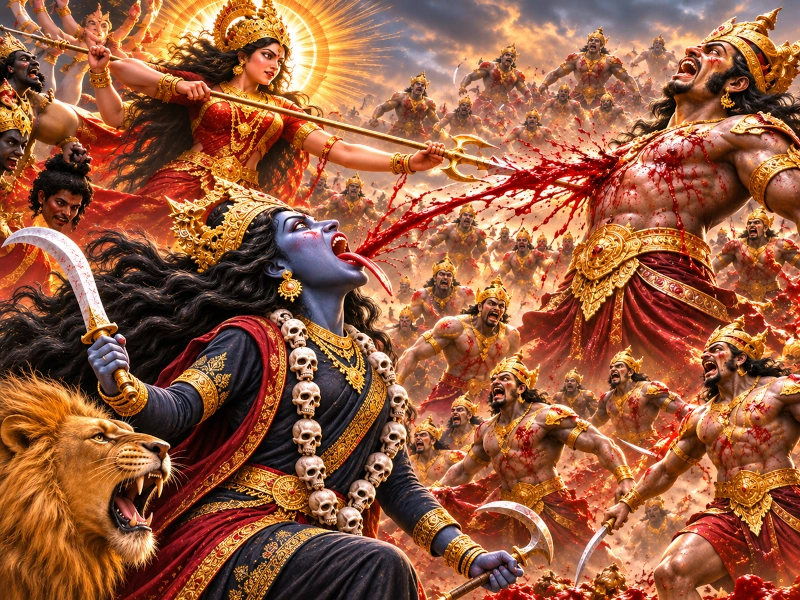
Among the extraordinary battles described in the Devī Māhātmya, the confrontation with Raktabīja presents one of the most unusual military problems in sacred literature. The demon possesses an ability that transforms every successful attack against him into an opportunity for reinforcement. Whenever a drop of his blood touches the earth, another warrior of identical form, strength and fighting ability emerges. Conventional weapons, rather than diminishing his power, increase the number of enemies confronting the Goddess.
The battle therefore develops into a contest between overwhelming proliferation and strategic adaptation. Caṇḍikā and the divine Mothers initially employ their formidable weapons against Raktabīja, only to discover that each wound produces additional opponents. The battlefield becomes increasingly crowded with warriors generated from his blood, threatening to turn the very strength of the divine offensive against its objective.
The decisive breakthrough comes when Caṇḍikā directs Kālī, also known as Cāmuṇḍā, to intercept Raktabīja’s blood before it reaches the ground and consume the warriors arising from it. The Goddess then resumes her assault while Kālī prevents further multiplication. Through a military lens, the encounter illustrates the importance of understanding an enemy’s means of reinforcement, recognising when an existing method has become counterproductive, and coordinating different capabilities to eliminate a threat at its source.
The principal account appears in Chapter 8 of the Devī Māhātmya, traditionally titled Raktabījavadha. The chapter belongs to the larger narrative of the Goddess’s conflict with Śumbha and Niśumbha. The tactical observations that follow interpret the sacred narrative without treating its supernatural events as historically verifiable military operations or assuming that the scripture describes formal modern doctrines.
The Strategic Crisis Following the Defeat of Caṇḍa and Muṇḍa
The battle arises during the continuing struggle between the Goddess and the armies of Śumbha and Niśumbha. In the preceding chapter, Kālī destroys the powerful commanders Caṇḍa and Muṇḍa, after which Caṇḍikā bestows upon her the name Cāmuṇḍā. Their destruction represents a substantial defeat for the asura forces, but it does not end the wider conflict.
Śumbha responds to these losses by ordering a general mobilisation. He summons numerous asura clans, including the Kambus, Koṭivīryas, Dhaumras, Kālakas, Daurhṛdas, Mauryas and Kālakeyas. The opening verses of Chapter 8 describe a large coalition of forces advancing under his command, indicating that the conflict has escalated beyond individual commanders into a major confrontation involving the wider strength of the asura armies.
From a strategic perspective, Śumbha’s response is an effort to recover the initiative through mass mobilisation. The destruction of his earlier commanders has demonstrated that isolated attacks are insufficient, prompting him to commit a much larger portion of his available strength. The narrative’s numerical descriptions convey the magnitude of this mobilisation within the Puranic setting rather than provide historically recoverable troop strengths.
Caṇḍikā meets the advancing army with an unmistakable display of power. The sound of her bowstring fills the space between heaven and earth, her lion roars, and her bell adds to the tremendous noise. Kālī then overwhelms these sounds with her own terrifying cry. The asuras surround the Goddess, her lion and Kālī from every direction, establishing the conditions for a prolonged battle against a numerically formidable opponent.
Sound serves an important narrative function at this stage. The Goddess’s bowstring, the lion’s roar, the bell and Kālī’s cry express the authority and fearlessness of the divine forces. Read through a military lens, the passage also draws attention to the psychological dimension of confrontation, where displays of strength can influence the confidence of opposing combatants before the decisive fighting begins.
The Divine Mothers: Multiple Capabilities on a Single Battlefield
As the battle intensifies, the powers of the principal gods manifest as divine Mothers, or Mātṛkās, and join Caṇḍikā. Each appears with the form, weapons and mount associated with the deity whose power she embodies. Their arrival transforms the battlefield into an engagement involving several distinct forms of divine martial capability.
Brahmāṇī arrives in a swan-drawn vehicle, carrying her rosary and water vessel. Māheśvarī bears a trident and rides a bull, while Kaumārī carries a spear and appears with a peacock. Vaiṣṇavī arrives upon Garuḍa with weapons including the discus, conch, mace, bow and sword. Vārāhī assumes the form associated with the divine boar, and Nārasiṃhī manifests the ferocity of the man-lion. Aindrī, bearing Indra’s thunderbolt, appears upon an elephant.
The weapons and methods employed by the Mothers differ considerably. Brahmāṇī diminishes the enemy’s strength through water from her vessel, while Māheśvarī, Kaumārī and Vaiṣṇavī strike directly with their respective weapons. Aindrī destroys large numbers of opponents with her thunderbolt. Vārāhī and Nārasiṃhī attack through their formidable physical powers, while Kālī engages the enemy with her own weapons and overwhelming ferocity.
The narrative presents these powers as manifestations of divine Śakti rather than separate military formations. Nevertheless, their participation offers an instructive image of diverse capabilities operating within a common struggle. Some attacks rely on piercing or cutting weapons, others employ overwhelming force, and still others weaken or disrupt the enemy through supernatural means.
A military interpretation can recognise the value of complementary capabilities without imposing a modern command structure upon the text. The Mothers do not need to be treated as specialised regiments or battlefield divisions. Their significance lies in the variety of means brought against the asuras and in their shared commitment to Caṇḍikā’s purpose.
Raktabīja Enters the Battle: An Enemy Who Multiplies Under Attack
After the divine Mothers inflict substantial destruction upon the asura forces, Raktabīja enters the battle. His appearance fundamentally alters the nature of the engagement because he possesses an extraordinary ability that makes ordinary combat increasingly dangerous for his opponents.
The Devī Māhātmya explains that whenever a drop of blood falls from Raktabīja’s body onto the ground, another asura of the same stature and strength emerges. These newly created warriors are not described as weaker imitations. They possess his appearance, vigour and fighting ability, and they immediately join the battle against the divine Mothers.
This ability introduces an unusual relationship between damage and enemy strength. In conventional combat, successfully striking an opponent is expected to reduce his capacity to continue fighting. Against Raktabīja, however, a successful blow creates additional combatants. The greater the injury inflicted without preventing his blood from reaching the earth, the greater the potential multiplication of the enemy.
The strategic danger therefore lies not merely in Raktabīja’s individual strength but in the consequences of attacking him through conventional means. His blood becomes the mechanism by which his fighting presence expands across the battlefield. The defenders confront a threat in which successful tactical actions produce increasingly unfavourable operational results.
The central question is no longer how many blows can be delivered against Raktabīja. It is how the Goddess can defeat him without allowing those blows to generate additional enemies.
The Thunderbolt and Discus: When Successful Attacks Strengthen the Enemy
The first major demonstration of Raktabīja’s power occurs during his engagement with Aindrī. She strikes him with her thunderbolt, causing blood to flow from his wounded body. As the blood reaches the earth, warriors identical to Raktabīja appear and begin fighting the divine Mothers.
A further thunderbolt strike produces thousands of additional warriors. Instead of weakening the opposing force, Aindrī’s powerful weapon multiplies the number of combatants facing the Goddess and her companions. The thunderbolt remains an effective instrument of destruction, but its immediate effect upon Raktabīja creates an unintended consequence.
Vaiṣṇavī then strikes the demon with her discus, while other Mothers attack with their own weapons. The wounds inflicted by the discus, spear, sword and trident produce further bloodshed, and the resulting drops generate even more warriors. The text describes the world becoming filled with the asuras arising from his blood.
The significance of this sequence lies in the distinction between the immediate effect of a weapon and its overall effect upon the battle. Each successful strike wounds Raktabīja, yet the consequences of that wound favour his ability to multiply. The weapons themselves have not failed in their immediate function; rather, the enemy’s extraordinary power has changed the meaning of success.
This is a particularly important insight for a warcraft interpretation. A commander must evaluate an action not only by whether it damages the intended target but also by what happens after the damage is inflicted. Against an opponent whose strength grows through a particular kind of engagement, repeated success at the tactical level can produce failure at the wider operational level.
Battlefield Saturation and the Crisis of Uncontrolled Proliferation
As the fighting continues, the divine Mothers confront an expanding multitude of Raktabīja’s duplicates. Every wound threatens to produce more opponents, and those newly created warriors immediately participate in the struggle. The battlefield becomes increasingly saturated with enemies whose appearance and strength match those of the original demon.
The situation creates a problem that cannot be resolved simply by increasing the intensity of attack. Greater violence produces more bloodshed, and more bloodshed creates further multiplication. The very method that had proved effective against earlier asura commanders has become unsuitable for the present adversary.
The Devī Māhātmya explicitly records the alarm of the gods when they observe the enormous number of warriors arising from Raktabīja’s blood. Their fear reflects the apparent impossibility of overcoming an enemy who continually replenishes and expands his strength whenever he is wounded.
The battle thus moves beyond a contest of individual weapons. It becomes a struggle over the conditions that permit the enemy to regenerate. Unless the connection between bloodshed and multiplication is broken, the divine forces cannot prevent their actions from increasing the number of opponents.
The theological narrative presents this crisis through a supernatural power unique to Raktabīja. Its military significance lies in a more general principle: an opponent’s capacity to replenish losses can matter as much as the ability to withstand an initial attack. Destroying individual combatants may achieve little when the mechanism generating replacements remains intact.
Caṇḍikā Identifies the Enemy’s Decisive Vulnerability
The turning point occurs when Caṇḍikā observes the distress of the gods and responds with confidence rather than alarm. Instead of continuing the same pattern of attack, she identifies the mechanism responsible for Raktabīja’s multiplication and issues a specific instruction to Kālī.
Addressing her as Cāmuṇḍā, Caṇḍikā orders Kālī to open her mouth wide and swiftly receive the blood released by the wounds inflicted upon Raktabīja. She must also consume the asuras that emerge from his blood. By doing so, Kālī will prevent the appearance of further warriors and allow Raktabīja to be gradually deprived of his strength.
This instruction represents the decisive change in the battle. Caṇḍikā does not abandon the objective of destroying Raktabīja, nor does she merely search for a more powerful weapon. She changes the conditions under which her weapons can be employed.
Previously, every successful wound created new enemies because the blood reached the ground. Under the revised method, the wounds can weaken Raktabīja without allowing his blood to produce additional combatants. The same destructive weapons that had earlier multiplied the threat can now contribute directly to his defeat.
The difference lies in the supporting action. Kālī’s task is not simply to strike Raktabīja more fiercely but to prevent his blood from activating the power that sustains his multiplication.
Through a military lens, this moment illustrates the value of recognising an adversary’s critical dependence. The enemy’s greatest advantage is also governed by a specific condition. Once Caṇḍikā identifies that condition, she is able to formulate an effective countermeasure.
Kālī’s Intervention: Containing the Mechanism of Reinforcement
Following Caṇḍikā’s instruction, the Goddess strikes Raktabīja while Kālī intercepts the blood flowing from his wounds. The Devī Māhātmya describes Kālī receiving the blood in her mouth, preventing it from falling upon the earth and generating additional warriors.
Raktabīja continues fighting and strikes Caṇḍikā with his mace, but his attack causes her no meaningful injury. The Goddess maintains the offensive, and more blood flows from his body. Kālī moves across the battlefield, consuming the blood wherever it appears and devouring the warriors generated within her mouth.
The sequence creates a direct relationship between the actions of Caṇḍikā and Kālī. Caṇḍikā inflicts the wounds necessary to destroy Raktabīja, while Kālī prevents the consequences that had previously made those wounds dangerous. Their actions are complementary: the attack reduces the demon’s strength, and the accompanying intervention prevents his replenishment.
The scripture does not describe a formal military plan involving units, signals or a mapped deployment. What it does describe is a clearly expressed instruction followed by coordinated action, with each divine power contributing a distinct function to the defeat of the same opponent.
This is the battle’s strongest illustration of adaptive warcraft. Rather than measuring progress by the number of blows delivered, Caṇḍikā changes the relationship between offensive action and enemy regeneration. The countermeasure succeeds because it addresses the source of the problem instead of repeatedly confronting its consequences.
Kālī’s intervention is therefore decisive not merely because of her ferocity but because her action makes the final destruction of Raktabīja possible.
The Final Assault: Destroying Raktabīja Without Allowing Regeneration
Once Kālī begins intercepting his blood, Raktabīja’s extraordinary advantage is progressively neutralised. Caṇḍikā continues striking him with weapons that include the spear, thunderbolt, arrows and sword, while Cāmuṇḍā consumes the blood released by his wounds.
The demon can no longer convert his injuries into an expanding army. The blows that previously created new opponents now steadily exhaust him. His ability to resist is diminished as the Goddess maintains her attack and Kālī prevents the process of multiplication.
The Devī Māhātmya concludes that Raktabīja falls to the earth, deprived of blood and overwhelmed by the accumulated strikes of divine weapons. The gods rejoice, and the divine Mothers celebrate the destruction of the enemy whose extraordinary power had threatened to overwhelm their combined forces.
The conclusion is striking because the decisive factor is not the discovery of an entirely new weapon. The Goddess employs weapons already available during the earlier stages of the battle. What changes is the manner in which their effects are controlled.
Raktabīja’s destruction follows from the removal of his capacity to generate reinforcements. Once that capacity is denied, his remaining strength proves insufficient to withstand the divine assault.
The battle therefore ends not through an escalation of indiscriminate force but through the effective application of force under newly established conditions.
The Military Principle: Denying an Enemy the Benefits of Engagement
The Raktabīja episode offers a distinctive lesson about the relationship between battlefield action and an opponent’s ability to sustain or increase resistance. The divine Mothers initially attack through methods that have proved effective against other enemies, yet those same methods produce an adverse outcome when used against Raktabīja.
The problem is not a lack of courage, weapons or fighting ability. It is the failure of the initial method to account for the enemy’s unique characteristic. Until that characteristic is understood, greater force merely increases the difficulty of achieving victory.
Caṇḍikā’s response demonstrates the importance of adapting the method of engagement after identifying why an existing approach is failing. The Goddess does not allow the apparent impossibility of defeating Raktabīja to dictate the outcome. She examines the mechanism of his power and changes the sequence of actions necessary to overcome him.
The episode also illustrates why successful attacks must be evaluated according to their wider consequences. In the narrative, wounding the enemy initially creates new threats, while the later interception of blood transforms those same wounds into irreversible damage.
A useful contemporary military parallel is the distinction between destroying an opponent’s deployed forces and preventing the systems that replenish those forces from functioning. Modern military planning often examines supply networks, recruitment, production and the processes through which an adversary sustains its operations. The Raktabīja narrative is not a historical anticipation of those doctrines, but it provides an illuminating literary analogy for the importance of attacking the mechanism of reinforcement rather than its repeated products.
The battle further demonstrates how complementary capabilities can produce results that individual weapons cannot achieve independently. Caṇḍikā provides the destructive force, while Kālī performs the indispensable task of preventing regeneration. Victory emerges from the relationship between these actions rather than from either action considered in isolation.
Modern Warfare Parallel: Russia–Ukraine Drone War and the Strategic Lesson of Raktabīja
The ongoing Russia–Ukraine war offers a striking modern parallel to the battle against Raktabīja described in the Devī Māhātmya. Russia’s large-scale deployment of Shahed-type one-way attack drones demonstrates how an adversary can sustain relentless pressure despite substantial battlefield losses. According to the Center for Strategic and International Studies (CSIS), Russian Shahed launches increased from approximately 200 per week in September 2024 to more than 1,000 per week by March 2025, while subsequent assessments indicated that Russia was deploying more than 5,000 such drones monthly during early 2026. Although Ukrainian air defences successfully intercepted large numbers of these weapons, Russia’s expanding manufacturing capacity enabled it to replenish losses and sustain repeated attacks. This resembles the strategic dilemma confronting Caṇḍikā, whose initial attacks against Raktabīja produced additional enemies whenever his blood touched the ground. The fundamental lesson is that destroying individual threats does not necessarily eliminate an adversary’s ability to regenerate its fighting strength. Just as Caṇḍikā directed Kālī to prevent Raktabīja’s blood from generating new warriors, modern military strategy must address the production networks, supply chains and operational infrastructure that enable an opponent to replace its losses. The comparison illustrates an enduring principle of warfare: lasting success requires not merely defeating the forces already deployed but also disrupting the mechanisms that continually restore their strength.
Strategic Adaptation as the Decisive Factor in Victory
One of the most significant features of the battle is the contrast between the initial response to Raktabīja and the approach adopted after Caṇḍikā identifies his vulnerability. At first, the divine Mothers respond to the demon’s advance by employing their familiar weapons. These attacks are powerful and accurate, but their consequences undermine the larger objective.
The turning point comes through recognition of the enemy’s governing condition. Raktabīja multiplies because his blood reaches the earth. Preventing that contact removes the mechanism through which his power expands. Caṇḍikā therefore formulates a countermeasure that allows the offensive to continue without reproducing the original problem.
The episode offers a clear distinction between persistence and adaptation. Persistence alone would have prolonged the battle and multiplied the asuras. Adaptation allows the same forces to achieve a result that had appeared impossible under the earlier method.
This principle has applications far beyond direct combat. In strategic planning, an effective response requires understanding how an adversary gains strength, what conditions sustain that strength and whether one’s own actions inadvertently reinforce the problem being confronted.
The Raktabīja narrative expresses this through an extraordinary supernatural encounter. Its underlying logic is nevertheless accessible: effective power requires understanding, and understanding becomes decisive when it changes how power is employed.
The Triumph of Śakti and the Restoration of Order
The destruction of Raktabīja forms part of the larger struggle through which the Goddess confronts the domination of Śumbha and Niśumbha. His defeat removes an especially dangerous obstacle, but the wider conflict continues in the following chapters of the Devī Māhātmya.
Within the religious narrative, the divine Mothers embody the many manifestations of Śakti, the supreme power through which the universe is sustained and protected. Their participation demonstrates that the Goddess’s strength appears in different forms, each capable of confronting a particular aspect of the forces threatening cosmic order.
Kālī’s terrifying appearance and extraordinary actions must also be understood within this theological framework. Her consumption of Raktabīja’s blood is not presented as an act of uncontrolled violence. It is a deliberate response to a destructive power that cannot be overcome through ordinary means. Her intervention prevents the continual multiplication of the threat and makes its final destruction possible.
Caṇḍikā’s authority remains central throughout the encounter. She recognises the danger, identifies the necessary response and directs Kālī’s action. The battle therefore unites discernment, command and overwhelming force within the protective purpose of the Goddess.
For the Warcraft in the Puranas series, Raktabīja’s defeat stands as an exceptional study of adaptive strategy. The divine forces initially confront an enemy who grows stronger through their attacks. Victory becomes possible when Caṇḍikā identifies the mechanism of that growth and ensures that further attacks can no longer sustain it.
Where the battle against Mahishasura demonstrates adaptation to an enemy who repeatedly changes his form, the battle against Raktabīja illustrates adaptation to an enemy who repeatedly multiplies his strength. In both encounters, the Goddess prevails not through physical power alone but through the ability to recognise the true nature of the threat and apply the appropriate countermeasure.
The spiritual meaning remains inseparable from the martial narrative. The Goddess restores balance by confronting a power whose uncontrolled multiplication threatens the world. Her victory affirms the union of strength, knowledge and disciplined action in the protection of Dharma.
You may also like
-
The Coronation of Sugrīva: Political Legitimacy and the Responsibilities of an Alliance
-
The Rāma–Sugrīva Alliance: How Mutual Interests Created a Strategic Partnership
-
UNESCO Recognises Mahabharata, Arthashastra and Rajatarangini Manuscripts, Taking India’s Asia-Pacific Heritage
-
India’s Atal Innovation Mission Helps Establish Advanced Robotics and AI Laboratory in Sri Lanka
-
NCERT Introduces Personal Finance and Entrepreneurship in Class 9 Social Science Textbooks
