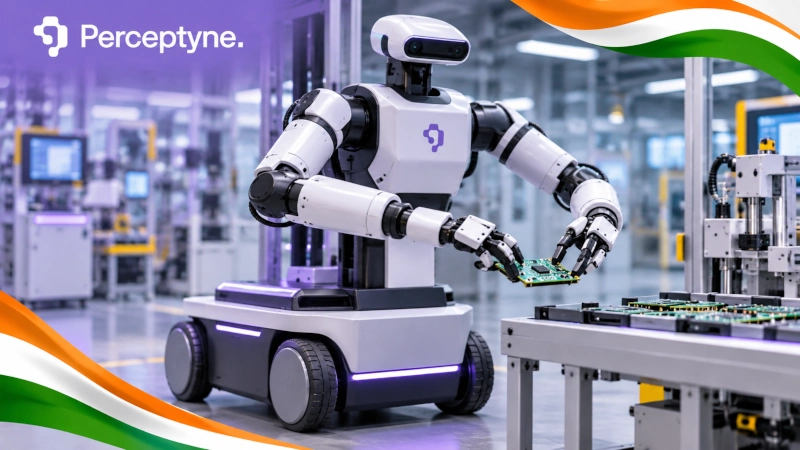
Indian deep-technology startup Perceptyne is developing an advanced semi-humanoid industrial robot called PR-OMNI, combining artificial intelligence, precision robotic manipulation and autonomous mobility to address complex manufacturing requirements. Designed and engineered in Hyderabad, the platform incorporates two seven-degree-of-freedom robotic arms, sophisticated sensing technologies and a proprietary Physical Intelligence system intended to automate repetitive and dexterous industrial tasks.
Unlike conventional fixed industrial robotic arms, PR-OMNI combines human-like upper-body manipulation with a mobile wheeled platform, allowing it to move between workstations and interact with different manufacturing environments. The robot is designed to undertake activities involving component handling, assembly and equipment interaction, particularly in industries where production processes require flexibility, precision and coordinated movement.
Perceptyne’s development represents an important contribution to India’s emerging industrial robotics ecosystem, where domestic companies are increasingly combining mechanical engineering, embedded electronics, advanced sensors and artificial intelligence to develop specialised automation technologies. The company is focusing on building integrated robotic systems capable of operating in existing industrial facilities while addressing manufacturing tasks that are difficult to automate using conventional machinery.
PR-OMNI Combines Human-Like Dexterity with Industrial Mobility
The PR-OMNI platform incorporates a semi-humanoid upper body mounted on a four-wheel holonomic mobile base. This configuration enables the robot to move in multiple directions within industrial environments while retaining the ability to manipulate objects using two coordinated robotic arms.
Each arm provides seven degrees of freedom, allowing complex movements comparable to several motions performed by a human arm. This flexibility enables the robotic system to approach objects from different angles, adjust its position and undertake coordinated two-handed manipulation.
According to Perceptyne’s official technical specifications, the robot has an aluminium body measuring approximately 157 centimetres in height and weighing 120 kilograms. Each robotic arm has an 800 mm reach and supports a payload of up to five kilograms, providing a combined payload capacity of ten kilograms.
The platform also incorporates a vertical gantry with 800 mm of movement, allowing its upper body to adjust height while interacting with equipment, components and workstations. The manufacturer specifies a maximum working reach of approximately two metres.
These characteristics are intended to make PR-OMNI suitable for manufacturing environments where robotic systems must interact with equipment positioned at different heights and locations.
Advanced Force and Tactile Sensors Enable Precision Manipulation
An important technological feature of PR-OMNI is its combination of force-torque sensing and tactile feedback.
Perceptyne states that the platform incorporates force-torque sensing at every robotic arm joint, allowing the control system to monitor forces generated during movement and interaction with objects. This information can help the robot regulate its actions when handling components or performing tasks that require controlled physical contact.
Tactile sensors integrated into the robot’s end effectors provide additional information about contact between the grippers and objects being manipulated. These sensors are intended to support operations requiring controlled gripping and delicate handling.
Such capabilities are particularly relevant to industrial assembly, where components may require precise positioning, insertion or manipulation without excessive force.
Traditional industrial robots often perform best when objects are presented in carefully controlled positions. By incorporating advanced sensing and adaptive control, Perceptyne aims to develop systems capable of responding to variations in component placement and the physical conditions encountered during manufacturing operations.
The company’s approach reflects the growing importance of robotic systems that can perceive and respond to their surroundings rather than relying exclusively on fixed sequences of programmed movements.
Physical Intelligence Software Forms the Core of the Platform
Perceptyne is developing PR-OMNI around its proprietary Physical Intelligence technology, known as PR-PhI, which is intended to combine perception, autonomous control and physical interaction within a unified robotics framework.
The company’s software architecture incorporates information from cameras, force sensors and tactile sensors to support robotic decision-making during physical tasks.
Unlike artificial intelligence systems designed primarily for language processing or digital information analysis, Physical AI focuses on enabling machines to perceive and interact with their physical environment.
Perceptyne’s software framework uses a modular architecture with skill components developed for specific industrial operations. This approach is intended to enable robotic systems to perform different tasks by combining perception, movement planning and controlled manipulation.
The platform also incorporates visual servoing, allowing the robot to adjust its movements based on visual information received during an operation. According to the company, this technology enables tracking of moving objects without requiring external markers.
PR-OMNI supports open-source AI models alongside Perceptyne’s proprietary software capabilities, providing flexibility for developing and adapting industrial automation applications.
The integration of physical intelligence with advanced robotic hardware represents an important direction in automation technology, particularly as manufacturers seek systems capable of handling more varied and complex tasks.
Computer Vision and Autonomous Navigation Support Factory Operations
PR-OMNI incorporates three RGB-D cameras, positioned at its wrists and head, to capture visual and depth information about its surroundings.
RGB-D cameras combine conventional colour imaging with depth measurements, enabling robotic systems to estimate the position and distance of objects within their working environment.
The robot also uses two LiDAR sensors for indoor navigation and simultaneous localisation and mapping, commonly known as SLAM. This technology allows a mobile robot to construct or update a representation of its surroundings while estimating its position within that environment.
Combined with its four-wheel holonomic drive, the navigation system is designed to allow PR-OMNI to move between workstations and operate within industrial spaces.
Perceptyne lists a maximum mobility speed of two metres per second and incorporates collision-avoidance technology as part of the platform’s safety architecture.
The system is powered by an NVIDIA Jetson Orin computing platform alongside an Intel NUC, providing onboard processing capabilities for perception, robotics control and AI workloads.
These technologies are intended to reduce the dependence on fixed robotic installations and enable more flexible automation across different sections of a manufacturing facility.
Six-Hour Battery Operation and Remote-Control Capabilities
Perceptyne has designed PR-OMNI with a three-kilowatt-hour battery system comprising two interchangeable 1.5 kWh battery units.
According to the company’s published specifications, the robot has an operating runtime of approximately six hours. The swappable battery configuration is intended to simplify power management during industrial operations.
The robot also supports virtual-reality-based teleoperation, allowing an operator to control or guide its movements remotely through compatible equipment.
Teleoperation can support the development of robotic skills by enabling engineers to demonstrate tasks and collect information about the movements required to perform them.
Perceptyne’s Physical Intelligence architecture incorporates shared-autonomy capabilities, combining operator guidance with automated control functions.
This approach can be particularly useful during the development and testing of specialised industrial tasks, where robotic systems must learn or reproduce complex manipulation sequences.
The company also provides simulation-based development capabilities using NVIDIA Isaac technology, enabling potential customers and engineering teams to examine robotic workflows in simulated industrial environments before physical deployment.
Applications in Electronics, Automotive and Precision Manufacturing
Perceptyne is positioning PR-OMNI for industrial operations requiring coordinated manipulation, adaptable movement and precision handling.
Electronics manufacturing is one potential application because production processes frequently involve handling small components, positioning assemblies and performing operations that require controlled force.
Automotive manufacturing also presents opportunities for mobile robotic manipulation, particularly in assembly activities where components must be positioned, transferred or handled across different workstations.
Additional applications may include machine tending, equipment interaction, material handling, inspection and selected warehouse operations.
The combination of dual robotic arms and autonomous movement could allow a single robotic platform to undertake several related activities within an industrial workflow, rather than performing only one fixed operation.
Perceptyne’s stated objective is to develop automation technologies that can undertake repetitive and physically demanding activities while allowing human workers to concentrate on supervision, quality management and more complex production responsibilities.
The platform’s commercial applications remain dependent on successful integration, operational testing and validation within specific customer environments.
Indigenous Robotics Development Strengthens India’s Deep-Tech Ecosystem
Perceptyne’s development of PR-OMNI reflects India’s expanding capabilities in advanced robotics and AI-driven industrial systems.
The company has emphasised its commitment to designing and engineering robotic technologies in India, including the development of proprietary hardware and software required for its platforms.
This approach contributes to domestic expertise in robotic actuation, sensor integration, embedded computing, autonomous navigation and intelligent manipulation.
Industrial robotics is an important area of technological development because automation systems increasingly influence manufacturing productivity, product quality and operational flexibility.
The ability to develop advanced robotic systems domestically can create opportunities for Indian engineering enterprises, component suppliers, software developers and specialised manufacturing companies.
Perceptyne’s work also demonstrates how Indian startups are moving into complex hardware-intensive technology sectors that require integration across mechanical engineering, electronics, artificial intelligence and industrial software.
The company’s development activities contribute to an emerging ecosystem of domestic robotics enterprises seeking to address manufacturing requirements through indigenous technological innovation.
Perceptyne’s Wider Robotics Portfolio Supports Flexible Automation
In addition to PR-OMNI, Perceptyne is developing other robotic platforms designed for different industrial requirements.
Its PR-DUO system incorporates two seven-degree-of-freedom robotic arms in a compact configuration intended for coordinated manipulation within relatively confined workspaces.
The PR-UNO platform uses a single robotic arm and is designed for industrial applications that do not require simultaneous two-arm manipulation.
These systems share elements of the company’s broader technology architecture, including sensing, control and Physical Intelligence capabilities.
By developing multiple robotic configurations, Perceptyne aims to address a range of manufacturing requirements while maintaining common technological foundations.
The availability of different configurations could allow industrial customers to select robotic systems based on workspace constraints, manipulation requirements and operational complexity.
This modular approach is particularly relevant to manufacturing facilities seeking automation solutions that can be integrated into existing production processes.
Indian Physical AI Innovation Moves Towards Industrial Applications
The emergence of Physical AI represents an important technological development in industrial automation, combining advances in machine intelligence with the mechanical and sensing capabilities of robotic systems.
Perceptyne’s PR-OMNI platform illustrates this convergence through its integration of dual robotic arms, autonomous mobility, computer vision, tactile sensing and intelligent control software.
The company’s emphasis on domestic engineering and proprietary technology demonstrates the expanding capabilities of India’s deep-technology startup ecosystem in developing sophisticated industrial hardware.
For Indian manufacturing, such technologies offer opportunities to explore more flexible automation methods capable of responding to changing production requirements and performing tasks that require coordinated physical interaction.
Perceptyne’s continuing development of PR-OMNI, alongside its other robotic platforms, contributes to India’s growing expertise in intelligent industrial machinery and advanced manufacturing technologies.
As the company advances its robotics systems towards wider industrial application, its work highlights the increasing role of Indian startups in developing the next generation of factory automation technologies under the broader objectives of Make in India and Atmanirbhar Bharat.
You may also like
-
Indian Space Startup PierSight Advances Antenna Testing for Varuna 2.0 Maritime Surveillance Satellite
-
India and Italy Explore Expanded Textile Manufacturing, Technology and Investment Partnerships
-
Chennai Deep-Tech Startup Torus Motion Develops Indigenous Axial-Flux Motors for Electric Vehicles and Industrial Automation
-
Rekise Marine Advances Indigenous MPAUV and Jalkapi Autonomous Submarine Programmes with Sea Trials in Goa
-
India’s Steel Consumption Nears 100 Million Tonnes as Domestic Demand Grows 7.5% in April–October 2026
