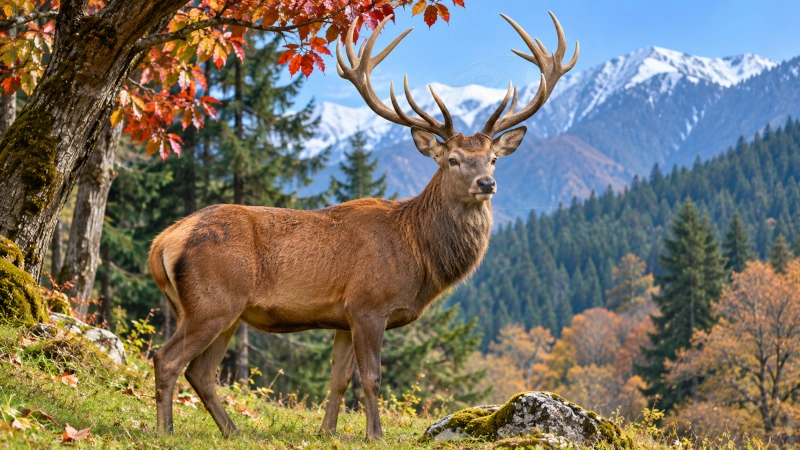
The Jammu and Kashmir Government has directed the Wildlife Protection Department to undertake the conservation of the endangered Hangul, or Kashmir stag, on a mission-mode basis, with particular emphasis on scientific population monitoring, habitat improvement and stronger protection measures. The directive was issued by Minister for Forests, Ecology and Environment Altaf Ahmad Wani during a comprehensive review meeting of the Wildlife Protection Department and the Jammu and Kashmir Forest Research Institute (JKFRI) in Jammu on November 5, 2026.
The Minister emphasised the importance of protecting Jammu and Kashmir’s unique biodiversity, identifying the Hangul as one of the region’s most important wildlife species. He called for a coordinated conservation approach combining scientific research, habitat management, institutional cooperation and greater public participation. The meeting also reviewed the Union Territory’s protected-area network, biodiversity documentation, human-wildlife conflict management and forest research activities.
Hangul Conservation to Receive Special Attention
The Hangul is a rare deer native to the Kashmir region and represents an important component of the Himalayan ecosystem. Recognised for its distinctive branching antlers and reddish-brown coat, the Kashmir stag is closely associated with the forests of Dachigam National Park near Srinagar, which remains its principal surviving habitat.
The species has experienced considerable conservation challenges arising from habitat fragmentation, disturbance, restricted distribution and pressures on its natural environment. Its limited population and geographical concentration make sustained protection and scientific monitoring particularly important.
During the review meeting, Wani described the Hangul as an integral part of Jammu and Kashmir’s natural heritage and directed the Wildlife Protection Department to undertake dedicated conservation measures. The proposed mission-mode approach places emphasis on systematic population assessments, improvement of natural habitats and strengthening the scientific basis of wildlife management.
Scientific monitoring is particularly important for understanding the Hangul’s population structure, breeding patterns, habitat requirements and seasonal movements. Regular assessments can help conservation authorities identify ecological pressures and develop appropriate measures for supporting the species within its natural habitat.
Habitat improvement is another important component of the proposed conservation effort. Maintaining suitable vegetation, protecting breeding areas and preserving ecological connectivity can support the long-term conservation of the Hangul and other wildlife species inhabiting Kashmir’s forests.
Jammu and Kashmir Maintains 50 Protected Areas Covering 4,861 Square Kilometres
During the meeting, officials presented details of Jammu and Kashmir’s protected-area network, which comprises 50 protected areas extending across approximately 4,861.282 square kilometres in 20 districts. The network includes four national parks, 14 wildlife sanctuaries, 16 conservation reserves and 16 wetland reserves.
These protected landscapes play an important role in conserving the Union Territory’s diverse ecosystems, ranging from temperate forests and alpine habitats to wetlands and mountainous wildlife corridors. They provide habitats for numerous mammals, birds, reptiles, amphibians and other species associated with the western Himalayan region.
Officials also informed the Minister that Eco-Sensitive Zones had been notified for ten protected areas, including Jasrota, Rajparian, Ramnagar, Hirpora, Surinsar-Mansar, Gulmarg, Kazinag, Kishtwar High Altitude National Park, Dachigam-Overa-Aru and Tral.
Eco-Sensitive Zones provide an additional mechanism for protecting ecologically important landscapes adjoining designated conservation areas. By regulating specified activities around sensitive habitats, these zones help support wildlife protection and encourage environmentally compatible development.
The protected-area network provides an important institutional foundation for Jammu and Kashmir’s biodiversity conservation efforts, including species-specific programmes, habitat protection and scientific wildlife monitoring.
Region Supports More Than 600 Bird Species and 100 Mammal Species
The Wildlife Protection Department presented an extensive overview of Jammu and Kashmir’s biodiversity, highlighting the ecological importance of the region’s forests, mountains, wetlands and other natural habitats.
According to the departmental presentation, Jammu and Kashmir supports approximately 4,440 plant species, 111 mammal species, 608 bird species, more than 68 reptile species, 14 amphibian species, over 308 butterfly species and more than 100 fish species.
The region’s wildlife includes several rare and threatened species, among them the Hangul, Kashmir musk deer, markhor and Asiatic ibex. These animals represent the ecological diversity of the Himalayan landscape and underscore the importance of maintaining effective conservation programmes.
Jammu and Kashmir’s varied elevations and climatic conditions support a broad range of habitats, enabling species adapted to forests, alpine meadows, mountain slopes and freshwater ecosystems to survive within a relatively concentrated geographical region.
The Minister directed officials to prepare a comprehensive compendium documenting the Union Territory’s wildlife, flora and fauna in consultation with scientific experts. The proposed publication is intended to provide organised biodiversity information for researchers, students, conservation authorities and the wider public.
Such documentation can strengthen the availability of reliable ecological information and support scientific studies, conservation planning and educational programmes involving the region’s natural heritage.
Human-Wildlife Conflict Response to Be Strengthened
Human-wildlife conflict management was another major subject discussed during the review meeting. The Minister directed the department to strengthen its response mechanisms, particularly in areas where wildlife movements bring animals into contact with villages and agricultural settlements.
He emphasised that Rapid Response Teams must reach conflict locations without delay and that affected families should receive compensation within prescribed timelines. The department was also instructed to strengthen early-warning systems and organise public awareness programmes in vulnerable communities.
The proposed measures involve cooperation with Panchayati Raj institutions, which can help improve communication between forest authorities and local residents. Community participation is particularly important in areas where settlements border wildlife habitats and where timely information can help prevent dangerous encounters.
Jammu and Kashmir’s mountainous terrain and extensive forest landscapes create conditions in which wild animals may occasionally move near agricultural land, orchards and residential areas. Effective conflict management therefore requires a combination of scientific wildlife monitoring, local awareness, rapid intervention and coordination among government agencies.
The Minister’s directions seek to strengthen both wildlife protection and public safety through better preparedness, communication and timely field-level action.
Forest Research Institute Expands Scientific Conservation Activities
The meeting also reviewed the work of the Jammu and Kashmir Forest Research Institute, with particular attention to scientific research, forest resource management and the conservation of valuable plant species.
Officials informed the Minister that JKFRI had established two seed banks, one in Jammu and another in Srinagar, for preserving seeds collected from designated forest seed-production areas. These facilities support the conservation of forest genetic resources and provide material for future planting and restoration activities.
The institute has also developed cultivation protocols for several important medicinal plants, including Kuth, Tilpushpi, Mushkwala, Pushkarmul, Angur Shefa and Shinglimingli. The research is intended to improve scientific understanding of these species and support their conservation and cultivation.
JKFRI has undertaken the inventory and mapping of medicinal plants across Jammu and Kashmir and established germplasm collections in its nurseries. These activities provide a foundation for conservation research, propagation and the development of sustainable cultivation practices.
The Minister called for stronger cooperation between the institute, the Forest Department, farmers and industry representatives. He emphasised that scientific research should contribute to practical forest conservation and create opportunities for local communities to benefit from sustainable natural-resource management.
Around 30,000 Chinar Trees Geo-Tagged Across Jammu and Kashmir
The review also highlighted progress in the digital documentation and conservation of culturally and ecologically significant trees across Jammu and Kashmir.
Officials reported that approximately 30,000 Chinar trees had been geo-tagged and incorporated into a digital database. Additionally, QR-enabled metal identification plates have been installed on 10,000 prominent Chinar trees in Kashmir and 3,500 Peepal and Bargad trees in Jammu.
The initiative uses geographical information and digital identification to improve the documentation and monitoring of important trees. Such records can assist conservation authorities in maintaining information about tree locations and supporting future protection and management activities.
The department plans to undertake a second phase of geo-tagging covering the remaining Chinar, Bargad and Peepal trees. The expansion will further strengthen the digital inventory of significant trees across the Union Territory.
Chinar trees occupy a special place in Kashmir’s landscape and cultural heritage. Their conservation, alongside the protection of other indigenous and ecologically important trees, contributes to maintaining the region’s distinctive natural environment.
Scientific Monitoring and Habitat Protection Form Core of Conservation Strategy
The directions issued during the review meeting bring together several important aspects of wildlife management, including endangered species protection, habitat conservation, scientific research, community participation and digital biodiversity documentation.
The mission-mode conservation directive for the Hangul establishes a clear priority for strengthening efforts to protect one of Kashmir’s most distinctive wild animals. The accompanying emphasis on scientific monitoring and habitat improvement provides an important framework for conservation planning.
Jammu and Kashmir’s extensive protected-area network, specialised wildlife institutions and growing biodiversity research capabilities provide a foundation for implementing these measures. The involvement of forest officials, researchers, local communities and public institutions can further strengthen cooperation across the conservation sector.
The government’s renewed focus on Hangul protection forms part of a wider effort to safeguard the Himalayan region’s wildlife heritage while improving scientific understanding, habitat management and the conservation of its diverse natural ecosystems.
You may also like
-
Wildlife Institute of India Researchers Record Gaur at 3,542 Metres in Sikkim Himalayas
-
Chhattisgarh Plans to Reintroduce 50 Blackbucks into Gomarda Wildlife Sanctuary After Five Decades
-
Zoological Survey of India Plays Major Role in Landmark Global Coral Reef Assessment
-
National Zoological Park Records 46 Bird Species During 67th Foundation Day Celebrations
-
Scientists Discover New Microscopic Land Snail Species in Maharashtra’s Western Ghats
