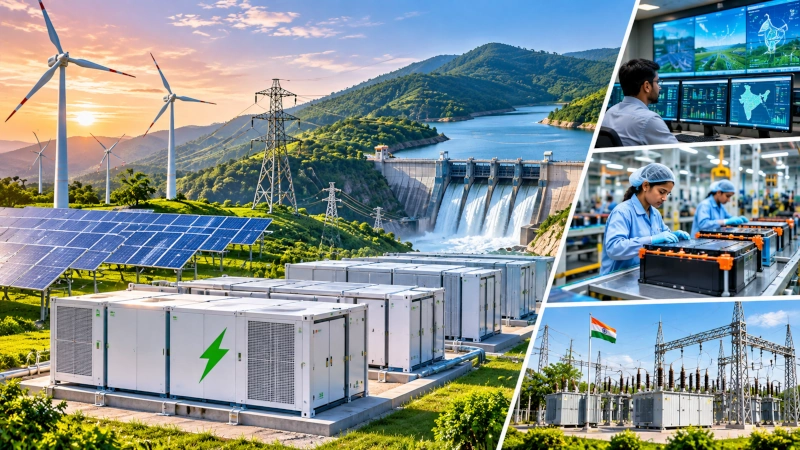
The Union Cabinet has approved a ₹14,500 crore viability gap funding scheme to support the development of 92 gigawatt-hours (GWh) of grid-scale energy storage capacity across India, marking a major expansion of the country’s renewable energy infrastructure. The initiative, approved on November 4, 2026, is expected to facilitate investments of approximately ₹97,600 crore while strengthening electricity grid stability, promoting indigenous battery manufacturing and enabling greater integration of renewable energy into the national power system.
The scheme, approved by the Union Cabinet chaired by Prime Minister Narendra Modi, will be implemented over five financial years, from 2026–27 to 2030–31. It will support the development of 60 GWh of hydro pumped storage capacity, 30 GWh of battery energy storage systems and 2 GWh through emerging storage technologies. The programme is designed to address the growing requirement for reliable electricity storage as India expands its solar, wind and other non-fossil fuel-based generation capacities.
₹97,600 Crore Investment to Expand Grid-Scale Energy Storage
The new programme aims to accelerate the deployment of energy storage infrastructure by providing viability gap funding (VGF) for projects that require financial assistance to achieve commercial feasibility. The ₹14,500 crore allocation will support the development of storage facilities involving an estimated combined investment of ₹97,600 crore, creating opportunities for power utilities, infrastructure developers, technology manufacturers and private investors.
According to the Ministry of Power, the additional capacity supported under the scheme will be equivalent to approximately 170% of India’s existing grid-scale energy storage capacity. The programme will also contribute towards meeting the country’s projected requirement of 411 GWh of grid-scale energy storage by 2031–32, reflecting the substantial infrastructure expansion needed to accommodate increasing renewable electricity generation.
The scheme will be implemented in collaboration with state governments, allowing energy storage capacity to be distributed across different regions according to national and regional electricity requirements. The geographical expansion of storage infrastructure will strengthen the ability of state electricity networks to manage variations in generation and demand while supporting the integration of renewable energy projects.
60 GWh Pumped Hydro Storage to Strengthen Electricity Supply
Pumped hydro storage will account for the largest component of the programme, with 60 GWh of capacity planned under the scheme. These facilities store energy by pumping water from a lower reservoir to a higher reservoir when surplus electricity is available. During periods of increased electricity demand, the stored water is released through turbines to generate power.
The technology provides a means of storing electricity over extended periods and is particularly suitable for supporting renewable energy systems with variable generation patterns. By allowing electricity generated during periods of abundant solar or wind power to be used when demand increases, pumped storage can improve grid flexibility and reduce dependence on conventional power generation for balancing electricity supply.
The development of additional pumped hydro storage projects will also create opportunities for Indian engineering companies, construction firms, equipment manufacturers and hydroelectric technology providers. Large-scale storage infrastructure requires substantial investment in civil engineering, turbines, pumps, electrical systems and grid connectivity, providing opportunities for domestic participation across multiple industrial sectors.
30 GWh Battery Storage Capacity to Support Renewable Energy Integration
Battery energy storage systems will form the second major component of the programme, with 30 GWh of capacity allocated for development. These systems store electricity in large battery installations and release it when required, enabling faster responses to changes in electricity demand and renewable energy generation.
Battery storage has become increasingly important as solar power capacity expands across India. Solar installations generate electricity primarily during daylight hours, while electricity demand frequently remains high during evening periods. Battery systems can store surplus solar electricity during the day and supply it to the grid when generation declines, improving the availability of renewable power beyond its immediate production period.
The proposed expansion of battery storage capacity will support electricity distribution companies in managing peak demand, improving grid reliability and reducing fluctuations associated with renewable generation. The programme will also encourage investments in battery assembly, power conversion systems, energy management software, grid integration equipment and related manufacturing activities.
Minimum 40% Domestic Content Requirement to Promote Indian Manufacturing
A significant feature of the Cabinet-approved scheme is the introduction of a minimum 40% domestic content requirement for battery energy storage projects supported under the programme. The provision is intended to encourage the use of domestically manufactured components and strengthen India’s indigenous energy storage manufacturing ecosystem.
The requirement will create additional opportunities for Indian companies involved in battery systems, electrical equipment, power electronics and related technologies. By linking financial support to domestic content, the government aims to stimulate demand for locally manufactured products while reducing dependence on imported energy storage components.
The initiative complements existing measures supporting advanced battery manufacturing and domestic industrial capacity. As energy storage deployment expands, the development of Indian manufacturing capabilities can contribute to stronger supply chains, technological development and employment opportunities in the country’s emerging clean energy industries.
The domestic content provision also reflects the growing importance of energy storage technologies within India’s broader manufacturing strategy, particularly as batteries become essential for renewable electricity integration, electric mobility and industrial energy management.
Competitive Bidding to Encourage Public and Private Investment
Energy storage capacity under the scheme will be allocated through a tariff-based competitive bidding process designed to encourage cost-effective project development. Public and private sector electricity distribution companies will be eligible for viability gap funding support for battery energy storage and pumped hydro storage projects.
Projects involving alternative energy storage technologies will be implemented by eligible public and private sector entities, allowing participation from companies developing emerging solutions beyond conventional batteries and pumped hydro systems.
The allocation of 2 GWh for alternative energy storage technologies creates an opportunity for technological diversification within India’s electricity storage infrastructure. Emerging storage systems may offer different operating characteristics, discharge durations and applications, complementing established technologies in meeting future grid requirements.
The competitive procurement framework is intended to encourage efficient project development while expanding opportunities for private investment and technology participation in India’s power sector.
Energy Storage to Support India’s Growing Non-Fossil Electricity Capacity
The Cabinet approval comes as India continues expanding its non-fossil fuel-based electricity generation infrastructure. Briefing the media following the Cabinet meeting, Union Minister for Information and Broadcasting Ashwini Vaishnaw highlighted that nearly 52% of India’s installed electricity generation capacity now comes from non-fossil fuel sources.
The increasing contribution of solar, wind, hydroelectric and nuclear energy to installed power capacity has created a corresponding requirement for energy storage and grid management infrastructure. Unlike conventional electricity generation, solar and wind output varies according to weather conditions and the time of day, making storage systems important for balancing electricity supply with consumer demand.
Grid-scale storage facilities allow electricity produced during periods of surplus generation to be retained and supplied when required. Their deployment can improve renewable energy utilisation, reduce curtailment of available generation and strengthen the reliability of electricity supply for households, industries and commercial establishments.
By supporting both battery-based and pumped hydro storage, the new scheme will help establish a more diversified energy storage system capable of meeting different operational requirements across India’s electricity network.
Strengthening India’s Long-Term Energy Security
The ₹14,500 crore viability gap funding scheme represents a substantial investment in the infrastructure required to support India’s expanding clean energy economy. Its proposed 92 GWh storage capacity, estimated ₹97,600 crore investment and emphasis on domestic manufacturing combine electricity system modernisation with industrial development.
The programme is particularly significant for Indian manufacturers of batteries, electrical equipment, power electronics and hydroelectric machinery, alongside infrastructure developers and renewable energy companies. Its implementation will create additional opportunities for domestic technology development and private sector participation in the country’s energy transition.
As India progresses towards its projected requirement of 411 GWh of grid-scale energy storage by 2031–32, the Cabinet-approved scheme establishes an important framework for expanding storage infrastructure, strengthening electricity supply reliability and supporting the continued growth of renewable energy generation.
The initiative reinforces India’s objective of developing a resilient, technologically advanced and increasingly self-reliant electricity system capable of supporting long-term economic and industrial growth.
You may also like
-
India’s Free Trade Agreement Network Could Cover 75% of Merchandise Exports, Expanding Access to US$329 Billion in Trade
-
NMDC Iron Ore Production Rises 22% to 32.32 Million Tonnes in April–October 2026
-
India’s Services PMI Climbs to Four-Month High of 55.8 in October as Inflationary Pressures Ease
-
Tonbo Imaging Plans High-Power Microwave Manufacturing and Testing Facilities in Karnataka
-
India Approves 12 Electronics Manufacturing Projects Worth ₹7,503 Crore, Launches Semicon 2.0 Portal
