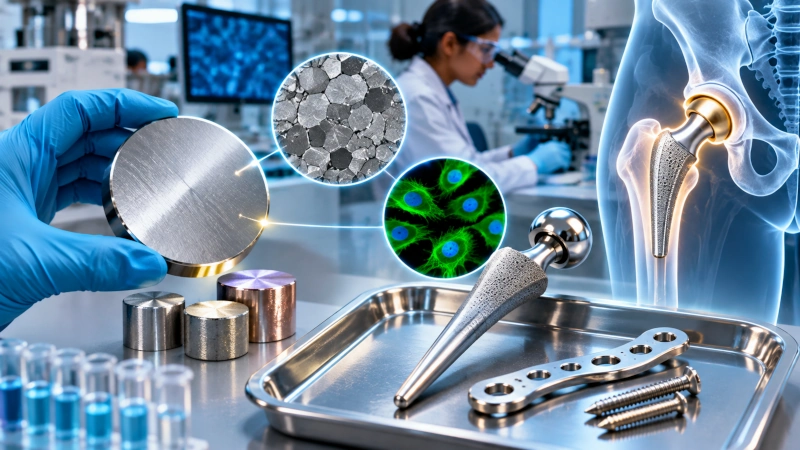
Researchers from the University of Hyderabad, IIT Delhi, IIT Bhubaneswar and CSIR-Central Electrochemical Research Institute (CSIR-CECRI), Karaikudi, have developed a new family of advanced metal alloys with promising applications in orthopaedic implants. The innovative materials, composed of titanium, cobalt and chromium, demonstrate high mechanical strength, resistance to wear and corrosion, and favourable compatibility with living cells, offering a potential foundation for developing safer and more durable medical implants.
The research introduces titanium-cobalt-chromium (TiCoCr) multi-principal element alloys designed to address limitations associated with conventional metallic implants, including mechanical wear, corrosion and differences in stiffness between artificial implants and natural bone. The findings were published in the international peer-reviewed journal Advanced Healthcare Materials on October 30, 2026, with the University of Hyderabad formally announcing the development on November 3. The collaboration brings together expertise in materials engineering, surface science, metallurgy and electrochemistry from four leading Indian research institutions.
New Alloy Design Combines Titanium, Cobalt and Chromium
Traditional metallic implants are generally manufactured using alloys in which one metal forms the principal component, while smaller quantities of other elements are added to improve particular properties. The Indian research team adopted a different approach by developing multi-principal element alloys containing titanium, cobalt and chromium in equal or deliberately varied proportions.
The researchers examined two compositions: an equiatomic alloy containing approximately 33% each of titanium, cobalt and chromium, and a non-equiatomic alloy containing approximately 50% titanium, 25% cobalt and 25% chromium. These compositions were selected to investigate how different concentrations of the constituent metals influence the microstructure, hardness, mechanical behaviour and biological compatibility of the resulting materials.
Multi-principal element alloys represent an emerging area of advanced metallurgy in which several elements contribute substantially to a material’s overall characteristics. By carefully selecting constituent metals and their proportions, researchers can develop alloys with combinations of mechanical and chemical properties suited to demanding industrial and biomedical applications.
The TiCoCr alloys developed by the Indian team demonstrated high hardness and favourable resistance to mechanical wear. These characteristics are particularly important for orthopaedic implants, where components may experience repeated loading, movement and friction over extended periods.
Advanced Materials Could Improve the Performance of Orthopaedic Implants
Medical implants such as artificial hip joints, bone plates and other orthopaedic components must withstand considerable mechanical stress while maintaining compatibility with surrounding tissues. Their performance depends on several factors, including mechanical strength, surface stability, resistance to corrosion and the interaction between the implanted material and the body.
One challenge associated with metallic implants is the difference between the stiffness of the implant and that of natural bone. When an implant is substantially stiffer than the surrounding bone, the resulting difference in load distribution can contribute to a phenomenon known as stress shielding, potentially affecting the bone’s long-term structural condition.
The University of Hyderabad researchers reported that their TiCoCr alloys demonstrated a favourable combination of strength and mechanical behaviour, including stiffness characteristics that offer potential advantages for biomedical applications. By developing materials with properties more compatible with the mechanical environment of bone, the research opens opportunities for improved implant design.
Wear resistance is another important consideration, particularly in artificial joints where repeated movement can generate microscopic particles from contacting surfaces. Reducing material deterioration can help improve the mechanical durability of implant components and limit the accumulation of wear-related debris.
The newly developed alloys demonstrated strong wear-resistant properties during laboratory evaluation, making them promising candidates for further investigation in applications requiring sustained mechanical performance.
Laboratory Tests Demonstrate Corrosion Resistance and Biocompatibility
The research team conducted detailed laboratory investigations to evaluate the mechanical, chemical and biological characteristics of the new alloys. These included microstructural analysis, hardness measurements, wear testing, electrochemical evaluation and cell-based biocompatibility studies.
To examine their behaviour under conditions resembling those inside the human body, the researchers conducted wear and corrosion tests using Hanks’ balanced salt solution at approximately 37°C. The testing environment provided a controlled method for evaluating how the materials respond to physiological conditions.
The results demonstrated improved wear behaviour and strong corrosion resistance, with the equiatomic Ti33Co33Cr33 composition showing particularly favourable electrochemical performance. These characteristics are important because corrosion of metallic implants can contribute to the release of metal ions and deterioration of the implant surface.
The researchers also examined the biological response of cells exposed to the experimental materials. The study reported favourable cell adhesion and proliferation, with measured cell viability reaching approximately 105% after three days and 115% after five days relative to the experimental control.
These findings indicate that the alloys supported cellular activity under the conditions examined and did not demonstrate adverse effects in the reported laboratory tests. The results provide encouraging evidence of biocompatibility and support the further development of TiCoCr alloys for biomedical applications.
The study establishes the materials’ potential through laboratory investigations rather than clinical implantation. Its findings provide a scientific basis for continued biomedical materials research and the development of future implant technologies.
Heat Treatment Helps Researchers Understand Alloy Properties
An important component of the investigation involved examining the effects of heat treatment on the internal structure and mechanical characteristics of the alloys. Heat treatment is widely used in metallurgy to modify the arrangement of phases within a material and influence properties such as hardness, strength and wear behaviour.
The researchers observed that the two TiCoCr compositions developed different microstructural characteristics following heat treatment. The equiatomic alloy exhibited two major body-centred cubic phases along with a minor hexagonal close-packed phase, while the titanium-rich composition contained a body-centred cubic phase and a Laves phase.
These structural differences provided important information about how variations in alloy composition and processing influence material performance. The researchers observed a slight reduction in hardness following heat treatment, alongside favourable wear and corrosion behaviour under the tested conditions.
Understanding these relationships is essential for designing advanced alloys because their performance depends not only on chemical composition but also on the manufacturing and processing techniques used to produce the final material.
The findings contribute to the broader scientific understanding of multi-principal element alloys and provide useful information for optimising their properties for specialised biomedical engineering applications.
Collaborative Research Brings Together Four Indian Institutions
The research was conducted as part of the doctoral work of Nanda Kishore Karnam, a materials engineering researcher at the School of Engineering Sciences and Technology, University of Hyderabad. The work was supervised by Professor Koteswararao V. Rajulapati, who also served as the corresponding author of the published study.
The collaborative team included Dr Junaid Syed and Professor Nitya Nand Gosvami from IIT Delhi, Ravishankar Suman and Professor Srikant Gollapudi from IIT Bhubaneswar, and Dr Ann Mary Mathew and Dr Deepak Kumar Pattanayak from CSIR-Central Electrochemical Research Institute, Karaikudi.
The participation of these institutions enabled the researchers to combine expertise across materials development, advanced characterisation, surface interactions, electrochemical behaviour and biological evaluation. Such interdisciplinary cooperation is particularly important in biomedical materials research, where a material must satisfy several performance requirements simultaneously.
The research also illustrates the growing contribution of Indian universities, IITs and national laboratories to advanced materials science. By integrating fundamental metallurgy with potential medical applications, the collaboration demonstrates how engineering research can address challenges relevant to healthcare technology.
Indian Research Advances Next-Generation Biomedical Materials
The development of TiCoCr multi-principal element alloys represents an important contribution to India’s research capabilities in advanced metallurgy and biomedical engineering. Orthopaedic implants require sophisticated materials capable of maintaining their mechanical and chemical properties while interacting safely with biological tissues.
The experimental alloys developed by the research team demonstrate a promising combination of hardness, wear resistance, corrosion stability and cellular compatibility. These characteristics provide opportunities for further research into materials suitable for artificial joints, bone-supporting implants and other specialised medical devices.
The work also strengthens India’s scientific knowledge in multi-principal element alloy design, an emerging field with applications extending beyond healthcare to aerospace, energy, industrial engineering and other sectors requiring advanced metallic materials.
By developing and evaluating novel alloy compositions through collaboration among leading domestic institutions, Indian researchers are expanding the country’s expertise in high-performance materials and their potential biomedical applications.
The University of Hyderabad-led study demonstrates how advanced materials engineering can contribute to the development of future medical technologies. Its findings provide a foundation for exploring implant materials that combine mechanical durability with favourable biological characteristics, strengthening India’s contribution to international research in biomedical metallurgy.
Sources: University of Hyderabad, official research announcement, November 3, 2026; Advanced Healthcare Materials, October 30, 2026.
You may also like
-
VELC on Board Aditya-L1 Reveals Asymmetric Expansion of Solar Eruption that Could Impact Space Weather
-
24 Years X-ray Observations Trace the Mystery Behind One of the Brightest X-Ray Emitters in Nearby Galaxies
-
ISRO Successfully Raises NVS-03 Satellite Orbit, Moves Closer to Strengthening India’s NavIC System
-
ISRO Successfully Launches GSLV-F18, Places NVS-03 Navigation Satellite into Geosynchronous Transfer Orbit
-
India Establishes ₹325 Crore Bharat Bovine Breeding and Research Centre in Gujarat to Advance Indigenous Cattle Genetics
