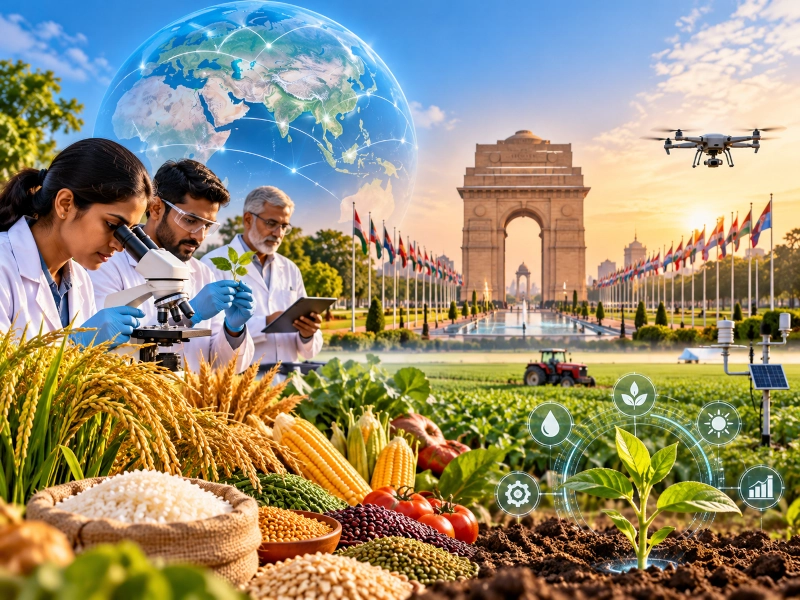
India will host the ICAR–CGIAR Science and Partnership Week 2027 in New Delhi from 12 to 17 April 2027, bringing together more than 5,000 delegates from across the world to advance agricultural research, technological innovation and international cooperation in food and farming systems.
The event was officially announced on 30 October 2026 by the Indian Council of Agricultural Research (ICAR) and CGIAR, an international agricultural research partnership working to strengthen food security, agricultural productivity and sustainable farming practices.
The six-day gathering will bring together agricultural scientists, researchers, farmers, policymakers, entrepreneurs, startups, businesses and international organisations to examine scientific innovations capable of addressing emerging challenges in global agriculture.
Organised jointly by ICAR, under the Department of Agricultural Research and Education (DARE) of the Ministry of Agriculture and Farmers Welfare, and CGIAR, the event will provide a platform for exchanging scientific knowledge and strengthening international partnerships.
The conference will also showcase India’s agricultural transformation and its growing contribution to agricultural research, innovation and technology sharing with developing countries.
India to Bring Global Agricultural Scientists and Researchers Together
The ICAR–CGIAR Science and Partnership Week 2027 is expected to become a major international gathering dedicated to agricultural science and innovation.
Scientists and research institutions from different countries will discuss developments in crop improvement, natural resource management, food systems, agricultural technology and sustainable farming.
The event will examine how scientific innovations already benefiting farmers can be expanded to reach larger agricultural communities.
Discussions will also focus on identifying research gaps and developing partnerships capable of translating laboratory discoveries into practical agricultural applications.
One of the principal objectives is to connect agricultural research institutions with farmers, governments and private enterprises to accelerate the adoption of technologies that improve productivity and agricultural resilience.
The conference will provide opportunities for researchers and industry representatives to explore partnerships addressing common challenges associated with agricultural production, food security and environmental sustainability.
India and CGIAR Complete More Than Five Decades of Agricultural Cooperation
India’s partnership with CGIAR extends over more than five decades and has contributed to significant developments in agricultural science and food production.
ICAR leads one of the world’s largest national agricultural research systems, while CGIAR operates through an international network of research centres focusing on agriculture, food systems and environmental sustainability.
According to the Ministry of Agriculture and Farmers Welfare, CGIAR comprises 15 research centres operating across more than 100 countries.
Ten CGIAR research centres currently work with India on agricultural research involving crops, water resources, livestock, fisheries, nutrition and agricultural policy.
The partnership has supported crop improvement, agricultural productivity, natural resource management and the development of scientific solutions for farming communities.
Research institutions such as the International Maize and Wheat Improvement Center (CIMMYT), International Rice Research Institute (IRRI) and International Crops Research Institute for the Semi-Arid Tropics (ICRISAT) have played important roles in India’s agricultural development.
Their collaboration with Indian research institutions has contributed to crop breeding, improved farming technologies and the exchange of agricultural knowledge.
Climate-Resilient Agriculture to Receive Major Attention
Climate resilience will be one of the principal subjects of discussion during the international gathering.
Agricultural systems face increasing challenges associated with irregular rainfall, drought, extreme temperatures, water scarcity and changing environmental conditions.
These challenges can influence crop productivity, soil quality and the availability of water for irrigation.
Researchers are developing crop varieties and farming practices that can help agricultural systems respond more effectively to changing climatic conditions.
The conference will examine opportunities for strengthening research into climate-resilient agriculture and improving the capacity of farmers to manage environmental stresses.
Scientific cooperation in this area could support the development of crop varieties capable of tolerating drought, heat and other adverse growing conditions.
The discussions will also explore sustainable agricultural practices that help protect natural resources while maintaining productivity.
Water Management and Soil Health Among Research Priorities
Water management and soil health will feature prominently in the conference agenda.
Agriculture accounts for a substantial proportion of freshwater use in many countries, making efficient irrigation and water conservation important priorities.
The event will examine technologies and scientific approaches intended to improve water-use efficiency and support sustainable agricultural production.
Researchers will also discuss soil management practices that help maintain fertility, improve nutrient availability and support long-term agricultural productivity.
Healthy soils are essential for crop production because they influence water retention, nutrient cycling and the biological processes supporting plant growth.
International collaboration in soil and water research can contribute to the development of farming practices adapted to different climatic and environmental conditions.
The conference will provide a platform for exchanging research findings and identifying practical technologies that can be adopted by farming communities.
India to Showcase Digital Agriculture and AgriStack
Digital agriculture will be another important focus of the ICAR–CGIAR Science and Partnership Week.
India intends to highlight its progress in agricultural digitalisation, including the development of AgriStack and other technology-enabled agricultural systems.
Digital agriculture involves the application of technologies such as satellite monitoring, remote sensing, data analytics and digital information platforms to improve agricultural decision-making.
Such technologies can help farmers access information concerning crops, weather conditions, soil characteristics and agricultural services.
India’s digital agriculture initiatives are intended to strengthen the delivery of agricultural information and support the development of more efficient farming systems.
The conference will provide opportunities for international researchers and policymakers to examine how digital technologies can be adapted to different agricultural environments.
The discussions will also address the role of innovation in improving access to agricultural knowledge and services.
Agricultural Mechanisation, Millets and Natural Farming to Feature
India will present developments in agricultural mechanisation, millet cultivation, natural farming and sustainable agricultural practices.
Agricultural mechanisation can improve the efficiency of farming operations by reducing labour-intensive activities and supporting timely cultivation, harvesting and post-harvest management.
India’s experience in promoting millets is relevant to global discussions on food security because several millet crops are adapted to relatively dry growing conditions.
The conference will examine opportunities for exchanging scientific knowledge about these crops and their contribution to diversified agricultural systems.
Natural farming and other sustainable agricultural practices will also form part of the discussions.
These approaches are being examined for their potential contributions to soil health, resource conservation and reduced dependence on certain external agricultural inputs.
The gathering will allow scientists and institutions to exchange research findings concerning the performance and suitability of different farming practices.
India to Expand Agricultural Cooperation with African Countries
An important objective of the 2027 gathering will be strengthening South–South cooperation in agricultural research and technology.
South–South cooperation refers to the exchange of knowledge, technology and development experience among countries of the Global South.
India plans to share agricultural innovations and scientific expertise with developing countries, particularly in Africa.
Dr. M. L. Jat, Secretary of the Department of Agricultural Research and Education and Director General of ICAR, highlighted the importance of expanding international cooperation and sharing India’s agricultural experience with other developing economies.
He identified climate-resilient agriculture, digital agriculture, agricultural mechanisation, millets and sustainable farming as areas offering opportunities for international collaboration.
India’s agricultural research institutions have already contributed to crop development and scientific cooperation beyond the country’s borders.
The Ministry highlighted an example involving groundnut genetic material originating in India, preserved and shared through ICRISAT, which contributed to the development of varieties cultivated in Malawi, Uganda, Mozambique and Zambia.
Such examples demonstrate how agricultural research and the exchange of genetic resources can support crop improvement across different countries.
Hyderabad Centre Supports International Agricultural Innovation
India’s contribution to South–South agricultural cooperation is also supported by the Centre of Excellence for South–South Cooperation in Agriculture in Hyderabad.
The centre facilitates the exchange of agricultural innovations and proven farming practices among countries in Asia, Africa and Latin America.
Its activities reflect the increasing importance of international partnerships in addressing agricultural challenges shared by developing countries.
The ICAR–CGIAR Science and Partnership Week will provide an additional opportunity to strengthen these connections.
International cooperation can help countries access agricultural technologies, scientific expertise and research findings that may otherwise require substantial resources to develop independently.
The sharing of agricultural innovations is particularly important for countries facing similar challenges involving climate variability, food security and resource limitations.
Startups and Private Enterprises to Participate in Agricultural Innovation
The conference will also examine the role of startups, private enterprises and public-private partnerships in agricultural research and development.
Agricultural startups are increasingly developing technologies for crop monitoring, precision farming, irrigation management, mechanisation and supply-chain efficiency.
Collaboration between research institutions and private enterprises can help translate scientific discoveries into products and services available to farmers.
The event will provide opportunities for researchers, entrepreneurs and businesses to discuss potential partnerships and identify technologies suitable for wider deployment.
Youth and women’s participation in agriculture will also be addressed during the conference.
The organisers intend to examine how scientific innovation, entrepreneurship and institutional support can contribute to greater participation in agricultural development.
The role of the media in communicating agricultural research and technological innovations will form another component of the discussions.
CGIAR Highlights India’s Role in Global Agricultural Research
Dr. Ismahane Elouafi, Executive Managing Director of CGIAR, highlighted India’s achievements in agricultural science and the importance of expanding international research cooperation.
She observed that India’s agricultural research institutions have demonstrated how scientific advances can be implemented on a large scale.
According to CGIAR, agricultural seeds and scientific knowledge originating in India are already contributing to farming systems in other parts of Asia and Africa.
The 2027 gathering is intended to build upon these achievements while identifying future priorities for international agricultural collaboration.
Dr. Elouafi also emphasised the importance of recognising the contribution of scientists and research institutions to improving human well-being and strengthening global food systems.
The conference will examine how partnerships can help ensure that agricultural research produces practical benefits for farmers and communities.
ICRISAT Highlights India’s Agricultural Transformation
Dr. Himanshu Pathak, Director General of ICRISAT, described India’s agricultural development as an example of the contribution of science, technology and international cooperation to food production.
India’s agricultural system has undergone substantial changes since the Green Revolution, moving from food shortages and dependence on imports towards becoming a major producer and exporter of agricultural commodities.
Scientific research, crop improvement programmes and institutional partnerships have contributed to these changes.
Dr. Pathak emphasised the importance of using the 2027 gathering to showcase India’s agricultural achievements while learning from scientific developments in other countries.
The event is expected to encourage collaborative research addressing emerging challenges in agriculture and food systems.
New Delhi to Host Second Edition After Nairobi
The first CGIAR Science Week was organised in Nairobi, Kenya, in April 2025.
The inaugural gathering provided a platform for presenting CGIAR’s research portfolio and discussing international cooperation in agricultural science.
The New Delhi edition in April 2027 will focus on translating scientific research into measurable improvements in agricultural systems.
It will also examine how international partnerships can strengthen South–South cooperation and accelerate the adoption of agricultural innovations.
The event will explore the contribution of agricultural science and technological innovation to India’s long-term development objectives under the Viksit Bharat 2047 vision.
The detailed programme and list of speakers are expected to be announced in the coming months.
Strengthening Global Food Security Through Scientific Cooperation
The ICAR–CGIAR Science and Partnership Week 2027 represents an opportunity for India to strengthen its engagement with the international agricultural research community.
The expected participation of more than 5,000 delegates reflects the importance attached to scientific cooperation in addressing global challenges involving food production, environmental sustainability and agricultural livelihoods.
The conference will bring together institutions working on crop improvement, water conservation, soil management, digital agriculture and sustainable farming technologies.
For India, the gathering will provide a platform to showcase its agricultural research capabilities while expanding scientific partnerships with other countries.
The emphasis on climate resilience, innovation and South–South cooperation also reflects the growing importance of agricultural research in addressing food security challenges across developing economies.
By connecting scientific institutions with farmers, governments and businesses, the event aims to accelerate the translation of agricultural research into practical solutions that support productivity, sustainability and the long-term resilience of farming communities.
References
1. Press Information Bureau — Ministry of Agriculture and Farmers Welfare
Publication date: 30 October 2026
Official announcement: India to Host ICAR–CGIAR Science and Partnership Week 2027 in New Delhi from April 12–17; Over 5,000 Delegates Expected to Participate.
https://www.pib.gov.in/PressReleseDetailm.aspx?PRID=2330371
2. Indian Council of Agricultural Research
Official institutional information: Partnership with CGIAR.
https://www.icar.gov.in/index.php/en/partnership-cgiar
3. Indian Council of Agricultural Research
Official institutional information: International Relations Division and international agricultural research cooperation.
https://icar.gov.in/en/international-relation
You may also like
-
India Brings Together Over 5,000 Global Delegates at ESTIC 2026
-
AI Journey 2026 Rescheduled to November 26–28 in Moscow, Indian AI Experts Among International Participants
-
IIT Bombay and Russia’s Rosatom Launch Atomic Hack India 2026 to Advance Nuclear Engineering and Digital Twin Technologies
-
Indian Experts to Participate in Moscow Startup Summit as Global Technology Leaders Gather in Russian Capital
-
One Voice – One Resolve – One India: Namami Bharatam Marks 150 Years of Vande Mataram Across the Nation
