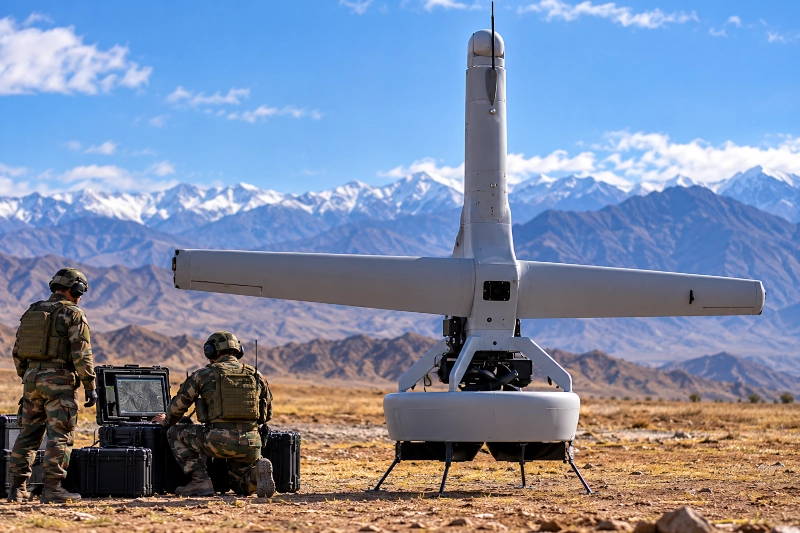
The Indian Air Force (IAF) is reportedly evaluating the possibility of procuring V-BAT unmanned aerial vehicles developed by American defence technology company Shield AI, as India expands its efforts to strengthen indigenous drone manufacturing and autonomous military capabilities. The aircraft has attracted interest because of its runway-independent operations, extended surveillance endurance and ability to operate in environments affected by electronic warfare.
According to defence reporting published on October 29, 2026, the IAF has shown interest in the V-BAT system following demonstrations of the platform to Indian military authorities. The aircraft is already associated with an Indian Army procurement programme officially announced by Shield AI in January 2026.
The reported Air Force interest comes as JSW Defence expands its industrial partnership with Shield AI to manufacture V-BAT aircraft in India. The collaboration, announced in November 2024, involves plans to establish advanced manufacturing, assembly and testing infrastructure capable of supporting the requirements of Indian armed forces and international customers.
Although the reported development indicates potential opportunities for expanding V-BAT’s presence within India’s defence establishment, neither the Ministry of Defence nor Shield AI has announced a confirmed Indian Air Force procurement contract. The reported evaluation should therefore be distinguished from the Indian Army’s officially documented selection of the platform.
Indian Air Force Reportedly Examines V-BAT for Surveillance Missions
The Indian Air Force’s reported interest in V-BAT reflects the growing importance of unmanned aircraft capable of providing persistent intelligence, surveillance and reconnaissance capabilities across diverse operational environments.
According to an October 29 report by IDRW, the aircraft has been demonstrated to both the Indian Army and Indian Air Force, with the latter reportedly considering the platform for its own operational requirements.
The report suggests that the Air Force may explore procurement arrangements involving JSW Defence and Shield AI, although no formal negotiations or acquisition decisions have been publicly confirmed by the organisations concerned.
V-BAT’s operational characteristics could make it relevant to surveillance requirements involving remote airfields, forward operating locations and other environments where conventional runway infrastructure may be limited.
Unlike conventional fixed-wing unmanned aircraft, V-BAT can take off and land vertically before transitioning to horizontal flight. This arrangement allows the system to combine the flexibility of vertical take-off operations with the endurance advantages associated with fixed-wing aircraft.
The platform’s potential applications include reconnaissance, target identification, border surveillance and monitoring activities in geographically challenging areas.
However, the selection of a drone for military service depends on several considerations, including operational performance, sensor capabilities, communication systems, reliability, maintenance requirements and procurement costs.
Any future Indian Air Force acquisition would therefore require an appropriate assessment of the platform against its operational requirements.
Indian Army Officially Selects V-BAT and Hivemind Autonomous Software
The Indian Army’s procurement of V-BAT represents the most significant officially confirmed Indian military development involving the aircraft.
On January 28, 2026, Shield AI announced that India had selected the company to supply V-BAT unmanned aircraft systems to the Indian Army.
The agreement includes V-BAT aircraft and licences for Shield AI’s Hivemind autonomous flight software, which will be integrated into the unmanned platform.
The contract also includes access to the Hivemind software development kit, allowing selected Indian partners to develop, evaluate and deploy autonomous capabilities tailored to domestic operational requirements.
According to Shield AI, the arrangement is intended to support India’s development of sovereign autonomous defence capabilities by providing software tools that can be adapted for Indian applications.
The company emphasised that the V-BAT platform can conduct surveillance missions without requiring conventional runways and is designed to operate in challenging environments where satellite navigation and communication systems may be disrupted.
These characteristics are relevant to military operations in remote regions, including mountainous terrain and maritime environments.
Shield AI did not publicly disclose the number of aircraft included in the Indian Army contract or its total financial value.
The January 2026 announcement nevertheless established a formal procurement relationship between Shield AI and the Indian Army, providing a foundation for the company’s expanding engagement with India’s defence sector.
JSW Defence and Shield AI Establish Indigenous Manufacturing Partnership
The development of domestic V-BAT manufacturing capabilities is based on a strategic partnership announced by JSW Defence and Shield AI on November 12, 2024.
Under the agreement, the companies committed to establishing manufacturing, assembly and testing infrastructure in India for the V-BAT Group 3 unmanned aircraft system.
The partnership is intended to support Indian military requirements while also positioning India as a potential manufacturing centre for international V-BAT customers.
JSW Group announced plans to invest approximately $90 million over two years, with around $65 million allocated during the initial 12 months.
The proposed investment covers manufacturing infrastructure, technology licensing, regulatory compliance systems, workforce training and the establishment of a domestic aerospace supply chain.
The agreement also envisages the development of local capabilities for aircraft assembly, testing, maintenance, repair and overhaul.
These activities could create opportunities for Indian companies involved in aerospace components, electronics, precision manufacturing and unmanned systems engineering.
The partnership represents an effort to establish manufacturing capabilities within India rather than relying exclusively on the import of fully assembled aircraft.
However, the official November 2024 announcement did not establish a specific percentage of indigenous content in the proposed aircraft.
The extent of localisation will depend on the development of domestic suppliers, the transfer or licensing of relevant manufacturing processes and the implementation of the industrial programme.
Manufacturing Facility Near Hyderabad Supports V-BAT Production Plans
JSW Defence has been developing manufacturing infrastructure at EMC Maheshwaram near Hyderabad as part of its expansion into advanced unmanned aircraft production.
The facility is intended to support the assembly, manufacturing and testing of V-BAT aircraft while strengthening the company’s participation in India’s defence aerospace sector.
The Hyderabad region has developed an established ecosystem of aerospace manufacturers, engineering firms, electronics companies and research institutions.
The location therefore provides access to industrial capabilities that could support unmanned aircraft manufacturing and associated technologies.
Domestic manufacturing could also help establish maintenance and technical support infrastructure closer to Indian military operators.
Such capabilities are important because unmanned aircraft systems require continuing access to spare parts, software updates, maintenance equipment and trained technical personnel.
The October 29 defence report indicates that manufacturing activities and initial aircraft assembly are progressing at the facility.
However, specific reported production quantities, annual manufacturing capacity and operational commissioning milestones have not been independently established through the official Shield AI announcements examined for this article.
The confirmed development remains the strategic manufacturing agreement and the companies’ commitment to establishing Indian production capabilities.
V-BAT Combines Vertical Take-Off with Fixed-Wing Endurance
One of V-BAT’s distinguishing technical characteristics is its ability to operate as a vertical take-off and landing aircraft while using a fixed-wing configuration for sustained flight.
The aircraft employs a ducted-fan propulsion system that allows it to take off and land vertically within a relatively small operating area.
After take-off, the aircraft transitions into horizontal flight, enabling it to conduct surveillance and reconnaissance missions without requiring a conventional runway.
According to Shield AI’s official technical specifications, V-BAT has a wingspan of approximately 3.8 metres and a maximum gross take-off weight of 75 kilograms.
The aircraft can carry payloads weighing up to approximately 18.1 kilograms, depending on mission configuration and operating conditions.
Shield AI states that the platform provides an endurance exceeding 12 hours when equipped with an electro-optical and infrared sensor payload.
This endurance allows the aircraft to remain airborne for extended surveillance missions without requiring frequent recovery and relaunch.
The manufacturer also states that the aircraft can be deployed by a two-person team and prepared for operations in less than 30 minutes.
These characteristics could make the platform suitable for military units requiring mobile surveillance capabilities with comparatively limited ground-support infrastructure.
Compact Launch Requirements Could Support Forward Military Operations
The V-BAT’s runway-independent design could provide advantages in operational environments where conventional aircraft launch facilities are unavailable or difficult to maintain.
Shield AI states that the aircraft requires a landing area measuring approximately 4.6 metres by 4.6 metres.
This compact operating footprint makes it possible to conduct missions from confined locations that would be unsuitable for many conventional fixed-wing unmanned aircraft.
The aircraft’s design could therefore support surveillance operations from forward military positions, temporary operating sites and appropriately equipped naval platforms.
For India’s armed forces, the ability to deploy unmanned aircraft without conventional runways is relevant to regions characterised by difficult terrain and limited transport infrastructure.
Mountainous locations, remote border regions and maritime environments can impose logistical constraints on conventional aviation operations.
Unmanned systems capable of operating from small areas may provide additional flexibility for surveillance and reconnaissance.
However, practical deployment will depend on weather conditions, available communications, terrain, mission requirements and the operational limitations of the aircraft.
Hivemind Artificial Intelligence Supports Autonomous Flight Operations
A central component of Shield AI’s V-BAT programme is the company’s Hivemind autonomous flight software.
The technology is designed to enable unmanned aircraft to perform certain flight and mission functions without continuous direct control from a human operator.
According to Shield AI, Hivemind allows compatible autonomous platforms to process information from onboard sensors, make decisions within programmed operational parameters and adapt to changing environmental conditions.
The company has developed the technology to support operations in environments where satellite navigation signals or communication links may be degraded or unavailable.
This capability is particularly relevant to military applications involving electronic warfare, navigation interference and disrupted communication networks.
Conventional unmanned aircraft often depend heavily on satellite navigation and communication systems for guidance and remote operation.
Disruption of these systems can affect mission performance or limit the ability of operators to control the aircraft.
Autonomous navigation and mission-management capabilities can potentially reduce dependence on continuous communication links.
However, the precise capabilities available in any operational deployment depend on the aircraft’s configuration, software integration, sensor package and authorised mission parameters.
Autonomous operation also does not necessarily imply that all mission decisions are made without human oversight.
The level of human supervision and control remains an important consideration in military applications involving autonomous systems.
Indian Army Agreement Includes Autonomous Software Development Capabilities
The Indian Army’s January 2026 agreement with Shield AI extends beyond the procurement of unmanned aircraft.
The inclusion of Hivemind software development kit licences provides an opportunity for selected Indian partners to work on autonomous technologies tailored to domestic requirements.
This aspect of the programme is particularly important because autonomy software is becoming an increasingly significant component of modern unmanned aircraft systems.
The ability to modify and develop mission software can provide greater flexibility in adapting platforms for different operating conditions.
For Indian technology companies and defence research organisations, access to suitable development tools could support work involving autonomous navigation, sensor integration and mission-specific applications.
The programme may also encourage collaboration between aerospace manufacturers, artificial intelligence developers and defence electronics companies.
However, software licensing should not automatically be interpreted as unrestricted ownership of the underlying proprietary technology.
The scope of development rights, technology access and operational independence will depend on the terms of the relevant agreements.
The officially confirmed arrangement nevertheless represents an important component of India’s expanding cooperation with international developers of autonomous defence technologies.
Indian Air Force Expands Engagement with Domestic Drone Industry
The reported interest in V-BAT coincides with the Indian Air Force’s broader efforts to strengthen its unmanned and autonomous systems capabilities.
On October 21, 2026, the IAF conducted an industry outreach programme at Vigyan Bhawan in New Delhi to communicate its long-term requirements to Indian technology companies.
The programme was chaired by Air Marshal Premkumar K, Director General of Weapon Systems at Air Headquarters, and brought together approximately 100 representatives from drone manufacturers, startups, micro, small and medium enterprises and other industry partners.
According to the Ministry of Defence, the event provided a formal platform for the Air Force to explain its operational requirements and technological priorities in unmanned systems.
The discussions were based on the IAF Unmanned and Autonomous Systems Roadmap, which had been released during Dronathon 2026 at Pokhran on September 14.
The roadmap reflects the Air Force’s increasing emphasis on autonomous technologies, advanced sensors, unmanned platforms and their integration into future military operations.
Although the October 21 event did not identify V-BAT as a selected system, it demonstrates the IAF’s continuing engagement with the domestic unmanned aircraft industry.
The programme also highlights opportunities for Indian manufacturers to develop technologies aligned with the Air Force’s future operational requirements.
Dronathon 2026 Demonstrates Growing Interest in Autonomous Military Systems
The Indian Air Force organised Dronathon 2026 at the Pokhran Field Firing Range in Rajasthan from September 14 to 16.
The event was intended to provide Indian defence companies and technology developers with an opportunity to demonstrate unmanned aerial systems and counter-drone technologies under realistic operational conditions.
More than 20 companies, startups, public sector enterprises and other organisations participated in the programme.
The demonstrations covered surveillance and reconnaissance, autonomous operations, drone swarms, electronic warfare and technologies associated with countering unmanned aircraft.
According to the Ministry of Defence, the Air Force considers unmanned systems an important complement to conventional manned aviation.
Such platforms can provide additional operational flexibility, extend surveillance coverage and support military activities that may be difficult or inefficient to conduct exclusively with crewed aircraft.
The programme also reinforced the Air Force’s interest in working with domestic manufacturers and encouraging indigenous technological development.
The reported consideration of V-BAT should be viewed within this broader context of expanding unmanned aircraft capabilities, rather than as an independently confirmed procurement decision.
V-BAT Could Support Persistent Border and Maritime Surveillance
The technical capabilities of V-BAT make it relevant to several surveillance applications that are important to India’s defence requirements.
Extended flight endurance can support persistent observation of areas where continuous monitoring is necessary.
Vertical take-off and landing capabilities can reduce dependence on established airfields and provide additional flexibility in selecting operating locations.
The platform’s electro-optical and infrared sensors can support surveillance under different lighting conditions, while compatible mission equipment may provide additional reconnaissance functions.
For border surveillance, such capabilities could assist military units in monitoring difficult terrain and identifying activities within designated operating areas.
In maritime environments, unmanned aircraft can support situational awareness by observing coastal waters, monitoring vessel movements and assisting with reconnaissance missions.
Shield AI also offers its ViDAR passive wide-area search technology for V-BAT, enabling the platform to support surveillance over maritime and land environments.
However, the precise sensor configurations that may be acquired by Indian military operators have not been fully disclosed in the official announcements.
The suitability of individual payloads would depend on operational requirements, aircraft configuration and procurement decisions.
Indigenous Manufacturing Could Strengthen India’s Defence Aerospace Ecosystem
The Shield AI–JSW Defence partnership is relevant to India’s efforts to expand domestic manufacturing of sophisticated unmanned aircraft systems.
Modern military drones combine several advanced technologies, including aerospace structures, propulsion systems, communications equipment, sensors, electronics and autonomous software.
Manufacturing such platforms requires specialised industrial capabilities and adherence to demanding quality and reliability requirements.
The establishment of domestic production facilities could create opportunities for Indian suppliers to participate in the manufacture and integration of these systems.
The programme may also support workforce development in aerospace assembly, testing, software integration and maintenance.
Over time, the expansion of local supply chains could strengthen India’s ability to support unmanned aircraft operations and reduce dependence on imported finished equipment.
However, the extent of these benefits will depend on the actual localisation achieved, the capabilities transferred to Indian manufacturers and the commercial scale of production.
Domestic assembly alone does not necessarily establish complete technological self-reliance.
The development of indigenous subsystems, advanced software capabilities and local maintenance infrastructure will remain important considerations as the manufacturing programme progresses.
India’s Autonomous Defence Capabilities Continue to Expand
The growing interest in platforms such as V-BAT reflects wider changes in military aviation and surveillance technology.
Unmanned aircraft are increasingly being developed to perform missions requiring extended endurance, persistent observation and operations in difficult or hazardous environments.
Advances in artificial intelligence, onboard computing and sensor integration are also expanding the range of functions that unmanned aircraft can perform with reduced operator workload.
For India’s armed forces, these developments create opportunities to strengthen surveillance capabilities while complementing existing manned aircraft and ground-based systems.
The Indian Army’s confirmed V-BAT acquisition represents one example of this transition.
The Indian Air Force’s broader unmanned systems roadmap and industry engagement activities demonstrate that autonomous technologies are also becoming increasingly important in its future capability planning.
Meanwhile, the JSW Defence–Shield AI manufacturing partnership provides an industrial framework for producing V-BAT aircraft within India.
Together, these developments illustrate the growing relationship between defence procurement, domestic manufacturing and advanced autonomous software.
Reported IAF Interest Highlights Potential for Wider V-BAT Adoption
The reported evaluation of Shield AI’s V-BAT by the Indian Air Force represents a possible extension of a platform already selected for the Indian Army.
If the Air Force eventually chooses to pursue procurement, the availability of domestic manufacturing infrastructure through JSW Defence could become relevant to the programme.
Common platforms across military services may also provide opportunities for cooperation in maintenance, operator training and logistical support, depending on the configurations selected and the arrangements established by the armed forces.
However, no official Indian Air Force contract, confirmed order quantity or procurement schedule has been announced.
The October 29 report therefore represents an indication of possible future interest rather than evidence of a completed acquisition.
The confirmed developments are the Indian Army’s selection of V-BAT and Hivemind software, the strategic manufacturing partnership between Shield AI and JSW Defence, and the Indian Air Force’s continuing engagement with the domestic unmanned systems industry.
As India’s armed forces expand their autonomous capabilities, the combination of indigenous manufacturing, advanced surveillance platforms and artificial intelligence technologies is expected to remain an important area of defence development.
The potential involvement of the Indian Air Force in the V-BAT programme will depend on future operational evaluations, procurement decisions and official agreements.
References
1. Shield AI — Official Corporate Announcement, January 28, 2026
“Shield AI Selected to Provide V-BAT Unmanned Aircraft Systems and Hivemind Autonomy Software to the Indian Army.”
The announcement confirms the Indian Army’s selection of V-BAT aircraft and the associated Hivemind autonomous software licensing arrangement.
Official Source: https://shield.ai/shield-ai-selected-to-provide-v-bat-unmanned-aircraft-systems-and-hivemind-autonomy-software-to-the-indian-army/
2. Shield AI and JSW Defence — Official Partnership Announcement, November 12, 2024
“JSW Defence & Shield AI Forge Strategic Partnership to Bring Cutting-Edge Military Aircraft Technology to India.”
The announcement confirms plans for approximately $90 million in investment and the establishment of Indian manufacturing, assembly, testing and support capabilities for V-BAT.
Official Source: https://shield.ai/jsw-defence-shield-ai-forge-strategic-partnership-to-bring-cutting-edge-military-aircraft-technology-to-india/
3. Ministry of Defence, Government of India — Official Press Release, October 21, 2026
“Indian Air Force Engages Industry Outreach Programme on Unmanned and Autonomous Systems Roadmap on 21 Oct 26.”
Press Information Bureau, Government of India. The release confirms the Air Force’s engagement with approximately 100 industry representatives and its long-term unmanned systems capability requirements.
Official Source: https://www.pib.gov.in/PressReleseDetailm.aspx?PRID=2326184&lang=1®=3
4. Ministry of Defence, Government of India — Official Press Release, September 14, 2026
“Indian Air Force Dronathon – 2026.”
Press Information Bureau, Government of India. The release confirms the organisation of Dronathon 2026 at Pokhran and the participation of Indian unmanned systems developers.
Official Source: https://www.pib.gov.in/PressReleasePage.aspx?PRID=2310246&lang=1®=19
5. Shield AI — Official V-BAT Technical Information
The manufacturer’s technical documentation provides details concerning V-BAT’s propulsion system, vertical take-off capabilities, endurance, payload capacity, operating requirements and surveillance applications.
Official Source: https://shield.ai/v-bat/
6. IDRW — Defence Industry Reporting, October 29, 2026
“IAF in Talks With Shield AI to Procure V-BAT Unmanned Aircraft.”
The report discusses the Indian Air Force’s possible interest in V-BAT and the expanding manufacturing relationship between JSW Defence and Shield AI. The reported IAF discussions have not been independently confirmed through an official procurement announcement.
Source: https://idrw.org/iaf-in-talks-with-shield-ai-to-procure-v-bat-unmanned-aircraft/
You may also like
-
INS Samarthak: India’s Indigenous Multi-Purpose Warship Designed to Serve as a Mothership for Naval Drones
-
Indian Defence Firm Tonbo Imaging Secures European EO/IR Seeker Export Order with €13 Million Potential
-
Japan Explores Indian Missile Testing Facilities for Long-Range Anti-Ship Weapons and Attack Drones
-
L&T and BAE Systems Begin Production of BvS10 Sindhu All-Terrain Vehicles for Indian Army at Hazira
-
HAL Expands Aerospace Component Procurement, Strengthening Make in India Manufacturing Ecosystem
