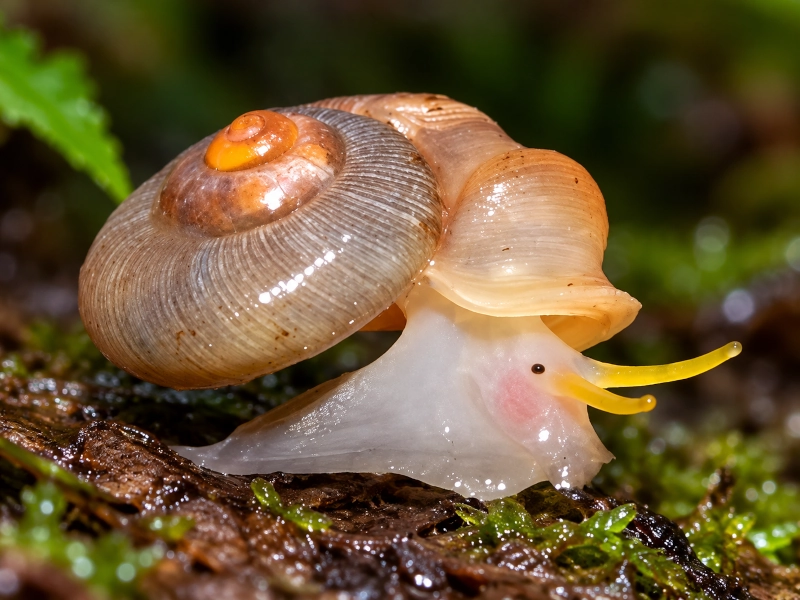
Scientists have discovered and formally described a new species of microscopic land snail in the northern Western Ghats of Maharashtra, adding another species to India’s documented biodiversity. The snail, scientifically named Dicharax tilariensis, was discovered in the semi-evergreen forests of the Tilari region in Kolhapur district and is currently known only from this geographical area.
The discovery was documented in a research paper published on October 24, 2026, in the international scientific journal Journal of Conchology, published by the Conchological Society of Great Britain and Ireland. The research was conducted by Amrut Bhosale, Tejas Thackeray and Akshay Khandekar, with the scientists examining the snail’s shell structure, external morphology and specialised anatomical features to establish its identity as a distinct species.
The study is particularly significant because it demonstrates that the northern Western Ghats continue to harbour previously undocumented organisms, including tiny invertebrates that are rarely encountered during conventional wildlife surveys.
The new species belongs to the genus Dicharax, a group of small terrestrial gastropod molluscs distinguished by specialised shell structures and an operculum, a protective structure that closes the shell opening.
New Species Discovered in Tilari’s Semi-Evergreen Forests
The specimens used to describe Dicharax tilariensis were collected from the Tilari Nagar region of Kolhapur district, particularly near Swapnavel Point.
The collection locality lies within the northern Western Ghats at an elevation of approximately 700–800 metres above sea level.
The region supports semi-evergreen forests characterised by seasonal rainfall, substantial vegetation cover and moist forest-floor environments.
These conditions create specialised habitats for small terrestrial invertebrates, including land snails that depend on moisture and sheltered microhabitats for survival.
Unlike larger wildlife species that can be observed relatively easily, microscopic land snails often remain concealed within leaf litter, decaying vegetation and the upper layers of moist soil.
Their small size and dependence on specific environmental conditions make them difficult to document without systematic field surveys and detailed laboratory examination.
The discovery of Dicharax tilariensis demonstrates the importance of investigating these lesser-studied habitats when assessing the biodiversity of the Western Ghats.
Researchers Examine Twelve Specimens to Establish New Species
The scientific description of Dicharax tilariensis was based on 12 specimens collected from the Tilari region.
The researchers examined the specimens to determine whether they represented an existing species or a previously undocumented member of the genus.
Taxonomic identification required detailed comparison of the snail’s shell morphology with that of closely related species already described from the Western Ghats and other parts of India.
The scientists identified several distinctive characteristics that separated the specimens from their known relatives.
These included the shape and elevation of the shell’s spire, the arrangement of ribs across different shell regions and the structure of the operculum.
The researchers also documented the living animal and examined its radula, a specialised feeding structure found in molluscs.
The combination of these morphological characteristics provided the basis for formally recognising Dicharax tilariensis as a new species.
The study illustrates the continuing importance of detailed anatomical examination in biological classification, particularly for small organisms whose external appearance may closely resemble that of related species.
Distinctive Shell Structure Helps Identify the Species
One of the most important findings of the study concerns the unusual structural characteristics of the snail’s shell.
According to the scientific description, Dicharax tilariensis possesses an elevated spire and a distinctive arrangement of ribs across different regions of its shell.
The first region of the shell, identified as R1 in the taxonomic description, contains fine or irregular ribs that gradually become stronger and more widely spaced.
The second region, R2, is characterised by elevated, widely spaced and blunt ribs.
The third region, R3, displays a pronounced sharp swelling that helps distinguish the species from closely related members of the genus.
Another identifying characteristic is found on the inner surface of the operculum, which possesses a prominent nipple-like projection.
The operculum functions as a protective structure, allowing the snail to close the shell opening when its body is withdrawn.
The arrangement of shell ribs, the shape of the swelling and the internal structure of the operculum were among the important features used to establish the taxonomic identity of the new species.
These characteristics distinguish Dicharax tilariensis from other southern Indian species of the genus, including Dicharax devraivasi, a species previously described from the northern Western Ghats.
Discovery Adds to Known Diversity of the Genus Dicharax
The genus Dicharax includes small terrestrial snails belonging to the family Cyclophoridae and subfamily Alycaeinae.
Members of this group possess specialised shell structures that are important for distinguishing individual species.
The identification of Dicharax tilariensis is particularly noteworthy because another species of the same genus, Dicharax devraivasi, was described from sacred groves in the northern Western Ghats in 2025.
That earlier research was also conducted by scientists associated with the present discovery.
The description of Dicharax devraivasi established the presence of the genus in the northern Western Ghats and extended its documented geographical distribution within the mountain range.
The discovery of Dicharax tilariensis provides further evidence that the region supports multiple species of these specialised land snails.
It also suggests that additional systematic surveys could reveal further diversity within habitats that have received relatively little scientific attention.
Although the new species is currently known only from Tilari, additional field investigations would be required to establish its complete geographical distribution.
Tiny Land Snails Form Part of Complex Forest Ecosystems
Land snails are important components of terrestrial biodiversity, although they receive considerably less public attention than mammals, birds, reptiles and larger invertebrates.
Many species inhabit moist forest-floor environments containing decomposing leaves, organic debris, vegetation and soil.
These habitats support complex ecological interactions involving microorganisms, fungi, invertebrates and other organisms associated with nutrient cycling and decomposition.
Land snails can participate in these ecological processes through their feeding activities and interactions with the surrounding environment.
They also form part of food webs involving various invertebrate predators and other animals.
Because many small land snails depend on moisture and suitable microhabitats, changes in forest-floor conditions can affect their survival and distribution.
However, the precise ecological role and feeding behaviour of Dicharax tilariensis have not yet been comprehensively established.
Further research will be necessary to understand its population structure, habitat requirements, reproductive biology and interactions with other organisms.
Western Ghats Continue to Reveal Previously Unknown Biodiversity
The Western Ghats are recognised as one of the world’s important biodiversity hotspots, supporting numerous endemic plants, animals and microorganisms.
The mountain range extends along India’s western peninsula and contains diverse ecosystems, including evergreen forests, semi-evergreen forests, moist deciduous forests, grasslands and specialised high-altitude habitats.
Its varied rainfall patterns, elevations and geographical conditions have contributed to the evolution of many organisms with restricted distributions.
While the region is widely known for its distinctive mammals, amphibians, reptiles and birds, its invertebrate biodiversity remains incompletely documented.
Small terrestrial molluscs are among the groups that require additional scientific investigation.
Their limited mobility and dependence on particular environmental conditions can contribute to geographically restricted distributions.
The discovery of Dicharax tilariensis illustrates how detailed surveys of small forest habitats can reveal species that have remained undocumented despite the broader scientific attention given to the Western Ghats.
It also demonstrates the importance of examining biodiversity at multiple scales, from large protected landscapes to individual forest-floor microhabitats.
Tilari Forests Emerge as Important Habitat for Lesser-Known Wildlife
The Tilari region of Maharashtra forms part of the northern Western Ghats and supports forest habitats that are important for a variety of plant and animal species.
The region’s semi-evergreen vegetation and seasonal moisture conditions create habitats suitable for specialised terrestrial organisms.
The discovery of Dicharax tilariensis adds to the scientific importance of these forests by documenting another species currently known only from the area.
The finding also highlights the need to understand biodiversity beyond the larger and more conspicuous wildlife species traditionally associated with conservation programmes.
Forest-floor organisms can be particularly vulnerable to changes in moisture availability, vegetation cover and microhabitat structure.
Activities that disturb leaf litter, alter drainage patterns or significantly modify the forest canopy can affect the environmental conditions required by moisture-dependent species.
However, the newly described snail has not yet undergone a comprehensive conservation assessment, and its population size and specific threats remain insufficiently documented.
Scientific surveys and habitat studies would therefore be necessary before assigning a conservation status or determining the extent of any threats facing the species.
Scientific Taxonomy Provides Foundation for Wildlife Conservation
The formal description of a new species is an important step in understanding and conserving biodiversity.
Before an organism can be effectively studied or included in conservation assessments, scientists must establish its identity and distinguish it from closely related species.
Taxonomic research provides this foundation through the examination of physical characteristics, anatomical structures, geographical distribution and, where appropriate, molecular evidence.
In the case of Dicharax tilariensis, the researchers established its identity through detailed morphological comparisons.
The scientific description provides information that other researchers can use to recognise the species during future biodiversity surveys.
Such documentation is particularly valuable for organisms that are difficult to identify through ordinary visual observation.
Once a species has been formally described, researchers can investigate its distribution, population trends, ecological requirements and potential conservation needs.
The discovery therefore represents an important starting point for further scientific investigation rather than the completion of research into the organism.
Discovery Highlights Importance of Protecting Microhabitats
Wildlife conservation is frequently associated with protecting large mammals, birds and other prominent species. However, forest ecosystems also depend on an enormous diversity of smaller organisms.
Microscopic land snails represent an important but comparatively understudied component of this biodiversity.
Their habitats may consist of small patches of moist soil, accumulated leaf litter, decaying wood and sheltered spaces beneath vegetation.
These environments can be affected by changes in land use, forest disturbance, altered rainfall patterns and the loss of vegetation cover.
Protecting forest ecosystems therefore involves maintaining the environmental conditions necessary for organisms of different sizes and ecological requirements.
The discovery of Dicharax tilariensis reinforces the scientific value of conserving relatively undisturbed forest habitats and conducting detailed surveys of lesser-known invertebrate groups.
It also highlights the importance of documenting species before environmental changes potentially alter or eliminate the habitats in which they occur.
Indian Researchers Expand Knowledge of Western Ghats Biodiversity
The discovery reflects the contributions of Indian researchers to the scientific documentation of the Western Ghats.
Amrut Bhosale, Tejas Thackeray and Akshay Khandekar combined field surveys with detailed taxonomic examination to establish the identity of the new species.
Their research contributes to a growing body of scientific literature documenting previously unknown terrestrial molluscs from the region.
The study also builds upon earlier research into Dicharax species from the northern Western Ghats.
Such work is essential for developing more comprehensive inventories of India’s biodiversity.
The documentation of small and geographically restricted organisms can provide valuable information about patterns of endemism, habitat diversity and biological evolution.
Continued collaboration between field researchers, taxonomists, research institutions and conservation organisations will be important for identifying and studying additional species.
New Discovery Reinforces the Western Ghats’ Conservation Significance
The formal identification of Dicharax tilariensis adds another species to the documented biodiversity of Maharashtra’s northern Western Ghats.
Its discovery in the Tilari forests demonstrates that even relatively small areas can support organisms with distinctive anatomical characteristics and potentially restricted geographical distributions.
The research also highlights how much remains to be understood about India’s terrestrial invertebrates.
While the Western Ghats have been extensively studied for several major groups of plants and animals, microscopic organisms continue to reveal previously undocumented diversity.
The scientific description published on October 24, 2026, provides a foundation for future research into the new snail’s ecology, distribution and conservation requirements.
As scientists continue investigating the forest ecosystems of the Sahyadri mountains, discoveries such as Dicharax tilariensis reinforce the importance of preserving biodiversity at every level, including the smallest and least visible forms of wildlife.
References
1. Bhosale, Amrut; Thackeray, Tejas; and Khandekar, Akshay — Original Scientific Research
“Dicharax tilariensis n. sp., a new micro-snail from the northern Western Ghats, India (Caenogastropoda: Cyclophoridae: Alycaeinae).”
Journal of Conchology, Volume 45, Issue 6. Published October 24, 2026.
Publisher: Conchological Society of Great Britain and Ireland.
Official Scientific Publication: https://conchsoc.org/jconch-45-6
DOI: https://doi.org/10.61733/jconch/4591
2. Bhosale, Amrut; Thackeray, Tejas; Yadav, Omkar; and Khandekar, Akshay — Earlier Scientific Research
“A new micro-snail species of the genus Dicharax Kobelt & Möllendorff, 1900 (Caenogastropoda: Cyclophoridae: Alycaeinae), from sacred groves in the northern Western Ghats, India.”
Journal of Conchology, Volume 45, Issue 3. Published April 5, 2025.
DOI: https://doi.org/10.61733/jconch/4543
3. The Times of India — Discovery Report
“New Microscopic Snail Species Discovered in Kolhapur’s Tilari.”
Published October 29, 2026.
Source: https://timesofindia.indiatimes.com/city/kolhapur/new-microscopic-snail-species-discovered-in-kolhapurs-tilari/articleshow/135277911.cms
You may also like
-
Thousands of Butterflies Migrate Across Tamil Nadu as Northeast Monsoon Arrives
-
Indian Researcher Surveys Over 3,000 Western Ghats Frogs to Track Deadly Amphibian Fungus
-
Zoological Survey of India Discovers Three New Centipede Species in Western Ghats of Kerala and Karnataka
-
Scientists Document 3,261 Flowering Plant Species in Agasthyamalai Biosphere Reserve, Including 1,018 Indian Endemics
-
Scientists Discover Two Rare Blind Fish Species in Assam’s Underground Waters, Revealing Hidden Biodiversity
