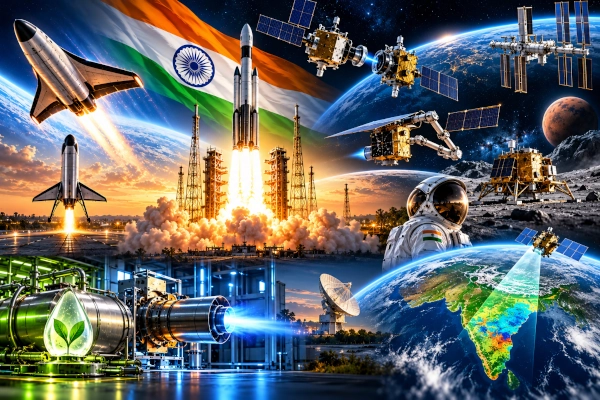
India is advancing its indigenous space technology capabilities through research and development in reusable launch vehicles, advanced propulsion systems, autonomous spacecraft docking, orbital servicing and human spaceflight technologies. These developments form part of the country’s long-term strategy to reduce the cost of space missions, strengthen technological self-reliance and expand its participation in the global space economy.
The Government of India highlighted these developments in a comprehensive backgrounder published by the Press Information Bureau on 28 October 2026. The document examines technological achievements made by the Indian Space Research Organisation (ISRO), the Department of Space and India’s emerging private space industry, while outlining programmes expected to support the next generation of Indian space missions.
The technologies covered include reusable rockets, electric propulsion, green propellants, semicryogenic engines, radioisotope-based power systems, autonomous spacecraft docking and future in-orbit servicing capabilities. Several of these technologies have already undergone successful experimental demonstrations, while others remain under research, development or testing.
The government has identified these advanced technologies as important components of India’s future space exploration programmes, including Gaganyaan, the proposed Bharatiya Antariksh Station, lunar exploration and increasingly sophisticated satellite missions.
India Strengthens Reusable Launch Vehicle Technologies
One of India’s principal objectives is to develop launch vehicles capable of recovering and reusing major components after completing space missions. Conventional expendable rockets discard their stages during flight, requiring fresh hardware for subsequent launches. Reusable launch systems are designed to recover selected components, potentially reducing manufacturing expenditure, improving launch availability and lowering the recurring cost of accessing space.
ISRO has been developing technologies required for reusable space transportation through experimental programmes involving autonomous guidance, atmospheric flight, precision navigation and controlled landing. The agency has made progress through its Pushpak Reusable Launch Vehicle technology demonstrator, which has successfully completed a series of autonomous runway landing experiments.
The first Reusable Launch Vehicle Landing Experiment was conducted on 2 April 2023, followed by the second experiment on 22 March 2024 and the third on 23 June 2024. These experiments demonstrated autonomous landing capabilities under different operating conditions and provided valuable data for developing reusable aerospace systems.
The third experiment, designated RLV-LEX-03, demonstrated the vehicle’s ability to execute an autonomous landing under challenging cross-range and wind conditions. The successful tests established important technological capabilities involving navigation, flight control, landing guidance and automated recovery procedures.
However, the Pushpak experiments involved a winged technology demonstrator rather than the recovery of an operational orbital launch vehicle. Further development will be necessary before these capabilities can be integrated into a fully operational reusable space transportation system.
Next Generation Launch Vehicle to Expand India’s Heavy-Lift Capabilities
India’s reusable launch technology ambitions are closely linked to the development of the Next Generation Launch Vehicle (NGLV), a major programme approved by the Union Cabinet in September 2024.
The government sanctioned ₹8,240 crore for the NGLV development programme, covering technological development, three developmental flights, essential infrastructure, programme management and launch campaign activities.
The NGLV is being designed to place approximately 30 tonnes of payload into Low Earth Orbit in its expendable configuration. This would represent a substantial increase over the approximately 10-tonne Low Earth Orbit payload capability of India’s existing LVM3 launch vehicle.
ISRO is also pursuing a partially reusable configuration of the NGLV, with a planned payload capability of approximately 14 tonnes to Low Earth Orbit. The reusable architecture is intended to improve launch economics while supporting future missions requiring larger spacecraft and more frequent access to space.
The programme is expected to contribute to India’s plans for establishing the Bharatiya Antariksh Station, undertaking advanced lunar missions and expanding commercial satellite launch activities. The NGLV remains under development, and its projected capabilities have not yet been demonstrated through operational launches.
Indigenous Electric Propulsion Technology Advances Satellite Efficiency
India is making progress in electric propulsion systems designed to improve the efficiency of satellite operations and reduce dependence on large quantities of conventional chemical propellants.
Electric propulsion systems use electrical energy to accelerate charged particles or other propellant material, generating thrust with considerably higher propellant efficiency than many conventional chemical propulsion technologies. Although these systems generally produce relatively low thrust, they can operate over extended periods and are particularly suitable for orbital adjustments, station keeping and long-duration space missions.
On 27 March 2025, ISRO completed a 1,000-hour life test of its indigenously developed 300-millinewton stationary plasma thruster. The experiment demonstrated a specific impulse at least six times greater than that of conventional chemical propulsion systems, according to the government’s technical assessment.
Specific impulse measures how efficiently a propulsion system uses its propellant. A higher specific impulse allows spacecraft to perform certain manoeuvres using less propellant, potentially reducing launch mass or permitting satellites to carry additional equipment.
ISRO plans to validate the plasma propulsion technology aboard its Technology Demonstration Satellite, TDS-01. Successful operational validation could support future Indian satellite missions requiring efficient orbit raising, orbital maintenance and extended service lifetimes.
The development of indigenous electric propulsion systems is also relevant to India’s expanding commercial satellite manufacturing industry, where improved efficiency and lower spacecraft mass can contribute to operational and economic advantages.
India Develops Green Propulsion and Semicryogenic Rocket Engines
The government has identified environmentally preferable propulsion technologies as another important area of research within India’s space programme. These technologies aim to improve propulsion efficiency, reduce certain handling hazards and develop alternatives to conventional propellant combinations.
One of ISRO’s major programmes involves developing semicryogenic propulsion systems using liquid oxygen and rocket-grade kerosene. The agency has been investigating ISROSENE, an indigenous rocket-grade kerosene intended for use in future high-thrust launch vehicle engines.
Semicryogenic engines use a cryogenic oxidiser, such as liquid oxygen, together with a fuel stored at comparatively higher temperatures. This arrangement can offer advantages in propulsion performance, operational handling and engine design for large launch vehicles.
ISRO is developing a 200-tonne-thrust semicryogenic engine as part of its efforts to strengthen India’s heavy-lift launch capabilities. The programme is expected to contribute to the development of more powerful and efficient launch systems suitable for future commercial and exploration missions.
Indian private-sector enterprises are also participating in advanced propulsion research. Bengaluru-based Bellatrix Aerospace has developed a one-newton-class green monopropellant thruster under the Defence Research and Development Organisation’s Technology Development Fund programme.
The thruster is intended for microsatellite attitude control and orbital maintenance. Elements of the system’s functionality were demonstrated in orbit through a payload launched aboard ISRO’s PSLV-C58 mission in January 2024.
These activities demonstrate the increasing participation of Indian private companies in specialised spacecraft propulsion technologies, although individual systems must undergo appropriate testing and qualification before broader operational adoption.
Manastu Space Receives ₹116 Crore Support for Indigenous Green Propulsion
India’s emerging deeptech industry is contributing to advanced satellite propulsion technologies through companies such as Navi Mumbai-based Manastu Space Technologies.
On 26 October 2026, the Technology Development Board under the Department of Science and Technology announced an agreement to provide ₹116 crore in financial assistance to Manastu Space under the Research Development and Innovation Fund.
The supported project has a total estimated cost of ₹277.63 crore and focuses on developing scalable green propulsion systems for satellites and launch vehicles. The programme covers propulsion requirements ranging from five millinewtons to 300 newtons, enabling potential applications across different classes of spacecraft.
Manastu Space is developing propulsion systems based on hydrogen peroxide formulations and specialised catalyst technologies. These systems are intended to provide alternatives to certain conventional satellite propellants while supporting operational efficiency and safety.
The company has previously demonstrated elements of its propulsion technology in space. The newly supported programme is intended to advance further engineering, testing, manufacturing and validation activities.
The development illustrates the growing contribution of Indian startups to sophisticated aerospace technologies and the increasing availability of institutional support for indigenous deeptech research.
India Explores Radioisotope Power Systems for Deep-Space Missions
India is also investigating technologies capable of providing thermal energy and electrical power to spacecraft operating in environments where conventional solar power may be insufficient.
ISRO and the Department of Atomic Energy are collaborating on requirements for Radioisotope Heater Units and Radioisotope Thermoelectric Generators, two technologies with potential applications in long-duration planetary exploration.
Radioisotope Heater Units generate heat through the natural radioactive decay of selected materials. This heat can help maintain critical spacecraft components at suitable operating temperatures during missions involving extreme cold.
Radioisotope Thermoelectric Generators convert heat produced by radioactive decay into electrical energy. Such systems can provide continuous power for extended periods without requiring direct sunlight.
These technologies are particularly relevant to missions involving distant planetary exploration, shadowed lunar environments and spacecraft operating far from the Sun.
India’s research is associated with the possible requirements of future Chandrayaan and Mars exploration missions. However, the government has described these activities as research and requirements development rather than the completion of operational radioisotope power systems.
The successful development of such technologies could eventually expand India’s ability to undertake complex missions beyond Earth’s immediate orbital environment.
SpaDeX Establishes India’s Autonomous Spacecraft Docking Capability
One of the most significant recent technological achievements in India’s space programme has been the successful Space Docking Experiment, known as SpaDeX.
The mission demonstrated technologies required for two spacecraft to approach one another in orbit, align their positions and establish a controlled physical connection.
ISRO successfully docked the two SpaDeX satellites on 16 January 2025, establishing India as the fourth country to demonstrate spacecraft docking after the United States, Russia and China.
The mission subsequently demonstrated undocking and completed a second docking operation on 20 April 2025. During the second operation, the spacecraft executed fully autonomous docking from an inter-satellite separation of approximately 15 metres.
On 21 April 2025, ISRO also demonstrated bidirectional electrical power transfer between the docked spacecraft.
These achievements established important indigenous capabilities in orbital rendezvous, docking, spacecraft coordination and electrical connectivity between separate satellites.
Autonomous docking is essential for missions involving multiple spacecraft operating together, including orbital station construction, spacecraft assembly and the transfer of equipment between vehicles.
The technologies demonstrated through SpaDeX are expected to support India’s future human spaceflight and orbital infrastructure programmes.
Autonomous Docking Could Enable Future Satellite Servicing
The successful SpaDeX experiments also provide a technological foundation for more advanced orbital operations, including the inspection, maintenance and possible servicing of satellites.
Most conventional satellites operate for a predetermined period before being retired or replaced. Their useful lifetimes may be limited by factors such as propellant availability, component degradation or technological obsolescence.
Future in-orbit servicing systems could potentially allow specialised spacecraft to inspect selected satellites, perform maintenance tasks, transfer propellant or replace certain components without returning the entire spacecraft to Earth.
Such capabilities could extend the operational lives of compatible satellites and reduce the need for replacement launches.
Orbital servicing technologies may also contribute to the construction and maintenance of larger structures in space, including future space stations and scientific platforms.
However, the SpaDeX mission demonstrated foundational docking and power-transfer technologies rather than a complete satellite refuelling or repair capability.
Additional developments involving robotic manipulation, fluid transfer, specialised docking mechanisms and autonomous inspection systems would be necessary before India could establish a comprehensive operational satellite servicing programme.
Gaganyaan Programme Strengthens Human Spaceflight Technologies
India’s Gaganyaan programme represents another major component of its efforts to develop advanced space technologies.
The programme aims to establish India’s indigenous capability to undertake human spaceflight missions by developing the launch systems, crew spacecraft, life-support technologies and ground infrastructure required to transport astronauts safely into space and return them to Earth.
Human spaceflight presents demanding engineering challenges because spacecraft must maintain reliable environmental conditions while protecting crew members from the hazards of launch, orbital operations and atmospheric re-entry.
These requirements involve the development of environmental control systems, crew escape mechanisms, reliable avionics, thermal protection technologies and mission-monitoring infrastructure.
The technological experience gained through Gaganyaan is expected to support India’s longer-term ambition of establishing the Bharatiya Antariksh Station.
An operational orbital station would require sustained spacecraft operations, regular supply missions, reliable docking systems and the ability to support human activity in space over extended periods.
The development of advanced launch vehicles and autonomous orbital technologies is therefore closely connected to India’s human spaceflight objectives.
Bharatiya Antariksh Station to Require Advanced Orbital Infrastructure
India’s proposed Bharatiya Antariksh Station represents an ambitious long-term programme intended to establish an indigenous orbital research facility.
The station is expected to provide opportunities for scientific experiments, technology demonstrations and human research in the microgravity environment of Low Earth Orbit.
Developing such infrastructure will require the integration of multiple complex technologies, including heavy-lift launch vehicles, autonomous docking, spacecraft power systems, environmental control equipment and reliable communication networks.
India’s progress in the SpaDeX mission provides experience relevant to the docking and assembly operations that future orbital infrastructure may require.
The NGLV programme is also expected to support missions involving larger payloads and more demanding orbital operations.
Reusable launch technologies could eventually contribute to lowering the recurring cost of transporting equipment and supplies to orbital facilities.
The Bharatiya Antariksh Station remains a future programme, and the technologies required for its construction and operation are being developed through successive missions and research initiatives.
NavIC Strengthens India’s Independent Navigation Infrastructure
India’s indigenous satellite navigation system, Navigation with Indian Constellation, is another important component of the country’s space technology ecosystem.
NavIC provides positioning, navigation and timing services across India and an area extending approximately 1,500 kilometres beyond the Indian mainland.
The system supports civilian users through its Standard Positioning Service while providing a separate encrypted Restricted Service for authorised applications.
Reliable navigation and timing services are essential for transportation, maritime operations, aviation, surveying, communication networks and numerous other civilian and strategic applications.
An independent navigation system also strengthens India’s ability to maintain essential services without relying exclusively on foreign satellite navigation networks.
NavIC supports applications such as vehicle tracking, maritime navigation and emergency communication for fishermen operating beyond the reach of conventional terrestrial networks.
The government is encouraging greater integration of NavIC into compatible electronic devices and commercial services.
The system contributes to India’s broader objective of developing sovereign technological infrastructure for national security and economic development.
Advanced Earth Observation Technologies Support National Development
India’s space technology initiatives also include advanced Earth observation systems that provide important information for agriculture, environmental management, disaster preparedness and scientific research.
The NASA-ISRO Synthetic Aperture Radar mission, NISAR, launched on 30 July 2025 aboard GSLV-F16, represents a major scientific collaboration involving advanced radar imaging technologies.
NISAR combines NASA’s L-band and ISRO’s S-band radar systems to observe changes across Earth’s surface.
Radar imaging can collect information through cloud cover and during darkness, making it particularly useful for monitoring areas where optical satellite observations may be limited.
The mission is designed to support research into surface deformation, glacier movement, vegetation, soil moisture and natural hazards.
India has also developed hyperspectral imaging technologies capable of analysing reflected light across numerous narrow wavelength bands.
The Hyperspectral Imaging Satellite, launched in November 2018, supports applications in agriculture, geology, forestry and coastal monitoring.
These technologies demonstrate how advanced space research can contribute directly to economic activity, resource management and public services.
Indian Space Startups Expand Indigenous Innovation
The participation of Indian startups and private companies is becoming increasingly important to the development of advanced space technologies.
The government’s reforms allowing greater private participation in the space sector have encouraged investment in companies developing launch systems, satellite components, propulsion technologies, imaging equipment and space-based services.
According to the Department of Space, cumulative investments in Indian space startups reached approximately US$618.5 million as of 31 March 2026.
The government has also highlighted the role of NewSpace India Limited in transferring technologies developed by ISRO to Indian industry.
According to the October 2026 backgrounder, NSIL had signed 118 technology transfer agreements covering 83 technologies developed by ISRO.
These arrangements are intended to enable domestic manufacturers and technology companies to commercialise research outcomes and participate in the growing space economy.
The involvement of companies such as Bellatrix Aerospace and Manastu Space demonstrates how Indian enterprises are developing specialised capabilities in advanced propulsion technologies.
Greater private-sector participation is expected to support manufacturing expansion, technological innovation and the development of internationally competitive products.
India Targets a US$44 Billion Space Economy by 2033
The government’s long-term strategy aims to increase India’s participation in the global space economy through technological development, industrial investment and commercial expansion.
India has set a target of developing a space economy valued at US$44 billion by 2033.
Achieving this objective will require continued investment in indigenous research, manufacturing infrastructure, advanced launch systems and private-sector capabilities.
Reusable rockets could eventually reduce the recurring cost of placing satellites into orbit, while electric propulsion systems may improve spacecraft efficiency and operational lifetimes.
Autonomous docking and future orbital servicing technologies could support more sophisticated satellite operations and the development of orbital infrastructure.
Advanced navigation, communication and Earth observation systems will continue to provide services essential to India’s economic development and national security.
The growth of domestic space startups and specialised manufacturing enterprises could also create opportunities for research employment, technological partnerships and exports of advanced aerospace products.
India Moves Towards a New Generation of Space Capabilities
India’s journey in space technology began with the launch of a sounding rocket from Thumba in Kerala on 21 November 1963. Over the following decades, the country developed independent capabilities in satellite manufacturing, launch vehicles, planetary exploration and space-based applications.
The technologies highlighted in the government’s 28 October 2026 backgrounder represent another stage in this continuing development.
Some capabilities, including reusable vehicle landing demonstrations, autonomous spacecraft docking and selected electric and green propulsion technologies, have already achieved important experimental milestones.
Other programmes, including operational reusable launch systems, radioisotope power technologies, advanced in-orbit servicing and the Bharatiya Antariksh Station, remain under development.
The distinction between experimental achievements and operational capabilities is essential to understanding the progress of India’s space programme.
Successful demonstrations provide the scientific and engineering foundation for more advanced missions, but additional testing, qualification and infrastructure development are necessary before emerging technologies can enter routine operational service.
India’s continued investment in reusable launch systems, advanced propulsion, autonomous spacecraft technologies and indigenous industrial capabilities reflects its ambition to develop a more technologically sophisticated and self-reliant space sector.
As these programmes progress, they could strengthen the country’s ability to undertake complex scientific missions, expand commercial space activities and establish a more prominent role in future international space exploration.
You may also like
-
India Advances $4 Billion Thoothukudi Mega Shipyard Project with South Korea’s HD Hyundai
-
India Releases ₹1,000 Crore MSME Subsidy to Support 11,333 New Enterprises and Over One Lakh Jobs
-
Navin Fluorine Expands US Specialty Chemicals Supply Contract to $590 Million, Extends Agreement Until 2032
-
India Approves ₹1,856 Crore Scheme to Develop Global Sports Equipment Manufacturing Industry
-
Brazilian Military Delegation Explores India’s BrahMos and Akash Missile Systems During Two-Week Defence Visit
