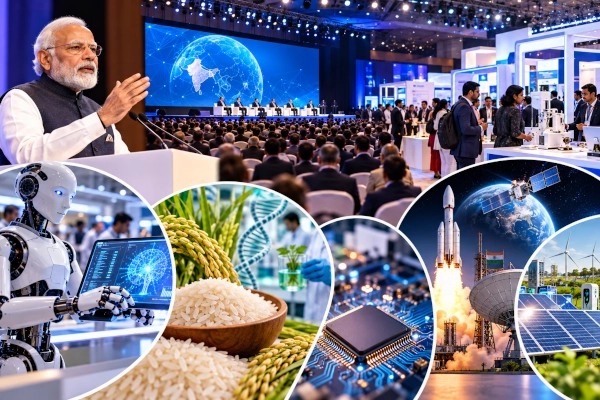
India has brought together more than 5,000 delegates from the global scientific community, research institutions, industry, government and emerging technology enterprises at the Emerging Science, Technology and Innovation Conclave (ESTIC) 2026 in New Delhi. The three-day gathering, inaugurated by Prime Minister Narendra Modi on 27 October 2026, aims to strengthen India’s capabilities in twelve critical areas of scientific research while accelerating the transformation of indigenous innovations into commercially viable technologies.
Organised at Bharat Mandapam from 27 to 29 October, the conclave brings together scientists, Nobel laureates, policymakers, entrepreneurs, academic institutions and industrial organisations to examine emerging opportunities in artificial intelligence, advanced manufacturing, biotechnology, semiconductors, quantum communication, energy technologies and other strategically important fields.
A major attraction of the event is an innovation exhibition featuring 50 selected deep-tech startups, 13 departmental stalls and ten technologies developed or showcased by participating government departments and research institutions. The exhibition highlights India’s expanding scientific capabilities and provides opportunities for entrepreneurs, researchers, investors and manufacturers to explore technology partnerships.
According to two official announcements issued by the Ministry of Science and Technology on 28 October 2026, the conclave places particular emphasis on connecting scientific discoveries with practical industrial applications, strengthening domestic technological capabilities and encouraging greater commercial adoption of research outcomes.
Prime Minister Calls for Scientific Research to Deliver Measurable Results
Inaugurating ESTIC 2026, Prime Minister Narendra Modi called upon India’s scientific community, researchers and young innovators to focus on developing technologies capable of delivering measurable benefits to society and industry.
The Prime Minister emphasised that scientific achievements should progress beyond laboratory demonstrations and contribute to practical solutions addressing national requirements. He urged researchers and technology developers to pursue concrete, measurable and scalable outcomes within a three-year operational horizon.
The approach reflects an increasing emphasis on linking publicly supported research with industrial development, technological self-reliance and wider societal benefits.
India has invested in scientific institutions, advanced research facilities and innovation programmes across several emerging sectors. However, translating laboratory discoveries into commercially successful products requires additional capabilities, including engineering development, prototype validation, industrial manufacturing, regulatory approvals and access to investment.
The Prime Minister’s address highlighted the importance of strengthening these connections so that scientific progress contributes more directly to economic development and technological capability.
The conclave also provides a platform for evaluating India’s progress in frontier technologies and identifying areas where coordinated research, industrial participation and supportive policies could accelerate future development.
Twelve Critical Technology Areas Form the Core of ESTIC 2026
ESTIC 2026 is organised around twelve thematic areas representing some of the most important opportunities and challenges in contemporary science and technology.
These include advanced manufacturing, energy technologies, systems and synthetic biology, ocean and maritime technologies, intelligent networks and quantum communication, semiconductor technologies, agricultural technology, generative and autonomous artificial intelligence, robotics, advanced healthcare, immersive technologies and space science.
The selection reflects the increasing convergence of scientific disciplines, where progress in one technological field frequently supports innovation in several others.
Artificial intelligence, for example, can contribute to advanced manufacturing, biological research, medical diagnostics and autonomous systems. Semiconductor technologies are essential for modern telecommunications, industrial automation, aerospace electronics and computing infrastructure.
Similarly, developments in materials science and energy technologies influence industries ranging from renewable power generation to transportation, electronics and advanced manufacturing.
By bringing researchers from these disciplines together, the conclave seeks to encourage interdisciplinary cooperation and identify opportunities for developing technologies with applications across multiple sectors.
The discussions also emphasise the importance of ensuring that Indian research institutions and industries possess the capabilities required to participate in increasingly complex international technology supply chains.
Fifty Deep-Tech Startups Showcase Indigenous Innovations
The exhibition at ESTIC 2026 provides a dedicated platform for 50 selected deep-tech startups to present technologies, prototypes and research-based solutions to potential industrial partners and investors.
Unlike conventional businesses that primarily rely on established commercial models, deep-tech enterprises frequently develop products based on advances in scientific research, engineering or specialised technologies.
Such ventures often operate in areas including artificial intelligence, robotics, biotechnology, semiconductor design, advanced materials, aerospace technologies and sustainable manufacturing.
Developing these technologies can require substantial investment, specialised technical expertise, extensive testing and long development periods before commercial deployment becomes possible.
The exhibition is designed to help emerging enterprises establish connections with established manufacturers, scientific institutions, government departments and potential customers.
Direct engagement with industrial organisations can enable startups to better understand manufacturing requirements, identify practical applications for their inventions and explore opportunities for scaling production.
For established companies, partnerships with research-based startups can provide access to emerging technologies that may improve production efficiency, product capabilities or industrial competitiveness.
The participation of 50 deep-tech enterprises reflects the government’s efforts to encourage a more integrated innovation ecosystem in which scientific research, entrepreneurship and industrial manufacturing support one another.
Ten Departmental Technologies Highlight India’s Research Capabilities
Alongside the startup exhibition, ESTIC 2026 features ten departmental technologies and thirteen departmental stalls presenting research activities and technological developments undertaken by participating institutions.
These exhibits demonstrate the breadth of scientific work being carried out across India’s publicly supported research system.
Government laboratories and research organisations undertake scientific investigations in several strategically important fields, including advanced materials, food technology, electronics, biotechnology, environmental sustainability and industrial engineering.
The exhibition provides an opportunity to demonstrate the practical applications of selected research outcomes while encouraging interaction with potential technology adopters.
For publicly funded research institutions, industrial collaboration is an important mechanism for moving laboratory-developed technologies towards wider use.
Commercial deployment may require additional investment, manufacturing partnerships, engineering modifications and validation under actual operating conditions.
The participation of government laboratories alongside startups and private industries provides a common platform for identifying these requirements and exploring possible arrangements for technology transfer.
The exhibition should therefore be understood as an opportunity to demonstrate technological capabilities and encourage future partnerships rather than confirmation that every displayed technology has already achieved commercial-scale production.
CSIR-NIIST Showcases High-Protein Designer Rice
One of the notable indigenous technologies presented at the conclave is a specially developed rice-based food product from the CSIR–National Institute for Interdisciplinary Science and Technology (CSIR-NIIST), Thiruvananthapuram.
The innovation, known as CSIR Designer Rice, has been developed to provide improved nutritional characteristics through the use of rice fractions and structural modification techniques.
According to the Ministry of Science and Technology, the product contains approximately 20 per cent protein and has a reported glycaemic index of 54, placing it within the low-glycaemic-index category under commonly used classifications.
The development reflects ongoing research into improving the nutritional properties of widely consumed foods through food science and processing technologies.
Rice is a major staple food across India and several other Asian countries. Research aimed at improving its nutritional composition could therefore have applications in the development of specialised food products and dietary alternatives.
The innovation is particularly relevant to the growing field of functional foods, which involves designing or modifying food products to provide particular nutritional characteristics.
However, the reported protein content and glycaemic index describe the characteristics of the showcased product. They do not independently establish clinical benefits for people with diabetes or other metabolic conditions.
Further evaluation, regulatory compliance and commercial development would determine its suitability for wider market adoption.
The participation of CSIR-NIIST also highlights the contribution of Indian research institutions outside major metropolitan centres to emerging areas of food technology and industrial innovation.
Indigenous JEET Microcontroller Demonstrates Semiconductor Design Capabilities
Another important technology displayed at ESTIC 2026 is JEET, an indigenous microcontroller developed by Indian semiconductor technology company Signalchip.
The SCMC4212 microcontroller incorporates a Yati 32-bit RISC-V central processing unit and an Avarta 32-bit digital signal processor.
The device integrates computing, memory, power-management and other functional capabilities within a compact electronic architecture.
Microcontrollers are essential components of modern electronic systems, enabling the control and coordination of devices used across industrial, commercial and technological applications.
The JEET microcontroller has potential applications in flight controllers, Internet of Things devices, robotics, smart electronic products and industrial automation.
Its development reflects the growing participation of Indian technology companies in semiconductor design and specialised electronic systems.
RISC-V is an open-standard instruction set architecture that allows developers to design processors and related computing systems without relying exclusively on proprietary processor architectures.
For Indian semiconductor companies, expertise in processor architecture, digital signal processing and embedded systems can support the development of domestically designed electronic components for a wide range of applications.
The demonstration of JEET at ESTIC 2026 provides an example of indigenous semiconductor design capabilities, although the exhibition announcement does not establish the device’s commercial production volumes or deployment across specific industrial programmes.
Government Emphasises Stronger Links Between Startups and Industry
Union Minister of State for Science and Technology Jitendra Singh visited the ESTIC exhibition on 28 October and reviewed technologies presented by startups, government departments and scientific institutions.
During the visit, the minister emphasised the importance of creating stronger connections between technology developers and industries capable of adopting and commercialising their innovations.
He observed that scientific discoveries and technological inventions must be supported by an ecosystem that enables their practical development, industrial application and wider market adoption.
The minister encouraged research institutions, investors, established manufacturers and entrepreneurs to identify opportunities for collaboration.
Such partnerships can be particularly important for deep-tech startups because many research-based technologies require extensive testing, manufacturing infrastructure and financial support before reaching commercial maturity.
Government facilitation can help connect emerging enterprises with potential customers and industrial partners, while research institutions can provide scientific expertise and specialised laboratory facilities.
The minister’s remarks reflected an emphasis on strengthening the entire process through which scientific ideas are transformed into usable technologies.
The exhibition provides an opportunity for these interactions, but the establishment of specific commercial partnerships will depend on subsequent negotiations and agreements between participating organisations.
Nobel Laureates Discuss Advanced Biomedical Research
The conclave also featured scientific presentations by internationally recognised researchers, including Nobel laureates Joachim Frank and Richard J. Roberts.
Joachim Frank, who received the Nobel Prize in Chemistry in 2017, delivered a presentation on the applications of cryo-electron microscopy in biological research, drug-target discovery and pharmaceutical development.
Cryo-electron microscopy allows scientists to investigate the three-dimensional structures of biological molecules and molecular complexes at very high resolution.
Understanding these structures can provide valuable information about the functions of proteins and other biological components involved in cellular processes.
Such knowledge can support the development of new research approaches in structural biology and contribute to the identification of potential targets for pharmaceutical research.
Richard J. Roberts, who shared the 1993 Nobel Prize in Physiology or Medicine, addressed developments involving split genes, gene splicing, microbial genomics and restriction-modification enzymes.
His presentation examined fundamental biological mechanisms and their relevance to modern biotechnology.
The discussions also explored how advances in the life sciences can contribute to sustainable agriculture, public health, diagnostics and other practical applications.
The participation of Nobel laureates provided an opportunity for Indian researchers and students to engage with developments in internationally recognised fields of scientific investigation.
Artificial Intelligence Research Focuses on Indigenous Capabilities
Artificial intelligence emerged as a major area of discussion during the first day of ESTIC 2026.
A dedicated session on generative and autonomous artificial intelligence examined the development of indigenous large language models, access to high-performance computing infrastructure and the emerging applications of autonomous AI systems.
The discussions involved researchers, industry representatives and officials associated with India’s artificial intelligence development programmes.
Among the participating experts was Professor Mitesh M. Khapra of IIT Madras, whose work includes machine learning and natural language processing.
The session also examined the role of the IndiaAI initiative in supporting domestic computing capabilities and AI development.
Large language models and other advanced AI systems require substantial computing resources, specialised datasets, technical expertise and evaluation mechanisms.
Developing indigenous capabilities in these areas can support applications involving Indian languages, public services, education, healthcare, research and industrial automation.
The discussions also addressed the importance of deploying artificial intelligence responsibly, including the need for appropriate safeguards and evaluation frameworks.
The emphasis on domestic AI research reflects India’s interest in developing technological capabilities suited to national requirements while participating in international advances in artificial intelligence.
Advanced Manufacturing Research Examines Robotics and Digital Technologies
The Advanced Manufacturing session at ESTIC 2026 brought together experts from scientific institutions, industry and defence technology organisations to examine emerging industrial technologies.
The session was chaired by CSIR Director General N. Kalaiselvi and included a keynote address by former DRDO Chairman G. Satheesh Reddy.
Discussions covered digital twins, collaborative robotics, additive manufacturing, precision measurement technologies and the development of stronger industrial supply chains.
Digital twins involve the creation of virtual representations of physical systems that can be used to study performance, evaluate operating conditions and support engineering decisions.
Collaborative robots are designed to work alongside human operators in suitable industrial environments, while additive manufacturing enables the production of components through controlled layer-by-layer fabrication.
These technologies can contribute to improvements in manufacturing flexibility, design capabilities and production efficiency.
For India, their development is particularly relevant to advanced engineering industries, including aerospace, defence, automotive manufacturing, electronics and specialised industrial equipment.
The session also considered the importance of supporting micro, small and medium enterprises in adopting modern manufacturing technologies.
Smaller industrial firms frequently face challenges associated with investment costs, technical expertise and access to advanced engineering infrastructure.
Closer cooperation between research institutions and industry could help address these challenges and support the gradual modernisation of India’s manufacturing ecosystem.
Synthetic Biology Offers Opportunities in Healthcare and Agriculture
Systems and synthetic biology formed another major theme of the scientific discussions.
Synthetic biology combines principles from biology, engineering and computational science to understand, design and modify biological systems for specified purposes.
The session examined approaches involving biological design, experimentation and iterative testing, with potential applications in healthcare, agriculture and industrial biotechnology.
Researchers discussed opportunities involving precision biotherapeutics, metabolic pathway engineering, biofortified crops and the conversion of biological waste into useful industrial products.
These areas are relevant to India’s expanding biotechnology sector, particularly efforts to develop advanced biological medicines, improve agricultural productivity and create sustainable industrial processes.
India’s biological diversity, scientific workforce and established pharmaceutical manufacturing capabilities provide a foundation for research in these fields.
However, translating laboratory discoveries into commercially useful biological technologies requires careful evaluation of safety, effectiveness, regulatory compliance and manufacturing feasibility.
The discussions at ESTIC 2026 therefore focused on both scientific possibilities and the institutional capabilities required to support future development.
Research Commercialisation Becomes a National Priority
A central theme connecting the scientific sessions and technology exhibition was the need to strengthen the movement of research outcomes from laboratories into industrial and commercial applications.
India possesses an extensive network of scientific institutions, universities, national laboratories and technology companies engaged in research across different disciplines.
However, transforming scientific discoveries into commercially viable technologies can be a complex process requiring coordination among researchers, investors, manufacturers and regulatory authorities.
Technologies developed in laboratories may require further engineering, prototype development, testing, certification and manufacturing investment before they can be used at scale.
ESTIC 2026 seeks to create opportunities for addressing these challenges through direct interaction between research institutions, startups and industry.
The government’s ₹1 lakh crore Research, Development and Innovation Fund and mechanisms associated with the Anusandhan National Research Foundation were also discussed as important components of India’s wider research and innovation support framework.
These initiatives are intended to strengthen scientific research and encourage the development of technologies capable of progressing towards practical applications.
The conclave’s emphasis on commercialisation reflects a broader objective of ensuring that research investments contribute to industrial capabilities, technological innovation and economic development.
Scientific Collaboration Extends Beyond Metropolitan Centres
The expansion of India’s startup ecosystem beyond traditional technology centres was another important subject highlighted during ESTIC 2026.
Jitendra Singh observed that approximately 50 to 60 per cent of startups are now emerging from Tier-II and Tier-III cities, reflecting the geographical expansion of entrepreneurial activity.
The minister noted that India had witnessed substantial growth in startup participation over the previous decade, creating new opportunities for entrepreneurs and technology developers across different regions.
This geographical diversification is significant because scientific and technological innovation increasingly depends on access to research infrastructure, skilled personnel, financing and industrial networks.
Entrepreneurs operating outside major metropolitan centres may possess valuable technical ideas but face difficulties connecting with established industries and investment institutions.
National platforms such as ESTIC can help create opportunities for these innovators to interact with researchers, policymakers and potential commercial partners.
The participation of institutions such as CSIR-NIIST in Thiruvananthapuram also demonstrates the contribution of regional research centres to India’s technological development.
Encouraging innovation across a wider geographical area could strengthen local industrial ecosystems and create opportunities for employment and technology-based entrepreneurship.
Strengthening India’s Position in Global Science and Technology
The discussions at ESTIC 2026 reflected India’s interest in moving beyond the adoption of technologies developed elsewhere and expanding its role in the creation of advanced scientific solutions.
Principal Scientific Adviser to the Government of India Ajay Kumar Sood emphasised the importance of aligning fundamental scientific research with industrial development and supportive government policies.
The ability to develop advanced technologies domestically depends on several interconnected capabilities, including high-quality scientific research, specialised infrastructure, engineering expertise and access to manufacturing facilities.
This is particularly important in strategically significant sectors such as semiconductors, quantum communication, advanced materials, artificial intelligence and biotechnology.
International scientific collaboration also remains important because frontier technologies frequently require knowledge and expertise drawn from multiple countries and disciplines.
The participation of global researchers and scientific institutions at ESTIC provides an opportunity to expand these connections while highlighting India’s emerging technological capabilities.
The objective is not simply to increase the number of research publications or scientific demonstrations, but to create a stronger ecosystem capable of converting scientific knowledge into technologies that address economic and societal requirements.
Towards a Stronger Indigenous Innovation Ecosystem
The Emerging Science, Technology and Innovation Conclave 2026 represents an important effort to bring together the different components of India’s scientific and technological development system.
The participation of more than 5,000 delegates, discussions across twelve critical technology sectors and the exhibition of 50 deep-tech startups and ten departmental technologies demonstrate the scale of the initiative.
The display of CSIR-NIIST’s Designer Rice, Signalchip’s JEET microcontroller and other indigenous innovations also highlights the diverse applications of Indian research, extending from food science and biotechnology to electronics and advanced industrial systems.
At the same time, the conclave recognises that successful technological development requires more than scientific expertise. Research institutions must be connected with manufacturing capabilities, financial resources, appropriate regulatory frameworks and potential users of new technologies.
The government’s emphasis on startup-industry collaboration, technology transfer and research commercialisation is intended to strengthen these connections.
The actual impact of ESTIC 2026 will depend on the partnerships, research programmes and commercial applications that emerge from the discussions and exhibitions.
As India pursues its long-term development objectives under Viksit Bharat 2047, strengthening indigenous scientific capabilities and improving the commercial application of research will remain important priorities.
By bringing together scientists, research institutions, entrepreneurs, manufacturers and policymakers on a common platform, ESTIC 2026 seeks to support a more integrated innovation ecosystem capable of contributing to India’s industrial development, technological capabilities and participation in global scientific progress.
Official References
Ministry of Science and Technology, Press Information Bureau, 28 October 2026, Release ID 2329291. The official announcement titled Prime Minister Shri Narendra Modi inaugurates Emerging Science, Technology and Innovation Conclave 2026 provides details of the inaugural proceedings, participation of more than 5,000 delegates, twelve scientific priority areas, addresses by Nobel laureates and discussions involving artificial intelligence, advanced manufacturing and synthetic biology.
Ministry of Science and Technology, Press Information Bureau, 28 October 2026, Release ID 2329583. The official announcement titled Government Facilitating Startup-Industry Linkages to Take Indigenous Innovations to the Market, says Union Minister Dr. Jitendra Singh confirms the exhibition of 50 deep-tech startups, thirteen departmental stalls and ten departmental technologies. It also provides details of CSIR-NIIST’s Designer Rice, Signalchip’s JEET microcontroller and the government’s emphasis on strengthening research commercialisation.
Ministry of Science and Technology, Press Information Bureau, 10 September 2026, Release ID 2308750. The official curtain-raiser announcement provides background on the organisation of ESTIC 2026, the involvement of CSIR and CSIR-NIIST, the participation of scientific institutions and the conclave’s twelve thematic research areas.
Ministry of Science and Technology, Government of India. Additional institutional information on scientific research, technology development and innovation programmes is available through the Council of Scientific and Industrial Research, Department of Science and Technology and Office of the Principal Scientific Adviser to the Government of India.
You may also like
-
AI Journey 2026 Rescheduled to November 26–28 in Moscow, Indian AI Experts Among International Participants
-
IIT Bombay and Russia’s Rosatom Launch Atomic Hack India 2026 to Advance Nuclear Engineering and Digital Twin Technologies
-
Indian Experts to Participate in Moscow Startup Summit as Global Technology Leaders Gather in Russian Capital
-
One Voice – One Resolve – One India: Namami Bharatam Marks 150 Years of Vande Mataram Across the Nation
-
Tarang Shakti 2026: Eight Foreign Air Forces and 32 Observer Nations to Join IAF Exercise at Jodhpur
