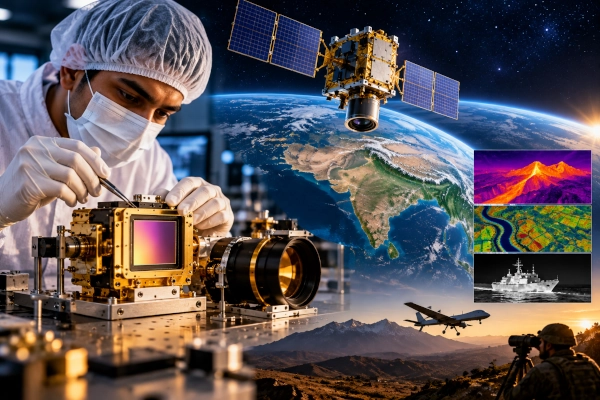
Ahmedabad, October 27, 2026: India’s indigenous space and defence technology ecosystem has received another boost as Ahmedabad-based deep-tech startup SpectraGaze Systems Private Limited has secured ₹3.7 crore in seed funding to accelerate the development of advanced optical imaging sensors, infrared detectors and electro-optical payloads. The funding round, announced on October 23, 2026, was led by Gujarat Venture Finance Limited (GVFL), with participation from angel investors.
Founded in 2023 by former Indian Space Research Organisation (ISRO) scientist Arup Banerjee, SpectraGaze Systems is developing specialised imaging technologies intended to reduce India’s dependence on imported detectors and strengthen domestic capabilities in space instrumentation, defence surveillance and scientific research.
The investment represents the company’s first external funding round following approximately three years of operations supported primarily through customer-funded technology development programmes. During this period, SpectraGaze established relationships with major Indian scientific and industrial organisations, including ISRO, the Physical Research Laboratory (PRL) and Kaynes Technology India Limited.
The newly raised capital will be used to accelerate product development, expand the company’s engineering team, strengthen its testing infrastructure and support the execution of existing customer programmes.
The development highlights the growing participation of Indian startups in specialised technological sectors where advanced sensor design, semiconductor engineering and precision manufacturing are essential for developing indigenous capabilities.
Former ISRO Scientist Leads Indigenous Imaging Technology Development
SpectraGaze Systems was established by Arup Banerjee, a former ISRO scientist with approximately 23 years of experience in space technology and related engineering disciplines.
The company was founded with the objective of developing advanced imaging sensors and electro-optical systems in India, particularly for applications where specialised components have traditionally been sourced from international suppliers.
Optical imaging technologies play an essential role in modern satellites, surveillance platforms, scientific instruments and advanced industrial equipment. The performance of these systems depends heavily on the quality and sensitivity of their detectors, optical components and signal-processing electronics.
SpectraGaze is working to strengthen India’s capabilities in these areas by developing specialised sensors and payload technologies suited to demanding operational environments.
The company initially pursued development through customer-funded programmes, allowing it to build technical experience and establish relationships with research institutions and industrial organisations.
According to the company, this approach helped validate its technological capabilities before securing its first external investment.
The ₹3.7 crore funding round is expected to provide additional resources for scaling engineering activities and advancing products intended for space and defence applications.
Funding to Strengthen Engineering and Testing Infrastructure
The seed investment led by GVFL is intended to support several aspects of SpectraGaze’s technology development programme.
A major priority will be the expansion of the company’s engineering team, enabling it to undertake additional research, product development and system integration activities.
The funding will also support improvements to testing infrastructure, which is particularly important for advanced imaging sensors intended for aerospace and defence applications.
Such technologies often require extensive evaluation to establish their performance under different operating conditions.
Infrared detectors, for example, must be assessed for sensitivity, noise characteristics, response uniformity and suitability for their intended spectral bands.
Sensors intended for spacecraft may require additional environmental testing associated with vibration, temperature variations and radiation exposure.
Improved testing capabilities can help technology developers identify design limitations, refine system performance and prepare products for customer evaluation.
SpectraGaze also plans to use the investment to execute existing customer programmes and strengthen business development activities.
The funding therefore supports both the company’s engineering capabilities and its efforts to expand commercial participation in India’s growing space and defence technology markets.
Developing Indigenous Infrared Detectors for Space and Defence
Infrared detectors are among the important technologies being developed by SpectraGaze Systems.
Unlike ordinary visible-light cameras, infrared imaging systems detect radiation in infrared wavelength bands. Depending on their design, these detectors can be used to identify thermal characteristics, observe objects under particular environmental conditions and obtain information that may not be visible through conventional imaging.
Infrared technologies are used in a wide range of applications, including thermal imaging, scientific observation, industrial inspection, environmental monitoring and military surveillance.
In space applications, infrared detectors can support Earth observation, atmospheric studies and scientific instruments designed to measure radiation emitted or reflected by different materials.
Developing advanced infrared sensors requires specialised expertise in detector technology, electronic design, optics, signal processing and precision manufacturing.
Some high-performance infrared systems also require sophisticated cooling arrangements to reduce unwanted thermal noise and improve detector sensitivity.
SpectraGaze’s work is intended to contribute to the domestic development of these capabilities.
India’s ability to manufacture specialised infrared detectors is significant because such components can represent critical elements within larger imaging and surveillance systems.
Developing indigenous detector technologies could eventually help strengthen domestic supply chains and provide Indian system integrators with additional sourcing options.
However, the funding announcement should not be interpreted as evidence that all categories of advanced infrared detectors have already entered mass production in India.
The company’s projects represent specific development and delivery milestones within a broader process of strengthening indigenous imaging capabilities.
SpectraGaze Has Delivered Infrared Detector and Test System to ISRO
One of SpectraGaze’s reported technical milestones involves the delivery of an infrared detector and associated test system to the Indian Space Research Organisation.
The achievement demonstrates the company’s participation in specialised imaging technology programmes associated with India’s national space research ecosystem.
ISRO develops and operates satellites serving communication, navigation, Earth observation, scientific research and other national requirements.
Many of these spacecraft depend on advanced optical and electronic payloads capable of collecting information across different regions of the electromagnetic spectrum.
Infrared detectors and associated testing equipment are important for evaluating the performance of instruments designed to operate in these wavelength bands.
The delivery of such equipment provides an example of how specialised private-sector enterprises can contribute components and engineering services to larger space programmes.
It also reflects the increasing opportunities available to Indian startups supplying technologies for institutional and industrial customers.
The available announcement confirms the reported delivery of the detector and test system but does not establish the full technical specifications or subsequent operational deployment of the equipment.
The development is nevertheless relevant to India’s efforts to expand domestic expertise in space-grade sensing technologies.
Participation in ISRO’s High-Resolution Satellite Programme
SpectraGaze has also secured an image sensor development contract associated with ISRO’s next-generation High Resolution Satellite programme, commonly referred to as HRSAT.
The work is being undertaken in partnership with AMETEK, an international manufacturer of electronic instruments and electromechanical systems.
High-resolution Earth observation satellites use advanced imaging instruments to capture detailed information about the Earth’s surface.
Such imagery can support applications involving land-use mapping, infrastructure monitoring, environmental analysis, disaster assessment and scientific research.
The performance of these satellites depends on several factors, including detector sensitivity, optical design, image resolution and the precision of onboard electronic systems.
The development of specialised image sensors is therefore an important component of modern satellite payload engineering.
Participation in an imaging sensor development programme provides SpectraGaze with an opportunity to contribute to technologies associated with India’s future Earth observation capabilities.
The reported contract should be understood as a development assignment rather than confirmation that a completed SpectraGaze sensor has already been deployed aboard an operational HRSAT spacecraft.
The significance of the programme lies in the company’s involvement in advanced satellite sensor development and its potential contribution to the domestic space technology supply chain.
iDEX PRIME Challenge Supports Indigenous Infrared Detector Development
Another important achievement reported by SpectraGaze is its selection under the Innovations for Defence Excellence (iDEX) PRIME Challenge for developing an indigenous Infrared Detector Dewar Cooler Assembly.
The iDEX initiative operates under the Ministry of Defence and is intended to encourage startups, MSMEs and other innovators to develop technologies addressing the requirements of India’s armed forces and defence establishments.
The challenge associated with SpectraGaze involves the development of an infrared detector integrated with a Dewar and cooling arrangement.
A Dewar is a specialised thermal enclosure designed to help maintain controlled temperatures around sensitive components.
In certain high-performance infrared imaging systems, cooling is required to reduce thermal noise and improve the detector’s ability to identify weak infrared signals.
An integrated detector and cooling assembly is therefore an important component of some advanced thermal imaging systems.
The development of such technology requires expertise in detector materials, cryogenic engineering, electronic integration and thermal management.
SpectraGaze’s participation in the challenge is relevant to India’s efforts to develop specialised defence imaging components domestically.
Successful indigenous development could eventually provide Indian defence equipment manufacturers with additional options for sourcing critical sensor assemblies.
However, winning an innovation challenge does not automatically establish that a technology has completed qualification, entered serial production or been inducted into military service.
The subsequent stages of engineering development, testing and customer acceptance remain important for determining operational readiness.
Hyperspectral Camera Under Development for Kaynes Technology Satellite
SpectraGaze is also developing a hyperspectral imaging camera intended for a 3U small satellite associated with Kaynes Technology.
According to the reported development programme, the camera is targeted for delivery in November 2026.
A 3U satellite generally refers to a compact spacecraft configuration based on three standard CubeSat units, although individual spacecraft dimensions and engineering arrangements can vary.
Small satellites provide opportunities for technology demonstrations, scientific experiments and specialised Earth observation applications.
Hyperspectral cameras differ from conventional colour cameras because they collect information across many narrow wavelength bands rather than recording only broad red, green and blue channels.
This enables researchers to examine the spectral characteristics of materials and potentially distinguish substances that appear similar in ordinary photographs.
In Earth observation, hyperspectral imaging can support analysis of vegetation, land surfaces, water bodies and atmospheric or environmental conditions.
The technology can also contribute to research involving mineral identification, agricultural monitoring and pollution assessment.
Developing a compact hyperspectral payload for a small satellite presents engineering challenges involving optical design, detector performance, data processing, power consumption and spacecraft integration.
SpectraGaze’s proposed camera could contribute to the development of indigenous small-satellite imaging technologies if the programme successfully completes its technical milestones.
The November 2026 date represents a planned delivery target. The available reports do not establish that the payload has already been delivered, integrated into a spacecraft or launched into orbit.
Applications in Agriculture, Environment and Scientific Research
Advanced optical imaging sensors have applications extending well beyond conventional satellite photography.
In agriculture, multispectral and hyperspectral imaging can help researchers assess vegetation characteristics and investigate differences associated with crop growth, water stress and plant conditions.
Such technologies can support precision agriculture by providing information that complements field observations, laboratory analysis and other agricultural data.
Environmental monitoring is another important application because different substances interact with electromagnetic radiation in characteristic ways.
By analysing spectral information, researchers can investigate changes in vegetation cover, water quality and selected atmospheric or surface conditions.
Hyperspectral instruments can also contribute to the identification of certain minerals and geological materials through their spectral signatures.
In industrial applications, optical and infrared sensors may assist with material inspection, temperature measurement and the monitoring of manufacturing processes.
The development of such technologies within India could therefore benefit multiple scientific and commercial sectors.
However, the accuracy and usefulness of individual imaging applications depend on the performance of the sensor, environmental conditions, data-processing methods and appropriate validation.
SpectraGaze’s development roadmap identifies several of these applications as potential markets, although they should not all be interpreted as commercially deployed products.
Defence Surveillance and Unmanned Aerial Systems
Infrared and electro-optical imaging systems are also important components of modern defence surveillance technologies.
Military surveillance platforms often use specialised sensors to observe terrain, detect objects and collect information under varying illumination and environmental conditions.
Thermal imaging systems can provide information based on differences in infrared radiation, while conventional optical sensors collect visible-light imagery.
Some surveillance systems combine multiple sensor types to improve situational awareness and support the interpretation of observations.
Unmanned aerial vehicles can carry compact imaging payloads for reconnaissance, infrastructure inspection and environmental monitoring.
Developing lightweight, power-efficient sensors is especially important for smaller unmanned platforms because their payload capacity and onboard energy resources are limited.
SpectraGaze’s reported technology roadmap includes drone-based hyperspectral imaging and space-based surveillance applications.
These areas could create opportunities for Indian manufacturers seeking domestically developed electro-optical components.
The company’s involvement in defence-oriented technology development also reflects the wider role of startups in supplying specialised systems to India’s defence manufacturing ecosystem.
However, potential surveillance applications should be distinguished from confirmed military orders, qualification achievements or operational deployments.
Reducing Dependence on Imported Imaging Technologies
One of the principal objectives of SpectraGaze’s development programme is to reduce India’s dependence on imported optical and infrared detector technologies.
Advanced imaging systems frequently require specialised components manufactured using sophisticated semiconductor processes and precision engineering techniques.
Developing such components domestically involves substantial technological challenges, including material selection, detector fabrication, packaging, electronic integration and performance testing.
For space and defence applications, additional requirements relating to reliability and environmental qualification can further increase the complexity of development.
India has established capabilities in satellite design, spacecraft manufacturing and electro-optical instrumentation through organisations such as ISRO and several domestic research institutions.
The expansion of specialised private-sector suppliers can complement these capabilities by increasing the number of companies participating in component development and manufacturing.
Startups such as SpectraGaze can contribute through focused research and engineering activities involving particular technologies.
Domestic development may eventually improve supply-chain resilience, support specialised employment and encourage the creation of intellectual property within India.
However, the degree of import substitution achieved by individual products depends on their component sourcing, manufacturing processes and technical performance.
The long-term significance of the company’s work will therefore depend on its ability to move successfully from technology development towards repeatable manufacturing and reliable commercial delivery.
GVFL Investment Highlights Growing Interest in Indian Deep Technology
The ₹3.7 crore investment also reflects increasing venture capital interest in Indian companies developing specialised hardware and engineering technologies.
Unlike software-oriented startups, deep-tech hardware companies often require substantial investment in research, prototyping, testing and manufacturing infrastructure before products can be commercialised.
The development of advanced sensors may involve lengthy engineering cycles and close cooperation with institutional customers.
SpectraGaze’s initial growth through customer-funded programmes demonstrates one approach to developing specialised products while establishing technical credibility.
GVFL’s investment provides additional financial resources to support the next stage of the company’s development.
The venture capital firm has identified indigenous imaging detectors and electro-optical technologies as important areas for India’s technological self-reliance.
The company has also highlighted SpectraGaze’s previous work with ISRO and its participation in the iDEX PRIME Challenge as significant elements of its technological progress.
The funding could help strengthen engineering capabilities and support the development of additional products for institutional and industrial customers.
However, seed financing represents an early stage of business development, and future commercial expansion will depend on technical performance, customer demand and the company’s ability to scale its operations.
Indian Space Startups Expand into Specialised Satellite Components
India’s private space industry has been expanding beyond satellite launch services and spacecraft manufacturing into specialised components, propulsion systems, communication technologies and scientific payloads.
The development of a broad domestic supply chain is important because modern spacecraft rely on numerous components produced by different engineering and technology specialists.
Optical detectors, electronic subsystems, navigation equipment, communication hardware and onboard computing systems all contribute to satellite performance.
Startups developing these technologies can become important participants in the broader space manufacturing ecosystem.
The involvement of SpectraGaze in sensor development programmes for ISRO and industrial customers provides an example of this emerging specialisation.
Its work with Kaynes Technology also reflects the growing connections between India’s electronics manufacturing industry and private satellite development activities.
Such collaboration may create opportunities for companies specialising in advanced electronic components to participate in future space missions.
As India’s commercial space ecosystem develops, the availability of reliable domestic payload and sensor suppliers could become increasingly important for both government and private-sector programmes.
Funding Supports India’s Long-Term Sensor Technology Capabilities
The ₹3.7 crore seed funding secured by SpectraGaze Systems represents a significant milestone for an Indian startup working in a technically demanding segment of the space and defence industry.
The company has developed its initial operations through customer-funded programmes, established relationships with major scientific institutions and undertaken projects involving infrared detectors, imaging sensors and specialised satellite payloads.
Its reported achievements include delivering an infrared detector and test system to ISRO, securing participation in the HRSAT image sensor development programme and winning an iDEX PRIME Challenge concerning an indigenous infrared detector assembly.
The planned development of a hyperspectral camera for a small satellite further demonstrates the company’s interest in expanding into advanced Earth observation technologies.
The new investment is intended to support engineering recruitment, testing infrastructure, product development and the execution of existing programmes.
Although several projects remain under development, the company’s activities illustrate the growing opportunities for Indian startups to contribute specialised technologies to larger aerospace, scientific and defence systems.
For India, strengthening indigenous capabilities in infrared detection and advanced optical imaging is relevant to long-term efforts to develop a more comprehensive domestic technology ecosystem.
The success of such initiatives will depend on sustained research, manufacturing capability, technical qualification and commercial adoption.
SpectraGaze’s latest funding round therefore represents another step towards expanding India’s participation in advanced sensor technologies, with potential applications across space exploration, national security, environmental monitoring and scientific research.
References
- GVFL. Official corporate communication confirming the ₹3.7 crore seed investment in SpectraGaze Systems Private Limited. October 2026.
https://www.linkedin.com/company/gvfl/ - YourStory. “Startup News and Updates: Daily Roundup (October 23, 2026).” 23 October 2026.
https://yourstory.com/2026/10/startup-news-and-updates-daily-roundup-october-23-2026 - Indian Startup Times. “Ahmedabad-Based Space-Tech Startup to Accelerate Indigenous Imaging Technology Development for Space and Defence Applications.” 23 October 2026.
https://www.indianstartuptimes.com/investment/ahmedabad-based-space-tech-startup-to-accelerate-indigenous-imaging-technology-development-for-space-and-defence-applications/ - India Space Index. “Funding Rounds: Indian Private Space Sector.” Entry for SpectraGaze Systems, 23 October 2026.
https://indiaspaceindex.com/funding/ - Indian Startup News. “Ex-ISRO Scientist’s SpectraGaze Raises Rs 3.7 Crore Led by GVFL to Build Indian Infrared Detectors.” 24 October 2026.
https://indianstartupnews.com/ - SpectraGaze Systems Private Limited. Official Company Website.
https://spectragaze.com/
You may also like
-
India’s Telephone Subscriptions Reach 136.79 Crore as Telecom Sector Records Strong Growth in September 2026
-
Government Introduces ₹1,500 Annual Highway Toll Pass for Residents Living Within 20 Kilometres of Toll Plazas
-
India’s Kaynes Space Partners with WISeSat to Develop Quantum-Secure Satellites
-
India Advances Tracked Artillery Procurement, Creating Opportunities for Domestic Defence Manufacturers
-
DAC Approves ₹20,000 Crore Procurement of 200 Light Multi-Role Helicopters for Indian Army and Air Force
