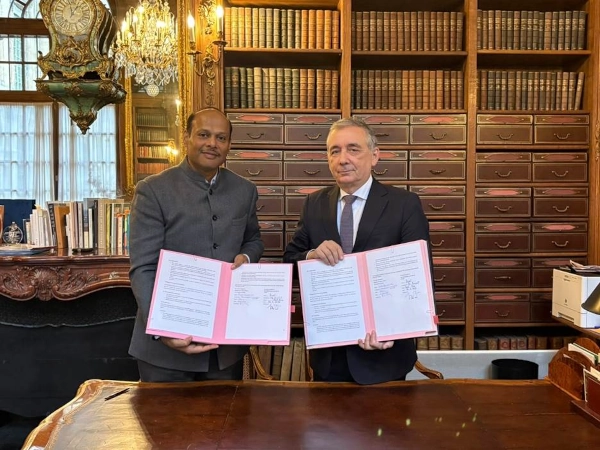
New Delhi, October 27, 2026: India and France have strengthened their cooperation in cultural heritage preservation through a Memorandum of Understanding (MoU) aimed at identifying, digitising, conserving and promoting manuscripts of Indian origin preserved in French collections. The agreement brings together leading cultural institutions from both countries under India’s Gyan Bharatam Mission, opening new opportunities for research into the country’s extensive intellectual and civilisational heritage.
The MoU was signed and exchanged in Paris on October 26, 2026, between the Ministry of Culture, Government of India, and the Bibliothèque nationale de France (BnF), the National Library of France. Vivek Aggarwal, Secretary, Ministry of Culture, signed the agreement on behalf of India, while Gilles Pécout, President of BnF, represented the French institution.
The collaboration establishes an institutional framework for preserving historical manuscripts, improving their digital accessibility and encouraging cooperation between Indian and French researchers, archivists, conservation specialists and technology experts.
Identifying Indian Manuscripts Preserved in France
One of the principal objectives of the agreement is to identify and digitise manuscripts and documentary collections of Indian origin held by the National Library of France.
Historical manuscripts preserved in overseas institutions represent an important part of India’s intellectual history. These collections can offer valuable insights into the transmission of knowledge, literary traditions, languages, philosophical thought and cultural exchanges that developed across different historical periods.
Through the new partnership, Indian and French specialists will work together to identify relevant collections and explore opportunities for their systematic documentation and digitisation.
Digitisation can enable researchers to examine historical material without requiring repeated physical handling of fragile originals. It can also facilitate access to collections that would otherwise remain geographically distant from scholars and institutions in India.
The agreement provides a framework for cooperation rather than announcing the immediate digitisation of a specified number of manuscripts. The identification of collections and implementation of individual projects will form part of subsequent institutional collaboration.
Five Areas of Cooperation Under the Agreement
The partnership will operate through five principal areas comprising digitisation, cross-sharing through the National Digital Repository, technology exchange, conservation, and research and development.
The Indian institutions participating in the collaboration include Gyan Bharatam, the National Archives of India in New Delhi and the National Library in Kolkata. These institutions will work with the Bibliothèque nationale de France to develop cooperation in manuscript preservation and the management of documentary heritage.
The proposed activities include exchanging technical expertise in digital preservation, improving cataloguing practices, sharing conservation methodologies and exploring technological solutions for handling historical documents.
The agreement also envisages collaborative research projects, scholarly publications, exhibitions, workshops and professional exchanges.
These activities are expected to strengthen institutional capabilities while improving the documentation and study of manuscripts connected with India’s historical knowledge traditions.
Advanced Digital Technologies for Reading Ancient Scripts
An important technological component of the partnership concerns the exchange of expertise in Optical Character Recognition (OCR) and Handwritten Text Recognition (HTR) technologies for Indian scripts.
OCR systems are designed to identify and convert printed or written characters in scanned documents into machine-readable text. HTR technologies extend these capabilities to handwritten documents, where variations in writing styles, character formations and document conditions present additional challenges.
Such technologies have considerable relevance for India’s manuscript heritage, which survives in numerous languages, scripts and historical writing traditions.
The application of advanced recognition tools could assist researchers in transcribing historical documents, identifying textual patterns and organising large collections for systematic study.
However, the interpretation of older manuscripts frequently requires specialised knowledge of historical scripts, languages and writing conventions. Automated recognition therefore needs to be supported by expert examination and verification.
The proposed technology exchange between Indian institutions and BnF could contribute to the development and refinement of digital tools suited to these challenges.
The collaboration will also cover digital humanities, an interdisciplinary field that applies computational technologies to the study of historical, literary and cultural material.
Conservation and Research to Receive Special Attention
Beyond digitisation, the agreement recognises the importance of preserving original manuscripts through scientific conservation practices.
Historical manuscripts are often vulnerable to deterioration caused by environmental conditions, ageing, repeated handling and the physical characteristics of their writing materials.
Conservation requires specialised assessment and appropriate treatment to protect the original documents while retaining their historical integrity.
The cooperation between India and France will facilitate the exchange of knowledge relating to conservation methods, preservation technologies and professional training.
Joint workshops and capacity-building programmes are envisaged to provide opportunities for specialists to exchange practical experience and strengthen technical expertise.
Research initiatives, publications and exhibitions could further encourage scholarly engagement with manuscripts preserved in both countries.
Exchanges involving researchers, archivists and conservation experts are also expected to promote sustained institutional cooperation.
Gyan Bharatam Mission Expands India’s Manuscript Preservation Programme
The agreement forms part of the Gyan Bharatam Mission, the Ministry of Culture’s flagship initiative to identify, document, conserve, digitise, translate, research and disseminate India’s manuscript heritage.
Announced in the Union Budget 2025–26, the mission seeks to strengthen the preservation of historical manuscripts through modern technology, institutional collaboration and systematic documentation.
India possesses an extensive manuscript tradition covering fields such as philosophy, mathematics, astronomy, medicine, linguistics, literature, governance, religion and the arts. These records preserve knowledge developed and transmitted across different regions and historical periods.
The Gyan Bharatam Mission aims to bring greater coordination to efforts involving manuscripts held by academic institutions, libraries, museums, religious establishments and private custodians.
A major component of the programme is the development of a National Digital Repository intended to organise and preserve digital records of Indian-origin manuscripts and traditional knowledge collections.
The repository is designed to support structured access to manuscript material, subject to the permissions and access arrangements applicable to individual collections.
By incorporating manuscripts preserved outside India, international partnerships can help broaden the geographical scope of the mission.
Building a Global Digital Repository of Indian Knowledge
The proposed cooperation with the National Library of France could contribute to India’s efforts to develop a more comprehensive digital record of its manuscript heritage.
Manuscripts of Indian origin are preserved in libraries, museums, research institutions and private collections across different parts of the world. Their geographical distribution reflects centuries of scholarly exchanges, travel, trade and historical interactions.
Establishing connections between these collections and Indian research institutions can help scholars study related manuscripts held in different countries.
Digital documentation and compatible cataloguing systems can also make it easier to identify manuscripts, compare textual traditions and trace the historical movement of knowledge.
The National Digital Repository envisaged under Gyan Bharatam provides a framework through which such information could be organised and made accessible according to agreed conditions.
The agreement with BnF specifically provides for cross-sharing through the repository, creating a potential mechanism for improved scholarly access to identified collections.
Importantly, the arrangement concerns cooperation in preservation, digitisation and knowledge-sharing. It should not be interpreted as an agreement for the physical transfer or repatriation of manuscripts from France to India.
Strengthening India–France Cultural and Academic Cooperation
The new agreement adds another dimension to the cultural relationship between India and France, extending cooperation into manuscript studies, digital preservation and historical research.
The two countries have previously collaborated in the field of documentary heritage. In October 2015, India and France signed an agreement concerning the digital preservation and conservation of rare written material, providing an earlier framework for technical and institutional cooperation.
The latest partnership under Gyan Bharatam places this cooperation within India’s broader national programme for manuscript documentation and preservation.
Its significance extends beyond safeguarding historical documents. By connecting cultural institutions with digital technologies and academic research, the initiative can support new approaches to studying India’s intellectual traditions.
For Indian scholars, improved access to manuscript collections preserved abroad could create opportunities to investigate historical texts and develop a better understanding of the transmission of knowledge across civilisations.
For conservation professionals and technology researchers, the partnership offers scope for exchanging expertise and developing solutions for the long-term preservation of fragile documentary collections.
The India–France agreement represents another step towards connecting India’s manuscript heritage with modern systems of preservation, research and digital access.
As the Gyan Bharatam Mission develops its national and international institutional network, such collaborations could help ensure that historical knowledge preserved across the world remains available for scholarly investigation and future generations.
Reference: The October 26 agreement and its specific provisions are based on the PIB Ministry of Culture release dated October 27, 2026.
You may also like
-
Huna in the Mahabharata: Nakula’s Western Campaign, the Harahunas and Central Asia’s Changing Frontiers
-
GeM’s AABHAR Collection Showcases 294 Indigenous Products, Strengthens Market Access for Indian Artisans
-
Tushara in the Mahabharata: The Lands Beyond the Hindu Kush and the Horsemen Who Faced Arjuna
-
Shaka in the Mahabharata: Central Asia’s Steppe Peoples, Nakula’s Campaign and the Alliance with Duryodhana
-
Yavana in the Mahabharata: Greek Connections, Pandava Campaigns and the Warriors of Kurukshetra
