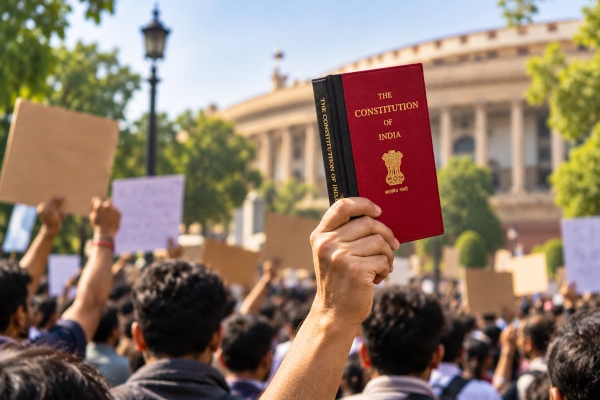
India has entered an extraordinary age of digital activism. A smartphone, an Instagram account and a sufficiently dramatic expression can turn almost anyone into a public personality. A confrontation lasting thirty seconds can receive more attention than a policy discussion lasting three hours. A carefully edited Reel can travel across the country before anyone has established what actually happened.
Welcome to the attention economy, where every controversy is a potential career opportunity, every confrontation is content, and every national issue apparently deserves a background soundtrack.
Public demonstrations remain an essential part of democracy. Citizens have every right to question authority, demand accountability and peacefully oppose government decisions. However, a growing culture of performative outrage raises an uncomfortable question: Are we genuinely interested in solving problems, or are we becoming more interested in making them viral?
When National Issues Become Entertainment
India faces serious challenges involving employment, education, infrastructure, economic development, public administration and national security. These subjects demand sustained attention, informed discussion and practical solutions.
Unfortunately, none of these requirements guarantees an exciting Instagram Reel.
A detailed explanation of an administrative problem rarely competes with a dramatic confrontation. A carefully negotiated settlement may attract less attention than someone shouting into a camera. An exaggerated controversy can circulate widely while the actual issue remains poorly understood.
The result is a curious transformation of public debate. Instead of asking whether a problem has been resolved, audiences may become more interested in who delivered the most dramatic speech, confronted an official or attracted the largest number of views.
Somewhere between the slogans, smartphones and social media reactions, the original grievance risks becoming a supporting character in its own story.
The Country Has Problems to Solve, Not Episodes to Produce
National development requires continuity, planning and institutional cooperation. Roads must be constructed, industries developed, schools improved, research supported and public services strengthened. These responsibilities cannot operate according to the demands of the latest trending video.
Yet the attention economy thrives on immediacy. A complicated problem needs explanation, but a confrontation needs only a camera. An effective solution may require months of work, while a dramatic accusation can become viral within minutes.
This difference creates incentives for sensationalism. When controversy attracts greater attention than constructive discussion, individuals seeking online visibility may prefer dramatic presentation over meaningful engagement.
There is nothing wrong with exposing failures or demanding better governance. Indeed, such scrutiny is necessary for national progress. The problem begins when public accountability is replaced by a continuous competition to produce the next spectacle.
A country cannot measure democratic participation by the number of Reels produced or judge national progress by the volume of online outrage.
The Hidden Cost of Manufactured Drama
A genuine protest may temporarily inconvenience the public. That is not sufficient reason to question its legitimacy, because peaceful assembly is a constitutionally protected democratic activity.
Deliberately manufactured disruption presents a different problem.
When individuals spread misinformation, stage confrontations or intentionally provoke disturbances, the consequences extend beyond their social media accounts. Public services may be interrupted, businesses affected, administrative resources diverted and ordinary citizens inconvenienced.
The individuals responsible for addressing a grievance may find themselves spending more time responding to exaggerated controversies than working towards a solution.
Naturally, the internet may reward the resulting confusion with another round of views.
The important distinction is between the unavoidable inconvenience of legitimate democratic participation and disruption deliberately created for attention or personal advantage. The former deserves constitutional protection; the latter deserves scrutiny based on evidence.
National interest requires protecting both public freedoms and the ability of institutions to perform their legitimate responsibilities.
When the National Flag Becomes a Prop and the Constitution Becomes a Viral Performance
Apparently, in the age of Instagram activism, holding the nation hostage for the next viral clip can be conveniently rebranded as a noble struggle for democracy. All it takes is an Indian flag for patriotic effect, a copy of the Constitution clutched dramatically against the chest, a few emotional slogans and, if the cameras are positioned correctly, a theatrical performance of rolling on the road.
The spectacle is complete once smartphones begin recording and the footage reaches Instagram with suitably emotional background music. Never mind the inconvenience to ordinary citizens, the disruption of public life and businesses or whether the original grievance is any closer to resolution.
The flag becomes a prop, the Constitution becomes a costume accessory and public inconvenience becomes production value. Of course, waving the national flag and invoking constitutional rights are perfectly legitimate expressions of democratic participation.
The absurdity begins when these national symbols are exploited as stage properties for manufactured drama, where the objective appears less about defending democracy and more about ensuring that the next Reel crosses a million views. After all, solving a problem might end the protest, but keeping the spectacle alive offers the prospect of another viral episode.
Are We Better at Making Problems Viral Than Solving Them?
India’s digital environment has become remarkably efficient at transforming incidents into national conversations. A short recording can trigger widespread discussion before reliable information about the circumstances becomes available.
However, generating attention is not the same as developing a solution.
A viral video may expose a genuine injustice, prompting authorities to investigate and take corrective action. In such cases, social media performs a valuable public service.
But a million views do not automatically produce a million informed citizens. Repeated sharing does not establish accuracy, and public anger does not replace evidence.
When every disagreement becomes a confrontation and every confrontation becomes entertainment, meaningful discussion becomes increasingly difficult.
The uncomfortable reality is that solving a problem often requires patience, negotiation and technical understanding. Unfortunately, those activities rarely offer the dramatic visuals that make someone an overnight internet sensation.
India needs citizens who can identify problems, certainly. It also needs citizens interested in what happens after the camera stops recording.
Even Outrage Needs an Audience
Content creators alone are not responsible for the popularity of sensational material. Audiences help determine which videos receive attention.
When viewers enthusiastically share dramatic clips without examining their context, they contribute to the visibility of that content. Creators may subsequently produce similar material because previous recordings attracted engagement.
This can encourage a cycle in which increasingly emotional presentations compete for attention.
The irony is difficult to ignore. People complain that public discussion has become unnecessarily dramatic while repeatedly rewarding its most dramatic examples.
Responsible digital citizenship requires more than expressing opinions. It involves checking information, understanding context and distinguishing credible reporting from selective presentation.
Before sharing the next extraordinary confrontation, audiences might ask whether they are helping explain a genuine public problem or merely promoting another episode of online entertainment.
Patriotism Is Not Silence, and Protest Is Not a Certificate of Virtue
India’s Constitution protects freedom of speech and expression under Article 19(1)(a) and the right to assemble peaceably and without arms under Article 19(1)(b), subject to constitutionally permitted restrictions.
These protections allow citizens to challenge government policies, expose wrongdoing and demand accountability. Criticism of an elected government is not criticism of India itself.
Equally, describing an activity as a protest does not automatically establish that every action undertaken in its name serves the public interest.
Genuine dissent can strengthen the nation by identifying failures and encouraging reform. Deliberate misinformation, intimidation and manufactured disturbances cannot claim the same justification merely by adopting the language of public activism.
Article 51A of the Constitution also outlines fundamental duties, including safeguarding public property, abjuring violence and promoting harmony.
The principle is straightforward: citizens possess democratic freedoms alongside responsibilities towards the wider community.
Loving the nation does not require applauding every government decision. Neither does opposing a government provide unlimited justification for conduct that harms the public.
National Development Cannot Become a Permanent Reality Show
India is pursuing ambitious programmes involving advanced manufacturing, infrastructure, defence modernisation, scientific research, digital technology and economic development.
These programmes require scrutiny because public resources, institutional responsibilities and national priorities are involved. Constructive criticism can improve implementation and expose weaknesses before they become larger problems.
However, development cannot be evaluated responsibly through isolated viral incidents alone.
A complicated infrastructure project cannot be understood through one dramatic confrontation. An education reform cannot be assessed solely through the most emotional speech at a demonstration. A national security issue deserves more serious consideration than a collection of competing social media reactions.
The country needs informed disagreement, not manufactured certainty. It needs public scrutiny supported by evidence, not allegations whose principal achievement is generating engagement.
The national interest is best served when genuine problems receive attention proportional to their importance rather than their entertainment potential.
A Viral Moment Is Not a National Achievement
The creator economy has opened legitimate opportunities for independent journalism, public communication and entrepreneurship. Individuals who document demonstrations accurately can contribute to transparency and accountability.
However, the pursuit of popularity becomes problematic when it begins influencing the representation of public events.
A creator may gain followers from a protest that achieves nothing. A dramatic video may become commercially successful while the underlying grievance remains unresolved. An online personality may continue benefiting from controversy long after the original participants have moved on.
These possibilities reveal an important distinction between personal success and public achievement.
The fact that an individual becomes famous through a demonstration does not mean the demonstration has succeeded. Equally, a protest that attracts limited online attention may still achieve significant results through negotiations or institutional action.
Perhaps the simplest test is whether the public issue received a meaningful response after the cameras disappeared.
If the answer is no, the number of views is an impressive statistic with remarkably little relevance to the original grievance.
The Nation Must Come Before the Next Viral Reel
India’s democratic strength lies in its ability to accommodate disagreement while maintaining the institutions necessary for national development.
Public protests, independent journalism and citizen participation contribute to that strength when they expose genuine problems and encourage accountability.
A responsible society must distinguish peaceful dissent from deliberate disruption, informed criticism from misinformation, and meaningful public participation from attention-seeking performance.
Citizens have a responsibility to question authority, while institutions have a responsibility to respond fairly and transparently. Content creators and media organisations must also recognise the consequences of presenting complex national issues through incomplete or sensational narratives.
India does not need fewer questions. It needs better-informed questions, greater accountability and more attention to practical solutions.
The country has infrastructure to build, industries to develop, institutions to strengthen and a future to secure. Those responsibilities deserve more attention than the next carefully staged expression of outrage.
A viral Reel may create an overnight celebrity. It cannot substitute for responsible citizenship, sound public policy or meaningful national progress.
The nation must come before the next viral Reel.
References
- Constitution of India — Article 19. Freedom of speech and expression and the right to assemble peaceably and without arms, subject to constitutional restrictions. Legislative Department, Ministry of Law and Justice.
https://legislative.gov.in/constitution-of-india/ - Constitution of India — Article 51A. Fundamental Duties of Indian citizens, including safeguarding public property, abjuring violence and promoting harmony. Legislative Department, Ministry of Law and Justice.
https://legislative.gov.in/constitution-of-india/ - YouTube Help — Advertiser-Friendly Content Guidelines. Official platform policies addressing controversial issues, sensitive events and monetisation.
https://support.google.com/youtube/answer/6162278 - Advertising Standards Council of India. Guidelines for Influencer Advertising in Digital Media, including the disclosure of material commercial relationships.
https://www.ascionline.in/the-asci-code-guidelines/
You may also like
-
Government Finalises Airfare Pricing Rules to Protect Passengers from Excessive Ticket Charges
-
The Rise of Protebrities, Protestainers and Protestpreneurs: How Insta Reels Are Turning Public Protests into a Business
-
The Global Business of Paid Protests: Government Investigations Reveal Millions Spent on Manufactured Crowds
-
The Business of Political Opposition: Protest Funding, Manufactured Narratives and the Economics of Political Influence
-
BHAVYA: India’s push to build 100 plug-and-play industrial parks
