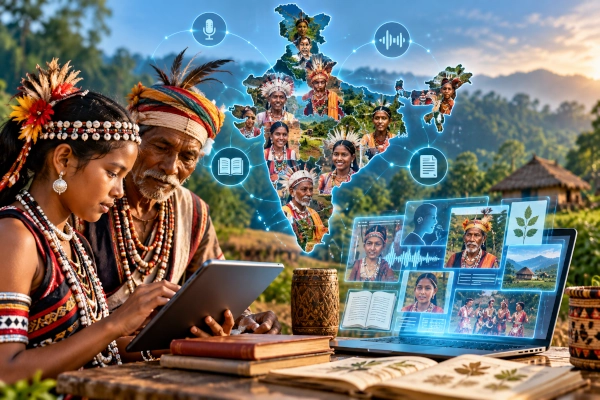
India is taking a significant step towards preserving its indigenous linguistic heritage through the development of a National Digital Repository for Tribal Languages, bringing together artificial intelligence, linguistic research, digital documentation and community participation. The Ministry of Tribal Affairs has initiated a coordinated programme involving leading Indian Institutes of Technology (IITs), universities, research institutions and tribal communities to protect endangered languages and make traditional linguistic knowledge accessible to future generations.
The initiative gained momentum on October 15, 2026, when the Ministry of Tribal Affairs convened the first meeting of its Working Group on Tribal Languages. The meeting focused on developing a national roadmap for documenting tribal languages, strengthening digital archives, preserving oral traditions and promoting mother-tongue-based education. Researchers and language specialists discussed how technology could support the systematic preservation of languages that have remained largely dependent on oral transmission.
At the centre of the programme is Adi Vaani, an artificial intelligence-powered language platform developed by IIT Delhi in collaboration with the Ministry of Tribal Affairs. Originally created to facilitate communication between tribal communities and government institutions, Adi Vaani is now being developed into a comprehensive national repository containing dictionaries, language datasets, educational resources, oral histories and traditional knowledge. The initiative will combine the technological capabilities of Indian research institutions with the linguistic expertise of indigenous communities.
Ministry of Tribal Affairs Establishes National Working Group on Tribal Languages
The Ministry of Tribal Affairs convened the first meeting of the Working Group on Tribal Languages on October 15, 2026, under the chairpersonship of Ranjana Chopra, Secretary, Ministry of Tribal Affairs. The meeting brought together linguists, academic researchers, technology specialists and community language practitioners to discuss the development of a coordinated national framework for preserving India’s tribal languages.
The Working Group includes representatives from IIT Delhi, IIT Dharwad, IIT Kanpur, the Central Institute of Indian Languages, Tezpur University, Manipur University, Assam University and Sikkim University. Distinguished participants included Padma Shri Chamu Krishna Shastry, Chairman of the Bhasha Samiti, and Dr. K. Sreenivasa Rao, former Secretary of the Sahitya Akademi. The discussions also benefited from expertise associated with the Living Tongues Institute for Endangered Languages and Indian organisations working on linguistic diversity and cultural preservation.
The Ministry has tasked the Working Group with developing an integrated approach to language documentation, research, technological development and educational applications. Participating institutions will examine existing linguistic resources, identify gaps in documentation and develop methods for bringing together research materials held by universities, Tribal Research Institutes and individual scholars.
The programme will place particular emphasis on community participation, recognising that indigenous language preservation requires the involvement of native speakers who possess detailed knowledge of pronunciation, vocabulary, oral traditions and cultural expressions. By establishing a coordinated institutional framework, the Ministry aims to strengthen existing preservation efforts and develop a sustainable national system for linguistic documentation.
India’s Tribal Languages Preserve Centuries of Cultural Knowledge
India is home to an extraordinary variety of indigenous languages that reflect the country’s diverse cultural traditions, geographical landscapes and historical experiences. These languages preserve knowledge associated with agriculture, forests, wildlife, medicinal plants, traditional occupations, social institutions and community practices that have evolved over generations.
According to information released by the Ministry of Tribal Affairs in 2025, India has 461 tribal languages spoken by Scheduled Tribe communities and 71 distinct tribal mother tongues, based on the Census 2011 classifications used in the Ministry’s assessment. The Ministry also identified 81 languages as vulnerable and 42 as critically endangered, highlighting the importance of sustained efforts to document and revitalise indigenous linguistic traditions.
Many tribal languages have historically developed through oral communication rather than extensive written literature. Traditional stories, songs, ceremonial expressions, agricultural knowledge and community histories are often transmitted directly from elders to younger generations. This oral heritage contains linguistic structures and cultural information that may not exist in conventional written records.
Changes in education, employment, migration and communication patterns have influenced the use of indigenous languages in several communities. Younger generations increasingly interact through dominant regional or national languages, which can gradually reduce the everyday use of smaller community languages.
Digital documentation provides an opportunity to preserve these languages while encouraging their continued use. By recording speech, developing dictionaries, preparing educational materials and creating searchable archives, the proposed national repository will support both linguistic research and intergenerational transmission of traditional knowledge.
Adi Vaani to Become India’s National Tribal Language Repository
Adi Vaani forms the technological foundation of the proposed national repository. Developed by IIT Delhi in collaboration with the Ministry of Tribal Affairs, the platform uses artificial intelligence and natural language processing to support communication between tribal languages and other widely used Indian languages.
The platform was initially designed to address communication difficulties encountered by tribal communities when accessing government services, educational information and public welfare programmes. Its translation capabilities allow information to be presented in languages familiar to local communities, improving opportunities for meaningful interaction with government institutions.
According to the Ministry’s October 15 announcement, Adi Vaani currently provides text-to-text translation in nine tribal languages, alongside speech-related functions, optical character recognition and video subtitling capabilities. The platform also provides searchable access to more than 300 language primers developed through Tribal Research Institutes and associated institutions.
The Ministry now intends to expand Adi Vaani beyond translation services by transforming it into a comprehensive digital repository. The proposed system will bring together language corpora, dictionaries, educational materials, recorded speech, oral narratives and community-developed linguistic resources within an integrated platform.
Ranjana Chopra highlighted the potential of Adi Vaani to serve as a national gateway for tribal languages while supporting community ownership of cultural and linguistic knowledge. The initiative seeks to create digital resources that remain useful to researchers, teachers, students, government institutions and the communities whose languages are being documented.
IIT Delhi Leads Artificial Intelligence Development for Indigenous Languages
IIT Delhi is playing an important role in developing the artificial intelligence technologies that support Adi Vaani. The platform combines natural language processing, machine translation, speech technologies and digital data management to address the challenges associated with languages that have limited representation in existing computing systems.
Modern language-processing technologies typically require extensive collections of written and spoken information. These datasets allow researchers to develop models capable of recognising words, understanding sentence structures and generating translations between languages. Widely used languages often possess substantial digital resources, making it easier to develop sophisticated language applications.
Many indigenous languages, however, have relatively small collections of digitised material. Some possess limited written literature, while others are primarily spoken within geographically concentrated communities. Differences in dialect, pronunciation and writing conventions create additional challenges for researchers developing automated translation and speech-recognition systems.
The Adi Vaani initiative addresses these limitations through collaboration between technical institutions, linguistic researchers and native-speaking communities. Field recordings, translated sentences and educational materials provide the foundational data required to improve language-processing systems.
The technological development has also involved a wider academic ecosystem, including BITS Pilani, IIIT Hyderabad and IIIT Naya Raipur, alongside participating research organisations. By combining expertise in artificial intelligence, computational linguistics and language documentation, the collaboration is helping develop specialised technologies suited to India’s indigenous linguistic diversity.
Tribal Research Institutes Contribute 13.9 Lakh Sentences and 300 Hours of Speech
The National Tribal Language Repository will build upon linguistic datasets already collected through cooperation between the Ministry of Tribal Affairs and state Tribal Research Institutes. These institutions have contributed substantial amounts of written and spoken material to support the development of Adi Vaani’s language-processing capabilities.
According to the Ministry’s latest announcement, approximately 13.9 lakh text sentences covering ten languages and 300 hours of recorded speech have been contributed to the programme. These resources provide an important foundation for developing translation models, speech-recognition applications, dictionaries and educational tools.
Written language datasets allow researchers to examine vocabulary, grammatical structures and relationships between expressions. Speech recordings provide additional information about pronunciation, intonation, regional variations and the characteristics of everyday spoken communication.
Such resources are particularly important for languages with limited standardised written documentation. By combining recorded speech with carefully prepared transcriptions and translations, researchers can create digital datasets that support both linguistic preservation and technological development.
The Ministry also reported that Adi Vaani has recorded more than 48,000 Android downloads and approximately 6,500 monthly users. These figures demonstrate growing public engagement with the platform and provide an operational foundation for its expansion into education, cultural documentation and public communication.
As additional linguistic resources become available, the repository will be able to support more comprehensive documentation and improve the accessibility of indigenous languages through digital applications.
Central Institute of Indian Languages Proposes Regional Research Networks
The Central Institute of Indian Languages (CIIL), Mysuru, is expected to contribute its extensive linguistic research expertise to the national programme. The institution has longstanding experience in language documentation, linguistic analysis, educational resource development and the study of India’s multilingual traditions.
During the Working Group meeting, CIIL Director Professor Basavraj Kudagonti recommended adopting a phased approach to language documentation. He proposed establishing regional research teams supported by coordinators who could guide documentation activities across different geographical and linguistic areas.
A regional approach would allow researchers to account for variations in language distribution, dialects, cultural practices and existing documentation resources. It would also facilitate collaboration between universities, local researchers and tribal communities working within the same geographical region.
Professor Shailendra Mohan, former Director of CIIL, emphasised the importance of cooperation between communities, schools and universities. He proposed developing an atlas of tribal languages and mother tongues across India to provide a clearer understanding of their geographical distribution and linguistic relationships.
Such an atlas could become an important research resource by bringing together information about language locations, speaker communities and regional variations. When integrated with digital mapping and searchable linguistic databases, it could help researchers identify languages requiring urgent documentation and support the planning of preservation activities.
The proposed regional networks will strengthen coordination while ensuring that documentation efforts remain responsive to the linguistic and cultural characteristics of individual communities.
IIT Kanpur and Tezpur University Bring Specialised Language Research Expertise
The involvement of IIT Kanpur and Tezpur University will expand the programme’s capabilities in computational linguistics, speech technology and community-based language documentation.
Dr. Chaitra Puttaswamy of IIT Kanpur highlighted the importance of training tribal community members to participate directly in collecting and documenting linguistic information. She proposed the use of engaging, non-verbal prompts to develop parallel language corpora that could support research across different languages.
Parallel corpora contain corresponding expressions or sentences in two or more languages. These collections are particularly valuable for machine translation because they help researchers understand how meanings and grammatical structures correspond across linguistic systems.
Using non-verbal prompts can also help researchers collect comparable expressions without relying exclusively on an intermediary language. Such approaches are useful when documenting languages that have limited written resources or significant differences in sentence structure.
Tezpur University is contributing specialised expertise in speech technologies for tonal languages spoken in northeastern India. Dr. Amalesh Gope offered access to research resources, dictionaries and speech datasets associated with regional languages.
Tonal languages use variations in pitch to distinguish meanings, creating additional challenges for automated speech recognition and language processing. Developing accurate technologies for these languages requires detailed phonetic information and carefully documented speech data.
The participation of these institutions will strengthen India’s research capabilities in low-resource language technologies while supporting the development of practical digital tools for indigenous communities.
Assam University and Sikkim University Support Indigenous Language Archives
Universities in northeastern India are contributing expertise in the documentation of languages associated with the region’s diverse indigenous communities.
Dr. Monali Longmailai of Assam University presented her experience with the community-based Bodo and Dimasa Heritage Digital Archive. The initiative demonstrates how digital technology can preserve language resources, oral traditions and cultural materials through collaboration between researchers and native-speaking communities.
Community archives can contain recorded conversations, traditional narratives, poetry, songs, dictionaries and other materials that reflect the linguistic and cultural characteristics of a particular group. Such collections provide valuable resources for academic research while supporting language learning among younger generations.
Dr. Samar Sinha of Sikkim University emphasised the importance of developing technical vocabulary in tribal languages for school subjects. Many modern educational concepts in mathematics, science and technology are introduced through languages that may not be familiar to students from indigenous communities.
Developing appropriate terminology within tribal languages can help teachers explain these concepts more effectively while supporting multilingual education. It can also strengthen the continued use of indigenous languages in contemporary academic and professional contexts.
The participation of Assam University, Sikkim University and other regional institutions will help the repository incorporate community-specific knowledge, educational resources and linguistic research developed through sustained engagement with indigenous populations.
Community Participation Will Remain Central to Language Preservation
The Ministry of Tribal Affairs has emphasised that tribal communities must remain active participants in documenting and preserving their languages. The programme recognises that linguistic preservation involves more than collecting words and recording speech; it also requires understanding the cultural meanings, traditions and social contexts associated with language use.
Dr. K. Sreenivasa Rao proposed establishing district-level community resource groups involving trained tribal youth. These groups could participate in documenting oral histories, recording traditional songs, collecting vocabulary and preserving community narratives.
Such participation would help develop local expertise while ensuring that language documentation reflects the perspectives of native speakers. Young community members could also acquire skills in digital recording, transcription, archival management and linguistic documentation.
The Working Group examined proposals for creating searchable directories of writers, researchers and linguistic resources organised by language and state. These directories could make existing materials easier to locate and encourage collaboration between institutions and community scholars.
Dr. Karthick Narayanan of the Council for Diversity and Innovation proposed developing a federated network of digital archives connected through common metadata standards. Under this approach, communities and institutions could maintain their own digital collections while making appropriate resources accessible through Adi Vaani.
The Ministry has stressed that linguistic resources developed in collaboration with communities should remain connected to their ownership and cultural rights. This principle is particularly important when documenting traditional knowledge, ceremonial expressions and other materials that may carry cultural sensitivities.
By incorporating community participation and ownership into the proposed framework, the national repository aims to preserve indigenous linguistic heritage while supporting its continued development.
Eklavya Model Residential Schools to Benefit from Tribal Language Resources
Education is expected to become an important application of the National Tribal Language Repository, particularly through the network of Eklavya Model Residential Schools (EMRS).
Representatives of the National Education Society for Tribal Students highlighted opportunities to use Adi Vaani’s digital resources in these institutions. According to the Ministry, more than 525 Eklavya Model Residential Schools serve over 1.7 lakh students from Scheduled Tribe communities.
The proposed repository could provide schools with access to multilingual dictionaries, educational primers, recorded stories, language-learning materials and digital translation tools. These resources can support students who are familiar with indigenous languages but receive formal instruction through another language.
Mother-tongue-based multilingual education helps connect classroom learning with the linguistic knowledge children develop within their families and communities. It can also support the transmission of indigenous vocabulary, oral literature and cultural traditions.
The Working Group discussed opportunities for teachers and students to contribute educational materials, poems, stories and suitable cultural content to the repository. Such participation would allow educational institutions to support language preservation while using the resulting resources in classroom activities.
The initiative complements the emphasis on multilingual education under the National Education Policy 2020, which recognises the importance of teaching and learning through familiar languages, particularly during foundational education.
By linking digital language resources with tribal education, the Ministry aims to support both academic learning and the preservation of community linguistic identity.
Digital Translation Could Improve Access to Government Services
The expansion of Adi Vaani also has important implications for public administration and the delivery of government services.
Language differences can create communication barriers when individuals seek information about healthcare, education, welfare programmes, agricultural assistance and other public services. These challenges are particularly relevant in regions where indigenous languages remain the primary means of everyday communication.
Artificial intelligence-powered translation tools can help government functionaries present information in languages understood by local communities. Speech-based technologies may provide additional support for individuals who are more comfortable communicating orally than through written documents.
Adi Vaani’s existing capabilities include text translation, speech-related functions, optical character recognition and video subtitling. These technologies can support different forms of multilingual communication, including the translation of written information and the preparation of accessible audiovisual materials.
The Ministry has identified improved outreach and welfare delivery among the potential benefits of expanding the platform. By developing additional language resources, the programme can strengthen communication between public institutions and tribal communities.
The repository’s educational materials and linguistic datasets can also support the development of future digital applications tailored to regional requirements.
As the platform expands, its combination of translation technology and community-developed language resources will create opportunities to improve digital accessibility while encouraging the everyday use of indigenous languages.
National Repository to Follow a Phased Two-Year Development Roadmap
The Working Group has proposed a structured approach to developing the National Tribal Language Repository, recognising that comprehensive documentation requires sustained research, technical development and community participation.
Dr. K. Sreenivasa Rao recommended a two-year action plan supported by quarterly reviews. The proposed framework would allow participating institutions to evaluate progress, coordinate research activities and address challenges encountered during language documentation.
The roadmap is expected to include the preparation of a national linguistic baseline, documentation of endangered languages, collection of speech and text datasets, development of educational materials and expansion of digital archives.
The Ministry also intends to gather information about linguistic resources already available with universities, Tribal Research Institutes and individual researchers. This exercise will help identify existing documentation and determine where additional field research is required.
The programme will need to accommodate differences between languages in the availability of written materials, recorded speech, standardised vocabulary and trained researchers. A phased approach will allow institutions to develop suitable methodologies for different linguistic communities.
Regular coordination between academic institutions, language specialists and community representatives will help maintain consistency in documentation while respecting regional differences.
The Ministry has indicated that the Working Group’s discussions will inform the preparation of a more detailed implementation roadmap for the national initiative.
Artificial Intelligence Opens New Opportunities for Indian Language Research
The National Tribal Language Repository represents an important development in India’s growing research capabilities in artificial intelligence and computational linguistics.
Many modern AI language systems are trained primarily on languages with extensive digital resources. This creates technological limitations for smaller languages that have not been systematically documented or digitised.
Developing datasets for tribal languages provides an opportunity to address this imbalance while advancing research into speech recognition, machine translation and multilingual computing.
The participation of IITs, universities and specialised linguistic institutions will help create a stronger domestic research ecosystem for low-resource language technologies.
These developments can also support innovation in educational software, digital libraries, multilingual public communication and speech-based applications.
Importantly, the programme connects technological development with cultural preservation. Rather than treating indigenous languages solely as subjects of historical research, the initiative seeks to develop practical digital tools that support their continued use.
By building language resources through community collaboration, India is creating opportunities for artificial intelligence to serve populations whose languages have remained underrepresented in modern computing systems.
India Moves to Preserve Tribal Languages for Future Generations
The Ministry of Tribal Affairs’ initiative to develop a National Digital Repository for Tribal Languages represents a significant step towards preserving India’s indigenous linguistic diversity through modern technology and coordinated research.
The programme brings together IIT Delhi, IIT Dharwad, IIT Kanpur, the Central Institute of Indian Languages, universities across India and organisations specialising in endangered language preservation.
With approximately 13.9 lakh text sentences, 300 hours of recorded speech and more than 300 educational primers already available through participating institutions, Adi Vaani provides a foundation for expanding digital language documentation.
The proposed development of community archives, linguistic directories, digital dictionaries and educational materials will strengthen the platform’s role in preserving cultural knowledge while supporting practical applications in education and public communication.
Equally important is the emphasis on community participation and ownership, ensuring that indigenous languages remain connected to the people who speak them and the traditions they represent.
As India advances its capabilities in artificial intelligence and digital public infrastructure, the National Tribal Language Repository will help extend these technologies to communities whose linguistic heritage has received limited representation in the digital world.
The initiative will contribute to preserving India’s extraordinary cultural diversity while encouraging the continued use, study and development of indigenous languages. By combining scientific research, advanced computing and community knowledge, India is building a digital foundation that can carry its tribal linguistic traditions into the future.
References
- Ministry of Tribal Affairs, Government of India. Ministry of Tribal Affairs Holds the First Meeting of the Working Group on Tribal Languages. Press Information Bureau, October 15, 2026.https://www.pib.gov.in/PressReleseDetailm.aspx?PRID=2323661&lang=1®=3
- Ministry of Tribal Affairs, Government of India. Adi Vaani — AI-Powered Tribal Language Platform. Official platform for indigenous language translation and digital resources.https://adivaani.tribal.gov.in/
- Ministry of Tribal Affairs, Government of India. Adi Vaani: India’s AI-Powered Tribal Language Translation Initiative. Press Information Bureau, September 2025.https://www.pib.gov.in/PressReleasePage.aspx?PRID=2162278
- Ministry of Tribal Affairs, Government of India. National Conclave on Tribal Languages and Museums Begins in Mysuru. August 24, 2026.https://www.pib.gov.in/newsite/erelcontent.aspx?lang=2®=48&relid=293876
- Ministry of Tribal Affairs, Government of India. Adi-Vaani, AI-Driven Platform for Tribal Language. Lok Sabha parliamentary reply, March 12, 2026.https://www.pib.gov.in/PressReleasePage.aspx?PRID=2238967&lang=1®=3
- Ministry of Tribal Affairs, Government of India. Tribal Repository — Digital Documentation of India’s Tribal Heritage.https://tribal.nic.in/repository/AboutUS.aspx
You may also like
-
Gandhara: The Northwestern Kingdom of Gandhari and Shakuni in the Mahabharata
-
Kekaya or Kaikeya: The Western Punjab Kingdom Divided by the Kurukshetra War
-
Madra: The Ancient Punjab Kingdom of Shalya and Madri in the Mahabharata
-
BRICS Theatre Festival 2026 Opens in New Delhi, Bringing Together Nine Nations to Strengthen Cultural Cooperation
-
Sauvira: The Indus Realm Linked With Jayadratha in the Mahabharata
