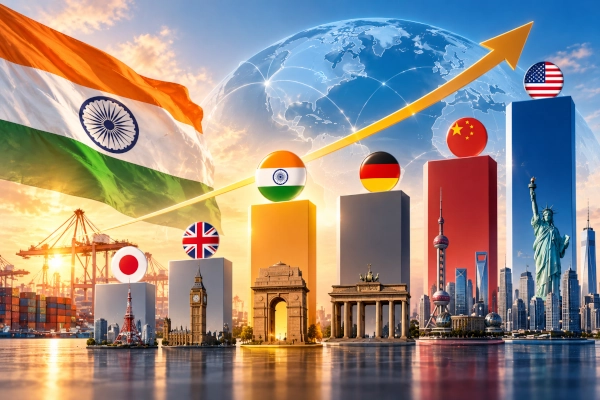
India is projected to become the world’s fourth-largest economy in 2027, overtaking Japan and the United Kingdom in nominal gross domestic product (GDP), according to the International Monetary Fund’s (IMF) October 2026 World Economic Outlook. The latest projections place India’s economy at approximately $4.52 trillion in 2027, reflecting the country’s expanding economic scale and sustained growth momentum.
The IMF’s updated estimates indicate that India will move ahead of Japan, whose nominal GDP is projected at approximately $4.47 trillion, and the United Kingdom, which is expected to reach $4.49 trillion. The United States, China and Germany are projected to retain the first three positions among the world’s largest economies.
The revised outlook also reflects India’s comparatively strong economic growth. The IMF has raised its forecast for India’s real GDP growth in FY 2026–27 to 7%, compared with its earlier estimate of 6.4%. The institution expects India to maintain 7% growth in FY 2027–28, supported by domestic economic activity and the services sector.
The latest projections, published in October 2026, represent an important development in India’s long-term economic expansion. They also demonstrate how differences in real economic growth, inflation and currency exchange rates can influence the relative size of national economies when measured in US dollars.
India Expected to Overtake Japan and United Kingdom in 2027
The IMF’s October 2026 World Economic Outlook projects a significant change in the ranking of the world’s largest economies.
India’s nominal GDP is forecast to increase from approximately $4.06 trillion in 2026 to $4.52 trillion in 2027. Over the same period, Japan’s nominal economic output is expected to reach $4.47 trillion, while the United Kingdom is projected to record approximately $4.49 trillion.
These estimates would place India ahead of both countries, making it the fourth-largest economy in nominal US dollar terms.
The projected rankings for 2027 are:
| Rank | Country | Projected nominal GDP |
|---|---|---|
| 1 | United States | $34.44 trillion |
| 2 | China | $22.94 trillion |
| 3 | Germany | $5.66 trillion |
| 4 | India | $4.52 trillion |
| 5 | United Kingdom | $4.49 trillion |
| 6 | Japan | $4.47 trillion |
The projections show relatively small differences between India, the United Kingdom and Japan. Changes in currency exchange rates, economic growth or inflation could therefore alter their final rankings.
The IMF’s October estimates nevertheless indicate that India’s economy is approaching another milestone in its expansion within the global economic system.
IMF Raises India’s Economic Growth Forecast to 7%
The IMF has upgraded India’s real GDP growth forecast for FY 2026–27 from 6.4% to 7%, reflecting stronger domestic economic momentum than previously anticipated.
The institution has also projected growth of 7% for FY 2027–28, indicating expectations of continued economic expansion over the next two financial years.
India’s projected growth remains substantially higher than the IMF’s global economic growth estimates of 3.1% for 2026 and 3.4% for 2027.
The difference highlights India’s position as one of the fastest-growing major economies, supported by its large domestic market, services activity, investment and infrastructure development.
Domestic consumption remains an important component of India’s economic activity, while manufacturing, construction and technology-related services contribute to employment, production and investment.
The IMF’s revised assessment comes amid uncertainty surrounding international energy prices, geopolitical developments and global financial conditions. India’s projected growth performance reflects the importance of its domestic economic foundations in sustaining activity during a challenging international environment.
India’s Economic Expansion Reflects Long-Term Structural Changes
India’s rise in the global economic rankings reflects decades of expansion across manufacturing, services, infrastructure and domestic consumption.The economy has undergone considerable transformation through improvements in transportation infrastructure, telecommunications, financial services and industrial production.
India’s information technology and business services industries have become major contributors to international trade, providing services to customers across North America, Europe, Asia and other regions.At the same time, the country’s domestic market has expanded as economic activity has increased across urban centres, industrial regions and emerging commercial locations.
Investments in roads, railways, ports, airports and logistics networks have strengthened connections between production centres and consumer markets.The growth of digital infrastructure has also transformed commercial activity by expanding access to financial services, enabling electronic payments and supporting technology-driven businesses.
These developments have contributed to the expansion of India’s productive capacity and its increasing participation in international economic activity.
Manufacturing Sector Supports India’s Economic Ambitions
Manufacturing occupies an important position in India’s efforts to strengthen long-term economic growth.
The country has expanded industrial activity across automobiles, pharmaceuticals, engineering goods, chemicals, electronics, renewable energy equipment and defence manufacturing.Government initiatives such as Make in India and Production Linked Incentive schemes have sought to encourage manufacturing investment and increase domestic production capabilities.
Electronics manufacturing has emerged as a prominent area of industrial expansion, particularly through investments in mobile phone production, electronic components and supporting manufacturing facilities.India’s engineering industry also contributes to domestic infrastructure projects and international merchandise exports, supplying machinery, components and industrial equipment to overseas markets.
Pharmaceutical manufacturing remains another important industrial strength, supported by India’s established capabilities in generic medicines, vaccines and active pharmaceutical ingredients.The development of these industries contributes to economic output while creating opportunities for specialised suppliers, engineering companies and supporting service providers.
Sustained improvements in manufacturing productivity, technology adoption and supply-chain efficiency will remain important to India’s long-term economic expansion.
Services Sector Remains a Major Contributor to GDP
India’s services sector has developed into a major component of the country’s economy, contributing substantially to domestic output, employment and international trade.Information technology, financial services, telecommunications, business consulting, transportation and professional services form important parts of this economic activity.
Indian technology companies have established a substantial international presence by supplying software development, business services, digital transformation and technology consulting to global customers.The growth of financial technology has also supported domestic economic activity by expanding digital payments, financial services and access to technology-enabled commercial platforms.
India’s startup ecosystem contributes to this development through businesses operating in artificial intelligence, enterprise software, healthcare technology, financial services and other emerging industries.he increasing adoption of digital technologies across established businesses has created demand for specialised services and new technological capabilities.
The IMF’s positive growth outlook recognises the contribution of services activity to India’s economic performance, particularly as international and domestic demand for technology-enabled services continues to evolve.
Infrastructure Development Strengthens India’s Productive Capacity
Infrastructure investment has been a central component of India’s economic development strategy.
The expansion of national highways, railway networks, airports, ports and urban transportation systems has improved connectivity across major industrial and commercial regions.
Projects involving freight corridors, multimodal logistics facilities and modernised transportation infrastructure are intended to reduce logistical constraints and improve the efficiency of moving goods.Better connectivity supports manufacturers by improving access to raw materials, production facilities, suppliers and domestic markets.
Infrastructure development also creates demand for construction materials, machinery, engineering services and skilled employment.
India’s growing electricity generation and transmission infrastructure supports the requirements of expanding industrial production and urban development.Investments in renewable energy, nuclear power, energy storage and electricity networks are also contributing to the development of a more diversified energy system.
These improvements in physical infrastructure support long-term productive capacity, providing an important foundation for sustained economic expansion.
Domestic Consumption Provides an Important Source of Economic Activity
India’s large domestic consumer market represents an important component of its economic growth.
Household expenditure supports activity across food production, retail, housing, transportation, healthcare, education and consumer services.
The expansion of digital commerce has created additional opportunities for businesses to reach customers across different regions.Technology-enabled marketplaces, logistics networks and electronic payment systems have made it easier for enterprises to conduct transactions and expand commercial operations.
The growth of organised retail and consumer manufacturing has also encouraged investment in distribution infrastructure, warehousing and supply-chain management.India’s demographic structure provides a substantial working-age population, creating opportunities for production, entrepreneurship and consumption.The economic benefits of this demographic profile depend upon continued improvements in employment opportunities, skills development, productivity and workforce participation.
The interaction between domestic consumption and industrial investment remains important to maintaining economic momentum.
Japan’s Economic Outlook Influences the Global Rankings
Japan remains one of the world’s most technologically advanced economies, with substantial capabilities in automobile manufacturing, electronics, industrial machinery, robotics and precision engineering.However, the country’s economic growth has been comparatively modest in recent years.
The IMF expects Japan’s real GDP growth to remain around 0.7% in 2026 and 2027.
Japan also faces long-term demographic challenges associated with population ageing and a declining working-age population.These trends influence labour availability, domestic demand and the country’s long-term economic growth potential.
Currency movements have also played an important role in Japan’s international GDP ranking.Because nominal GDP rankings are expressed in US dollars, depreciation of the Japanese yen can reduce the dollar value of Japan’s economic output even when domestic production continues to grow.
The IMF’s projections therefore reflect a combination of real economic performance, domestic price developments and exchange-rate assumptions.Japan is expected to remain a major global industrial and technological economy despite the projected change in its nominal GDP ranking.
Why Nominal GDP Rankings Depend on Exchange Rates
The IMF’s projected ranking is based on nominal gross domestic product expressed in current US dollars.
Nominal GDP measures the value of goods and services produced within an economy using prevailing prices.
For international comparisons, the value is converted into US dollars using applicable exchange rates.Consequently, changes in exchange rates can influence a country’s position in nominal GDP rankings independently of changes in actual production volumes.
For example, a weakening domestic currency can reduce the dollar value of an economy even when its output increases in local currency terms.Similarly, currency appreciation can increase the dollar value of national output without an equivalent increase in real production.
This distinction is particularly relevant to the projected 2027 rankings because the differences between India, the United Kingdom and Japan are relatively small.India’s projected GDP of approximately $4.52 trillion is only modestly higher than the estimates for the other two countries.
The IMF’s projections should therefore be understood as a forecast based on current economic assumptions rather than a final ranking that has already been achieved.
India Already Ranks Among the Largest Economies Under Purchasing Power Parity
Another important method of comparing national economies involves Purchasing Power Parity, commonly known as PPP.
PPP-based GDP adjusts for differences in domestic price levels and the purchasing power of currencies.This approach provides a different perspective on economic size because the same amount of money can purchase different quantities of goods and services across countries.
Under PPP-based comparisons, India is already among the world’s largest economies, ranking third behind China and the United States.
The IMF’s projection concerning India’s rise to fourth place in 2027 refers specifically to nominal GDP measured in US dollars.Both indicators are useful, but they serve different analytical purposes.
Nominal GDP is particularly relevant when examining international financial comparisons, while PPP-based GDP helps assess the volume of economic activity after adjusting for price-level differences.
Neither measure alone provides a complete assessment of household income, living standards or economic well-being.
Per-Capita Income Remains Important to India’s Development
India’s projected rise to the fourth position in nominal GDP reflects the increasing scale of its economy.
However, total GDP measures aggregate economic output rather than income per person.
A country with a large population can have substantial total economic output while recording a lower GDP per capita than smaller, wealthier economies.India’s development therefore involves both expanding total economic production and improving income levels, productivity and employment opportunities.Investment in education, healthcare, infrastructure and workforce skills can contribute to higher productivity and stronger long-term economic outcomes.
The development of advanced manufacturing industries and technology-intensive businesses can also create opportunities for higher-value employment.Improving agricultural productivity and strengthening economic opportunities in smaller towns and rural regions remain important components of inclusive economic development.
The projected rise in India’s global GDP ranking represents a measure of aggregate economic progress, while improvements in per-capita income and living standards remain essential indicators of the country’s wider development.
India’s Economic Outlook Faces Global Challenges
The IMF’s October 2026 World Economic Outlook identifies several international risks that could influence economic performance.Elevated energy prices represent an important concern for major energy-importing countries, including India.
Higher crude oil prices can increase import costs and place pressure on transportation, manufacturing and household expenditure.Disruptions to international shipping routes and supply chains can also affect trade flows and the availability of industrial inputs.Global financial conditions present another challenge, particularly when changes in interest rates and investor preferences influence international capital flows.
Currency movements can affect the value of imports, exports and foreign-currency-denominated economic indicators.
The IMF has also highlighted uncertainty associated with geopolitical tensions and changes in the international trading environment.India’s large domestic economy provides an important source of economic activity, while export diversification, infrastructure development and investment in domestic manufacturing contribute to its broader economic capacity.
Continued attention to economic stability, productive investment and supply-chain development remains relevant as India expands its international economic presence.
India’s Growing Economy Strengthens Its Position in Global Trade
India’s expanding economic scale is accompanied by increasing participation in global merchandise and services trade.
The Ministry of Commerce and Industry reported that merchandise exports reached $44.40 billion in September 2026, reflecting year-on-year growth of approximately 23%.Electronic goods, engineering products, petroleum products and chemicals contributed substantially to the increase.
The expansion of manufacturing exports reflects growing international demand for products manufactured by Indian industries.India’s services exports also represent an important source of foreign exchange earnings, supported by technology, business services and professional activities.
The country’s commercial relationships extend across major markets in North America, Europe, Asia, Africa and the Middle East.International trade agreements, export promotion initiatives and improvements in logistics infrastructure contribute to India’s efforts to expand commercial relationships.
A larger and more diversified export economy can support manufacturing investment, employment and international business opportunities.
These activities reinforce India’s growing participation in global production networks and international trade.
Economic Expansion Creates Opportunities for Indian Enterprises
India’s projected economic growth provides an encouraging environment for businesses operating across manufacturing, technology, infrastructure and services.
Large enterprises are investing in production facilities, logistics infrastructure and advanced industrial technologies, while startups are developing products in emerging sectors.
Artificial intelligence, semiconductors, biotechnology, renewable energy, defence manufacturing and space technology have become important areas of technological and industrial development.
India’s startup ecosystem has expanded opportunities for innovation, supported by entrepreneurs, research institutions and investment organisations.Small and medium-sized enterprises also play an important role in manufacturing, trade and employment.
The expansion of domestic supply chains creates opportunities for smaller businesses to supply components, materials and specialised services to larger manufacturers.Greater adoption of digital technology can support efficiency and help enterprises reach wider markets.
The interaction between established industries, emerging technology businesses and research institutions contributes to the development of a more diversified economic structure.
India Moves Towards Another Milestone in Its Economic Development
The IMF’s October 2026 World Economic Outlook projects that India will become the world’s fourth-largest economy in 2027, with nominal GDP reaching approximately $4.52 trillion.
The forecast places India ahead of Japan and the United Kingdom, while the United States, China and Germany are expected to retain the three largest positions.The projection reflects India’s sustained economic expansion, supported by domestic demand, services activity, manufacturing development and infrastructure investment.
India’s economic progress has also been accompanied by growth in digital infrastructure, financial services, export-oriented manufacturing and emerging technology industries.The country’s increasing economic scale creates opportunities for businesses, investors and workers while strengthening its participation in international trade and global economic activity.
At the same time, improvements in productivity, employment, household incomes and living standards remain central to the country’s longer-term development.
With the IMF forecasting 7% real GDP growth for FY 2026–27 and FY 2027–28, India’s economic outlook continues to demonstrate considerable momentum.The projected transition to the world’s fourth-largest economy represents another significant milestone in India’s development as a major centre of manufacturing, services, innovation and global commerce.
References
1. International Monetary Fund — World Economic Outlook Database
Date: October 2026
Title: World Economic Outlook Database, October 2026
Details: Official IMF forecasts for nominal GDP, real GDP growth, inflation, purchasing-power-parity comparisons and other economic indicators.
https://data.imf.org/Datasets/WEO
2. International Monetary Fund — World Economic Outlook
Date: October 2026
Details: Global economic growth projections, regional economic assessments and risks associated with inflation, energy prices and international financial conditions.
https://www.imf.org/en/Publications/WEO
3. International Monetary Fund — IMF DataMapper
Details: Country-level indicators for India, including nominal GDP, purchasing-power-parity GDP, real growth and other economic projections.
https://www.imf.org/external/datamapper/profile/IND/WEO
4. Ministry of Commerce and Industry, Government of India — Press Information Bureau
Date: October 15, 2026
Title: India’s Export and Import Performance, September 2026
Details: Merchandise exports, services trade, manufacturing export growth and cumulative trade figures for April–September 2026.
https://www.pib.gov.in/PressReleseDetailm.aspx?PRID=2323944
5. Reserve Bank of India
Details: Indian economic statistics, financial stability assessments, macroeconomic developments and official monetary policy publications.
https://www.rbi.org.in
6. Financial Express
Date: October 15, 2026
Title: India to Overtake Japan as 4th-Largest Economy in 2027, IMF Projects $4.52 Trillion GDP
https://www.financialexpress.com/policy/economy/india-to-overtake-japan-as-4th-largest-economy-in-2027-imf-projects-4-52-trillion-gdp/4362280
You may also like
-
India’s ₹1,000 Crore Space Venture Capital Fund to Accelerate Indigenous Space Startups and Advanced Technologies
-
BHAVYA: India’s push to build 100 plug-and-play industrial parks
-
India’s Gem and Jewellery Exports Rise 9.43% to $2.95 Billion in September 2026, Driven by Gold Jewellery and Lab-Grown Diamonds
-
India Launches National Strategic Trade Command Centre to Strengthen Export Intelligence
-
Biocon Secures Global Patent Settlement with Genentech for Pebrilzo Biosimilar, Targets European Launch in 2027
