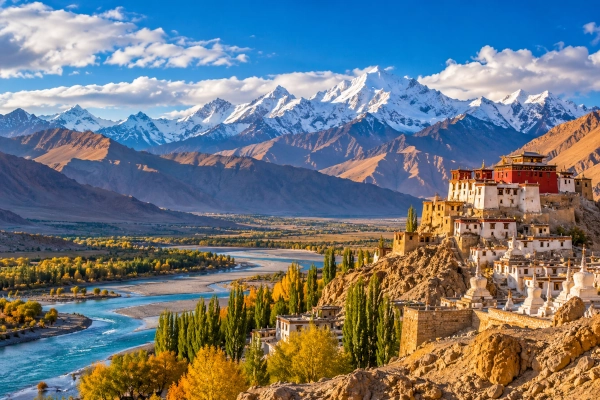
Prime Minister Narendra Modi inaugurated and dedicated five major development projects worth approximately ₹3,350 crore in Ladakh on October 15, 2026, marking another important milestone in the Union Territory’s infrastructure development. The projects encompass airport modernisation, strategic road connectivity, hydroelectric power generation, agricultural water conservation and archaeological heritage preservation. Together, these initiatives aim to improve living standards, strengthen regional connectivity, support economic activities and create new opportunities for communities across the high-altitude Himalayan region.
Addressing the people of Ladakh through video conferencing, the Prime Minister reaffirmed the Central Government’s commitment to accelerating development while protecting the region’s fragile environment and distinctive cultural heritage. He highlighted the considerable progress achieved in transportation, electricity, drinking water, healthcare, tourism and education since Ladakh became a Union Territory in 2019. The Prime Minister also acknowledged the contributions of engineers, construction workers, local communities and Border Roads Organisation personnel who worked under difficult geographical and climatic conditions to complete these projects.
Leh Airport’s New ₹650 Crore Terminal to Handle 35 Lakh Passengers Annually
One of the most significant projects inaugurated by the Prime Minister was the new passenger terminal at Kushok Bakula Rimpochee Airport in Leh, developed at an investment of approximately ₹650 crore. The modern terminal substantially expands the airport’s capacity, increasing annual passenger-handling capability from approximately 10 lakh to 35 lakh passengers. This threefold expansion represents an important improvement in Ladakh’s aviation infrastructure and will help accommodate the growing number of tourists, business travellers and residents travelling between the Union Territory and other parts of India.
The new terminal incorporates advanced infrastructure designed to function efficiently under Ladakh’s extreme climatic conditions, where winter temperatures frequently fall well below freezing. According to the Prime Minister, the facility is India’s first airport terminal to incorporate geothermal heating technology alongside solar energy utilisation. The integration of these technologies demonstrates how modern infrastructure can respond to local environmental conditions while reducing dependence on conventional energy sources. Such climate-responsive engineering is particularly relevant to Ladakh, where maintaining comfortable indoor temperatures requires considerable energy during the long winter season.
The expanded airport infrastructure is expected to strengthen tourism, hospitality and commercial activities throughout the region. Improved passenger-handling capacity will benefit hotels, homestays, transport operators, travel agencies and local businesses that depend on reliable air connectivity. The development will also improve access for residents who rely on air transportation when difficult weather conditions affect surface connectivity. The Prime Minister emphasised that the government’s objective is to develop modern infrastructure in Ladakh while ensuring that ecological considerations remain central to the development process.
₹2,500 Crore Nimmu–Padum–Darcha Road Transforms Connectivity to Zanskar
The Prime Minister dedicated the Nimmu–Padum–Darcha road, developed at an investment of approximately ₹2,500 crore, providing a major improvement in connectivity between Ladakh and Himachal Pradesh. Constructed by the Border Roads Organisation, the strategically important corridor connects Nimmu near Leh with Darcha through the remote Zanskar Valley. The road establishes an additional transportation route to Ladakh, complementing the existing Srinagar–Leh and Manali–Leh highways while improving accessibility to settlements that have historically faced considerable transportation difficulties.
According to the Prime Minister, the new road will reduce travel time on the relevant route from approximately 12 hours to three hours, significantly improving mobility for residents, traders and visitors. For communities living in Zanskar and neighbouring valleys, improved road access will make it easier to transport agricultural produce, construction materials, essential commodities and other goods. The corridor will also create opportunities for local tourism enterprises by allowing visitors to reach previously difficult-to-access destinations more conveniently, supporting employment in hospitality, transportation, handicrafts and related activities.
The Nimmu–Padum–Darcha road also carries considerable strategic importance because it provides an alternative approach to Ladakh through the Himalayan mountain system. Improved road infrastructure will strengthen logistical capabilities and facilitate the transportation of personnel, equipment and essential supplies. The project reflects the government’s continuing emphasis on developing border infrastructure that serves both national security requirements and the economic needs of remote communities. Its completion also demonstrates the engineering capabilities developed by Indian infrastructure agencies in constructing roads across challenging high-altitude terrain.
Hanu Hydroelectric Project Strengthens Ladakh’s Electricity Infrastructure
The Prime Minister dedicated the Hanu hydroelectric project and its associated transmission network, strengthening electricity generation and distribution infrastructure in Ladakh. The project forms part of broader efforts to provide dependable electricity to communities spread across remote valleys and mountainous settlements. Reliable power supply is particularly important in Ladakh because severe winters, geographical isolation and difficult transportation conditions create additional challenges for maintaining essential public services and supporting economic activities.
Improved electricity availability will directly benefit households, schools, healthcare centres, small industries and commercial establishments throughout the region. Educational institutions will gain better access to digital learning facilities, while hospitals and healthcare centres will be able to operate essential medical equipment more reliably. Local entrepreneurs engaged in food processing, handicrafts, hospitality and other activities will also benefit from improved electricity infrastructure, which can support business expansion and reduce operational difficulties caused by interruptions in power supply.
The Prime Minister also highlighted ongoing initiatives to develop modern power generation facilities in the Puga Valley, an area known for its geothermal energy potential. These initiatives complement earlier investments in Ladakh’s electricity transmission network, including the Srinagar–Leh transmission line. By expanding local generation capacity and strengthening transmission infrastructure, the government is working to improve regional energy security while encouraging the adoption of energy technologies suited to Ladakh’s distinctive geographical and climatic conditions.
Forty New Reservoirs to Improve Irrigation and Agricultural Water Security
Agricultural water conservation received a major boost with the dedication of 40 newly constructed reservoirs under Project Amrit Him Sarovar. These reservoirs have been developed to improve water availability for irrigation and strengthen agricultural resilience in a region where farming is heavily influenced by seasonal conditions. Ladakh experiences low precipitation, prolonged freezing temperatures and a relatively short cultivation period, making efficient water storage and management essential for sustaining agricultural production.
The newly constructed reservoirs will enable farming communities to store water and utilise it during important stages of crop cultivation, particularly when natural water availability becomes insufficient. Better irrigation facilities can help farmers maintain vegetable cultivation, fruit production and other agricultural activities while reducing the uncertainties associated with seasonal variations in water supply. The reservoirs will also complement ongoing efforts to expand protected cultivation and improve productivity in Ladakh’s high-altitude agricultural environment.
The initiative is particularly relevant to rural communities that depend on agriculture and allied activities for their livelihoods. Improved water management can support more dependable cultivation practices and create opportunities for farmers to diversify into higher-value crops. By strengthening irrigation infrastructure alongside modern agricultural technologies, the government is working to improve local food production, enhance farming incomes and build greater resilience against the environmental challenges associated with agriculture in the Himalayan region.
India’s First Petroglyph Conservation Park Inaugurated in Leh
The Prime Minister inaugurated India’s first Petroglyph Conservation Park in Leh, establishing a dedicated initiative for protecting Ladakh’s ancient rock art and archaeological heritage. The region contains numerous examples of prehistoric and historical rock carvings that provide valuable evidence of human settlement, cultural practices and artistic traditions across different periods. These archaeological remains form an important part of Ladakh’s historical identity and offer insights into the communities that inhabited and travelled through the Himalayan region over centuries.
Petroglyphs are images, symbols and inscriptions created by engraving, carving or pecking rock surfaces. Such markings can depict animals, human activities, religious symbols and other representations associated with the beliefs and lifestyles of ancient communities. Ladakh’s rock art is particularly significant because of the region’s historical role in facilitating cultural interactions across the Himalayan and trans-Himalayan regions. The conservation park will provide a dedicated setting for safeguarding these fragile remains while promoting archaeological awareness, heritage education and responsible tourism.
The project complements the preservation of Ladakh’s broader cultural landscape, which includes ancient Buddhist monasteries, traditional festivals, religious institutions and historic settlements. The Prime Minister emphasised that protecting this heritage will allow future generations to appreciate Ladakh’s ancient traditions while introducing visitors from India and abroad to the region’s cultural richness. Heritage conservation can also create opportunities for local communities through cultural tourism, educational activities and services associated with historically important destinations.
Ladakh’s Road Network Expands from 1,800 Kilometres to Over 4,000 Kilometres
Highlighting the transformation of Ladakh’s infrastructure since it became a Union Territory in 2019, the Prime Minister stated that the region’s road network has expanded from approximately 1,800 kilometres to more than 4,000 kilometres. This substantial increase reflects continued investment in transportation infrastructure across difficult mountain terrain, where settlements are frequently separated by long distances and access can become severely restricted during winter. The expansion has improved connectivity between villages, administrative centres, tourism destinations and strategically important locations.
The Prime Minister also noted that the number of major bridges has increased from 19 to nearly 75, while helipad infrastructure has expanded from seven facilities to more than 40. These improvements have strengthened transportation capabilities across areas where rivers, deep valleys and mountain passes create significant barriers to movement. Bridges provide more dependable road access, while helipads support emergency medical evacuation, disaster response, administrative operations and essential transportation requirements in remote settlements.
Another important component of Ladakh’s connectivity programme is the ongoing Zojila Tunnel project, which is expected to strengthen all-weather transportation between Ladakh and the Kashmir Valley. The tunnel forms part of efforts to reduce the region’s dependence on mountain passes that become difficult or inaccessible during periods of heavy snowfall. Together, the expansion of roads, bridges, aviation infrastructure and tunnel connectivity will support greater economic integration, improved public services and more dependable movement of essential supplies.
Household Tap Water Coverage Rises from 3.5% to Nearly 99%
The Prime Minister highlighted major improvements in drinking water infrastructure, stating that household tap water coverage in Ladakh has increased from approximately 3.5% to nearly 99%. This expansion represents a substantial improvement in access to piped drinking water for communities living across the Union Territory. Providing reliable water supply in Ladakh requires specialised infrastructure because freezing temperatures, difficult terrain and widely dispersed settlements create considerable challenges for pipeline installation, water storage and distribution.
Improved household water connections reduce dependence on distant water sources and ease the physical burden associated with collecting water, particularly during severe winter conditions. Reliable drinking water availability also contributes to better sanitation, public health and household convenience. The expansion of water infrastructure demonstrates the importance of adapting national development programmes to the specific geographical requirements of high-altitude regions.
Healthcare infrastructure has also received increased attention, with the Prime Minister stating that the number of hospital beds in Ladakh has doubled. Expanding healthcare capacity is particularly important for remote communities where patients may otherwise need to travel considerable distances to obtain treatment. Additional hospital infrastructure, supported by improved electricity, roads and digital connectivity, will strengthen the region’s ability to provide essential healthcare services and respond to medical emergencies.
Winter Tourism and Adventure Activities Create New Economic Opportunities
The government is actively promoting winter tourism and adventure activities to diversify Ladakh’s tourism economy and create employment opportunities beyond the conventional summer tourist season. The region’s distinctive mountain landscapes, snow-covered valleys, frozen water bodies and cultural heritage provide considerable potential for specialised tourism activities. Winter sports, mountaineering, trekking and cultural experiences can attract visitors while generating demand for local accommodation, transportation, guiding services and other tourism-related businesses.
The Prime Minister highlighted the remarkable growth of homestay accommodation across Ladakh, stating that the number of homestays has increased from approximately 150 to 3,000. This expansion has created new opportunities for local households to participate directly in the tourism economy. Homestays allow visitors to experience traditional Ladakhi hospitality, regional cuisine and local cultural practices while providing families with additional income. They also distribute tourism-related economic activity across smaller settlements rather than concentrating all benefits in major commercial centres.
The government is also upgrading more than 40 border settlements under the Vibrant Villages Programme, which focuses on improving infrastructure and strengthening economic opportunities in remote communities. Better roads, telecommunications, public facilities and livelihood opportunities can help residents develop sustainable local enterprises while improving access to essential services. These initiatives are intended to support the long-term development of border villages and encourage greater economic activity in areas that have traditionally faced geographical isolation.
Ladakh’s 11,000 Greenhouses Strengthen High-Altitude Agriculture
The Prime Minister stated that approximately 11,000 greenhouses are now operational across Ladakh, reflecting the increasing adoption of protected cultivation techniques in the region. Greenhouse agriculture has particular significance in Ladakh because its high-altitude climate restricts conventional farming to a relatively short growing season. Protected cultivation allows farmers to create more favourable growing conditions by reducing exposure to freezing temperatures, strong winds and other environmental challenges.
The expansion of greenhouse infrastructure supports the cultivation of vegetables and other crops that might otherwise be difficult to produce consistently under open-field conditions. By extending cultivation periods and improving local availability of fresh produce, greenhouse farming can strengthen food security and reduce dependence on supplies transported from distant markets. This is especially important during winter, when transportation difficulties can affect the availability and cost of perishable agricultural products.
Protected cultivation also creates opportunities for farmers to increase productivity, diversify crops and develop commercial agricultural enterprises. When combined with improved irrigation infrastructure, modern cultivation practices and access to markets, greenhouse agriculture can contribute to stronger rural livelihoods. The government’s continuing focus on agricultural infrastructure reflects efforts to enable Ladakhi farmers to make productive use of available resources while adapting farming practices to the region’s challenging climatic conditions.
Centre of Excellence in Leh to Expand Higher Education and Technology Training
Recognising the importance of education and technological skills in Ladakh’s long-term development, the Prime Minister highlighted the establishment of a major Centre of Excellence in Leh. The facility is being developed to provide young people with improved access to modern education, specialised training and emerging technologies. The initiative addresses the difficulties faced by students who must relocate to distant cities to pursue higher education or acquire professional qualifications in specialised fields.
The Prime Minister emphasised that Ladakh’s younger generation should have access to quality educational institutions and opportunities to develop advanced skills within their own region. A stronger local educational ecosystem can support professional development, entrepreneurship and participation in technology-driven industries. It can also help educational institutions collaborate with businesses and research organisations to identify training requirements relevant to Ladakh’s economic and developmental priorities.
The government is additionally advancing proposals for satellite campuses of the Indian Institute of Technology Jammu and the Indian Institute of Management Jammu. These initiatives aim to expand access to technical education, management studies, research and professional training. Greater institutional presence in Ladakh would help strengthen the regional knowledge economy and create pathways for students to pursue advanced learning while remaining connected to their communities.
BharatNet Expansion Connects Remote Communities to India’s Digital Economy
The expansion of digital infrastructure is another important component of Ladakh’s development programme, with ongoing efforts to extend BharatNet and high-speed internet connectivity to remote settlements. Reliable digital communication is essential for improving access to government services, education, healthcare and commercial opportunities in a region characterised by difficult terrain and widely dispersed populations. Improved connectivity can reduce geographical barriers and allow residents to participate more effectively in India’s expanding digital economy.
For tourism operators, hotels, restaurants and homestay owners, dependable internet connectivity supports online reservations, digital payments, customer communication and wider promotion of local services. Artisans and agricultural producers can also use digital platforms to market their products directly to consumers beyond Ladakh. This can help traditional enterprises reach new markets while reducing their dependence on geographically limited commercial networks.
Digital connectivity also strengthens public service delivery by facilitating online education, telemedicine and electronic government services. Students in remote villages can access educational resources, while residents can obtain information and services without undertaking lengthy journeys to administrative centres. The Prime Minister highlighted the growing opportunities created by online business, particularly for local entrepreneurs seeking to connect their products and services with customers across India and international markets.
New Sports Policy to Nurture Ladakh’s Winter Sports and Mountaineering Talent
The Prime Minister welcomed Ladakh’s new sports policy, which aims to identify promising athletes, improve training facilities and support participation in competitive sports. Ladakh has developed a distinctive sporting identity through ice hockey, mountaineering and other winter sports, supported by its geographical environment and the enthusiasm of local communities. The government’s focus is on creating stronger institutional support so that talented young athletes can develop their abilities and compete successfully at higher levels.
The expansion of sports infrastructure and specialised training opportunities can help young athletes access coaching, equipment and facilities required for professional development. Winter sports often involve specialised requirements that differ from conventional sporting disciplines, making appropriate training environments and technical support particularly important. By strengthening these facilities within Ladakh, the administration aims to provide local athletes with opportunities that reflect the region’s natural advantages and sporting traditions.
The Prime Minister emphasised that talented athletes from Ladakh should have access to the resources necessary to compete on national and international platforms. Improved sporting facilities can also complement the development of winter tourism by encouraging greater participation in recreational and competitive sporting activities. The policy represents an investment in youth development, sporting excellence and the broader promotion of Ladakh as an important destination for high-altitude and winter sports.
High Court Bench Approved to Improve Judicial Accessibility in Ladakh
The Prime Minister highlighted the Central Government’s approval in August 2026 for establishing a High Court Bench in Ladakh, addressing a longstanding demand for improved access to judicial institutions. The geographical distance between Ladakh and existing judicial facilities has created practical difficulties for residents seeking legal remedies, particularly during periods when adverse weather affects transportation. Establishing a dedicated bench will help bring higher judicial services closer to the region’s population.
Improved judicial accessibility is an important aspect of strengthening governance and public administration in the Union Territory. Residents, legal professionals and institutions will benefit from more convenient access to judicial proceedings, reducing some of the logistical challenges associated with pursuing cases outside the region. The initiative complements broader efforts to develop administrative infrastructure and improve the delivery of essential public services.
The decision also reflects the evolving institutional requirements of Ladakh following its establishment as a Union Territory in 2019. As infrastructure, commercial activity and public services continue to expand, accessible judicial institutions will play an important role in supporting effective governance and protecting citizens’ legal rights.
Ladakhi Pashmina, Apricots and Sea-Buckthorn Gain Greater Market Opportunities
The Prime Minister highlighted the commercial potential of Ladakh’s traditional products, agricultural specialities and handicrafts, emphasising the importance of strengthening their branding and market access. Among the products mentioned were Ladakhi Pashmina, GI-tagged apricots, sea-buckthorn and handicrafts, along with opportunities in high-altitude commercial floriculture. These products represent important elements of Ladakh’s rural economy and cultural identity, combining traditional knowledge with growing possibilities for commercial development.
Ladakhi Pashmina occupies a particularly important position in the region’s traditional livelihood system. The Changpa pastoral communities of the high-altitude Changthang region have long maintained herds of Pashmina-producing goats, whose fine undercoat provides the raw material for valuable textiles. Strengthening the identity and marketing of genuine Ladakhi Pashmina can help improve recognition of this traditional product while supporting the livelihoods of pastoral communities and artisans associated with its production and processing.
Ladakh’s apricots and sea-buckthorn also offer opportunities for expanding agricultural value addition and food processing. Apricots are an important fruit crop in several parts of the region, while sea-buckthorn is valued for its berries and potential use in processed food and other commercial products. Improved processing facilities, packaging, branding and distribution networks can help farmers and entrepreneurs secure better returns and reach customers beyond traditional regional markets.
The Prime Minister noted that he frequently presents Ladakhi products to international dignitaries and referred to gifts presented to the German Chancellor, the Swedish Prime Minister and the President of Kyrgyzstan. Such initiatives introduce regional products to international audiences and support their wider recognition. The government’s objective is to strengthen marketing opportunities and ensure that the economic benefits of expanding demand reach farmers, artisans and other local producers directly.
Ladakh’s Development Combines Strategic Infrastructure with Sustainable Economic Growth
The inauguration of five development projects worth approximately ₹3,350 crore represents a substantial investment in Ladakh’s transportation, energy, agricultural and cultural infrastructure. The new airport terminal will expand aviation capacity, while the Nimmu–Padum–Darcha road will improve civilian connectivity and strengthen strategic logistics. The Hanu hydroelectric project will enhance electricity infrastructure, and the newly developed reservoirs will support agricultural water security. Meanwhile, the Petroglyph Conservation Park will contribute to the protection of Ladakh’s ancient archaeological heritage.
These projects form part of a wider development programme that has already expanded the region’s roads, bridges, helipads, drinking water connections, healthcare infrastructure and tourism accommodation. The government’s additional focus on education, digital connectivity, sports, protected agriculture and traditional products demonstrates an effort to create economic opportunities across different sections of Ladakhi society. Improvements in these sectors will help strengthen the foundations for tourism, entrepreneurship, agricultural development and more accessible public services.
The Prime Minister concluded by reaffirming the Central Government’s commitment to Ladakh’s progress and expressing confidence in the collective efforts of its people. With continued investments in infrastructure, education, renewable energy, cultural preservation and local industries, Ladakh is advancing towards a development model that combines strategic importance with economic opportunity, environmental responsibility and improved living standards for communities across the Himalayan region.
References
- Press Information Bureau, Government of India. Prime Minister Shri Narendra Modi Inaugurates Five Development Projects Worth ₹3,350 Crore in Ladakh. October 15, 2026. PIB Delhi.
- Prime Minister’s Office, Government of India. Prime Minister’s Address During the Inauguration of Development Projects in Ladakh. October 15, 2026.
- Ministry of Road Transport and Highways, Government of India. Official information on the Nimmu–Padum–Darcha road and strategic road connectivity in Ladakh.
- Border Roads Organisation, Ministry of Defence, Government of India. Official information on infrastructure development and road connectivity in Ladakh.
- Ladakh Administration, Government of India. Official information on infrastructure, agriculture, tourism, sports and public service development in the Union Territory.
You may also like
-
AXISCADES Expands Global Technology Footprint with US Acquisition Plan and Swiss Company Takeover
-
Skyroot Aerospace Secures Two Satellite Launch Contracts from US Space Company Reflect Orbital
-
India Dispatches First 18 Railway Coaches to Bangladesh Under 200-Coach Export Agreement
-
IIT Madras-Backed Startup Develops Hummingbird Electric Sea Glider, Plans Ocean Trials by December 2026
-
PTC Industries Secures Safran Order to Manufacture Titanium Components for LEAP Aircraft Engines
