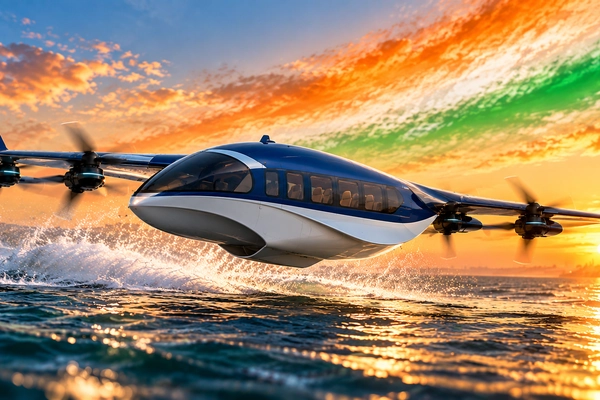
India’s emerging maritime technology sector has taken another step forward with the development of Hummingbird, an electric Wing-in-Ground (WIG) craft designed by Waterfly Technologies, a Chennai-based startup incubated at the Indian Institute of Technology Madras (IIT Madras). The innovative vehicle is designed to travel just above the water’s surface using aerodynamic ground effect, offering a new approach to coastal transportation that combines the speed potential of aircraft with the advantages of water-based operations.
Waterfly Technologies unveiled Hummingbird in Chennai on October 11, 2026, following the development and testing of a 300-kilogram prototype at Kaveripakkam Lake in Tamil Nadu’s Ranipet district. The company is now preparing to conduct ocean trials along the Chennai–Puducherry coastal route by December 2026. These trials will help engineers evaluate the vehicle’s performance under actual maritime operating conditions and advance its development towards commercial applications.
The project highlights India’s growing capabilities in indigenous aerospace engineering, electric propulsion and advanced maritime transportation. By developing a vehicle capable of flying close to the water, Waterfly Technologies aims to create faster and more efficient transportation options for coastal cargo movement, island connectivity and offshore logistics.
Waterfly Technologies Brings Aerospace Engineering to Maritime Transportation
Waterfly Technologies is an Indian deep-technology startup founded in 2025 by Harish Rajesh, Keshav Kumar Choudhary and Harshin N. The company specialises in developing electric Wing-in-Ground vehicles intended for coastal and inland-water transportation. Its engineering programme brings together aerodynamics, electric propulsion, structural design, advanced control systems and manufacturing technologies to create a new category of maritime vehicle.
The startup operates within the IIT Madras innovation ecosystem and is associated with the IIT Madras Incubation Cell. IIT Madras Research Park lists Waterfly Technologies among startups working on electric ground-effect seagliders. The institutional association provides a platform for developing engineering-intensive technologies and building the technical and commercial capabilities required for future industrial applications.
Unlike conventional boats that move through water, Waterfly’s proposed vehicles generate aerodynamic lift and travel above the surface. This operating principle can substantially reduce the hydrodynamic resistance encountered by waterborne vessels. The company seeks to use this advantage to develop transportation systems capable of carrying cargo at higher speeds while maintaining competitive operating costs.
Hummingbird represents the startup’s initial technological development platform. The prototype has allowed the engineering team to study the relationship between aerodynamic lift, propulsion efficiency, vehicle stability and control at low altitudes. The knowledge gained from these experiments will support the design of larger vehicles intended for commercial maritime operations.
Hummingbird Prototype Completes Initial Testing in Tamil Nadu
Waterfly Technologies began its development programme with a smaller experimental craft weighing approximately 30 kilograms. The initial prototype enabled engineers to examine fundamental aspects of ground-effect flight, including lift generation, take-off characteristics and vehicle stability above water. This phase provided an opportunity to evaluate the basic aerodynamic design before progressing to a larger experimental platform.
Following approximately six months of initial development, the company undertook another phase of engineering and prototype construction that resulted in a 300-kilogram Hummingbird vehicle. The larger craft underwent testing at Kaveripakkam Lake in Ranipet district, where the engineering team examined its behaviour during low-altitude operations over water.
According to company co-founder Keshav Kumar Choudhary, the prototype operated at approximately 1.5 metres above the lake’s surface during testing. The trials provided information about aerodynamic performance, propulsion characteristics and the vehicle’s response to changes in operating conditions. Engineers used the data to refine their digital simulations and improve the design of the subsequent prototype.
The testing programme demonstrates the importance of progressive engineering validation in the development of unconventional transportation systems. By moving from a small experimental platform to a larger prototype, Waterfly has been able to examine how design principles perform at different scales and identify areas requiring further refinement.
The next phase will extend this work into the marine environment, where waves, wind and changing surface conditions introduce additional engineering challenges.
Understanding the Wing-in-Ground Technology Behind Hummingbird
Hummingbird operates on a principle known as aerodynamic ground effect, a phenomenon that occurs when a wing travels close to a solid or liquid surface. The proximity of the surface changes the airflow around the wing and generally reduces induced drag, allowing the vehicle to operate more efficiently than it would at a greater altitude under comparable conditions.
Conventional aircraft generate lift through the movement of air around their wings. During flight, the relationship between airflow, pressure and wing geometry creates an upward aerodynamic force that supports the aircraft’s weight. When a suitable wing operates close to a surface, aerodynamic ground effect modifies its lift and drag characteristics, creating opportunities for improved efficiency.
Wing-in-Ground vehicles are designed to exploit this phenomenon by travelling at relatively low altitudes. Once the craft becomes airborne, its main body no longer moves through the water in the manner of a conventional vessel. This reduces direct contact with the water and avoids much of the resistance associated with hull movement.
The technology differs from hovercraft, which use powered fans to maintain a cushion of air beneath the vehicle. Ground-effect craft depend primarily on aerodynamic lift generated through forward movement and wing design. Their operation also differs from that of conventional aircraft because they are optimised for sustained travel close to the surface.
For maritime transportation, the technology offers an opportunity to bridge the performance gap between ships and aircraft. Conventional vessels can transport substantial quantities of cargo but generally operate at lower speeds, while aircraft provide rapid transportation at higher costs. A suitably developed Wing-in-Ground craft could offer an alternative for selected routes where both speed and operating efficiency are important.
Chennai–Puducherry Ocean Trials Planned for December 2026
Waterfly Technologies plans to conduct ocean trials of its Hummingbird prototype along the Chennai–Puducherry coastal route before the end of December 2026. The proposed testing programme represents the next stage in evaluating the technology after its initial trials at Kaveripakkam Lake.
Company co-founder Keshav Kumar Choudhary outlined the planned ocean trials in an interview published on October 13, 2026. The company intends to use the 300-kilogram prototype to assess how the vehicle performs under real maritime conditions, providing information that can support further design improvements and larger commercial models.
Ocean operations present challenges that are different from those encountered on relatively sheltered inland waters. Waves continuously alter the distance between the vehicle and the water’s surface, while changing wind conditions can influence stability, lift and directional control. Saltwater exposure also requires appropriate protection for electrical equipment, propulsion components and structural systems.
The trials will provide opportunities to evaluate the vehicle’s handling characteristics, propulsion performance and ability to maintain controlled low-altitude flight. Engineers can use the resulting data to improve aerodynamic design, strengthen control systems and refine the craft’s operational procedures.
Successful progression through this testing phase would support the company’s continuing engineering programme and provide a foundation for evaluating the technology’s suitability for larger cargo-carrying applications.
Electric Propulsion Creates Opportunities for Efficient Coastal Transport
Electric propulsion is central to Waterfly Technologies’ development strategy. The company intends to combine the aerodynamic advantages of ground-effect flight with battery-powered propulsion to create transportation systems suited to coastal and regional maritime routes.
Conventional vessels experience hydrodynamic resistance as their hulls move through water. Ground-effect vehicles reduce this resistance by lifting their primary structure above the surface during flight. Combining this operating principle with electric propulsion could create opportunities for efficient transportation, particularly on routes where stable low-altitude flight can be maintained.
Battery-powered propulsion also eliminates direct exhaust emissions during operation. The overall environmental performance of electric maritime vehicles depends on several factors, including electricity generation, battery production, energy consumption and the efficiency of the transportation system.
Waterfly is examining charging arrangements that could support extended maritime operations. Among the concepts under consideration are offshore charging platforms equipped with solar panels and battery storage systems. These facilities could potentially enable electric craft to recharge between journey segments without returning to major ports.
The company has outlined development targets involving an operating range of approximately 1,000 kilometres on a single charge and charging periods of around 15 minutes. These represent proposed performance objectives that will require engineering validation as the technology progresses towards larger and commercially deployable vehicles.
The integration of electric propulsion with ground-effect aerodynamics illustrates how technologies from different transportation sectors can be combined to explore new approaches to maritime mobility.
Coastal Cargo Transportation Forms the Startup’s Initial Commercial Focus
Waterfly Technologies intends to focus initially on cargo transportation across coastal and island routes. The company sees opportunities in moving industrial supplies, time-sensitive freight and specialised equipment between ports, islands and offshore facilities. Its proposed transportation system aims to provide an alternative for journeys where conventional ships require relatively long transit times and aircraft involve higher operating costs.
One application under consideration involves supporting offshore oil and gas installations. These facilities depend on regular deliveries of equipment, replacement components and essential supplies to maintain operations. A fast maritime transportation system could provide additional logistical flexibility, particularly when urgent cargo must travel between a coastal support base and an offshore installation.
Island connectivity offers another potential market for the technology. Many island communities depend on ships and smaller vessels for essential supplies, commercial goods and transportation. Travel times are influenced by distance, vessel availability and weather conditions. Ground-effect craft could eventually support selected routes by reducing journey times while operating across existing waterways.
Waterfly also plans to develop larger vehicles capable of carrying commercial cargo loads. The company’s proposed designs include a version that could transport a standard 20-foot shipping container. Such a capability would allow the technology to participate in established containerised freight operations and serve industries that rely on predictable cargo movement.
The startup has identified Southeast Asia as a potential early market for larger cargo-carrying vehicles. The region’s extensive island geography, coastal industrial centres and established maritime trade networks offer opportunities for alternative transportation systems. Waterfly’s longer-term vision also includes intercontinental cargo movement, although its present development programme remains focused on validating the technology and progressing towards practical maritime operations.
Waterfly Targets Competitive Freight Transportation Costs
The commercial development of Wing-in-Ground transportation depends on achieving operating costs that make the technology attractive to freight operators. Waterfly Technologies has outlined a target of transporting cargo for less than ₹10 per tonne-kilometre, based on its current design and projected operating expenses.
A tonne-kilometre represents the movement of one tonne of cargo across a distance of one kilometre. Transport operators use this measurement to compare freight costs across different transportation systems. For Waterfly, achieving its proposed target would require an effective combination of aerodynamic efficiency, electric propulsion, cargo-carrying capacity and manageable maintenance expenditure.
The company’s engineering strategy includes developing and manufacturing important components internally. This approach allows the design team to introduce modifications, evaluate improvements and undertake successive prototype iterations without depending entirely on external manufacturing arrangements.
Waterfly maintains a manufacturing facility in Sriperumbudur, Tamil Nadu, where the company reports having the capacity to produce two 300-kilogram craft per week. This capability supports continued prototype construction and testing as the startup refines its engineering systems.
The company’s projected transportation costs will ultimately depend on operational factors such as battery performance, energy consumption, vehicle utilisation, maintenance requirements and charging infrastructure. Continued testing will help determine how these factors influence the economics of commercial maritime transportation.
Larger Wing-in-Ground Craft Could Open New Maritime Markets
The development of Hummingbird forms part of Waterfly Technologies’ broader ambition to manufacture larger ground-effect vehicles for cargo transportation. The company is exploring designs that could accommodate substantial payloads while retaining the aerodynamic advantages associated with low-altitude flight.
One proposed application involves carrying standard shipping containers across coastal routes. Containerised freight forms the foundation of modern international trade because it allows goods to move efficiently between ships, ports, railway networks and road transport systems. A high-speed craft capable of transporting containers could create additional options for industries moving valuable or time-sensitive cargo.
Waterfly has identified Southeast Asian markets as promising locations for the initial introduction of larger vehicles. Countries across the region maintain extensive maritime transportation networks connecting islands, coastal cities and industrial centres. These geographical conditions could support specialised transportation services that operate directly over water.
The company has also outlined ambitions involving longer international routes, including transportation across the Pacific, Arctic and Atlantic oceans. Such operations would require substantial advances in vehicle capacity, energy storage, navigation, reliability and maritime infrastructure.
The Hummingbird programme provides an opportunity to establish the underlying engineering capabilities needed for future designs. As prototype testing progresses, the company can use operational data to improve its understanding of ground-effect aerodynamics, propulsion efficiency and vehicle stability.
Technology Offers Potential Applications in Maritime Security
The development of high-speed ground-effect vehicles could also create opportunities for specialised maritime security and logistics applications. These vehicles may eventually support the movement of equipment, supplies and personnel across coastal waters, particularly where conventional transportation requires longer transit times.
India’s extensive coastline and island territories create diverse maritime transportation requirements. Defence establishments, coastal installations and island facilities depend on reliable logistics networks for moving essential materials and maintaining operational readiness.
A mature Wing-in-Ground transportation system could provide an additional option for selected logistics operations. Its ability to travel above the water’s surface without requiring a conventional runway may offer advantages for routes connecting coastal facilities and offshore locations.
Other potential applications include maritime observation, environmental monitoring and specialised surveillance missions. The suitability of the technology for such roles would depend on the integration of appropriate sensors, communications equipment and operational systems.
Waterfly’s present development programme is focused on demonstrating and improving the performance of its electric ground-effect craft. The commercial and specialised applications being explored provide direction for future engineering work as the company develops larger and more capable platforms.
IIT Madras Startup Ecosystem Supports Advanced Engineering Innovation
The Hummingbird project reflects the growing contribution of India’s academic incubation ecosystem to the development of advanced transportation technologies. Waterfly Technologies is associated with the IIT Madras Incubation Cell and appears in the official startup directory maintained by IIT Madras Research Park.
The company’s founders began their collaborative engineering work at IIT Madras, where members of the team participated in developing an electric racing car. Their experience in electric mobility helped establish the technical foundation for exploring new transportation systems based on advanced propulsion and vehicle engineering.
Developing Wing-in-Ground craft requires expertise across several engineering disciplines. Aerodynamic design determines lift and drag characteristics, while propulsion systems influence acceleration, endurance and energy consumption. Structural engineering addresses the forces experienced during take-off, flight and landing, while control systems help maintain stability during low-altitude operations.
The development process also requires physical testing to validate computational models and engineering assumptions. Each experimental vehicle generates information that can help engineers refine designs and improve subsequent prototypes.
Waterfly’s progression from a 30-kilogram experimental craft to a 300-kilogram prototype illustrates this approach. The engineering team has used successive development stages to examine vehicle performance and establish the capabilities required for more advanced systems.
The startup’s activities also demonstrate how India’s academic institutions can support the creation of technology enterprises working in aerospace, clean mobility, advanced manufacturing and maritime engineering.
Certification and Ocean Testing Will Shape Commercial Development
Waterfly Technologies is examining the technical and certification requirements associated with operating Wing-in-Ground craft for commercial cargo transportation. The company has initiated discussions with classification and certification organisations, including Bureau Veritas, as part of its preparations for future operations.
Ground-effect vehicles combine characteristics associated with both aircraft and maritime vessels. Their operating requirements therefore involve considerations relating to aerodynamic performance, structural safety, navigation, propulsion reliability and maritime operating conditions.
The planned ocean trials will contribute information needed to assess these characteristics under practical conditions. Testing over open water will allow engineers to examine the vehicle’s response to waves, changing wind patterns and other environmental factors that influence low-altitude flight.
The resulting data can support improvements in flight-control systems, structural design, propulsion arrangements and operating procedures. It can also help the company understand the requirements for developing larger craft intended to carry commercial cargo.
Waterfly’s engagement with certification organisations forms part of its broader effort to prepare the technology for future deployment. The development process brings together engineering validation, manufacturing improvements and the establishment of suitable operational standards.
Hummingbird Highlights India’s Growing Maritime Technology Capabilities
Waterfly Technologies’ Hummingbird represents an important development in India’s emerging electric maritime transportation sector. The creation and testing of a 300-kilogram Wing-in-Ground prototype demonstrate the startup’s progress in combining aerodynamic engineering, electric propulsion and indigenous manufacturing.
The planned Chennai–Puducherry ocean trials by December 2026 will extend the company’s experimental programme into real maritime conditions. The trials will provide valuable operational information and contribute to the development of larger vehicles intended for coastal cargo transportation and offshore logistics.
The project also reflects the expanding capabilities of Indian deep-technology startups working on engineering challenges that require specialised knowledge, experimental development and advanced manufacturing systems. Waterfly’s association with the IIT Madras incubation ecosystem illustrates the role of academic innovation programmes in encouraging indigenous technological development.
The growing demand for efficient maritime transportation creates opportunities for technologies that combine speed, energy efficiency and flexible infrastructure requirements. Electric Wing-in-Ground craft offer one approach to meeting these requirements through the integration of established aerodynamic principles with modern propulsion and control technologies.
As Waterfly Technologies advances its development programme, Hummingbird provides a foundation for further innovation in coastal transportation, island connectivity and specialised maritime logistics. The project strengthens India’s participation in an emerging field of transportation engineering while supporting the broader development of indigenous aerospace and maritime technologies.
References
1. IIT Madras Research Park — Official Startup Directory.
Waterfly Technologies: Electric Wing-in-Ground Seagliders for Coastal and Inland Transportation.
https://respark.iitm.ac.in/startup-directory
2. Waterfly Technologies — Official Website.
Wing-in-Ground Craft Technology and Maritime Transportation Applications.
https://www.waterfly.info/
3. Waterfly Technologies — About the Company.
Company Background, Founding Team and Technology Development.
https://www.waterfly.info/about-1
5. India Seatrade News — October 14, 2026.
IIT Madras Startup Prepares for First Sea Trial of E-Flying Boat.
https://indiaseatradenews.com/iit-madras-startup-prepares-for-first-sea-trial-of-e-flying-boat/
You may also like
-
Ministry of Defence Signs ₹4,106 Crore Contracts for GSAT-7C Satellite and Varunastra Torpedoes
-
PM Modi Inaugurates ₹3,350 Crore Development Projects in Ladakh
-
AXISCADES Expands Global Technology Footprint with US Acquisition Plan and Swiss Company Takeover
-
Skyroot Aerospace Secures Two Satellite Launch Contracts from US Space Company Reflect Orbital
-
AVNL, Indian Army and Russian Delegation Explore Modernisation of Armoured Vehicles
