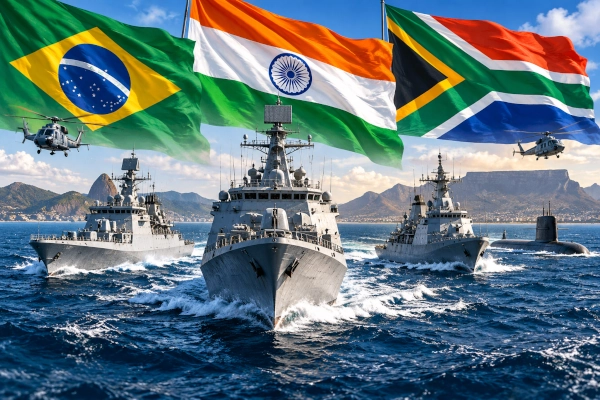
India is strengthening its maritime defence cooperation with Brazil and South Africa through the ninth edition of Exercise IBSAMAR 2026, a trilateral naval exercise aimed at improving operational coordination, enhancing maritime security and strengthening cooperation among the three countries. The Indian Navy has deployed its guided-missile stealth frigate INS Tarkash to South Africa to participate in the exercise alongside Brazilian and South African naval forces.
The Ministry of Defence announced India’s participation on 12 October 2026, highlighting the country’s commitment to expanding maritime partnerships and promoting security across strategically important international shipping routes. The exercise will bring together warships, a submarine and naval helicopters for operations covering surface warfare, anti-air warfare, anti-submarine warfare, maritime interdiction, anti-piracy and search-and-rescue activities.
IBSAMAR IX forms part of the established defence cooperation framework between India, Brazil and South Africa, three major democracies connected through the India–Brazil–South Africa Dialogue Forum. Since its inception in 2008, the exercise has provided a platform for their navies to exchange professional expertise, develop common operating procedures and strengthen their ability to conduct coordinated maritime operations.
The ninth edition carries the theme “Stronger Together Towards a Shared Future in the Maritime Domain,” reflecting the importance of cooperation in protecting commercial shipping, maintaining maritime stability and responding to emerging security challenges. The exercise also demonstrates the growing significance of South–South defence cooperation, particularly among countries whose economic development depends heavily on secure international maritime routes.
INS Tarkash Represents India in the Trilateral Naval Exercise
The Indian Navy is participating in IBSAMAR IX with INS Tarkash, a Talwar-class guided-missile stealth frigate capable of undertaking a wide range of maritime operations. The warship is equipped with guided missiles, naval guns, sensors and combat systems designed for surface warfare, air defence and anti-submarine operations. Its capabilities allow it to undertake independent missions and operate alongside other naval forces during coordinated maritime activities.
INS Tarkash represents an important element of the Indian Navy’s blue-water operational capability. Warships in this category can undertake extended deployments beyond India’s immediate maritime neighbourhood, contributing to international naval exercises, maritime surveillance, diplomatic engagements and cooperative security operations. Such deployments help demonstrate the Navy’s ability to sustain operations across distant maritime regions while maintaining close coordination with international partners.
The frigate’s participation in IBSAMAR IX will provide opportunities for its crew to practise complex maritime manoeuvres, exchange operational procedures and undertake coordinated missions with Brazilian and South African naval personnel. Operating alongside ships equipped with different sensors, communication systems and weapons requires careful planning and effective communication. These interactions help participating crews develop familiarity with the operational practices of partner navies.
INS Tarkash also carries an integral naval helicopter that extends its ability to conduct maritime surveillance and other supporting operations. The integration of helicopters with surface warships provides additional flexibility during naval exercises, particularly when conducting reconnaissance, search-and-rescue missions and coordinated maritime operations.
The deployment reinforces India’s commitment to maintaining an active naval presence across important international maritime regions while strengthening professional relationships with friendly countries.
Brazil Participates with BNS Barroso and Naval Aviation Assets
The Brazilian Navy is participating in IBSAMAR IX with BNS Barroso, a domestically designed corvette developed for maritime patrol, surface warfare and other naval missions. The vessel is accompanied by an integral Lynx helicopter, adding an aviation component to Brazil’s participation in the exercise.
BNS Barroso reflects Brazil’s experience in naval shipbuilding and maritime defence technology. The corvette is designed to undertake operations in coastal and offshore environments, supporting maritime surveillance, sea control and the protection of national maritime interests. Its participation provides an opportunity for Indian and South African personnel to gain operational familiarity with Brazilian naval equipment and procedures.
The embarked Lynx helicopter will support aviation-related training and coordinated operations with surface vessels. Naval helicopters are valuable during maritime missions because they can extend surveillance coverage beyond the immediate detection range of a ship and provide additional flexibility in responding to developing situations. Their operation also requires close coordination between aircrews, ship operators and maritime command teams.
Brazil maintains extensive maritime responsibilities in the South Atlantic, where offshore energy infrastructure, fisheries, commercial shipping and other economic activities require naval surveillance and protection. This operational experience contributes a different regional perspective to IBSAMAR, complementing India’s Indian Ocean experience and South Africa’s knowledge of maritime operations around the southern African coastline.
Through participation in the exercise, Brazil continues to strengthen its defence relationship with India and South Africa while contributing to the development of common maritime operating practices.
South Africa Deploys Frigates, Patrol Vessels and a Submarine
As the host country, South Africa is contributing several naval platforms to IBSAMAR IX, creating a diverse operational environment for the participating forces. According to the Indian Ministry of Defence, the South African Navy will participate with SAS Amatola, SAS King Sekhukhune I, SAS Adam Kok III and the submarine SAS Manthatisi.
SAS Amatola is a Valour-class frigate designed for maritime operations involving surface threats, surveillance and naval combat activities. Its participation provides opportunities for coordinated fleet manoeuvres, maritime security training and exercises involving ships operating in different tactical formations.
SAS King Sekhukhune I and SAS Adam Kok III contribute additional maritime patrol capabilities, allowing the participating navies to practise operations involving different classes of vessels. The presence of smaller naval platforms alongside larger warships creates opportunities to examine coordination during maritime security tasks, particularly those involving surveillance, patrol activities and responses to potential threats.
The participation of SAS Manthatisi, a Type 209 diesel-electric submarine, introduces an important underwater dimension to the exercise. Submarines present distinctive challenges to surface forces because they operate below the waterline and can limit their exposure to conventional surveillance systems. Detecting and tracking submarines requires specialised sensors, coordinated search procedures and careful interpretation of underwater acoustic information.
Exercises involving submarines allow participating surface ships and aviation assets to improve their understanding of anti-submarine warfare operations. Such training is particularly valuable because underwater detection conditions vary with water temperature, salinity, ocean depth and other environmental factors.
South Africa’s contribution of different naval platforms will enable the three countries to undertake coordinated training across surface, air and underwater operational environments, strengthening their ability to conduct complex maritime missions.
IBSAMAR IX Focuses on Surface Warfare and Maritime Combat Coordination
Surface warfare forms an important component of IBSAMAR IX, allowing participating ships to practise coordinated operations in simulated maritime combat situations. Modern surface warfare depends on effective surveillance, communication, tactical planning and the ability of naval forces to respond to changing operational conditions.
During multinational exercises, warships must coordinate their movements while maintaining awareness of the positions and activities of other vessels. Naval personnel also need to understand how partner forces communicate operational information and organise tactical decisions. These requirements become particularly important when ships from different countries operate in close proximity during complex manoeuvres.
IBSAMAR IX will provide a structured environment for developing these skills. By operating together, Indian, Brazilian and South African crews can improve their familiarity with multinational naval procedures and identify opportunities to strengthen coordination.
The exercise will also help participating personnel gain experience in maritime mission planning, tactical communication and coordinated responses to simulated threats. Such experience is valuable during future international operations, when naval forces from different countries may need to work together to protect commercial shipping or respond to security incidents.
The training reflects the broader importance of interoperability, which enables military forces with different equipment and operating procedures to conduct joint activities effectively.
Anti-Air Warfare Training Strengthens Naval Defensive Capabilities
Anti-air warfare will form another important part of the exercise, focusing on the detection, monitoring and coordinated response to simulated aerial threats.
Modern naval forces must remain prepared to operate in environments where aircraft, missiles and unmanned aerial systems can pose potential dangers. Effective maritime air defence depends on the ability to identify airborne objects, assess their characteristics and coordinate appropriate defensive responses.
Ships participating in IBSAMAR IX possess different surveillance sensors, combat-management systems and defensive capabilities. Operating together provides an opportunity to practise communication procedures and coordination during simulated air-defence situations.
Such exercises help naval crews understand the capabilities and limitations of their own systems while developing familiarity with the operational practices of partner forces.
The increasing use of unmanned aerial systems in military operations has added further complexity to maritime air defence. Naval forces must continually improve their understanding of emerging aerial threats and the procedures required to maintain situational awareness.
Although the Ministry of Defence has identified anti-air warfare as a component of IBSAMAR IX, the official announcement does not specify particular drone systems or counter-drone technologies scheduled for testing.
The exercise will nevertheless contribute to the participating navies’ broader preparedness for operations in increasingly complex maritime environments.
Anti-Submarine Warfare Operations Provide Advanced Naval Training
Anti-submarine warfare is among the most technically demanding areas of naval operations because submarines operate beneath the surface and can be difficult to detect.
The participation of South Africa’s SAS Manthatisi creates an opportunity for Indian, Brazilian and South African surface forces to undertake training involving a conventional submarine.
Anti-submarine operations require the integration of several capabilities, including underwater surveillance, acoustic detection, maritime reconnaissance and coordinated mission planning. Naval crews must interpret information from available sensors while considering the influence of environmental conditions on underwater sound propagation.
The operational challenge becomes more complex when several ships and aircraft participate in the same mission. Effective coordination requires clear communication, agreed procedures and an understanding of how different platforms contribute to underwater surveillance.
IBSAMAR IX will allow participating personnel to improve their familiarity with these requirements through planned exercises.
For India, anti-submarine warfare remains an important area of naval preparedness because the Indian Ocean contains major commercial shipping routes and strategic maritime areas. Maintaining the ability to detect and monitor underwater activity contributes to maritime security and the protection of naval forces.
The experience gained during multinational exercises can complement national training programmes and strengthen professional exchanges concerning underwater operations.
Maritime Interdiction and Anti-Piracy Operations Remain Major Priorities
IBSAMAR IX will also address maritime interdiction and anti-piracy operations, reflecting the importance of maintaining security across international shipping routes.
Maritime interdiction involves monitoring vessels and undertaking authorised actions to prevent activities that violate applicable laws or security restrictions. Depending on the circumstances, such operations may involve identifying suspicious vessels, establishing communication, conducting inspections and coordinating responses with other maritime authorities.
The exercise includes Visit, Board, Search and Seizure (VBSS) procedures, which prepare naval personnel to board and inspect vessels under authorised conditions. These activities require careful coordination because boarding teams must operate safely while transferring between vessels and conducting inspections in unfamiliar environments.
Training in VBSS procedures helps naval personnel develop communication, planning and safety practices relevant to maritime security operations.
Anti-piracy activities are equally important because attacks against merchant vessels can threaten civilian crews, disrupt international commerce and increase transportation costs. Maritime piracy has affected several important shipping regions, including areas connected with the Indian Ocean.
Naval forces responding to such threats may need to coordinate surveillance, identify vessels in distress and provide assistance to commercial shipping.
IBSAMAR provides India, Brazil and South Africa with an opportunity to exchange experience in these areas while improving their preparedness for cooperative maritime security operations.
Search and Rescue Operations Strengthen Humanitarian Maritime Cooperation
Search-and-rescue training forms an important part of the exercise because naval forces frequently assist civilian vessels and personnel facing emergencies at sea.
Maritime emergencies may arise from severe weather, collisions, mechanical failures, onboard fires, medical incidents or other unexpected situations. Responding effectively requires rapid communication, coordinated search procedures and the ability to deploy appropriate rescue assets.
Warships and naval helicopters can contribute to search-and-rescue missions by covering large maritime areas and supporting the identification of vessels or personnel requiring assistance.
During multinational operations, coordination becomes especially important because participating ships may use different communication systems and emergency procedures.India, Brazil and South Africa Strengthen Maritime Security Cooperation Through IBSAMAR IX Naval Exercise
IBSAMAR IX will provide opportunities for Indian, Brazilian and South African personnel to practise working together in simulated maritime emergencies.
The exercise will also include damage-control and firefighting activities, which are essential for maintaining the safety and operational capability of naval vessels.
Damage-control training prepares crews to respond to emergencies involving flooding, fires, equipment damage and other onboard hazards. Such incidents require disciplined coordination among personnel and the effective use of available emergency equipment.
By incorporating humanitarian and emergency-response activities alongside combat-related training, IBSAMAR IX reflects the wide range of responsibilities undertaken by modern naval forces.
IBSAMAR Has Developed into an Important Trilateral Naval Exercise Since 2008
Exercise IBSAMAR began in 2008 as part of efforts to strengthen maritime cooperation among India, Brazil and South Africa.
The exercise operates within the broader framework of the India–Brazil–South Africa Dialogue Forum, commonly known as IBSA. Over successive editions, IBSAMAR has provided opportunities for the three navies to conduct professional exchanges, practise operational procedures and improve their ability to undertake coordinated missions.
The participating countries maintain significant maritime interests despite being geographically separated by considerable distances. India operates across the Indian Ocean and adjoining maritime regions, Brazil has extensive responsibilities in the South Atlantic, and South Africa occupies a strategically important position near the meeting point of the Atlantic and Indian Oceans.
These different geographical perspectives give the exercise considerable value because participating navies bring experience from distinct maritime environments.
The exercise has evolved into a platform for improving operational familiarity among the three forces while strengthening defence relationships at the institutional and personnel levels.
Regular participation also allows naval crews to build upon experience gained during previous editions. Familiarity with partner forces contributes to improved coordination, particularly when ships and personnel from different countries must operate together.
IBSAMAR IX continues this established tradition of maritime cooperation and reinforces the importance of sustained professional engagement.
The IBSA Dialogue Forum Provides the Foundation for Naval Cooperation
The India–Brazil–South Africa Dialogue Forum was established in June 2003 to promote cooperation among three major democracies representing Asia, South America and Africa.
The grouping provides a platform for discussing international issues and advancing cooperation across areas such as trade, development, science, technology, education and governance.
Its creation reflected the participating countries’ shared interest in strengthening South–South cooperation and expanding the role of developing economies in international institutions.
Defence engagement forms one component of this wider relationship, with IBSAMAR serving as an established mechanism for trilateral naval cooperation.
India, Brazil and South Africa possess substantial coastlines, important maritime industries and economies connected with international trade. Their shared dependence on secure shipping routes creates a practical basis for cooperation on maritime safety and security.
The exercise demonstrates how diplomatic relationships can develop into operational partnerships through regular training and professional exchanges.
IBSA does not constitute a collective defence alliance, and IBSAMAR does not create obligations equivalent to a military treaty. Instead, the exercise allows the three countries to strengthen cooperation while maintaining their independent defence policies.
This distinction reflects the broader character of South–South partnerships, which often emphasise practical collaboration and mutual benefit across specific areas of shared interest.
South Africa’s Location Gives the Exercise Strategic Maritime Importance
South Africa occupies an important position in international maritime geography because major shipping routes connect the Atlantic and Indian Oceans around the southern African coastline.
The Cape of Good Hope route remains strategically important for vessels transporting petroleum, natural gas, manufactured goods and other cargo between major international markets.
Shipping around southern Africa can become particularly significant during disruptions affecting alternative maritime routes. Changes in maritime security conditions elsewhere may lead shipping companies to reconsider their routes, increasing the importance of secure navigation around the African continent.
South Africa’s maritime position therefore gives it a substantial interest in maintaining safe commercial transportation and responding to potential security threats.
For India, cooperation with South Africa supports engagement with a country located along an important maritime route connecting the Indian Ocean with the Atlantic.
Brazil’s participation provides an additional connection with South Atlantic maritime operations, creating opportunities for cooperation across a much wider geographical area.
The exercise allows the three navies to exchange operational experience relevant to these maritime environments while improving their ability to coordinate activities involving international shipping and maritime security.
Its strategic importance derives not from the creation of a new military alignment but from the shared objective of maintaining stable and secure international maritime transportation.
Naval Interoperability Is Essential for Multinational Maritime Operations
A central objective of IBSAMAR IX is to improve interoperability among the Indian, Brazilian and South African navies.
Interoperability refers to the ability of military forces from different countries to operate together effectively while using their respective equipment, communication systems and organisational procedures.
Naval forces may possess different types of warships, sensors, helicopters and combat-management systems. These differences can create operational challenges when several countries participate in the same mission.
Multinational exercises provide opportunities to identify such challenges and develop procedures that support better coordination.
During IBSAMAR IX, naval crews will practise working within a shared operational environment while maintaining communication and awareness of other participating platforms.
Such experience is valuable because maritime security operations often involve cooperation among countries with different equipment and operational traditions.
Improved interoperability can support future activities such as maritime surveillance, humanitarian assistance, disaster response and the protection of commercial shipping.
The exercise also strengthens professional relationships among naval officers and sailors, allowing them to exchange knowledge and develop a better understanding of partner forces.
These relationships can contribute to more effective cooperation during subsequent exercises and international maritime operations.
India’s Participation Reflects Its Expanding Maritime Diplomacy
The Indian Navy regularly undertakes overseas deployments and participates in bilateral and multinational exercises with friendly countries.
These engagements form an important part of India’s maritime diplomacy because they combine operational training with international cooperation and the development of professional defence relationships.
INS Tarkash’s participation in IBSAMAR IX reflects this broader approach.
By deploying a frontline warship to South Africa, India is strengthening its established relationship with two important partners while providing its naval personnel with experience in multinational operations.
The exercise also supports India’s interest in maintaining maritime security across international shipping routes that connect the Indian Ocean with other major commercial regions.
India’s maritime engagement increasingly emphasises cooperation with countries across the wider Indian Ocean Region and beyond.
The MAHASAGAR vision, representing Mutual and Holistic Advancement for Security and Growth Across Regions, places importance on cooperation, shared development and maritime security partnerships.
Naval exercises such as IBSAMAR contribute to this approach by encouraging professional interaction, improving operational understanding and strengthening institutional relationships.
The participation of INS Tarkash also demonstrates India’s ability to maintain an active naval presence across distant maritime regions.
Such deployments enhance operational experience while supporting India’s wider diplomatic engagement with countries that share an interest in maritime stability.
IBSAMAR IX Highlights the Importance of South–South Defence Cooperation
The ninth edition of IBSAMAR demonstrates the growing importance of direct defence cooperation among countries of the Global South.
India, Brazil and South Africa possess established armed forces, significant maritime responsibilities and extensive experience in conducting naval operations.
Their cooperation allows them to exchange technical and operational knowledge while strengthening their capacity to respond to shared maritime challenges.
International shipping security, piracy, maritime crime and humanitarian emergencies are issues that affect countries across different continents.
Addressing these challenges often requires cooperation among maritime nations, particularly when threats extend across national jurisdictions and international waters.
IBSAMAR provides a structured platform for developing the professional relationships and operational understanding required for such cooperation.
The exercise also illustrates how partnerships among developing economies can extend beyond trade and diplomatic consultations into practical military engagement.
By maintaining regular naval interactions, the three countries reinforce their commitment to cooperative maritime security without compromising their respective national defence priorities.
The resulting exchanges contribute to greater understanding among naval forces and create opportunities for continued cooperation in areas of mutual interest.
India, Brazil and South Africa Advance a Shared Maritime Security Partnership
IBSAMAR IX brings together a diverse combination of naval platforms, including guided-missile warships, patrol vessels, helicopters and a conventional submarine. This combination provides opportunities for training across surface, air and underwater operational environments while strengthening coordination among participating personnel.
The exercise’s emphasis on maritime interdiction, anti-piracy operations, search and rescue, damage control and firefighting reflects the broad responsibilities of modern naval forces. These activities contribute to military preparedness while supporting the protection of civilian shipping and international commerce.
For India, the deployment of INS Tarkash provides valuable operational experience and strengthens naval engagement with Brazil and South Africa. For the three participating countries, the exercise continues a maritime relationship that has developed steadily since 2008.
The cooperation also reflects the importance of maintaining safe and reliable international shipping routes connecting the Indian Ocean, Atlantic Ocean and major global trading regions.
As maritime security challenges evolve, professional exchanges and joint exercises will remain important tools for improving preparedness and strengthening cooperation among friendly naval forces.
Through IBSAMAR IX, India, Brazil and South Africa are advancing a longstanding maritime partnership built on operational cooperation, mutual understanding and shared security interests. The exercise reinforces their commitment to maintaining stable international shipping routes while contributing to stronger naval relationships and greater maritime preparedness across strategically important ocean regions.
References
- Ministry of Defence, Government of India – Press Information Bureau, 12 October 2026.
Indian Naval Ship Tarkash to Participate in IBSAMAR IX 2026, Reaffirming India’s Commitment to Maritime Cooperation.
Release ID: 2322377.
www.pib.gov.in/PressReleseDetailm.aspx?PRID=2322377 - Indian Navy – Ministry of Defence, Government of India.
Official information concerning Indian naval deployments, multinational exercises, maritime security operations and international naval cooperation.
www.indiannavy.nic.in - Ministry of External Affairs, Government of India – India–Brazil–South Africa Dialogue Forum.
Official information concerning the establishment of IBSA, trilateral relations and areas of cooperation among India, Brazil and South Africa.
www.mea.gov.in - Government of South Africa – Exercise IBSAMAR.
Official background concerning multinational naval exercises involving the Indian, Brazilian and South African navies.
www.gov.za - DD India – 12 October 2026.
INS Tarkash to Participate in IBSAMAR IX 2026 to Strengthen Trilateral Maritime Cooperation.
ddindia.co.in/2026/10/ins-tarkash-to-participate-in-ibsamar-ix-2026-to-strengthen-trilateral-maritime-cooperation/
You may also like
-
India Emerges as a Global Hub for Multinational Military Exercises, Bridging Diverse Defence Partnerships
-
India and Canada Move to Strengthen Trade, Energy and Defence Cooperation as Foreign Minister Anita Anand Announces Visit
-
India Establishes First High-Altitude Health Research Centre in Himachal Pradesh
-
India’s Three-Part Russia–Ukraine Peace Proposal: A Practical Path to Ceasefire, Black Sea Security and Global Economic Stability
-
Bengaluru Startup Astrome Wins Indian Army iDEX Challenge to Develop Indigenous Portable Electronic Intelligence System
