
Researchers have demonstrated how a remarkably small change in molecular structure can profoundly influence the way peptide-based molecules organize and function.
Such an approach could support the development of adaptable peptide-based nanomaterials for applications in biosensing, bioimaging, smart photonic materials, optoelectronics, and molecular electronics.
Peptides, the building blocks of proteins, can spontaneously organize into ordered nanostructures through supramolecular self-assembly. However, controlling this process to obtain desired structures and properties remains a major challenge.
A study by the Centre for Nano and Soft Matter Sciences (CeNS), Bengaluru, an autonomous institute of the Department of Science and Technology (DST) found that by introducing just, a single methylene (–CH₂–) spacer between a peptide and a fluorescent pyrene unit, the researchers were able to alter molecular geometry and, consequently, the self-assembly behaviour of the system.
The research led by Dr. Goutam Ghosh at CeNS, Bengaluru, together with his PhD student Mr. Sourav Moyra, in collaboration with Mr. Tarak Nath Das (JNCASR, Bengaluru) and Dr. Rabindra Nath Manna (Ghatal Rabindra Satabarsiki Mahavidyalaya, West Bengal) showed that the subtle addition of one carbon atom changed the relative orientation of the molecular components. This led to distinctly different molecular packing, supramolecular chirality, fluorescence lifetime behaviour, and nanoscale organization—without changing the fundamental peptide framework.
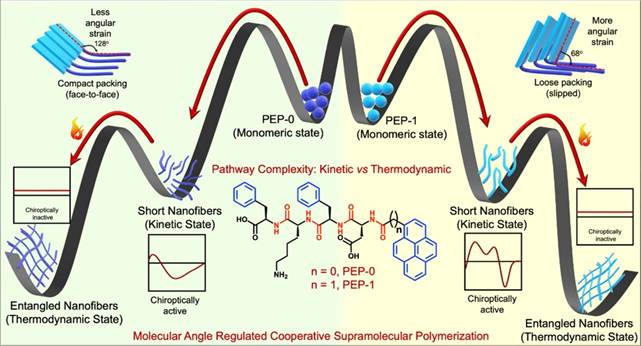
Fig: Schematic representation of how a minute change in molecular structure tunes the self-assembly behaviour and material properties
The findings introduce a useful molecular design strategy for programming functional soft materials through controlled molecular organization rather than extensive chemical modification. The work was published in the journal Polymer Chemistry by Royal Society of Chemistry.
The work highlights how small molecular changes can provide powerful control over supramolecular organization and material function, offering new opportunities for the rational design of next-generation functional and responsive biomaterials.
Publication Link: https://doi.org/10.1039/d6py00525j
You may also like
-
Japan Unveils Chandrayaan-5 Rover Prototype for Joint Lunar Exploration Mission with India
-
New Technology Developed for Stable, Tunable and Scalable White LEDs
-
Indian Scientists Pioneer Solar Particle Detection from Both Polar Regions
-
IIT Kanpur and Rolls-Royce Partner to Advance Aircraft Cabin Noise Reduction Technologies
-
First North-East India-Specific Antivenom Developed Against Neglected Pit Vipers Species
