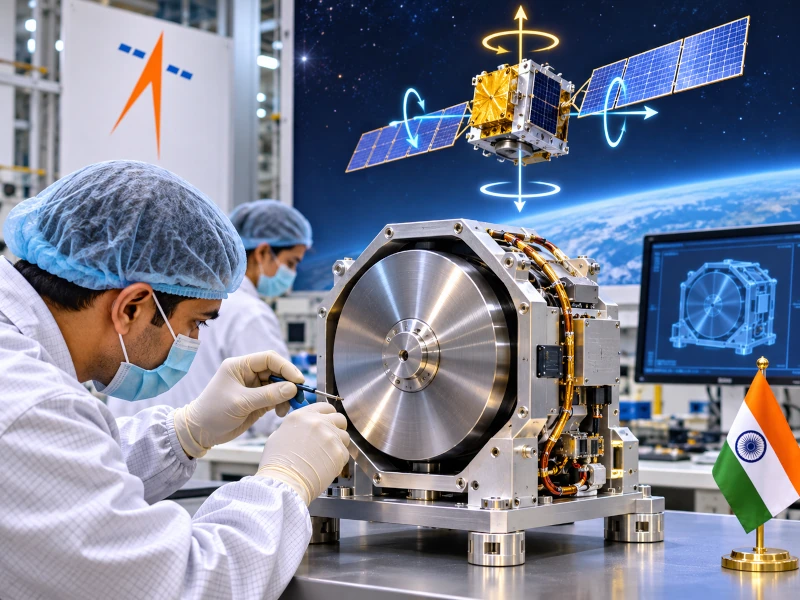
The Indian Space Research Organisation (ISRO) has invited industrial enterprises to participate in the manufacturing of Reaction Wheel Assemblies (RWAs), critical components of spacecraft attitude control systems. The Expression of Interest (EoI), issued on 25 November 2026 by the ISRO Inertial Systems Unit (IISU) at Vattiyoorkavu in Thiruvananthapuram, Kerala, seeks to identify qualified manufacturing partners. The initiative represents an opportunity to expand industrial participation in specialised spacecraft subsystem manufacturing and strengthen India’s domestic space technology supply chain.
Reaction Wheels: Essential Components of Spacecraft Orientation
Reaction wheels enable spacecraft to adjust and maintain their orientation in space through the principle of conservation of angular momentum. An electrically driven rotating mass generates a corresponding rotational response in the spacecraft as its speed changes. This mechanism allows satellites to perform many orientation adjustments without directly consuming propellant, although periodic momentum management may require other systems.
Precise orientation control is essential for Earth observation, satellite communications, astronomical observations and scientific missions. Imaging instruments must remain accurately directed towards their intended targets, while communication antennas and solar panels require appropriate positioning. The reliability of reaction wheel assemblies consequently has a direct bearing on spacecraft operational performance and mission continuity.
A Progressive Industrial Qualification Programme
The official IISU document outlines a three-stage qualification programme through which selected industrial partners would progressively assume responsibility for manufacturing reaction wheel assemblies. Each stage envisages the production of two models, accompanied by technical evaluation and documentation. IISU will provide initial training and technical assistance, with manufacturers gradually progressing towards independent production.
The final qualification stage requires vendors to undertake manufacturing activities without direct IISU assistance, subject to institutional assessment and clearance. This progressive approach is intended to establish industrial competence before manufacturers assume responsibility for regular production. It also provides a mechanism for preserving the stringent quality standards associated with spacecraft hardware.
Advanced Precision Engineering and Space-Grade Manufacturing
Reaction wheel assemblies require the integration of specialised mechanical, electrical and electronic subsystems within a compact and reliable configuration. Their manufacturing involves precision machining, advanced bearing technologies, electric motor integration and careful control of mechanical tolerances. Even minor manufacturing irregularities can introduce vibrations that affect the performance of sensitive spacecraft instruments.
The production of space-grade hardware also requires comprehensive quality assurance throughout the manufacturing process. Components must operate reliably under demanding environmental conditions, including the vibration associated with launch and the vacuum and temperature variations encountered in space. Developing these manufacturing capabilities within Indian industry could strengthen expertise across several high-value engineering disciplines.
IISU’s Established Spacecraft Technology Capabilities
The ISRO Inertial Systems Unit plays an important role in developing inertial sensing, navigation and spacecraft orientation technologies. Its research supports the wider requirements of India’s launch vehicle and satellite programmes, encompassing specialised sensors, actuators and associated electronic systems. The unit’s accumulated engineering expertise provides a foundation for extending selected manufacturing activities to qualified industrial enterprises.
An earlier example of IISU’s reaction wheel development was the Reaction Wheel Assembly experiment carried aboard the PSLV Orbital Experimental Module-4 (POEM-4) during the PSLV-C60/SpaDeX mission. The experiment incorporated three reaction wheels and associated drive electronics to investigate the stabilisation of the orbital platform. This earlier initiative illustrates IISU’s continuing work in advancing spacecraft orientation and control technologies.
Opportunities for India’s Space Manufacturing Ecosystem
The proposed industrial manufacturing programme provides opportunities for Indian enterprises specialising in precision engineering, electromechanical systems, advanced materials and aerospace component integration. Participation in such programmes can help manufacturers develop the technical expertise and quality management capabilities necessary to supply space-grade equipment. These capabilities could subsequently support commercial satellite manufacturers and emerging Indian space technology enterprises.
Expanding the domestic supplier base for critical spacecraft components can also contribute towards greater manufacturing resilience and production scalability. As India’s satellite requirements grow across communications, navigation, Earth observation and scientific research, access to reliable industrial manufacturing capacity becomes increasingly important. Establishing specialised domestic supply chains can support both institutional space programmes and the expanding commercial space economy.
Vendor Selection and Procurement Timeline
According to the official notification, prospective vendors may seek clarifications until 3 December 2026, with a pre-EoI discussion scheduled for 9 December 2026. The deadline for submitting Expressions of Interest is 8 January 2027 at 2 PM. Eligible vendors will subsequently be considered for shortlisting and participation in the formal procurement process.
The current notification constitutes a preliminary vendor identification exercise rather than a confirmed manufacturing contract. Industrial production will depend upon subsequent procurement decisions, technical qualification and institutional acceptance. No manufacturing partner has been announced through the present notification.
Strengthening India’s Space Industrial Self-Reliance
ISRO’s initiative to involve industry in reaction wheel manufacturing highlights the increasing importance of specialised domestic suppliers within India’s space programme. Developing industrial competence in spacecraft subsystems can help broaden the country’s manufacturing capabilities beyond structural components and conventional engineering services. It also creates opportunities for enterprises to participate in technologically sophisticated segments of the space industry.
The successful establishment of qualified industrial production capacity could allow ISRO to draw upon a wider manufacturing ecosystem while continuing its research into emerging spacecraft technologies. Sustained collaboration between scientific institutions and industrial enterprises will remain important in translating technological expertise into scalable manufacturing capabilities. Such initiatives can strengthen India’s long-term space industrial self-reliance and competitiveness within the global satellite manufacturing ecosystem.
You may also like
-
DRDO’s Directed Energy Weapons to Strengthen India’s Future Counter-Drone Capabilities
-
C-DAC Targets Indigenous GPU Development by Mid-2028 to Strengthen India’s AI Computing Capabilities
-
Hetero Plans Indian Launch of Long-Acting HIV Prevention Medicine
-
India and Canada Advance CEPA Negotiations Towards C$70 Billion Bilateral Trade Target
-
Indian AI Specialists Participate in Moscow’s AI Journey 2026 International Conference
