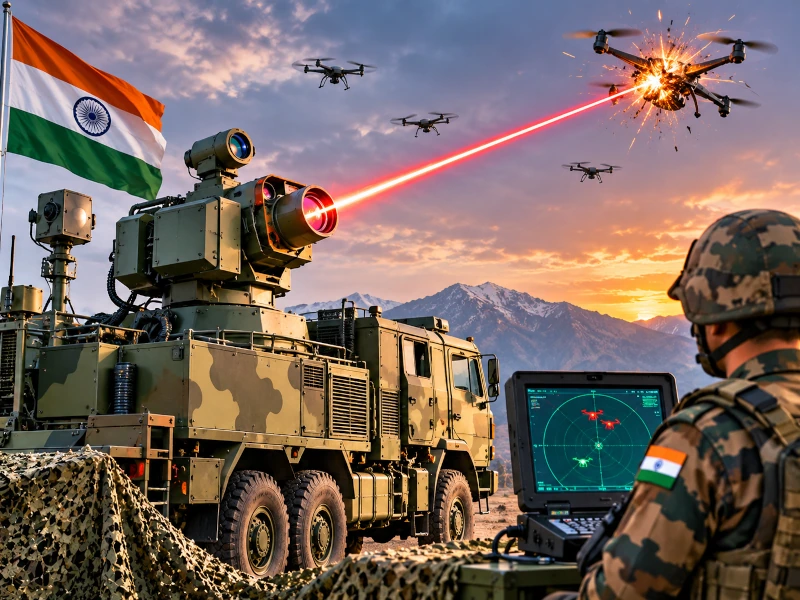
Chief of Defence Staff General N. S. Raja Subramani has identified laser-based Directed Energy Weapons (DEWs) as an important component of India’s future counter-drone capabilities, highlighting the indigenous technologies developed by the Defence Research and Development Organisation (DRDO). Speaking at the Vivekananda International Foundation in New Delhi on 27 November 2026, the CDS outlined India’s preparedness for future warfare and multi-domain operations. His remarks underscored the importance of integrating emerging technologies, indigenous defence manufacturing and joint operational capabilities into India’s evolving military architecture.
Directed Energy Weapons in India’s Future Defence Architecture
The increasing proliferation of unmanned aerial vehicles has introduced new challenges for conventional air defence systems. The widespread availability of relatively inexpensive drones has highlighted the need for technologically diverse and economically sustainable counter-drone capabilities. Directed energy technologies represent one of the emerging alternatives being developed to complement existing defensive systems.
Unlike conventional weapons that rely on physical projectiles, laser-based directed energy systems use concentrated electromagnetic energy. Their development involves advanced research in photonics, precision optics, electrical power management and electronic control systems. DRDO’s progress in these technological domains provides an important foundation for India’s future indigenous air defence capabilities.
DRDO’s Progress in Indigenous Laser Technology
DRDO has already demonstrated significant progress in the development of laser-based directed energy systems through its Centre for High Energy Systems and Sciences (CHESS) in Hyderabad. On 13 April 2025, the organisation successfully conducted a field demonstration of its vehicle-mounted Mk-II(A) Laser Directed Energy Weapon at Kurnool in Andhra Pradesh. The demonstration established an important technological milestone in India’s development of indigenous laser-based counter-drone systems.
The achievement reflected the convergence of several advanced engineering disciplines within a domestically developed defence platform. It also demonstrated India’s ability to undertake complex research in emerging military technologies that require sustained institutional investment and specialised scientific expertise. The CDS’s latest remarks indicate the continuing relevance of these capabilities to future military modernisation.
Integration Within a Multi-Layered Air Defence Architecture
DRDO has also incorporated directed energy technology into its indigenous Integrated Air Defence Weapon System (IADWS). The Ministry of Defence confirmed that the system underwent its maiden flight tests on 23 August 2025, marking progress in the integration of multiple indigenous air defence technologies. The development represents a broader approach towards combining complementary defensive capabilities within an integrated architecture.
Directed energy weapons are expected to complement rather than entirely replace conventional air defence technologies. Their introduction adds another technological dimension to India’s defensive capabilities while recognising the continuing importance of existing systems. The development of integrated architectures reflects the increasing complexity of contemporary aerial security requirements.
The Changing Economics of Modern Air Defence
The proliferation of relatively inexpensive unmanned aircraft has brought renewed attention to the economic sustainability of defensive operations. Conventional interceptor systems remain essential, but their procurement, maintenance and replenishment requirements underline the importance of developing complementary technologies. Directed energy systems offer the potential for a different cost structure by relying primarily on electrical energy rather than expendable conventional ammunition.
However, the overall economics of directed energy technology must also account for development expenditure, equipment procurement, maintenance and supporting infrastructure. The long-term operational and financial benefits of such systems will depend on their reliability and successful integration within military networks. Continued testing and evaluation therefore remain essential to determining their suitability for wider deployment.
Technological Self-Reliance and Industrial Development
General Subramani’s emphasis on indigenous defence capabilities reflects the importance of technological self-reliance in preparing for future military requirements. Directed energy systems require expertise across specialised areas of optics, electronics, advanced materials, electrical engineering and precision manufacturing. Developing these capabilities domestically can strengthen India’s defence research ecosystem while supporting the growth of specialised industrial enterprises.
Collaboration between DRDO, academic institutions and Indian defence manufacturers will be important in translating research achievements into mature industrial capabilities. Such partnerships can contribute towards the development of specialised supply chains, technical expertise and advanced manufacturing infrastructure. The wider benefits may extend beyond defence into other sectors requiring high-precision optical and electronic technologies.
Preparing India for Multi-Domain Operations
The CDS delivered his remarks during an address titled Future of Warfare and India’s Preparedness to Conduct Multi-Domain Operations. His broader assessment highlighted the growing significance of emerging technologies, indigenous capabilities and coordination among the armed forces. Directed energy weapons were identified within this wider discussion rather than through a standalone procurement or induction announcement.
Future military preparedness will increasingly depend on the integration of technologies developed across different scientific and engineering disciplines. India’s investment in directed energy research represents one component of this larger transformation. Its eventual operational contribution will depend on continued technological development, institutional coordination and formal military acquisition processes.
From Scientific Demonstration to Operational Capability
The successful demonstration of a defence technology represents an important milestone, but does not automatically establish its full operational readiness or widespread military deployment. Progression towards operational service involves further evaluation, qualification, production arrangements and formal acceptance by the armed forces. These processes are particularly significant for emerging technologies such as high-energy laser systems.
The latest remarks by the Chief of Defence Staff indicate the strategic importance attached to DRDO’s directed energy research. However, the address did not announce a new successful test, identify a fresh procurement contract or confirm the completion of operational induction. The development must therefore be understood as an indication of India’s future capability priorities rather than a newly completed technological milestone.
Strengthening India’s Next-Generation Defence Capabilities
DRDO’s progress in directed energy technologies represents an important dimension of India’s efforts to develop advanced indigenous defence systems. The recognition of these capabilities by the Chief of Defence Staff highlights their potential contribution to future air defence modernisation and counter-drone preparedness. Continued research and industrial collaboration will be essential in transforming demonstrated technologies into reliable operational capabilities.
By investing in advanced scientific research, precision engineering and domestic industrial expertise, India can establish a stronger foundation for next-generation defence technologies. The sustained development of indigenous directed energy systems can contribute towards technological self-reliance, defence industrial competitiveness and long-term national security preparedness.
You may also like
-
C-DAC Targets Indigenous GPU Development by Mid-2028 to Strengthen India’s AI Computing Capabilities
-
Hetero Plans Indian Launch of Long-Acting HIV Prevention Medicine
-
Alpex Solar Commences Commercial Production at 2.2 GW TOPCon Solar Cell Facility
-
SEBI Explores Indigenous AI Model for India’s Securities Market
-
India Advances ₹26,968 Crore Space-Based Surveillance Programme with 52-Satellite Constellation
