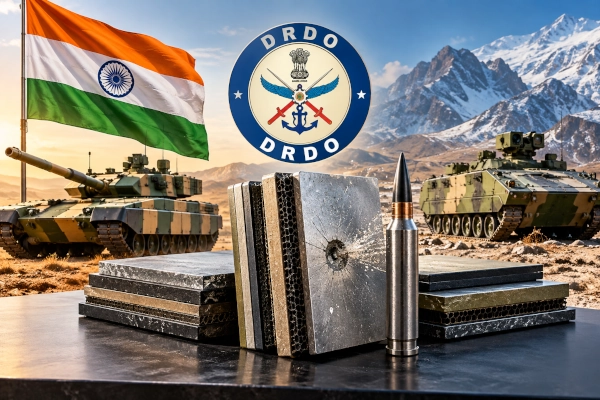
India has achieved an important milestone in indigenous military protection technology with the Defence Research and Development Organisation (DRDO) developing lightweight armour panels designed to provide STANAG 4569 Level 6 ballistic protection against 30 mm armour-piercing ammunition. The technology, developed by DRDO’s Research and Development Establishment (Engineers), R&DE(E), Pune, addresses one of the most demanding requirements of modern armoured warfare: protecting combat vehicles against powerful battlefield weapons while keeping their weight within operational limits.
On 1 October 2026, DRDO formally offered the manufacturing technology to Indian industry through its Transfer of Technology (ToT) programme. The technology is listed under Category A, covering military technologies, with three manufacturing licences available. The initiative creates an opportunity for domestic defence manufacturers to acquire an advanced armour-production capability for future armoured vehicle programmes.
The development is particularly relevant to India’s next-generation main battle tanks, light tanks and Future Infantry Combat Vehicles (FICVs), which require increasingly sophisticated protection against modern automatic cannons and other battlefield threats.
DRDO’s Pune Laboratory Develops Advanced Ballistic Protection
DRDO’s R&DE(E) laboratory in Pune has developed and tested the indigenous armour panels following an engineering programme involving design refinement, simulation and ballistic evaluation. The laboratory specialises in military engineering systems and technologies that support the operational requirements of the Indian Armed Forces.
According to reports describing the development, researchers conducted multiple design iterations to achieve the required combination of protection and reduced weight. The laboratory also developed a manufacturing approach for producing the panels, making the technology suitable for transfer to industrial partners.
The armour underwent testing against the specified STANAG Level 6 threat requirements, with reports indicating that the developed configuration achieved the necessary ballistic parameters. These results provided the basis for offering its manufacturing technology to industry.
The development demonstrates India’s growing expertise in ballistic protection engineering, where material selection, structural design, manufacturing precision and testing must work together to achieve demanding military specifications.
Understanding STANAG 4569 Level 6 Armour Protection
STANAG 4569 is a NATO standard that establishes protection levels for occupants of armoured military vehicles. It provides a recognised framework for assessing protection against specified ballistic threats and other battlefield hazards.
The standard helps military planners, vehicle designers and manufacturers evaluate protection according to defined threat categories rather than relying on general descriptions such as heavy armour or bullet resistance.
STANAG 4569 Level 6 is associated with protection against specified 30 mm armour-piercing and armour-piercing fin-stabilised discarding sabot ammunition. In the relevant kinetic-energy threat classification, the reference engagement distance is 500 metres, with protection requirements defined by the applicable test conditions.
Thirty-millimetre automatic cannons are considerably more powerful than conventional small arms. Their ammunition can deliver substantial kinetic energy and is designed to penetrate military vehicle protection systems.
Armour-piercing fin-stabilised discarding sabot ammunition uses a dense, narrow penetrator supported by fins. Its design concentrates impact energy into a relatively small area, making it particularly challenging for protective structures.
Consequently, achieving Level 6 protection requires armour capable of managing concentrated, high-energy impacts without allowing the specified projectile threat to penetrate the protected area.
However, the classification does not mean that a vehicle becomes invulnerable to every 30 mm round under all circumstances. Ballistic performance depends on the ammunition, impact velocity, strike angle, protected area and test configuration. Certification of an individual panel also differs from validation of an entire armoured vehicle.
Why Lightweight Armour Is Essential for Modern Combat Vehicles
Modern armoured vehicle development involves a fundamental engineering trade-off between protection, mobility and vehicle weight. Increasing conventional armour thickness can improve resistance against certain threats, but it also adds considerable mass.
Additional weight affects engine performance, acceleration, fuel consumption, suspension loading and the ability to negotiate difficult terrain. It can also complicate transportation by road, rail or specialised military transport aircraft.
Lightweight armour seeks to improve ballistic protection without imposing the same weight penalties associated with traditional heavy protective structures. Engineers evaluate this performance through measures such as areal density, which expresses armour mass per unit of protected surface.
A lower areal density for a given ballistic requirement can provide vehicle designers with greater flexibility. They may use the available weight allowance for additional equipment, improved protection elsewhere on the vehicle or increased operational mobility.
This balance is especially important for military vehicles operating in India’s mountains, deserts and regions with demanding road infrastructure. Vehicle weight influences tactical deployment, bridge-crossing capability and sustained mobility under challenging conditions.
DRDO’s emphasis on a lightweight solution therefore addresses an important consideration in the design of future Indian armoured platforms.
How Advanced Armour Panels Resist High-Energy Projectiles
Protection against medium-calibre armour-piercing ammunition requires more than simply increasing the thickness of a metal plate. Advanced armour systems use carefully engineered materials and structures to absorb, distribute or disrupt the energy delivered by an incoming projectile.
Modern armour engineering can employ combinations of high-hardness metals, ceramics, composites and energy-absorbing backing structures. Different materials perform specific functions, including resisting penetration, damaging the projectile and containing fragments generated during impact.
Ceramic materials, for example, can provide high hardness at comparatively low weight. Metallic and composite backing structures can help absorb residual energy and maintain structural integrity after the initial impact.
The effectiveness of these systems also depends on material interfaces, bonding quality, geometric configuration and the ability of the protective assembly to withstand severe mechanical loading.
DRDO has not publicly disclosed the precise material composition, thickness, areal density or detailed internal architecture of its STANAG Level 6 panels in the technology listing. Therefore, the engineering approaches described above explain the broader principles of advanced armour protection rather than identify the specific construction of DRDO’s product.
Manufacturing Technology Is as Important as Armour Design
Developing an effective armour configuration in a research laboratory is only one stage in creating a dependable military product. Manufacturing the same configuration consistently requires controlled industrial processes and reliable quality-assurance systems.
Armour production must maintain tight control over material properties, dimensional accuracy and structural integrity. Variations introduced during manufacturing can influence ballistic performance, making repeatability a critical requirement.
The technology-transfer package reportedly includes a bill of materials, manufacturing-process information, a quality-assurance plan and testing details. These elements are intended to help licensed manufacturers reproduce the developed armour configuration according to the prescribed requirements.
The quality-assurance framework is particularly important because ballistic resistance cannot be established through appearance or dimensional inspection alone. Manufacturers must ensure that their products meet the relevant material, process and performance requirements.
By transferring manufacturing knowledge alongside the developed technology, DRDO can help Indian companies establish specialised production capabilities rather than depend exclusively on imported finished armour systems.
Potential Applications in India’s Future Main Battle Tanks
Main battle tanks operate in environments where they face threats from automatic cannons, anti-armour weapons, artillery fragments and other battlefield systems. Their protection requirements vary considerably across different parts of the vehicle.
The frontal sections of modern main battle tanks generally receive the highest levels of protection, while the sides, rear and other areas have different design constraints and vulnerability profiles.
Lightweight armour panels capable of resisting specified 30 mm threats could contribute to protection solutions for selected vehicle sections, particularly where additional armour must fit within existing weight and space allowances.
Such technologies may also support modular protection arrangements that allow armoured vehicles to receive different protective configurations according to operational requirements.
However, DRDO’s technology-transfer announcement does not establish that these panels have already been selected for the Arjun main battle tank or any other operational tank programme. Their eventual use would depend on platform-specific engineering, qualification and procurement decisions.
Relevance to India’s Zorawar Light Tank Programme
India’s Zorawar light tank programme highlights the challenge of balancing firepower, mobility and protection in a vehicle intended for demanding terrain, including high-altitude operating environments.
Light tanks must remain sufficiently mobile for deployment across regions where heavier armoured platforms can face logistical or terrain-related constraints. Their designers therefore have a smaller weight allowance for protective structures.
Advanced lightweight armour technologies offer a potential means of improving protection without undermining the mobility requirements that define the light-tank category.
The STANAG Level 6 panels developed by R&DE(E) could provide useful engineering options for future light-armour applications, subject to compatibility with the vehicle’s design and overall weight limits.
There is no confirmed official announcement that the new armour panels have been integrated into Zorawar. The programme illustrates a potential application rather than an established integration.
Future Infantry Combat Vehicles Could Benefit from Higher Protection
Future Infantry Combat Vehicles are another important potential application for the indigenous armour technology. Unlike main battle tanks, these vehicles must combine battlefield protection with the ability to transport infantry personnel and their equipment.
Their designs must accommodate a troop compartment, weapons, communications equipment, mobility systems and protective structures within a defined vehicle envelope.
Modern infantry combat vehicles can encounter enemy vehicles armed with medium-calibre automatic cannons. Improving resistance against these weapons is therefore an important consideration in the development of next-generation platforms.
Lightweight armour panels could contribute to improved survivability while preserving space and weight for infantry transport and mission equipment. Their use would require integration with the vehicle’s hull structure, doors, observation systems and other vulnerable areas.
India’s continuing development of indigenous tracked and wheeled armoured platforms provides a wider technological context for this requirement. In April 2026, DRDO formally announced advanced tracked and wheeled armoured platforms developed by its Vehicles Research and Development Establishment, demonstrating ongoing work on indigenous infantry combat vehicle and armoured personnel carrier technologies.
Why Panel-Level Protection Does Not Automatically Mean Vehicle-Level Protection
An important distinction in military armour engineering is the difference between successfully testing an individual protective panel and demonstrating the protection of a complete vehicle.
A ballistic panel can meet its specified test requirement under controlled conditions, but an operational vehicle contains numerous structural features that influence its overall protection.
These include joints between armour sections, access hatches, doors, viewing systems, equipment openings and the structures connecting protective panels to the hull.
The performance of an installed armour system also depends on the supporting structure’s response to impact loads. Engineers must evaluate whether the vehicle can maintain protection without compromising structural integrity or essential functions.
A complete qualification programme therefore requires additional engineering work beyond panel-level ballistic evaluation. This can include installation assessments, environmental testing, structural analysis and live-fire validation of representative vehicle configurations.
The R&DE(E) development establishes a potential protective technology, while vehicle manufacturers and military users must undertake the additional work necessary for operational integration.
DRDO Offers Three Technology-Transfer Licences to Indian Industry
DRDO’s official technology-transfer portal lists Manufacturing Technology for STANAG-6 (30mm AP) Armour Panels under Category A, with R&DE(E), Pune, identified as the originating laboratory.
The listing, published on 1 October 2026, makes three licences available to eligible industrial applicants. Interested companies can seek access through DRDO’s established technology-transfer procedures.
The Expression of Interest invites Indian industry to participate in the manufacturing programme. Reports on the announcement indicate a response period of 21 days from publication.
The licensing mechanism allows DRDO to make developed technologies available for industrial production while retaining appropriate controls over sensitive military know-how.
The availability of three licences also creates the possibility of establishing multiple domestic manufacturing sources. This can support production capacity, supply-chain resilience and competition within the Indian defence manufacturing ecosystem.
The announcement does not identify successful licensees, confirm commercial orders or specify an operational production schedule.
Opportunities for India’s Defence Manufacturing Ecosystem
Advanced ballistic protection is a specialised industrial field involving materials science, precision engineering, testing infrastructure and rigorous process control.
Indian companies working in defence metallurgy, technical ceramics, composite materials and armoured vehicle manufacturing could potentially benefit from opportunities associated with this technology, subject to DRDO’s eligibility and licensing requirements.
Manufacturing high-performance armour can also encourage the development of specialised domestic suppliers. Such industrial activity may create demand for advanced raw materials, inspection equipment, production machinery and quality-control services.
Another important consideration is lifecycle support. Armoured vehicles often remain in military service for decades, requiring replacement panels, repairs and upgrades as their protection requirements evolve.
Domestic manufacturing capabilities can help simplify access to qualified replacement components and reduce dependence on overseas suppliers during long service periods.
The commercial opportunity, however, will depend on successful industrial qualification, production economics and demand from military vehicle programmes. A technology-transfer licence alone does not guarantee procurement.
How India’s Indigenous Armour Capability Fits into Atmanirbhar Bharat
India’s defence indigenisation programme increasingly extends beyond complete weapon systems to the critical technologies and components used in their construction.
Armour materials form an important part of this industrial ecosystem. Their availability can influence vehicle design, procurement costs, maintenance requirements and the freedom to develop future platform variants.
Reliance on foreign armour technology can create challenges involving intellectual-property restrictions, supply availability and access to manufacturing processes. Indigenous alternatives give Indian designers greater control over technology choices and production arrangements.
India has already pursued domestic capabilities in specialised armour materials and personal ballistic protection. DRDO’s Defence Materials and Stores Research and Development Establishment has developed Level 6 bulletproof jackets under the Indian BIS 17051 standard.
Those jackets address a different threat class from STANAG 4569 Level 6 vehicle armour and should not be considered equivalent. Nevertheless, both programmes illustrate the country’s broader effort to strengthen expertise in advanced protective materials.
The R&DE(E) initiative extends this indigenous technology-development approach into the demanding field of medium-calibre vehicle protection.
What Comes Next for DRDO’s STANAG Level 6 Armour
The next stage involves converting the technology-transfer opportunity into qualified industrial manufacturing capability.
Companies selected under DRDO’s licensing framework will need to establish the required production infrastructure, demonstrate process consistency and manufacture panels that meet the prescribed acceptance standards.
Subsequent adoption by defence programmes would require engagement with vehicle developers, system integrators and the Armed Forces to determine appropriate applications.
Cost, production rate, environmental durability and maintainability will influence the suitability of the armour for different vehicle categories. Platform developers will also need to account for the effect of additional protective structures on mobility and vehicle performance.
DRDO has not announced confirmed integration contracts, production quantities or a military induction timeline for the panels.
The development nevertheless represents a meaningful advance in India’s ability to design and manufacture sophisticated military protection systems. By combining indigenous research with opportunities for domestic industrial production, DRDO is helping strengthen the technological foundation for India’s next generation of armoured combat vehicles.
The availability of this manufacturing technology creates a pathway for Indian industry to acquire expertise in advanced ballistic protection, expand specialised defence production and contribute to the long-term modernisation of the Indian Armed Forces.
References
- Defence Research and Development Organisation (DRDO) — Manufacturing Technology for STANAG-6 (30mm AP) Armour Panels, official Transfer of Technology listing, 1 October 2026.
https://drdo.gov.in/drdo/en/offerings/transfer-of-technologies - DRDO — Official Technology-Transfer Document, R&DE(E), Pune, 1 October 2026.
https://drdo.gov.in/drdo/sites/default/files/tot/STANAG6_30mmAP01102026.pdf - Ministry of Defence, Government of India — DRDO Flags Off Indigenous Advanced Armoured Platforms at VRDE Ahilyanagar, Press Information Bureau, 25 April 2026.
https://www.pib.gov.in/PressReleasePage.aspx?PRID=2255549 - NATO STANAG 4569 — Protection Levels for Occupants of Armoured Vehicles, official standard record, promulgated 15 February 2022.
https://quicksearch.dla.mil/qsDocDetails.aspx?ident_number=277326 - DRDO — Technology Focus, March–April 2026 — Personal Protection Systems and Related Technologies, including indigenous Level 6 ballistic protection.
https://drdo.gov.in/drdo/sites/default/files/publication-document/TF_MarApr2026.pdf - The Defense News — DRDO’s R&DE(E) Pune Develops Indigenous Lightweight STANAG-6 Armour Panels, Issues EoI for Technology Transfer, 5 October 2026.
https://www.thedefensenews.com/DRDOs-RDEE-Pune-Develops-Indigenous-Lightweight-STANAG-6-Armour-Panels-Issues-EoI-for-Technology-Transfer/
You may also like
-
Exercise Tarang Shakti 2026 Concludes in Jodhpur, Showcasing India’s Air Power, Indigenous Defence Technology
-
Indian Navy Vice Chief Inspects Japan’s Mogami-Class Stealth Frigate as India-Japan Shipbuilding Cooperation Expands
-
India and Russia Explore Joint Icebreaker Construction as Maritime Industrial Cooperation Expands
-
Philippine Marine Wargames Reportedly Show BrahMos Can Penetrate Chinese Destroyer Air Defences
-
Safran Signs 18 Agreements with Indian Aerospace Suppliers, Expanding Make in India Manufacturing Partnerships
