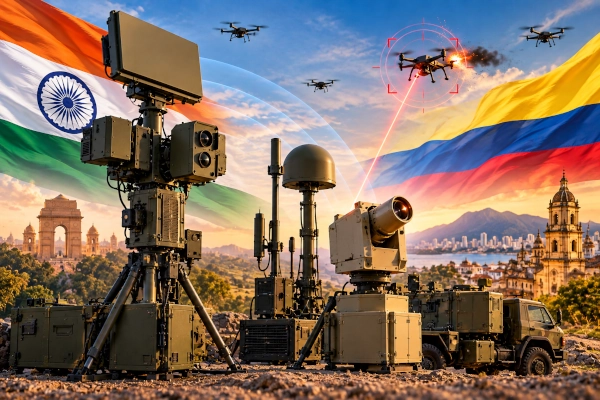
Colombia is exploring the acquisition of indigenous counter-drone systems developed by Bharat Electronics Limited (BEL) as the South American country seeks advanced technologies to combat drug cartels, armed criminal organisations and narco-terrorist groups. The development could open new opportunities for India’s defence industry while strengthening bilateral security cooperation between India and Colombia.
In an interview published on October 8, 2026, Colombia’s Ambassador to India, Victor Hugo Echeverri Jaramillo, confirmed that his government was in discussions with BEL regarding its counter-drone technology. The Ambassador highlighted the competitive pricing of Indian systems compared with European alternatives and expressed interest in expanding cooperation in intelligence, artificial intelligence and law-enforcement technologies.
The discussions follow an official visit by a high-level Colombian defence delegation to BEL’s Ghaziabad Unit and Central Research Laboratory in March 2026. During the visit, BEL demonstrated its indigenous capabilities in drone detection, counter-drone warfare and advanced security technologies.
Colombian Defence Delegation Evaluates BEL’s Indigenous Technologies
In March 2026, a Colombian delegation led by Vice Ministers of Defence Angélica Verbel López and Angélica Marín Agudelo visited Bharat Electronics Limited’s Ghaziabad facilities to examine the company’s advanced defence systems.
According to BEL’s official communication, the delegation toured several important research and manufacturing facilities, including its antenna and radar units, Strategic Communication and Command Systems facilities, and Integrated Air Command and Control System laboratory.
The visitors received presentations and demonstrations covering BEL’s Anti-Drone Shield, AI-based drone swarm technologies and drone cyber-resilience solutions. These demonstrations provided an overview of the company’s capabilities in modern unmanned aerial warfare and technologies designed to counter emerging aerial threats.
BEL stated that the Colombian representatives appreciated the work undertaken at its Central Research Laboratory and expressed interest in potential collaboration and exports, particularly in drone warfare, counter-drone systems and advanced security solutions.
The visit established direct engagement between Colombian defence officials and India’s state-owned defence electronics manufacturer, creating a foundation for subsequent procurement discussions.
Colombia Seeks Counter-Drone Technology to Combat Drug Cartels
Colombia faces persistent security challenges involving organised drug-trafficking networks, armed groups and criminal organisations operating across difficult terrain. The increasing availability of commercial and modified unmanned aerial vehicles has introduced additional complications for security forces conducting counter-narcotics and counter-insurgency operations.
Drones can support illegal surveillance, reconnaissance and the movement of contraband. Armed groups can also modify readily available UAVs to carry explosive payloads, creating threats to military personnel, police facilities and critical infrastructure.
Speaking to Mint, Ambassador Jaramillo emphasised that Colombia’s security challenges require greater international cooperation and access to advanced intelligence technologies. He identified artificial intelligence, information sharing and technological collaboration as important elements of the country’s approach to combating transnational criminal networks.
The Ambassador specifically acknowledged discussions with BEL and highlighted the competitive pricing of Indian anti-drone systems. His remarks indicate that Colombia views Indian defence electronics as a potential source of technology for strengthening its security capabilities.
The discussions remain exploratory, and neither government has announced a final procurement agreement with BEL.
Colombia Launches National Anti-Drone Shield Programme
Colombia’s interest in Indian technology forms part of a wider national effort to develop an integrated counter-drone defence architecture.
On January 9, 2026, Colombia’s Ministry of National Defence announced plans to invest more than 6.3 trillion Colombian pesos in its National Anti-Drone Shield programme. The initiative aims to improve the ability of the country’s armed forces and security agencies to detect, track and neutralise hostile unmanned aircraft.
In a subsequent official communication dated March 19, 2026, the Colombian Defence Ministry explained that the programme was progressing through the structuring stage of its procurement process. The ministry had invited companies to participate in preliminary consultations and technical evaluations.
The programme envisages several categories of counter-drone equipment, including fixed and semi-fixed installations, vehicle-mounted tactical systems, maritime platforms, portable countermeasures and handheld drone detectors.
Colombia’s Defence Ministry also stated that it had distributed preliminary technical requirements to more than 100 companies from different countries. The process was intended to assess available technologies before finalising procurement specifications.
BEL’s engagement with Colombian defence officials places the Indian manufacturer among the potential international technology partners relevant to these requirements. However, participation in discussions or technical assessments does not establish that the company has secured an equipment order.
BEL’s Indigenous D4 System Offers Multi-Layered Counter-Drone Defence
Bharat Electronics Limited manufactures the D4 Counter-Drone System, developed by the Defence Research and Development Organisation (DRDO). The system combines multiple detection, tracking and neutralisation technologies to counter small unmanned aerial vehicles.
According to BEL’s official product information, the D4 architecture incorporates radar surveillance, electro-optical and thermal imaging sensors, radio-frequency detection, electronic jamming, satellite navigation interference and laser-based interception.
The radar component detects and tracks potential aerial threats, while electro-optical sensors assist in identifying targets through visible-light and infrared imaging. Radio-frequency equipment detects communication signals associated with drones and their controllers, providing additional information for threat assessment.
The system supports both soft-kill and hard-kill countermeasures. Soft-kill capabilities use electronic interference to disrupt drone communication or navigation, while the hard-kill component employs a laser-directed energy weapon to physically neutralise suitable aerial targets.
An integrated command-and-control centre coordinates the different subsystems, enabling operators to assess threats and select appropriate countermeasures.
This layered architecture is relevant to operational environments where drones may employ different communication methods, flight profiles and navigation technologies. Its effectiveness against a particular threat depends on the drone’s characteristics, engagement conditions and the configuration of the deployed system.
BEL’s Counter-Drone Technology Offers Operational Flexibility
BEL’s official specifications describe counter-drone systems capable of providing continuous surveillance across a wide area. Its anti-drone radar architecture offers 360-degree azimuth coverage, supporting the detection of potential threats approaching from different directions.
The company’s published product information lists radar detection ranges of up to two kilometres for certain nano-class unmanned aircraft, four kilometres for micro-class targets and eight kilometres for larger small or hybrid UAVs. These figures depend on target radar cross-section and the system’s operating conditions.
The electro-optical subsystem incorporates daytime and thermal imaging capabilities to assist with target identification. Meanwhile, radio-frequency sensors and jammers provide additional options for detecting and disrupting UAV communication links.
BEL offers configurations suitable for integration with fixed installations and mobile platforms, allowing counter-drone capabilities to support different operational requirements.
For Colombia, such flexibility could be relevant to the protection of military bases, police installations, critical infrastructure and security deployments in remote areas. Portable and vehicle-mounted systems may also offer advantages in regions where permanent counter-drone installations are impractical.
The specific equipment configuration that Colombia may procure has not been publicly finalised.
DRDO and BEL Strengthen India’s Indigenous Counter-Drone Capabilities
The D4 system reflects cooperation between India’s defence research establishment and its domestic manufacturing industry.
DRDO developed the underlying counter-drone technologies, while BEL undertook production and system integration. The project brought together expertise in radar engineering, electronic warfare, optical surveillance, laser technology and command-and-control systems.
On August 31, 2021, the Indian Navy signed a contract with BEL for the supply of an indigenous Naval Anti-Drone System incorporating both soft-kill and hard-kill capabilities. BEL’s official announcement identified the programme as an important achievement in India’s efforts to develop domestic technologies against emerging UAV threats.
Multiple BEL facilities and DRDO laboratories contributed to the programme, including organisations specialising in radar, electronic warfare, optical systems and directed-energy technologies.
The experience gained through domestic development and military integration provides BEL with a foundation for engaging international customers. It also allows the company to offer technologies developed within India’s defence research and manufacturing ecosystem.
Colombia’s interest demonstrates how indigenous defence programmes can generate opportunities beyond their original domestic requirements.
India and Colombia Explore Wider Security and Intelligence Cooperation
The potential acquisition of counter-drone technology forms part of Colombia’s broader interest in strengthening security cooperation with India.
Ambassador Jaramillo has emphasised the transnational character of organised drug trafficking and the need for closer coordination between law-enforcement agencies. He identified intelligence sharing and advanced technologies as important tools for addressing criminal networks operating across national borders.
Colombia is also considering the appointment of a police attaché at its embassy in New Delhi to facilitate communication and cooperation with Indian law-enforcement institutions.
The two countries have already undertaken limited cooperation in police training. From March 26 to April 8, 2025, 25 officers from Colombia’s National Police attended an Indian Technical and Economic Cooperation (ITEC) training programme on artificial intelligence for human security at Rashtriya Raksha University in Gujarat.
Such exchanges provide a foundation for cooperation in intelligence analysis, technology applications and professional training. They also create opportunities for Indian academic and security institutions to engage with international agencies confronting complex criminal threats.
Colombia’s interest in BEL could expand this relationship into defence electronics and specialised counter-drone technologies.
India’s Defence Exports Gain Attention in Latin America
The discussions with Colombia highlight the expanding international interest in India’s indigenous defence manufacturing capabilities.
Bharat Electronics Limited has developed a broad portfolio of defence electronics covering radar systems, electronic warfare, military communications, surveillance equipment and integrated command-and-control technologies.
The company’s indigenous counter-drone systems represent a technologically significant segment of this portfolio, combining capabilities developed by DRDO with BEL’s manufacturing and integration expertise.
Latin America presents opportunities for Indian defence companies seeking to diversify their international partnerships. Countries across the region face varied security challenges involving organised crime, border surveillance, critical infrastructure protection and military modernisation.
Indian manufacturers can participate in these markets by offering equipment, technical support, maintenance services and training solutions suited to local requirements.
However, successful international engagement depends on meeting operational specifications, completing evaluation procedures and securing the necessary contractual and regulatory approvals.
The Colombia-BEL discussions remain at the stage of expressed interest and procurement engagement. No confirmed contract value, equipment quantity or delivery schedule has been announced as of October 10, 2026.
Indigenous Defence Technology Opens New Opportunities for India-Colombia Cooperation
Colombia’s exploration of BEL’s counter-drone systems represents a developing opportunity for India’s indigenous defence technology sector and its bilateral relationship with the South American country.
The Colombian delegation’s March visit established direct contact with BEL’s research and manufacturing facilities, while the Ambassador’s October remarks confirmed continued interest in Indian counter-drone technology. Colombia’s National Anti-Drone Shield programme provides the wider procurement framework within which such cooperation could develop.
For India, the engagement demonstrates the international relevance of technologies developed through cooperation between DRDO and domestic defence manufacturers. For Colombia, it offers access to another potential supplier of advanced surveillance and counter-drone equipment.
The growing dialogue between Colombia and Bharat Electronics Limited reflects India’s expanding role in international defence technology cooperation. It also strengthens the foundation for a broader India-Colombia partnership involving indigenous defence manufacturing, security training, intelligence cooperation and technological innovation.
References
- Bharat Electronics Limited — March 2026. Official company announcement confirming the Colombian defence delegation’s visit to BEL Ghaziabad and demonstrations of indigenous drone and counter-drone technologies.
https://www.linkedin.com/posts/bharat-electronics-limited_makeinindia-defencemanufacturing-dronetechnology-activity-7439628576649367552-Ji1G - Ministry of National Defence, Colombia — January 9, 2026. Official announcement regarding investment of more than 6.3 trillion Colombian pesos in the National Anti-Drone Shield programme.
https://www.mindefensa.gov.co/prensa/noticia-visualizacion/inversion-de-mas-de-6-3-billones-de-pesos - Ministry of National Defence, Colombia — March 19, 2026. Official Communication on the National Anti-Drone Shield Procurement Programme.
https://www.mindefensa.gov.co/prensa/noticia-visualizacion/comunicado_oficial_escudo_nacional_antidrones - Bharat Electronics Limited — Official Product Information. Anti-Drone System: DRDO-Developed D4 Counter-Drone System.
https://bel-india.in/product/anti-drone-system/ - Bharat Electronics Limited — Official Product Information. Anti-Drone System: Soft-Kill and Hard-Kill Configurations.
https://bel-india.in/product/anti-drone-system-soft-hard-kill/ - Bharat Electronics Limited — August 31, 2021. Indian Navy Signs Contract with BEL for Supply of Naval Anti-Drone System.
https://bel-india.in/news-bel/indian-navy-signs-contract-with-bel-for-supply-of-naval-anti-drone-system/ - Mint — October 8, 2026. Colombia Seeks Deeper Security Ties with India to Fight Drug Cartels. Interview with Colombian Ambassador Victor Hugo Echeverri Jaramillo.
https://www.livemint.com/news/colombia-seeks-deeper-security-ties-with-india-to-fight-drug-cartels-11791366028228.html
You may also like
-
CG Power Strengthens India’s Semiconductor Manufacturing Ecosystem with ₹7,600 Crore Sanand Investment
-
Honeywell Accelerates HTT-40 Engine Deliveries to HAL, Targets 16 Engines by Mid-2027
-
India and Singapore Deepen Economic Cooperation Amid Global Energy Challenges
-
India’s Tata WhAP 8×8 Debuts with 30 mm Unmanned Turret at Marrakech Air Show
-
India Gifts Indigenous Zen Technologies Shooting Range to Kyrgyzstan, Strengthening Defence Cooperation
