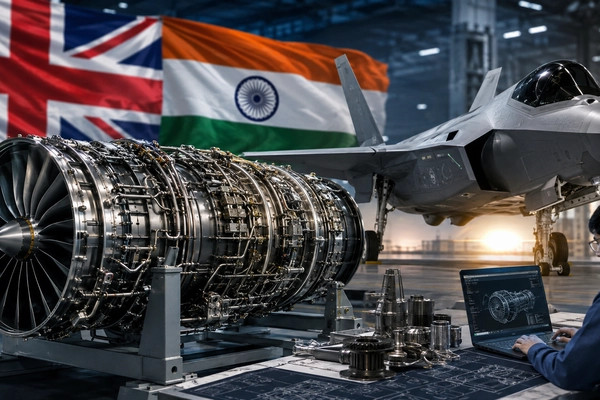
British aerospace and defence technology company Rolls-Royce is strengthening its engagement with India, with a proposed partnership with Reliance Industries aimed at developing an indigenous jet engine for India’s Advanced Medium Combat Aircraft (AMCA) programme. The initiative seeks to establish advanced fighter aircraft propulsion capabilities within India, supporting the country’s efforts to achieve greater technological independence in military aviation.
On August 14, 2026, Rolls-Royce and Reliance Industries Limited formally announced their strategic intention to collaborate on the design, development, manufacturing and delivery of an indigenous combat aircraft engine. The proposed partnership includes establishing an advanced aerospace propulsion ecosystem capable of supporting India’s future military aviation requirements.
The development builds on Rolls-Royce’s expanding relationship with India. On February 11, 2026, company CEO Tufan Erginbilgiç met Prime Minister Narendra Modi in New Delhi to discuss the company’s growing engagement with India’s industrial and technological sectors. The Prime Minister welcomed Rolls-Royce’s interest in expanding its Indian operations and collaborating with the country’s young engineering talent.
Rolls-Royce and Reliance Propose Joint Development of AMCA Fighter Engine
The proposed collaboration between Rolls-Royce and Reliance Industries focuses on creating sovereign Indian capabilities in advanced military aircraft propulsion. Unlike arrangements limited to assembling imported engines, the companies intend to offer capabilities covering the complete engine development process, from design and engineering to manufacturing, testing and operational support.
In their joint announcement, the companies identified the AMCA programme as the primary focus of their proposed collaboration. Rolls-Royce would contribute its experience in advanced aerospace propulsion, while Reliance would bring its industrial manufacturing capabilities, technology infrastructure and large-scale project execution expertise.
Anant Ambani, Executive Director of Reliance Industries Limited, emphasised the importance of sovereign capabilities in critical technologies. He said the proposed collaboration seeks to combine Rolls-Royce’s propulsion expertise with Reliance’s industrial strengths to establish an indigenous aero-engine ecosystem.
Rolls-Royce CEO Tufan Erginbilgiç also welcomed the opportunity to collaborate with Reliance. He described the initiative as an important step towards developing a stronger and more self-reliant aerospace industry in India.
The August announcement represents a strategic proposal by the two companies. It does not constitute confirmation that the Indian government has selected Rolls-Royce and Reliance as the AMCA engine development partners or awarded them a development contract.
Proposed Aerospace Gas Turbine Complex to Build Engine Development Capabilities
A major component of the Rolls-Royce–Reliance initiative is the proposed establishment of a dedicated Aerospace Gas Turbine Complex in India. The companies envisage the facility as a centre of excellence for advanced power and propulsion technologies.
According to the official announcement, the complex would support engine design, development, manufacturing, testing, production and through-life support. Bringing these activities together within India would help create an integrated industrial foundation for developing advanced gas turbine engines.
Modern fighter aircraft engines require specialised capabilities in high-temperature materials, precision manufacturing, aerodynamic engineering, combustion technology and complex control systems. Developing such capabilities domestically involves much more than producing engine components or assembling imported equipment.
An integrated propulsion development facility could help Indian engineers acquire experience across successive stages of engine development, including performance validation, reliability assessment and manufacturing refinement. It could also strengthen the domestic supplier network for specialised aerospace components and engineering services.
The companies have additionally identified opportunities to explore cooperation beyond military fighter engines, including civil aerospace and emerging power and propulsion technologies.
India’s AMCA Programme Opens Greater Opportunities for Indian Industry
The proposed engine partnership comes as India advances the development of its fifth-generation Advanced Medium Combat Aircraft, a major programme intended to strengthen the Indian Air Force’s future combat aviation capabilities.
On May 27, 2025, Defence Minister Rajnath Singh approved the AMCA Programme Execution Model, introducing a competitive industry partnership framework for developing the aircraft. The Aeronautical Development Agency (ADA), operating under the Defence Research and Development Organisation (DRDO), is responsible for executing the programme through industry participation.
The government-approved model provides opportunities for both public and private sector companies to participate in the aircraft development programme. Eligible Indian companies can compete independently or through joint ventures and consortium arrangements.
During an industry event on May 29, 2025, Rajnath Singh stated that the AMCA programme envisaged developing five prototypes before progressing towards series production. The approach reflects India’s effort to bring together public research institutions, established defence manufacturers and private industry for complex aerospace development.
The framework for developing the aircraft and the selection of an indigenous engine development partner are distinct matters. The Rolls-Royce–Reliance announcement concerns a proposed propulsion collaboration rather than an award under the AMCA aircraft development programme.
Indigenous Jet Engine Development Remains a Critical Priority for India
India has made considerable progress in the indigenous development of military aircraft, including airframes, avionics, flight control systems and associated technologies. However, developing high-performance fighter aircraft engines remains one of the country’s most demanding technological objectives.
Military jet engines operate under extreme thermal and mechanical conditions. Their development requires expertise in turbine materials, high-pressure compressors, combustion systems, cooling technologies and advanced manufacturing processes. Achieving the required combination of thrust, reliability, efficiency and durability involves extensive engineering validation and testing.
In February 2026, Defence Minister Rajnath Singh visited DRDO’s Gas Turbine Research Establishment (GTRE) and emphasised the importance of indigenous aero-engine development for India’s strategic security. He urged the organisation to focus on next-generation engines and strengthen the national ecosystem for advanced propulsion technologies.
The Rolls-Royce–Reliance proposal aligns with this broader national objective by seeking to establish domestic capabilities across the engine development lifecycle. Its emphasis on indigenous design and engineering is particularly relevant because long-term technological independence depends on the ability to develop, modify, manufacture and sustain critical propulsion systems.
Such capabilities would also allow Indian institutions and industries to accumulate technical knowledge that could support future aircraft and propulsion programmes.
Rolls-Royce Expands Its Long-Term Engagement with India
Rolls-Royce’s interest in India’s aerospace and defence industries received high-level attention during CEO Tufan Erginbilgiç’s meeting with Prime Minister Narendra Modi on February 11, 2026.
Following the meeting, the Prime Minister welcomed the company’s enthusiasm for expanding its activities in India and working with the country’s engineering and technology talent. The interaction reflected the importance placed on international industrial partnerships that contribute to domestic technological development.
The subsequent August announcement with Reliance Industries gave this broader engagement a specific direction in advanced military propulsion. By proposing joint development of an indigenous fighter engine, Rolls-Royce and Reliance outlined a possible framework for combining international aerospace experience with Indian industrial capabilities.
The companies’ public statements emphasise the development of an enduring aerospace ecosystem rather than limiting cooperation to a single manufacturing project. Their proposed approach includes engineering, testing, production and long-term support capabilities that could serve multiple aerospace applications.
AMCA Engine Proposal Supports Make in India and Aatmanirbhar Bharat
India’s pursuit of indigenous fighter engine technology forms an important part of its wider defence industrial strategy. The government’s Aatmanirbhar Bharat and Make in India initiatives seek to increase domestic participation in technologically advanced defence programmes while strengthening national manufacturing and research capabilities.
The proposed Rolls-Royce–Reliance partnership reflects the growing role of Indian private industry in pursuing complex aerospace technologies. Reliance’s participation would bring another major Indian industrial group into the field of advanced aircraft propulsion development.
Beyond engine manufacturing, such an initiative could generate opportunities for Indian engineering companies, research institutions, specialised component manufacturers and technology developers. Establishing a domestic aerospace gas turbine ecosystem would also help broaden the industrial base available for future aviation programmes.
The next stage of the initiative will depend on converting the companies’ strategic intent into defined development arrangements, industrial commitments and the necessary programme approvals. No final AMCA engine development contract was announced in the official Rolls-Royce–Reliance release of August 14, 2026.
India’s long-term objective is to acquire the technological and industrial capability to develop and sustain advanced fighter aircraft engines within the country. The Rolls-Royce–Reliance initiative adds a significant proposed industrial partnership to that national effort, reinforcing the growing emphasis on indigenous propulsion technology as India develops its next generation of combat aircraft.
References
- Rolls-Royce — August 14, 2026. Reliance Industries and Rolls-Royce Announce Strategic Intent to Partner and Develop India’s Indigenous Combat Engine for the Advanced Medium Combat Aircraft (AMCA) Programme.
https://www.rolls-royce.com/media/press-releases/2026/14-08-2026-reliance-industries-and-rolls-royce-announce-strategic-intent-to-partner-and-develop-indias-indigenous-combat-engine-for-the-amca-programme.aspx - Prime Minister’s Office — February 11, 2026. CEO of Rolls-Royce Meets Prime Minister.
https://www.pmindia.gov.in/en/news_updates/ceo-of-rolls-royce-meets-pm/ - Ministry of Defence, Press Information Bureau — May 27, 2025. Aatmanirbhar Bharat: Raksha Mantri Approves Advanced Medium Combat Aircraft Programme Execution Model Through Industry Partnership.
https://www.pib.gov.in/PressReleasePage.aspx?PRID=2131528 - Ministry of Defence, Press Information Bureau — May 29, 2025. Make-in-India Played a Key Role During Operation Sindoor; AMCA Execution Model to Allow Private Sector to Further Bolster Indigenous Capabilities.
https://www.pib.gov.in/PressReleseDetailm.aspx?PRID=2132239 - Ministry of Defence, Press Information Bureau — February 2026. Raksha Mantri’s Visit to DRDO’s Gas Turbine Research Establishment and Emphasis on Indigenous Aero-Engine Development.
https://www.pib.gov.in/PressReleasePage.aspx?PRID=2228670
You may also like
-
Larsen & Toubro and Spain’s Navantia Partner to Develop Four Amphibious Assault Ships for Indian Navy
-
Punjab’s Rail Coach Factory Advances Vande Bharat Manufacturing as 16-Coach Trainset Undergoes 180 kmph Trial
-
Gujarat’s Svaayatt Systems Proposes Nine-Drone Autonomous Swarm for Indian Armed Forces
-
EndureAir and Maraal Aerospace Partner to Develop Indigenous High-Altitude Pseudo-Satellite for India
-
Serum Institute of India-Manufactured Ebola Vaccine Enters Clinical Trial in Uganda
