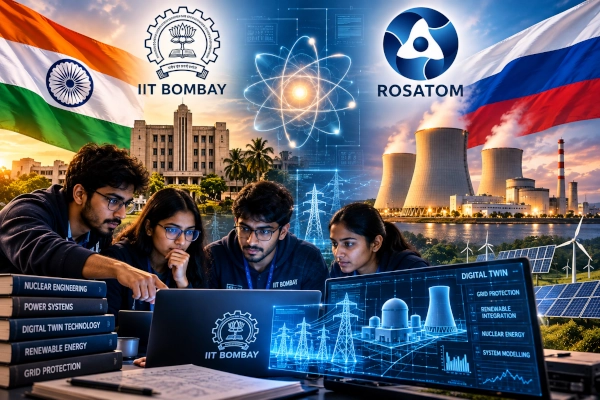
The Indian Institute of Technology Bombay (IIT Bombay) and Russia’s state nuclear corporation Rosatom have launched Atomic Hack India 2026, a national innovation competition focused on nuclear engineering, digital twin technologies, electrical grid protection and the integration of renewable energy into power systems.
The initiative brings together IIT Bombay’s Research Hub for Green Energy and Sustainability (GESH IITB), Rosatom’s engineering subsidiary JSC ETC GET and the Rosatom Corporate Academy. It aims to equip Indian engineering students with practical experience in solving complex industrial challenges associated with modern energy infrastructure.
Announced in October 2026, the programme combines advanced mathematical modelling, power engineering and industry mentorship. According to IIT Bombay’s official programme information, registration began on 1 October, while the final competition will take place from 4 to 6 December 2026 at the institute’s Mumbai campus.
The collaboration adds an educational and technological dimension to India–Russia cooperation in nuclear energy, extending the relationship into advanced engineering software, digital infrastructure and the development of specialised technical skills.
Atomic Hack India 2026 Focuses on Real-World Nuclear Engineering Challenges
Atomic Hack India 2026 is structured as a national engineering competition in which students develop solutions to practical problems involving nuclear power systems and electricity transmission networks.
Unlike conventional programming competitions, the event requires participants to construct engineering models, simulate operating conditions and demonstrate the effectiveness of their proposed solutions.
The programme focuses on nuclear engineering, power system protection, renewable energy integration, digital twins and the reliability of critical infrastructure. Participants will apply mathematical modelling techniques to investigate how electricity networks behave under different operating conditions.
Engineering and technology students from institutions across India can participate in teams of three or four members. The organisers particularly encourage students specialising in electrical engineering, physics, computer science, nuclear engineering and related disciplines.
The competition seeks to strengthen participants’ understanding of industrial engineering requirements while encouraging collaboration between universities and technology companies.
Students Will Design Protection Systems for Nuclear-Powered Electricity Grids
The central technical challenge involves developing a Zero-Sequence Directional Overcurrent Protection (ZDOP) system for a 220 kV transmission line connected to a nuclear-anchored electricity grid.
Participants must construct a simulated electrical network containing a nuclear power source, at least one conventional generating source, a renewable energy source and connected electrical loads.
They will then design a four-stage protection arrangement using directional overcurrent relays and associated control mechanisms.
The purpose is to identify electrical faults accurately and isolate affected transmission lines without unnecessarily disconnecting healthy sections of the network.
Power system protection is particularly important for large generating stations because failures within transmission infrastructure can disrupt electricity delivery and threaten the stability of interconnected grids.
Participants must demonstrate that their protective systems respond correctly to faults occurring on designated transmission lines while remaining stable when faults develop elsewhere.
The organisers have also introduced a challenge involving high renewable energy penetration, where changing generation patterns can make traditional fault detection more complex.
Why Renewable Energy Integration Creates New Grid Protection Challenges
India’s electricity network is undergoing significant transformation as solar and wind power account for an expanding share of generating capacity.
Traditional electrical grids were designed primarily around large synchronous generators operating at thermal, hydroelectric and nuclear power stations. These machines produce substantial fault currents that conventional protection systems can detect relatively easily.
Solar photovoltaic systems and many modern wind installations connect to the grid through power electronic converters. Their response to electrical faults can differ considerably from that of conventional generators.
Inverter-based generating systems frequently limit fault currents to protect their electronic components. Consequently, some traditional overcurrent protection arrangements may become less sensitive under certain operating conditions.
The Atomic Hack India challenge addresses this engineering problem by asking students to test protection systems when renewable energy output is high and available fault current becomes comparatively low.
Such simulations can help future engineers understand how modern electricity networks must adapt as nuclear, conventional and renewable generating sources operate together.
Reliable protection systems are essential for maintaining electricity supply, preventing unnecessary equipment damage and reducing the risk of cascading grid disturbances.
Rosatom’s REPEAT VISION Platform Will Support Digital Twin Development
Participants will use REPEAT VISION, a professional engineering modelling platform developed within the Rosatom Group.
The software supports mathematical modelling, system simulation and the development of digital representations of industrial processes.
A digital twin is a computational representation of a physical system that engineers can use to investigate performance, analyse changing conditions and assess alternative designs.
In electricity infrastructure, digital twins can represent generating stations, transmission networks, protection systems and other interconnected components.
Engineers can then introduce simulated equipment failures, variations in electrical demand or changes in generation patterns to examine how the system responds.
This approach allows technical teams to test operating strategies without exposing actual industrial equipment to potentially damaging experimental conditions.
For Atomic Hack India, REPEAT VISION will provide the environment in which students construct their electricity networks, implement protective logic and evaluate system performance.
The organisers will provide trial software licences, cloud computing resources and technical documentation. According to IIT Bombay, the platform can operate on standard laptops, with an India-hosted cloud version available to participants.
Competition Will Progress Through Online Qualification and an IIT Bombay Finale
Atomic Hack India 2026 will proceed through a combination of online preparation, technical qualification and an intensive on-campus engineering competition.
Registration opened on 1 October 2026 and will close at 11:59 p.m. IST on 20 October 2026. Participation is free.
During the initial stage, registered teams will receive access to the modelling platform, introductory resources and preliminary engineering tasks.
The online qualification phase will run from 20 to 28 October, allowing participants to become familiar with the software and demonstrate their technical capabilities.
Selected teams will advance to the final round at IIT Bombay from 4 to 6 December.
The grand finale will include a 48-hour engineering sprint during which participants work on the assigned problems with guidance from technical experts.
Teams will present and defend their solutions before evaluators, demonstrating their understanding of the models, simulations and protection systems they have developed.
IIT Bombay and Rosatom Will Provide Engineering Mentorship
The programme will give students access to specialists from IIT Bombay and Rosatom, combining academic knowledge with industrial engineering experience.
Participants will receive technical guidance on mathematical modelling, digital twins, power system simulation and the practical requirements of energy infrastructure.
The initiative also encourages interdisciplinary collaboration, allowing students with different technical backgrounds to contribute to a common engineering challenge.
Electrical engineers can focus on network architecture and protection coordination, while computer science students may contribute to computational modelling and simulation workflows.
Students specialising in nuclear engineering and physics can examine the characteristics of generating systems and their interactions with the electrical network.
The competition permits the use of artificial intelligence tools, provided participants disclose their use and independently explain their technical solutions.
This requirement encourages students to use computational assistance while retaining responsibility for engineering accuracy and technical reasoning.
International Internships and Research Opportunities for Participants
Atomic Hack India 2026 offers opportunities for selected participants to gain exposure to international engineering organisations.
According to IIT Bombay, prizes include a fully sponsored international research internship in Moscow, internships at Rosatom subsidiary JSC ETC GET and industry-recognised certificates.
Winners may also receive opportunities to visit advanced engineering centres in Russia and interact with specialists working on industrial modelling technologies.
The organisers intend to identify promising engineering ideas and prototypes that could eventually support research projects, pilot implementations or industry incubation programmes.
These opportunities remain prospective outcomes of the competition rather than confirmed commercial deployments.
By connecting students with industrial engineers and research institutions, the programme seeks to create pathways from academic learning into specialised technology development.
IIT Bombay’s Green Energy Research Hub Supports Advanced Energy Innovation
IIT Bombay’s Research Hub for Green Energy and Sustainability provides the academic foundation for the initiative.
Established in 2023 through an alumni contribution of approximately $18.6 million, the hub promotes interdisciplinary research addressing energy, environmental and sustainability challenges.
Its activities cover renewable energy technologies, sustainable infrastructure, energy storage, climate research and industrial decarbonisation.
The hub also supports collaboration between academic researchers, technology companies, policymakers and industrial organisations.
Atomic Hack India extends these activities into electricity grid modelling and nuclear energy systems integration, areas that will become increasingly important as India expands its generating infrastructure.
The programme also complements IIT Bombay’s wider engagement with nuclear engineering. In May 2026, the institute hosted the India Nuclear Energy Forum, where researchers, policymakers and industry representatives discussed the country’s long-term nuclear power development objectives.
India–Russia Cooperation Expands into Advanced Nuclear Engineering Skills
India and Russia have maintained a longstanding partnership in civilian nuclear energy, particularly through the Kudankulam Nuclear Power Project in Tamil Nadu.
Rosatom has played a major role in supplying reactor technology and supporting the construction of generating units at the facility.
Atomic Hack India introduces a different form of cooperation focused on engineering education, computational tools and technical problem-solving.
The programme does not involve the construction of a new nuclear reactor or the transfer of reactor technology. Its immediate objective is to develop engineering capabilities through simulation-based learning and industrial collaboration.
Such initiatives can broaden the pool of Indian engineers familiar with nuclear power systems, grid protection and advanced modelling techniques.
The skills developed through these exercises may also find applications in conventional electricity networks, renewable energy installations and industrial infrastructure.
Developing India’s Next Generation of Nuclear and Power Engineers
India’s long-term energy transition will require engineers capable of managing increasingly complex electricity networks.
The country has set a target of achieving 100 GW of nuclear power capacity by 2047, alongside continued expansion of renewable energy generation.
Meeting these ambitions will require expertise beyond reactor design and construction. Electricity transmission, system protection, digital monitoring and the coordination of different generating technologies will become equally important.
Atomic Hack India 2026 addresses part of this requirement by introducing students to the computational tools and engineering challenges associated with modern power infrastructure.
The competition also demonstrates how international research partnerships can support India’s domestic technical capabilities through structured training and exposure to industrial practices.
By connecting IIT Bombay’s academic ecosystem with Rosatom’s engineering expertise, the initiative provides Indian students with opportunities to develop skills relevant to both nuclear power and the wider electricity sector.
Atomic Hack India 2026 represents a constructive step towards developing a new generation of Indian engineers equipped to design, simulate and protect the advanced energy systems that will support the country’s future growth.
References
- IIT Bombay — Research Hub for Green Energy and Sustainability. Atomic Hack India 2026: National Innovation Challenge in Nuclear Engineering & Digital Twins. Official programme details, technical challenge, eligibility, registration and competition schedule.
https://gesh.iitb.ac.in/event-details/atomic-hack-india-2026 - IIT Bombay — Research Hub for Green Energy and Sustainability. Research programmes, industry collaboration and sustainability initiatives.
https://gesh.iitb.ac.in/ - IIT Bombay — 30 May 2026. India Nuclear Energy Forum 2026 Concludes at IIT Bombay; National Action Plan Formulated to Accelerate India’s 100 GWe Nuclear Target.
https://iitb.ac.in/breaking-news/india-nuclear-energy-forum-inef-2026-concludes-iit-bombay-national-action-plan - IIT Bombay — Green Energy and Sustainability Research Hub. Institutional background and research objectives.
https://gesh.iitb.ac.in/aboutus - The Economic Times — 9 October 2026. Rosatom and IIT Bombay Launch Atomic Hack India 2026 to Solve Next-Generation Energy Grid Challenges.
https://m.economictimes.com/news/india/rosatom-and-iit-bombay-launch-atomic-hack-india-2026-to-solve-next-generation-energy-grid-challenges/articleshow/134838647.cms
You may also like
-
Indian Experts to Participate in Moscow Startup Summit as Global Technology Leaders Gather in Russian Capital
-
One Voice – One Resolve – One India: Namami Bharatam Marks 150 Years of Vande Mataram Across the Nation
-
Tarang Shakti 2026: Eight Foreign Air Forces and 32 Observer Nations to Join IAF Exercise at Jodhpur
-
PM Modi to Inaugurate SEMICON India 2026 as India Expands Semiconductor Manufacturing Ecosystem
-
SBER Showcases Digital Finance, Photonic Computing and Smart-City Technologies at INNOPROM India
