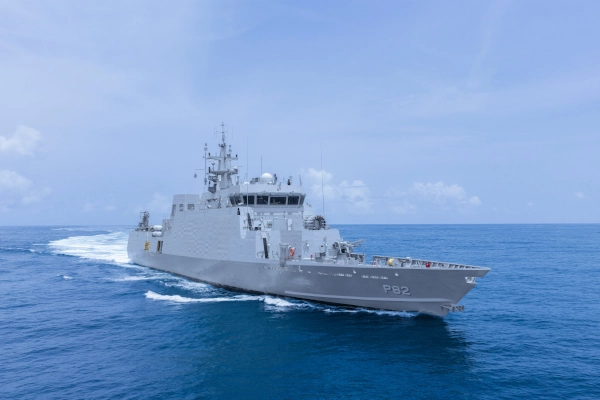
The Indian Navy is set to commission Mangrol, an indigenously built Anti-Submarine Warfare Shallow Water Craft (ASW-SWC), on October 12, 2026, at Naval Dockyard, Mumbai. The induction will strengthen India’s ability to detect, track and counter underwater threats in coastal waters while advancing self-reliance in naval shipbuilding.
Built by Cochin Shipyard Limited (CSL), Kochi, with over 80% indigenous content, Mangrol is the third vessel constructed by the shipyard under its eight-ship ASW-SWC programme. The warship combines modern sonar systems, lightweight torpedoes, anti-submarine rockets and waterjet propulsion to undertake specialised operations in shallow maritime environments.
The commissioning ceremony will be presided over by Vice Admiral Sanjay Vatsayan, Flag Officer Commanding-in-Chief, Western Naval Command. Senior naval officers, Ministry of Defence representatives, shipbuilding officials, veterans and representatives of indigenous defence equipment manufacturers are expected to attend.
Mangrol Designed for Anti-Submarine Warfare in Coastal Waters
Mangrol has been developed specifically for anti-submarine warfare operations in coastal and shallow waters, where underwater conditions create challenges for conventional naval platforms. Its primary responsibility will be to detect and counter hostile submarines operating near India’s coastline, strategic ports and important maritime approaches.
Coastal waters present a complex underwater environment because of varying depths, seabed conditions, marine traffic and acoustic interference. Submarines can exploit these conditions to reduce their chances of detection, making specialised shallow-water anti-submarine platforms an important component of maritime defence.
Unlike larger surface combatants primarily designed for operations across broader maritime areas, Mangrol can undertake dedicated underwater surveillance and anti-submarine missions in relatively confined coastal environments. Its operational capabilities will complement those of naval helicopters, maritime patrol aircraft and other surface warships, strengthening coordinated anti-submarine operations.
The vessel can also undertake low-intensity maritime operations and mine warfare-related assignments. These additional roles provide the Indian Navy with greater flexibility in protecting coastal infrastructure, monitoring maritime approaches and responding to emerging underwater security challenges.
Indigenous Sonar, Torpedoes and Anti-Submarine Weapons
Mangrol incorporates an integrated combination of underwater detection systems and anti-submarine weapons. Its equipment includes the Abhay Hull-Mounted Sonar, lightweight torpedoes, indigenous anti-submarine rocket launchers and the Maareech Advanced Torpedo Decoy System.
The Abhay sonar system supports underwater surveillance by detecting acoustic signals and helping identify potential submarine contacts. Hull-mounted sonar is particularly important for maintaining awareness of underwater activity and supporting anti-submarine engagements in coastal environments.
Lightweight torpedoes provide the vessel with a means of engaging hostile submarines after detection and localisation. The indigenous anti-submarine rocket system offers another weapon option for countering underwater threats, contributing to a layered anti-submarine warfare capability.
The Maareech Advanced Torpedo Decoy System strengthens the ship’s defensive capabilities against incoming torpedoes. By providing countermeasures against torpedo threats, the system adds an important element of survivability during operations in contested maritime environments.
Together, these systems give Mangrol the ability to conduct underwater surveillance, respond to submarine threats and protect itself while carrying out specialised coastal defence missions.
Waterjet Propulsion Enhances Manoeuvrability
Mangrol uses a propulsion arrangement consisting of three diesel engines driving waterjets, providing the manoeuvrability needed for operations in shallow and restricted waters.
Waterjet propulsion generates thrust by drawing in water and expelling it at high velocity. Compared with conventional exposed propeller arrangements, waterjets offer operational advantages for vessels designed to manoeuvre in confined maritime environments.
The propulsion configuration supports rapid changes in direction and precise vessel handling during coastal surveillance and anti-submarine operations. These characteristics are particularly useful when operating near harbours, coastal approaches and other areas where restricted sea room demands careful navigation.
Combining specialised propulsion with modern underwater surveillance equipment allows Mangrol to undertake missions that differ from those of larger destroyers and frigates. The vessel will consequently strengthen the Navy’s ability to maintain an effective anti-submarine presence closer to the Indian coastline.
Cochin Shipyard Strengthens Indigenous Warship Construction
Mangrol represents another milestone in India’s indigenous naval shipbuilding programme. Cochin Shipyard Limited constructed the vessel under a contract for eight Anti-Submarine Warfare Shallow Water Craft, supporting the Government of India’s Make in India and Aatmanirbhar Bharat initiatives.
The vessel’s indigenous content exceeding 80% reflects the increasing participation of Indian manufacturers in naval construction, propulsion, weapons, sensors and supporting equipment.
Building specialised anti-submarine vessels domestically also helps strengthen India’s maritime defence industrial ecosystem. Shipbuilding programmes create opportunities for Indian engineering firms, equipment suppliers and defence technology developers to manufacture and integrate systems intended for demanding naval environments.
Mangrol was delivered to the Indian Navy on August 21, 2026, following construction at Cochin Shipyard in Kochi. Its scheduled commissioning on October 12 marks the next stage in bringing the vessel into operational naval service.
The wider eight-vessel programme will expand the Indian Navy’s inventory of purpose-built coastal anti-submarine platforms while strengthening domestic expertise in the construction of specialised warships.
Mangrol Carries Forward the Legacy of an Earlier Indian Navy Warship
Mangrol derives its name from the coastal town and fishing harbour of Mangrol in Gujarat’s Junagadh district. The name reflects India’s maritime heritage and the longstanding relationship between its coastal communities and the Indian Ocean.
The new vessel also carries forward the legacy of INS Mangrol (M85), a minesweeper that served the Indian Navy until April 7, 2004. The earlier ship contributed to the Navy’s mine countermeasure capabilities, supporting maritime safety and naval operations.
By retaining the name, the Indian Navy continues its tradition of honouring former warships and preserving their historical association with maritime service.
The transition from a minesweeper to a modern anti-submarine warfare vessel also illustrates the evolution of India’s naval capabilities. While the earlier Mangrol served in mine countermeasures, its successor will focus primarily on underwater surveillance and anti-submarine warfare in coastal waters.
Mangrol to Strengthen India’s Coastal and Maritime Security
India’s extensive coastline, major commercial ports, naval bases and offshore infrastructure require sustained maritime surveillance and protection against underwater threats.
Submarines operating in coastal waters can pose risks to naval vessels, commercial shipping and critical maritime infrastructure. Effective protection therefore requires specialised platforms capable of detecting underwater activity and responding quickly to potential threats.
Mangrol will contribute to this protective network by conducting anti-submarine patrols, monitoring underwater activity and supporting coordinated operations with other naval assets.
Its induction will also reinforce the Indian Navy’s broader effort to develop a balanced fleet capable of operating across different maritime environments. While aircraft carriers, destroyers and frigates provide capabilities for larger naval operations, specialised shallow-water craft strengthen the security of coastal approaches and important maritime infrastructure.
The commissioning of Mangrol on October 12, 2026, will mark another step in strengthening India’s indigenous naval capabilities. With advanced anti-submarine systems, specialised propulsion and substantial domestic content, the vessel reflects the growing maturity of India’s defence shipbuilding ecosystem and the Indian Navy’s continuing commitment to maritime security and operational preparedness.
References
- Press Information Bureau, Ministry of Defence — October 9, 2026. Indian Navy Set to Commission Indigenous Anti-Submarine Warfare Shallow Water Craft ‘Mangrol’.
https://www.pib.gov.in/AllRelease.aspx - Press Information Bureau, Ministry of Defence — August 22, 2026. Delivery of Mangrol – The Third Anti-Submarine Warfare Shallow Water Craft Built by CSL, Kochi.
https://www.pib.gov.in/PressReleasePage.aspx?PRID=2302253 - Press Information Bureau, Ministry of Defence — February 21, 2023. Keel Laying of Second Ship (Malwan) and Third Ship (Mangrol) at CSL, Kochi.
https://www.pib.gov.in/PressReleasePage.aspx?PRID=1901133
You may also like
-
Nayan Technologies Selected by JSW MG Motor to Advance AI-Based Road Monitoring and Smart Mobility
-
JSW Steel’s Crude Steel Production Rises 5% to 7.27 Million Tonnes in Q2 FY2027
-
Kabra Extrusiontechnik’s GEON Commissions 20 MWh Battery Storage Project in Rajasthan
-
OBSC Perfection Secures ₹8.9 Crore Israeli Defence Order for Precision Fuze Components
-
NTPC Subsidiary NVVN Targets 1,000 MWh Battery Storage Capacity by March 2027
