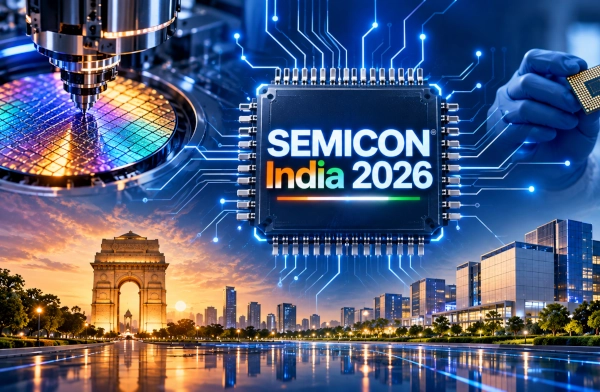
Prime Minister Narendra Modi will inaugurate the fifth edition of SEMICON India 2026 on September 17 at Yashobhoomi in New Delhi, bringing together semiconductor manufacturers, technology companies, investors, researchers and policymakers as India accelerates efforts to build a complete domestic semiconductor ecosystem.
The three-day conference and exhibition will run from September 17 to 19, 2026, at the India International Convention and Expo Centre. It is being jointly organised by the India Semiconductor Mission, the Ministry of Electronics and Information Technology and SEMI, the global industry association representing companies across the semiconductor and electronics design and manufacturing ecosystem.
The event comes at a significant stage in India’s semiconductor programme. Twelve semiconductor projects have now been approved under the first phase of the Semicon India Programme, while three of those projects have already entered commercial production. The Union Cabinet has also approved Semicon 2.0, intended to take India’s semiconductor strategy into its next phase.
More Than 600 Exhibitors Expected in New Delhi
SEMICON India 2026 will be held under the theme “Silicon to Systems: Building the Ecosystem,” reflecting India’s effort to develop capabilities across the semiconductor value chain rather than concentrate on chip fabrication alone.
According to the Ministry of Electronics and Information Technology, the exhibition will bring together more than 600 exhibitors, including around 300 international companies, across approximately 15,000 square metres of exhibition space. More than 150 speakers are expected to participate, along with delegations from over 40 countries.
The event will include six country pavilions and 12 state government pavilions, highlighting the growing involvement of Indian states in attracting semiconductor manufacturing, packaging, electronics and supply-chain investments.
The scale has increased since the government’s initial August announcement, which projected more than 500 exhibitors and over 240 international companies. The latest September 14 government release raises those figures to more than 600 exhibitors and 300 international companies.
From Semiconductor Materials to Complete Electronic Systems
A major focus of this year’s event will be India’s attempt to build capabilities across the complete semiconductor value chain.
SEMICON India 2026 will cover semiconductor materials, manufacturing equipment, wafer fabrication, advanced packaging, chip design, research and development, electronics manufacturing and finished systems.
A new “Sand to Silicon to Systems” Value Chain Experience will demonstrate how the different parts of semiconductor manufacturing connect, beginning with the materials needed to produce chips and extending through semiconductor fabrication and integration into electronic systems.
This broader approach is important because semiconductor self-reliance cannot be achieved by constructing fabrication plants alone. A competitive semiconductor industry also requires specialised chemicals and gases, manufacturing equipment, packaging and testing facilities, design capabilities, intellectual property, skilled engineers and a network of component and electronics manufacturers.
India’s current strategy is therefore increasingly directed towards developing an ecosystem around the fabrication plants now being established.
Twelve Semiconductor Projects Approved
The government has so far approved 12 semiconductor projects under Semicon 1.0, representing the first major wave of investments under the India Semiconductor Mission.
Three of these projects have already commenced commercial production, according to MeitY.
The transition from project announcements to actual production is an important milestone for India’s semiconductor strategy. For decades, India possessed substantial expertise in semiconductor design and software engineering but lacked comparable domestic capacity in large-scale semiconductor manufacturing.
The Semicon India Programme was created to address that gap by supporting fabrication plants, compound-semiconductor manufacturing, assembly, testing, marking and packaging facilities and semiconductor design.
The government has now approved Semicon 2.0, structured around six major pillars intended to further expand and strengthen the country’s semiconductor ecosystem.
More Than 400 Academic Institutions Receive Advanced Chip-Design Tools
India is simultaneously attempting to build the design and research capabilities required to support semiconductor manufacturing.
According to the latest government figures, state-of-the-art Electronic Design Automation tools have been made available to more than 400 academic institutions and 105 startups. These software platforms are essential for designing and verifying complex semiconductor chips before they enter fabrication.
The government has also approved 24 startups under the Design Linked Incentive Scheme, which supports Indian companies developing semiconductor designs and products for strategic and commercial applications.
Expanding access to professional EDA tools is particularly important because their cost has historically placed advanced semiconductor design beyond the reach of many universities and small companies.
By providing these tools through academic and startup programmes, India is attempting to develop a broader pool of semiconductor designers capable of creating indigenous intellectual property and eventually supplying chips for domestic and international markets.
Around 40 Semiconductor Startups to Be Showcased
SEMICON India 2026 will also feature a dedicated Startup Pavilion showcasing around 40 companies, reflecting the growing role of younger Indian technology firms in semiconductor design, materials, equipment, electronics and related technologies.
An Innovation Showcase and Startup Pitch Competition will provide additional opportunities for emerging companies to interact with investors, global semiconductor manufacturers and technology partners.
The event will also feature a Student Hackathon and Workforce Development Pavilion, aimed at addressing one of the semiconductor industry’s most important long-term requirements: skilled manpower.
Building semiconductor fabrication plants requires highly specialised engineers and technicians across process engineering, materials science, chip design, packaging, testing, equipment maintenance and manufacturing automation.
India already possesses a large engineering workforce, but the expansion of domestic semiconductor manufacturing will require more specialised training aligned with fabrication and advanced electronics.
Global Semiconductor Market Heading Towards $2 Trillion
The expansion of India’s semiconductor programme comes as global demand for chips continues to increase.
According to figures cited by the government, the global semiconductor market was valued at approximately $796 billion in 2025 and is projected to exceed $2 trillion by 2030.
Growth is being driven by artificial intelligence, advanced computing, electric mobility, telecommunications, industrial automation and increasingly sophisticated consumer electronics.
Semiconductors have also acquired strategic importance as governments seek to reduce dependence on highly concentrated international supply chains. Disruptions during recent years demonstrated that shortages of relatively small semiconductor components could halt production across industries ranging from automobiles to telecommunications equipment.
As a result, countries and companies are increasingly looking for geographically diversified and trusted manufacturing locations.
India is attempting to position itself within this restructuring of the global semiconductor industry.
India’s Semiconductor Demand Could Reach $103 Billion
India itself represents a rapidly expanding semiconductor market.
The government estimates domestic semiconductor demand at approximately $50 billion, with the market projected to reach around $103 billion by 2030.
That demand is being driven by growth in smartphones, telecommunications networks, automobiles, electric vehicles, industrial electronics, defence equipment, computing, data centres and consumer appliances.
A large domestic market gives India an important advantage while developing semiconductor manufacturing because fabrication and packaging facilities can potentially serve substantial local demand before expanding further into exports.
The long-term objective, however, extends beyond replacing imported chips. India is seeking to become part of international semiconductor supply chains by attracting global manufacturers while simultaneously developing Indian design, packaging and manufacturing companies.
Global Semiconductor Majors to Participate
SEMICON India 2026 is expected to feature participation from some of the world’s largest semiconductor and electronics companies.
The government has identified companies including ASML, Applied Materials, Teradyne, Infineon, IBM Research, NXP, Micron, Lam Research, Tokyo Electron, Tata Electronics, CG Power, Rapidus, Jabil and Advantest among the organisations expected to participate.
Their presence is significant because semiconductor manufacturing depends on a highly specialised international supply chain.
Companies such as ASML and Tokyo Electron produce sophisticated semiconductor-manufacturing equipment, while Applied Materials and Lam Research provide critical wafer-processing technologies. Micron and NXP represent major semiconductor manufacturers, while Indian companies such as Tata Electronics and CG Power are developing manufacturing and packaging capacity inside the country.
Bringing these companies together with Indian policymakers, states, startups and prospective suppliers is intended to facilitate investment discussions and supply-chain partnerships.
Building a Complete Semiconductor Ecosystem
The significance of SEMICON India 2026 lies in how India’s semiconductor strategy is beginning to move beyond individual project announcements.
The first stage concentrated heavily on attracting major semiconductor manufacturing investments. The emerging phase increasingly involves building the supporting ecosystem required to make those investments sustainable.
That includes semiconductor design, equipment, materials, chemicals and gases, advanced packaging, component manufacturing, research institutions, engineering talent and downstream electronics production.
A fabrication plant cannot operate as an isolated industrial facility. It depends on a complex network of suppliers and skilled personnel, while its economic impact increases substantially when packaging, testing, design and electronics manufacturing develop around it.
The theme “Silicon to Systems” therefore reflects a broader industrial objective: India wants to participate not merely in one stage of semiconductor manufacturing but across the chain that ultimately converts raw materials and chip designs into finished electronic products.
SEMICON India Becomes a Platform for India’s Semiconductor Ambitions
The fifth edition of SEMICON India will therefore take place at a different stage of India’s semiconductor journey from the earlier conferences.
Twelve semiconductor projects have now received approval, three have entered commercial production, a second phase of the national semiconductor programme has been approved, hundreds of academic institutions have gained access to advanced chip-design tools and a growing group of Indian startups is entering the sector.
At the same time, the international semiconductor industry is searching for additional manufacturing locations and more resilient supply chains.
SEMICON India 2026 is designed to bring these two developments together.
When Prime Minister Narendra Modi inaugurates the event on September 17, the focus will consequently extend beyond attracting another round of investment announcements. The larger objective will be demonstrating that India is beginning to assemble the manufacturing, design, research, talent and supply-chain capabilities required to emerge as a significant participant in the global semiconductor industry.
You may also like
-
Agnikul Advances Mission-02 with Long-Duration Test of 3D-Printed Agnite Rocket Engine
-
DRDO Successfully Flight-Tests Indigenous High-Altitude Platform at 21 km
-
AM Intelligence Orders 20,000 NVIDIA Rubin GPUs as India’s AI Compute Build-Out Accelerates
-
BEML Takes Indigenous Gaur Protected Vehicle to Australia for Land Forces 2026
-
Japan’s Semiconductor Companies Deepen India Footprint as Chip Ecosystem Advances
