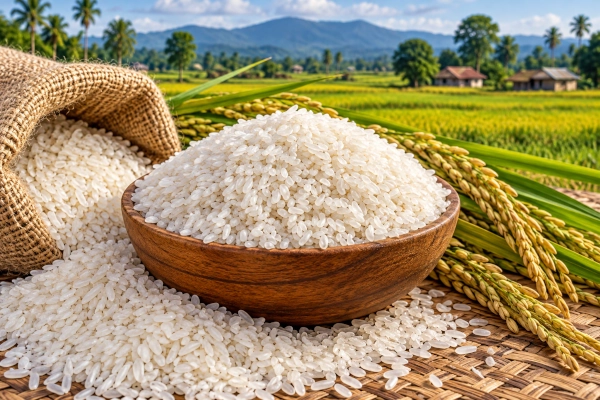
In the fertile agricultural plains of North Bengal grows Tulaipanji, an indigenous aromatic rice celebrated for its delicate fragrance, slender grains and distinctive cooking qualities. Traditionally cultivated in the Raiganj region of Uttar Dinajpur district, this heritage grain has been preserved by generations of farmers who value its natural aroma, pleasant taste and importance in Bengali cuisine.
Unlike the short, sticky aromatic rice varieties cultivated in some other regions of India, Tulaipanji is distinguished by its slender grains and comparatively non-sticky texture after cooking. Its fragrance remains noticeable in both raw and parboiled forms, making it particularly suitable for pulao, biryani, traditional rice dishes and festive preparations.
Tulaipanji belongs to the rich agricultural heritage of North Bengal, where farmers have maintained numerous indigenous rice varieties adapted to local soils, rainfall and cultivation practices. Its longstanding association with the Dinajpur region has established it as one of West Bengal’s distinctive speciality rice varieties.
Tulaipanji Rice received Geographical Indication (GI) registration on October 24, 2017, formally recognising its geographical identity and traditional reputation. The registration acknowledges the contribution of local farmers and agricultural institutions to preserving a rice variety that represents an important component of India’s indigenous crop diversity.
GI Details at a Glance
- Geographical Indication: Tulaipanji Rice
- State: West Bengal
- Product: Agricultural – Rice
- Class: 30
- Application Number: 530
- Date of Filing: 24 August 2015
- GI Journal: 97
- Journal Availability Date: 22 June 2017
- Certificate Number: 300
- GI Certificate Date: 24 October 2017
- Registered Proprietors: State Agriculture Management & Extension Training Institute (SAMETI), Government of West Bengal, and Uttar Banga Krishi Viswavidyalaya (UBKV)
- Registered Proprietors’ Addresses: SAMETI, Ramakrishna Mission Ashrama, Narendrapur, South 24 Parganas, West Bengal – 700103; and Uttar Banga Krishi Viswavidyalaya, Pundibari, Cooch Behar, West Bengal – 736165
- Geographical Area: West Bengal
- Traditional Cultivation Region: Uttar Dinajpur, Dakshin Dinajpur and parts of Darjeeling district
- Registration Valid Until: 23 August 2035
The Geographical Indications Registry confirms the registration under Application Number 530. The current validity follows a renewal recorded on May 26, 2025. IP India
Origins and History of Tulaipanji Rice in North Bengal
Tulaipanji belongs to the longstanding tradition of indigenous rice cultivation in the Dinajpur region of Bengal. Farmers have maintained the variety through successive generations, selecting seeds for their fragrance, grain quality and suitability for local agricultural conditions.
The exact date when Tulaipanji first entered cultivation remains uncertain. However, agricultural research identifies it as an established rice landrace associated with North Bengal’s traditional farming systems. Its preservation predates modern commercial seed development and reflects the importance of farmer-managed seed conservation.
Historically, the Dinajpur region formed part of Bengal’s extensive rice-growing landscape. Agricultural settlements developed around fertile plains, seasonal rainfall and networks of rivers and smaller watercourses. Rice became central to the region’s food culture, while distinctive local varieties acquired reputations based on their taste, aroma and cooking characteristics.
Tulaipanji developed a particularly strong association with Raiganj and surrounding areas. Its cultivation continued despite the expansion of modern high-yielding rice varieties because consumers valued its fragrance and culinary qualities.
Researchers from Raiganj University have documented the gradual decline of indigenous rice diversity in Uttar Dinajpur. Their findings highlight the importance of preserving traditional varieties such as Tulaipanji, which remain part of the district’s agricultural heritage.
The Geography and Climate Behind Tulaipanji Rice
Tulaipanji is cultivated primarily in the Raiganj subdivision of Uttar Dinajpur district, with additional traditional cultivation in parts of Dakshin Dinajpur and adjoining areas of North Bengal.
Uttar Banga Krishi Viswavidyalaya and Bidhan Chandra Krishi Viswavidyalaya identify Uttar Dinajpur, Dakshin Dinajpur and parts of Darjeeling among the geographical areas associated with Tulaipanji cultivation.
The region lies within North Bengal’s monsoon-influenced agricultural landscape, where seasonal rainfall, alluvial soils and established irrigation practices support paddy farming.
The growing season generally coincides with the southwest monsoon. Warm temperatures and adequate moisture encourage vegetative growth, while changing weather conditions during grain development influence crop maturity.
Traditional cultivation is particularly associated with the agricultural plains around Raiganj, where farmers have developed considerable experience in managing local rice varieties.
The combination of regional environmental conditions, inherited seed material and established farming practices has helped maintain Tulaipanji’s distinctive characteristics.
Its geographical identity reflects the relationship between the crop and the agricultural communities that have preserved it.
What Makes Tulaipanji Rice Unique?
Tulaipanji stands apart from many other aromatic rice varieties through its slender grains, pronounced fragrance and relatively non-sticky texture after cooking.
Agricultural research describes the grains as medium-long and slender, with an average length of approximately 5.5 millimetres. The grain length-to-breadth ratio has been reported at around 3.4, reflecting its narrow appearance.
When cooked, Tulaipanji develops a bright appearance and a soft yet comparatively separate grain structure. This characteristic makes it particularly suitable for preparations where individual grains should remain distinguishable.
Its natural fragrance is another important feature. Researchers have observed that the aroma remains appreciable in both raw and parboiled rice, unlike some aromatic varieties whose fragrance diminishes considerably after parboiling.
The variety’s comparatively high amylose content contributes to its cooking texture. Agricultural studies have reported amylose levels of approximately 28%, although measured values can vary with the seed material and testing conditions.
These characteristics distinguish Tulaipanji from softer and stickier aromatic varieties such as Gobindobhog and give it a separate place within Bengal’s rice heritage.
Traditional Cultivation and Indigenous Farming Knowledge
Tulaipanji is traditionally grown during the kharif agricultural season, when monsoon rainfall provides much of the moisture required for paddy cultivation.
Farmers prepare agricultural fields, select suitable seed material and establish the crop using methods adapted to local environmental conditions. Transplanting has traditionally been an important part of rice cultivation in the region.
Seed selection remains particularly significant. Farmers preserve grains from healthy plants to maintain the variety’s fragrance, grain appearance and other desirable characteristics across successive harvests.
Traditional production systems may incorporate farmyard manure, compost and locally available agricultural inputs. However, cultivation practices vary between farmers, and traditional production should not automatically be regarded as certified organic farming.
Tulaipanji generally produces lower yields than many modern high-yielding rice cultivars. This creates an economic challenge because farmers must balance the premium value of aromatic grain against the productivity advantages of commercial varieties.
Agricultural institutions have therefore focused on improving cultivation practices while maintaining the qualities responsible for Tulaipanji’s reputation.
The continued participation of farmers remains essential because the variety’s preservation depends on regular cultivation and the maintenance of authentic seed material.
Tulaipanji Rice in Traditional Bengali Cuisine
Tulaipanji occupies a distinctive place in North Bengal’s culinary traditions, particularly in preparations where fragrance and grain texture are important.
Its slender grains and relatively non-sticky consistency make it suitable for pulao, where the rice is cooked with spices, vegetables or other ingredients while retaining an appealing texture.
The variety is also used in biryani and seasoned rice dishes. Its natural aroma complements traditional spices without requiring artificial flavouring.
Tulaipanji can be served as plain steamed rice, allowing its fragrance and delicate flavour to remain prominent. In this form, it pairs well with vegetables, dal, fish preparations and other dishes associated with Bengali cuisine.
Rice flour produced from the grain can also be used in traditional sweets and pithe, a broad category of Bengali rice-based preparations commonly associated with seasonal and festive occasions.
Its versatility reflects the importance of indigenous aromatic rice in the region’s food culture. Rather than being valued solely as a premium commodity, Tulaipanji remains a grain connected with familiar household preparations and regional culinary knowledge.
Geographical Indication Recognition in 2017
Tulaipanji received Geographical Indication registration under India’s Geographical Indications of Goods (Registration and Protection) Act, 1999.
The application was filed on August 24, 2015, jointly by the State Agriculture Management & Extension Training Institute (SAMETI) and Uttar Banga Krishi Viswavidyalaya. The Patent Information Centre of West Bengal assisted with the registration process.
The Geographical Indications Registry published the application in Journal Number 97 on June 22, 2017. Tulaipanji subsequently received GI Certificate Number 300 on October 24, 2017, recognising its geographical identity and established reputation.
The registration provides a legal framework for protecting the Tulaipanji name against unauthorised use. It also helps distinguish genuine rice associated with its registered geographical origin from unrelated varieties marketed under similar descriptions.
The GI registration was renewed in May 2025, extending its validity until August 23, 2035. This continued protection supports efforts to maintain the rice’s authenticity and commercial identity.
Agricultural Universities Help Preserve Tulaipanji Rice
Uttar Banga Krishi Viswavidyalaya and Bidhan Chandra Krishi Viswavidyalaya have played important roles in documenting, conserving and promoting West Bengal’s traditional aromatic rice varieties.
Since 2009, the universities have participated in the Rashtriya Krishi Vikas Yojana-supported Bengal Aromatic Rice Project, which brings together agricultural researchers, farmer organisations and government marketing agencies.
The programme covers several indigenous varieties, including Tulaipanji, Gobindobhog, Kalonunia, Kataribhog and Radhunipagal. Its objectives include improving cultivation techniques, maintaining seed quality, strengthening farmer organisations and developing market connections.
According to the universities’ project documentation, the broader programme has involved more than 6,000 farmers belonging to approximately 70 farmer organisations across West Bengal. These figures cover several aromatic rice varieties rather than Tulaipanji alone.
The initiative has also produced technical publications examining the history, cultivation, processing, marketing and export potential of traditional aromatic rice.
For Tulaipanji, this institutional support connects scientific agricultural practices with the knowledge maintained by farmers in North Bengal.
Scientific Research into Tulaipanji Cultivation
Agricultural researchers have investigated methods of improving Tulaipanji productivity without sacrificing the grain characteristics responsible for its commercial reputation.
A study conducted at Uttar Banga Krishi Viswavidyalaya examined different crop-establishment methods and nutrient-management practices over two growing seasons.
The researchers compared mechanical transplanting, wet direct seeding and traditional establishment methods. They also evaluated nutrient sources, including vermicompost, farmyard manure and conventional fertilisers.
The findings indicated that mechanical transplanting improved grain yields by approximately 32% compared with traditional establishment methods under the experimental conditions. It also outperformed wet direct seeding in the study.
Vermicompost-based nutrient management increased yields by approximately 21% compared with the conventional fertiliser treatment used in the experiment. Researchers also observed improvements in selected soil biological indicators and grain-quality characteristics.
These findings demonstrate the potential for scientifically evaluated cultivation methods to improve the economic viability of traditional aromatic rice.
However, the results represent the conditions examined in the study. Field performance can vary according to rainfall, soil characteristics, farm management and other local factors.
Research Highlights the Decline of Indigenous Rice Diversity
Tulaipanji’s preservation has acquired additional importance because of the declining cultivation of traditional rice landraces in Uttar Dinajpur.
A study published in ORYZA – An International Journal of Rice in December 2021 examined the condition of indigenous rice cultivation in the district.
Researchers from Raiganj University identified approximately 74 indigenous rice landraces through their survey and documented agricultural information. However, only around 20 remained in active cultivation among farmers surveyed.
The study reported that more than 70% of the documented varieties were no longer being cultivated in the surveyed farming areas.
The researchers identified the expansion of high-yielding commercial varieties as a major factor contributing to the decline of traditional rice diversity.
Their work also examined genetic relationships among indigenous aromatic rice varieties, including Tulaipanji, Radhunipagal and Gobindobhog.
These findings highlight the value of conserving traditional seed populations. Such crops preserve genetic resources that may contribute to future agricultural research, crop improvement and adaptation to changing environmental conditions.
Farmer Organisations and Technology-Supported Group Cultivation
The Bengal Aromatic Rice Project has supported collective cultivation through farmer organisations and agricultural extension programmes.
In its published project records, the universities documented Tulaipanji cultivation involving 613 farmers across 613 bighas during 2023 under the technology-supported programme.
The initiative provides opportunities for farmers to receive technical guidance, coordinate production and participate in organised agricultural marketing systems.
Collective cultivation can help maintain varietal purity by encouraging farmers to use suitable seed material and follow appropriate production practices.
It also supports the aggregation of harvested rice, which can make cleaning, grading, processing and marketing more practical for small agricultural producers.
The universities have worked with agricultural marketing institutions, including Paschimbanga Agri Marketing Corporation and Sufal Bangla, to strengthen the distribution of speciality rice products.
These arrangements help connect traditional farmers with consumers interested in geographically identified agricultural products.
Quality Testing and AGMARK Development
Maintaining consistent grain quality is important for developing Tulaipanji as a recognised speciality rice.
Agricultural institutions have therefore supported scientific testing and the development of grading standards for Bengal’s indigenous aromatic varieties.
Between September 2015 and January 2016, the Bengal Aromatic Rice Project submitted 76 samples of Tulaipanji collected from farmer organisations for grain-quality evaluation through the Directorate of Marketing and Inspection’s testing system.
The samples formed part of a wider initiative examining the characteristics of several aromatic rice varieties grown in West Bengal.
In October 2023, draft Non-Basmati Aromatic Rice Grading and Marking Rules included Tulaipanji alongside Gobindobhog, Kataribhog, Kalonunia and Radhunipagal.
These efforts aim to establish recognised quality parameters that can support grading, packaging and consumer confidence.
GI registration and AGMARK serve different purposes. Geographical Indication protection identifies the product’s relationship with its geographical origin, while AGMARK standards address agricultural product quality and grading.
Together, geographical identification and reliable quality assessment can support the development of transparent markets for heritage rice.
Tulaipanji Rice and the Growing Market for Traditional Grains
Tulaipanji’s fragrance, grain characteristics and regional reputation provide opportunities within India’s market for premium non-Basmati aromatic rice.
The variety has attracted attention from consumers seeking traditional grains with distinctive culinary qualities. Its relatively non-sticky texture makes it suitable for dishes commonly associated with long-grained aromatic rice while offering an independent regional flavour.
Agricultural researchers and government marketing organisations have promoted Tulaipanji through farmer groups, exhibitions and packaged rice initiatives.
University documentation records efforts to develop marketing networks for Tulaipanji as early as 2010. The West Bengal agricultural marketing department subsequently supported promotional sales of packaged Tulaipanji rice under the Banga Krishisree brand.
These initiatives demonstrate the importance of moving beyond conventional paddy sales towards organised processing and differentiated agricultural marketing.
However, premium positioning alone does not guarantee higher farmer incomes. Production costs, yield, milling recovery, market access and the price received by cultivators all influence profitability.
Authentic geographical identification, consistent quality and effective farmer participation remain essential for strengthening the product’s commercial prospects.
Export Potential of North Bengal’s Aromatic Rice
Tulaipanji has also been identified as a variety with potential for international speciality rice markets.
The Bengal Aromatic Rice Project submitted proposals concerning the export promotion of Tulaipanji and Gobindobhog to the Parliamentary Standing Committee on Commerce in 2010.
The proposals addressed commercial cultivation, organised procurement, value-chain development, international trade exhibitions and research support.
The Standing Committee subsequently examined opportunities for promoting premium non-Basmati rice from India.
Tulaipanji’s distinctive aroma and cooking characteristics provide a basis for exploring demand among international consumers interested in Indian regional foods.
However, establishing a sustainable export market requires consistent production volumes, reliable traceability, food-safety compliance and appropriate packaging.
Scientific grading and organised farmer participation can help create the quality-assurance systems required for such markets.
The variety’s geographical identity offers an additional means of distinguishing it from other non-Basmati aromatic rice products.
Preserving Tulaipanji for Future Generations
The conservation of Tulaipanji involves protecting both its genetic characteristics and the traditional agricultural knowledge associated with its cultivation.
Farmer-managed seed systems remain particularly important because traditional rice varieties can gradually disappear when cultivation shifts towards commercially dominant alternatives.
Maintaining authentic seed populations helps preserve the grain’s fragrance, cooking characteristics and regional identity.
Agricultural universities can contribute through varietal characterisation, seed conservation, production research and farmer training.
Farmer producer organisations and marketing institutions also have important roles in helping cultivators obtain appropriate returns from traditional crops.
Consumer awareness provides another source of support. Recognition of regional aromatic rice varieties encourages demand for agricultural products whose value extends beyond yield and appearance.
By combining traditional knowledge with scientific cultivation and organised marketing, West Bengal can strengthen the preservation of Tulaipanji as a living agricultural resource.
Tulaipanji Rice: A Living Symbol of North Bengal’s Agricultural Heritage
Tulaipanji rice represents the enduring relationship between North Bengal’s agricultural landscape, farming communities and regional food traditions.
Its slender grains, natural fragrance and distinctive cooking qualities have helped preserve its identity across generations. The GI recognition granted in 2017 formally acknowledges this heritage and provides a framework for protecting its geographical reputation.
Research by agricultural universities has demonstrated opportunities to improve cultivation practices, while farmer organisations and marketing initiatives are helping develop the rice’s commercial potential.
Beyond its economic importance, Tulaipanji remains a valuable component of India’s indigenous rice biodiversity. Its preservation safeguards genetic resources, traditional cultivation knowledge and the culinary identity of the Dinajpur region.
With continued farmer participation, scientific support and growing appreciation for regional agricultural products, Tulaipanji can strengthen rural livelihoods while carrying North Bengal’s fragrant rice heritage to wider markets.
References
- Geographical Indications Registry, Intellectual Property India — Tulaipanji Rice, Application Number 530. Official GI registration, applicants, journal publication, certificate details and renewed validity.
https://search.ipindia.gov.in/GIRPublicSearch/Application/Details/530 - Bidhan Chandra Krishi Viswavidyalaya — Bengal Aromatic Rice: GI and AGMARK. University documentation covering GI registration, quality testing and grading initiatives.
https://bckv.edu.in/index.php/en/bengal-aromatic-gi-agmark-en - Bidhan Chandra Krishi Viswavidyalaya — Geographical Indication and Intellectual Property Rights. Documentation of Tulaipanji’s geographical association and GI registration.
https://www.bckv.edu.in/index.php/en/geographical-indication-ipr-en - Bidhan Chandra Krishi Viswavidyalaya — Bengal Aromatic Rice Project. Official information on indigenous aromatic rice, cultivation history and research collaboration.
https://www.bckv.edu.in/index.php/en/bengal-aromatic-rice-en - Bidhan Chandra Krishi Viswavidyalaya — Technology-Supported Group Cultivation. Farmer participation, cultivation area and agricultural development programmes.
https://www.bckv.edu.in/index.php/en/bengal-aromatic-group-cultivation-en - Indian Council of Agricultural Research — Farmers’ Awareness Programme on Production and Commercialisation of Scented Rice, February 2025. Agricultural training organised through Uttar Banga Krishi Viswavidyalaya.
https://icar.gov.in/en/farmers-awareness-programme-production-technique-and-commercialization-scented-rice-west-bengal - Biswas et al. — Problems and Prospects of Cultivation of Indigenous Rice Landraces of Uttar Dinajpur, with Special Reference to Tulaipanji. ORYZA – An International Journal of Rice, Volume 58, Issue 4, 2021.
https://epubs.icar.org.in/index.php/OIJR/article/view/119649 - Enhancing Aromatic Rice Production Through Agronomic and Nutritional Management for Improved Yield and Quality. Scientific study on crop establishment, nutrient management and Tulaipanji grain quality.
https://pmc.ncbi.nlm.nih.gov/articles/PMC11226650/ - Bidhan Chandra Krishi Viswavidyalaya — Recommendation for Export of Bengal Aromatic Rice. Documentation concerning parliamentary examination of export opportunities.
https://bckv.edu.in/index.php/en/bengal-aromatic-recommendation-en
You may also like
-
India’s Extreme Poverty Rate Falls from 27.1% to 2.6% Between 2011 and 2023: World Bank
-
Indian SpaceTech Company Pixxel Establishes US Subsidiary to Expand Defence and Satellite Intelligence Business
-
PI Industries Unveils India’s First Indigenously Discovered Insecticide Molecule Pioxaniliprole
-
Sun Pharma Secures US FDA Approval for ILUMYA to Treat Active Psoriatic Arthritis
-
India Expands UPI Payments for Online Tourist Bookings at Burj Khalifa and Singapore’s Resorts World Sentosa
