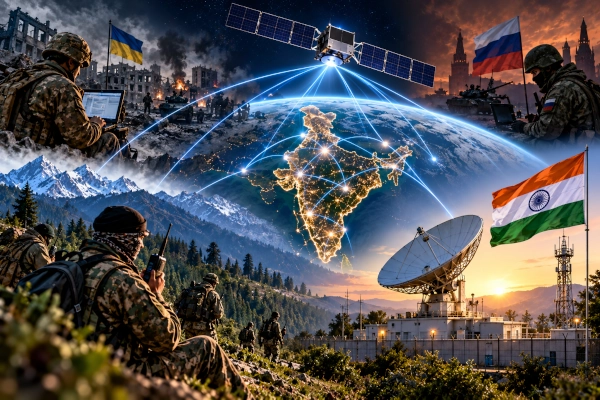
India’s emerging satellite internet industry promises to transform connectivity across remote villages, mountainous regions, border areas and underserved communities. However, the arrival of global satellite communication networks also presents a critical question: How can India benefit from advanced foreign technology without compromising its national security, communication sovereignty and ability to respond to terrorist threats?
The question has acquired greater significance following reports of terrorists in Jammu and Kashmir using communication devices that operate independently of conventional mobile networks. The April 2025 Pahalgam terrorist attack, subsequent security investigations and reports concerning the use of LoRa-based communication equipment illustrate the changing technological challenges facing India’s security agencies.
At the same time, developments involving American satellite internet provider Starlink in Ukraine have demonstrated how privately controlled communication infrastructure can become strategically important during international conflicts. Decisions concerning access to satellite services can affect military communications, emergency operations and the ability of governments to exercise control over essential infrastructure.
Against this background, India’s insistence on security assessments, domestic communication gateways, lawful interception capabilities and regulatory approval before permitting commercial satellite internet operations is an important element of national preparedness.
The objective is not to discourage international investment or technological innovation. It is to ensure that communication networks operating within India remain accountable to Indian law, protect national security and serve the country’s long-term strategic interests.
Pahalgam and Kashmir Highlight the Changing Nature of Terrorist Communications
The terrorist attack at Pahalgam on 22 April 2025 demonstrated the continuing threat posed by cross-border terrorism to India’s internal security, tourism industry and economic development.
Twenty-six civilians were killed in the attack. Investigations conducted by the National Investigation Agency (NIA) subsequently identified three Pakistani nationals affiliated with Lashkar-e-Taiba as the attackers, according to the agency’s June 2025 announcement.
The NIA arrested two individuals accused of providing shelter and logistical assistance to the terrorists before the attack. The investigation established the importance of identifying the networks that support terrorist operations, including their movements, communications, financing and logistical arrangements.
External Affairs Minister S. Jaishankar subsequently told Parliament that the Pahalgam attack was intended not only to kill civilians but also to damage Jammu and Kashmir’s economy and create communal divisions.
His observations highlighted an important dimension of terrorism: attacks on civilians can also target economic confidence, tourism, investment and social stability.
Communication technology plays an increasingly significant role in these security challenges. Terrorist organisations may attempt to avoid conventional networks by using alternative communication systems that offer greater operational independence.
This makes the regulation and monitoring of communication infrastructure an important component of India’s wider counterterrorism strategy.
LoRa Devices Reveal a New Challenge for Security Agencies
Reports published in October 2026 indicate that terrorists operating in Jammu and Kashmir have been using communication equipment based on LoRa, or Long Range radio technology.
LoRa is a low-power wireless communication technology capable of transmitting small amounts of data over relatively long distances. Unlike conventional mobile telephones, LoRa devices do not necessarily require SIM cards, cellular towers or internet connectivity.
The technology is widely used for legitimate civilian applications, including agricultural sensors, industrial monitoring, environmental measurement and Internet of Things networks.
However, similar communication capabilities can be misused by terrorist organisations seeking to exchange information without relying on commercial telecommunications networks.
Reports concerning Kashmir indicate that security agencies have encountered such equipment during counterterrorism operations. These reports raise concerns about the use of alternative communication technologies that may complicate conventional surveillance and investigation.
LoRa transmissions are not inherently undetectable. Their signals can be identified using suitable radio-frequency monitoring equipment, although detection and attribution depend on the devices, terrain and operating conditions.
Nevertheless, the reports demonstrate why security agencies must prepare for terrorist communications that operate beyond ordinary cellular infrastructure.
Satellite Internet Presents a Different but Related Security Challenge
LoRa radio networks and satellite broadband systems use different technologies, operate over different distances and serve different purposes. They should not be treated as interchangeable communication systems.
However, both illustrate how communications can function independently of conventional mobile towers.
Satellite broadband networks such as Starlink and OneWeb connect user terminals to satellites orbiting Earth. These satellites communicate with ground infrastructure or other satellites to carry information across extensive geographical areas.
The technology can provide valuable connectivity where conventional terrestrial networks are unavailable. This makes it particularly useful in remote districts, mountainous terrain and disaster-affected regions.
The same characteristics also create potential security concerns when satellite terminals are deployed without authorisation or become available to criminal and terrorist organisations.
An illegally imported or improperly registered terminal could complicate efforts to establish the identity, location and lawful use of a communication service. Cross-border operation and foreign-managed network infrastructure may introduce additional jurisdictional challenges.
These concerns do not mean that satellite internet is inherently insecure or that companies such as Starlink are facilitating terrorism. They demonstrate why India requires enforceable rules governing service providers, terminal registration, network operations and security cooperation.
A regulated satellite network can provide important public benefits while incorporating safeguards intended to prevent unauthorised use.
Why India Requires Domestic Satellite Gateways and Security Compliance
India’s Department of Telecommunications has established licensing requirements for Global Mobile Personal Communication by Satellite services.
Under the regulatory framework, authorised operators must comply with security, privacy, technical and operational conditions before providing commercial services.
An important requirement concerns the establishment of satellite communication gateways within India. These facilities connect satellite networks with terrestrial telecommunications infrastructure and support regulatory oversight of communications carried through the licensed service.
The government’s licensing framework also addresses lawful interception and the routing of Indian communication traffic through authorised domestic gateways.
These requirements help ensure that relevant communications infrastructure remains subject to Indian jurisdiction and that authorised security agencies can obtain legally permitted assistance during investigations.
Domestic infrastructure also contributes to operational accountability. Regulators must be able to identify responsible service providers, inspect applicable systems and enforce compliance when violations occur.
The Department of Telecommunications confirmed on 8 October 2026 that three licensed satellite broadband operators were undergoing security assessments before becoming eligible for spectrum assignment.
The government further clarified that these requirements were being applied without discrimination.
India’s approach therefore rests on a clear principle: commercial authorisation and national security compliance must progress together.
Foreign-Controlled Communication Networks Can Become Instruments of Geopolitical Pressure
India’s concerns about communication sovereignty are reinforced by developments involving Starlink during the Russia-Ukraine conflict.
Since Russia’s invasion of Ukraine in 2022, Starlink terminals have provided important connectivity for Ukrainian military units, public institutions and civilian infrastructure.
Their importance has also raised questions about the degree of influence a private company can exercise when its technology becomes essential to a country’s wartime communications.
In July 2025, a Reuters investigation reported that Elon Musk had ordered restrictions on Starlink service during a Ukrainian military operation in 2022, affecting communications in areas where Ukrainian forces were advancing.
In February 2025, Reuters separately reported that American officials had discussed the possibility of Ukraine losing access to Starlink services during negotiations involving Ukrainian mineral resources.
The reported discussions demonstrated how dependence on externally controlled technology could create geopolitical vulnerabilities. The latter report concerned a potential use of leverage, rather than a confirmed American decision to terminate services.
These developments however, establish that access to privately operated communications infrastructure can become entangled with strategic decisions and international negotiations.
For India, the broader lesson is clear. Essential national communications should not depend entirely on the commercial decisions of a foreign company or the political relationship between governments.
Myanmar Drone Training Case Raises Questions About India’s Border and Communication Security
India’s security concerns extend beyond Kashmir to its northeastern frontier, where investigations have revealed the potential movement of foreign nationals, drone technology and specialised military expertise across international borders. On 13 March 2026, the National Investigation Agency (NIA) arrested one American national, Matthew Aaron VanDyke, and six Ukrainian nationals in connection with alleged unauthorised cross-border activities involving armed groups in Myanmar.
According to the NIA’s allegations, the individuals travelled through Mizoram into Myanmar and provided training to ethnic armed groups in drone warfare, aircraft assembly, operational techniques and electronic jamming. Investigators also examined allegations concerning the movement of drones and associated equipment from Europe through Indian territory.
The investigation raised concerns because some Myanmar-based armed groups have been accused of maintaining links with insurgent organisations operating in India’s northeastern region. In September 2026, the NIA informed a Delhi court that investigators had received information suggesting the involvement of certain foreign nationals in a drone attack on a civilian aircraft in Myanmar.
Investigators indicated that the examination of possible terrorism-related offences was continuing, and reporting at that stage did not establish conclusive evidence of activities directed against India. The case therefore highlights a developing security concern without establishing that the accused acted on behalf of the United States government or participated in a proven anti-India conspiracy.
The growing use of drones adds a technological dimension to these concerns. Modern unmanned aerial vehicles can combine satellite navigation, onboard autonomous flight computers, radio-frequency command links and, in some configurations, cellular or satellite internet connectivity. Not all drones require internet access to navigate or operate, but connected systems can use communication networks for remote monitoring, data transmission and selected beyond-visual-line-of-sight operations.
This distinction is particularly important for national security because regulating satellite broadband alone cannot prevent drone misuse. India also requires effective border surveillance, radio-frequency monitoring, counter-drone capabilities, equipment registration and coordinated enforcement against unauthorised cross-border activity. The Myanmar investigation reinforces the importance of protecting India’s communication infrastructure while strengthening its ability to detect and respond to emerging technological threats.
Starlink Devices Found in Two Major International Drug-Smuggling Operations
India’s security concerns surrounding satellite internet technology have acquired greater significance following two major maritime drug seizures involving Starlink equipment. In November 2024, the Indian Coast Guard intercepted a Myanmar fishing vessel in the Andaman Sea carrying approximately 6,000 kilograms of methamphetamine. Investigators subsequently recovered Starlink equipment, which police said the smugglers had used during their voyage.
A second incident occurred on September 25, 2026, when the Indian Coast Guard and Gujarat Anti-Terrorism Squad intercepted an Iranian dhow near Lakshadweep, seizing 526 kilograms of heroin and methamphetamine worth more than ₹3,000 crore. Five Pakistani nationals were arrested, and Gujarat ATS officials reported that the vessel carried a Starlink satellite communication device.
Together, these incidents demonstrate how international narcotics networks can exploit commercially available satellite connectivity to maintain communications across remote maritime routes. Although the seizures do not establish wrongdoing by Starlink itself, they underscore the importance of device registration, subscriber verification, location monitoring, lawful interception capabilities and timely cooperation with Indian security agencies. India’s satellite internet approval process must account for these documented security risks before commercial services become widely available.
The United States Has Used Economic and Technological Leverage in Foreign Policy
The United States possesses considerable international influence through financial institutions, technology companies, export-control regulations and access to critical industrial systems.
American administrations have repeatedly employed sanctions, export restrictions and technology controls to pursue national security and foreign policy objectives.
Restrictions on advanced semiconductor exports, financial transactions and access to selected technologies demonstrate how economic and technological dependencies can become instruments of international pressure.
Such measures differ legally and operationally from decisions made independently by private companies. Nevertheless, both can affect countries that depend heavily on foreign technology ecosystems.
Satellite communications introduce a particularly sensitive dimension because the infrastructure may support civilian communications, government operations, emergency services and military activities.
A foreign-controlled network with extensive coverage may become difficult to replace once businesses and public institutions have incorporated it into essential operations.
This creates a strategic requirement for technological diversification, domestic regulatory authority and credible alternative communication capabilities.
For India, the appropriate response is to maintain constructive internet technology partnerships while avoiding excessive dependence on any single foreign provider.
Jaishankar’s Position on Terrorism Reinforces the Need for Independent Security Decisions
External Affairs Minister S. Jaishankar has repeatedly emphasised India’s position that terrorism must be addressed consistently, without selective interpretations based on geopolitical interests.
Following the Pahalgam attack, Jaishankar told Parliament on 28 July 2025 that India’s diplomatic response rested on zero tolerance for terrorism and the country’s right to defend its citizens.
He also highlighted the importance of international recognition of cross-border terrorism and the responsibility of governments to prevent terrorist organisations from obtaining political or operational support.
Jaishankar has separately criticised double standards in international discussions concerning terrorism and has argued that India must make security decisions based on its own national interests.
These positions are relevant to technology regulation because governments do not always share identical threat assessments or foreign policy priorities.
Indeed, in his July 2025 parliamentary statement, he acknowledged the United States’ designation of The Resistance Front as a terrorist organisation following the Pahalgam attack.
The distinction matters. India can recognise differences in international security priorities while maintaining productive cooperation with the United States on counterterrorism, intelligence and technology. National security regulation should not depend on whether a foreign country is currently friendly or unfriendly. It should be strong enough to protect Indian interests under changing geopolitical circumstances.
Unauthorised Communications Can Also Threaten Economic and Infrastructure Security
India’s growing dependence on digital infrastructure has created new security responsibilities extending beyond conventional counterterrorism.
Telecommunications networks support banking, stock exchanges, transport systems, electricity infrastructure, logistics and industrial operations. Disruption to these services can have consequences for economic activity and public safety.Unregulated communication equipment may also be misused for criminal coordination, cybercrime, sabotage or unauthorised access to sensitive locations.
Satellite broadband could become relevant to these risks if unregistered terminals or unauthorised network services were used to evade applicable telecommunications controls.Mass protests, political demonstrations and public gatherings can also place substantial demands on communications infrastructure and law-enforcement coordination.
A credible regulatory framework protects national infrastructure while preserving legitimate communications and constitutional freedoms.
Why Starlink Must Operate Under Indian Law
Starlink offers technological capabilities that could benefit India’s remote communities, businesses and public institutions.
Its low-Earth-orbit network can deliver broadband connectivity in locations where deploying conventional infrastructure is difficult. The service may also support emergency communications and specialised industrial applications.
These benefits provide strong reasons to welcome the company’s participation in India, subject to appropriate regulatory conditions.
However, Starlink’s international scale or technological sophistication cannot exempt it from Indian telecommunications law.
Like other satellite operators, it must meet the applicable requirements governing security assessments, spectrum assignment, authorised terminals, network infrastructure and cooperation with lawful regulatory processes.
The same principles must apply to Eutelsat OneWeb, Jio Satellite Communications and future operators.
Regulatory consistency is important because security standards lose credibility when different companies receive exemptions based on commercial influence or political relationships.
Foreign ownership alone does not establish a national security threat. The relevant considerations are who controls the network, where critical functions operate, how the service can be interrupted, what information the operator holds and whether Indian authorities can enforce applicable laws.
These questions should be answered through technical assessments, contractual safeguards and transparent regulation rather than assumptions about an operator’s nationality.
India’s National Security Cannot Be Compromised by Political or Commercial Pressure
Elon Musk’s decision to publicly challenge India’s satellite internet approval process and frame the issue in political terms should not influence the country’s regulatory priorities. Commercial pressure and public accusations can wait; the safety and security of India’s citizens must come first. India has every right to conduct thorough security assessments before allowing foreign-controlled satellite communication networks to operate within its territory. The country’s experience with cross-border terrorism, emerging communication technologies and threats to critical infrastructure makes such scrutiny essential. Starlink’s technological capabilities and commercial ambitions deserve consideration, but they cannot take precedence over India’s sovereign responsibility to protect its citizens.
A company seeking access to one of the world’s largest telecommunications markets must respect Indian laws, security requirements and regulatory procedures. India’s national security is not negotiable, and commercial urgency cannot become a justification for bypassing safeguards designed to protect its people.
A Strong Regulatory Framework Must Also Protect Privacy
National security and individual privacy are not opposing objectives. A reliable communications system requires both.
Satellite operators may handle sensitive information concerning users, devices, locations and communication activity. Such information must be protected against unauthorised access, cyberattacks and misuse.
Indian regulators therefore have responsibilities extending beyond lawful interception and the registration of equipment.
Security requirements should incorporate strong encryption, appropriate data protection, controlled access to sensitive systems and independent security assessments.
Where lawful interception is permitted, it should operate within the authority and procedures established by Indian law, with appropriate safeguards against misuse.
Government access to communications should not become a substitute for evidence-based investigation or a means of indiscriminately monitoring lawful political activity.
These safeguards strengthen national security by preserving public trust in communication infrastructure and ensuring that regulatory powers are exercised responsibly.
India Must Strengthen Indigenous Satellite Communication Capabilities
Regulation alone cannot eliminate strategic dependence on foreign-controlled communications infrastructure.
India also needs strong domestic capabilities in satellite manufacturing, communication payloads, ground systems, network software and user terminals.
ISRO, NewSpace India Limited, IN-SPACe and India’s private space industry provide an expanding foundation for developing these capabilities.
Indian companies are already active in satellite communications, electronics manufacturing, propulsion, satellite platforms and ground infrastructure.
Greater domestic participation can reduce dependence on imported systems while strengthening India’s ability to maintain essential communications during emergencies.Building indigenous capacity does not require excluding international companies. Technology partnerships, domestic manufacturing and competitive commercial services can coexist with national security requirements.
The strategic objective should be to ensure that India retains sufficient technical and operational capabilities to preserve critical connectivity even when international commercial relationships are disrupted.
Secure Satellite Communications Can Strengthen India’s Economic Development
A strong satellite communication framework offers benefits extending beyond national defence and counterterrorism.
Reliable satellite broadband can connect remote communities with education, healthcare, digital banking and public services. It can support businesses operating in difficult geographical environments and improve communication during natural disasters.The technology also creates opportunities for Indian manufacturers, system integrators, telecommunications operators and space technology startups.
Security standards can encourage investment by creating clearer responsibilities for operators and reducing uncertainty concerning infrastructure protection and service continuity.
Well-designed regulation should therefore support innovation while addressing identifiable risks through proportionate and enforceable safeguards.India’s satellite broadband market can benefit from international competition, domestic investment and the participation of multiple technology providers. Such diversity can improve resilience by preventing excessive dependence on one network.
A secure communications ecosystem also strengthens the foundations of economic growth by protecting the reliability of the infrastructure on which businesses and essential services depend.
India’s Digital Sovereignty Must Remain Central to Satellite Internet Expansion
The emergence of satellite broadband represents a major technological opportunity for India, but it also changes the relationship between communication infrastructure, commercial power and national security.
The Pahalgam terrorist attack demonstrated the continuing danger of organised cross-border terrorism, while reports of LoRa equipment in Kashmir illustrate the need to understand emerging communication technologies.Developments involving Starlink in Ukraine have revealed another dimension of technological dependence: the strategic consequences that can arise when essential communications rely on infrastructure controlled outside national jurisdiction.
These experiences support India’s decision to subject satellite broadband operators to security scrutiny, spectrum regulation and enforceable telecommunications requirements.The framework must remain technologically informed, proportionate and equally applicable to Indian and foreign companies. It must also protect privacy, lawful expression and legitimate economic activity.
India need to wisely choose between technological progress and national security. A strong regulatory framework allows the country to pursue both.
By combining international satellite technology with domestic oversight, indigenous manufacturing and resilient communication infrastructure, India can expand connectivity without surrendering control over its essential digital systems. The result will be a satellite broadband industry that contributes not only to digital inclusion and economic development but also to India’s long-term security, technological independence and strategic resilience.
References
- Ministry of Communications, Government of India — India’s Regulatory Framework for Satellite Communication Services Is Fair and Non-Discriminatory. Press Information Bureau, 8 October 2026.
https://www.pib.gov.in/PressReleasePage.aspx?PRID=2320510
Official clarification concerning the security assessments and regulatory position of satellite broadband operators. Press Information Bureau - Department of Telecommunications — GMPCS Service Authorisation Framework. Government of India.
https://www.eservices.dot.gov.in/gmpcs-global-mobile-personal-communication-satellite-service
Official licensing requirements covering satellite gateways, lawful interception, security compliance and spectrum assignment. eServices - National Investigation Agency — NIA Arrests Two for Harbouring Pakistani Terrorists in Pahalgam Attack Case. 22 June 2025.
https://nia.gov.in/nia-arrests-2-harbouring-pak-terrorists-pahalgamterrorattackcase-gets-identities
Official investigation findings concerning the Pahalgam terrorist attack. National Invasive Species Authority - Ministry of External Affairs — Statement by External Affairs Minister S. Jaishankar on Operation Sindoor. Lok Sabha, 28 July 2025.
https://www.hcimaputo.gov.in/section/speeches-and-interviews/statement-by-eam-dr-s-jaishankar-on-the-special-discussion-in-lok-sabha-on-operation-sindoor-28-july-2025/
Official remarks concerning cross-border terrorism, the economic targeting of Jammu and Kashmir and international counterterrorism cooperation. High Commission of India, Maputo - Reuters — Musk Ordered Shutdown of Starlink Satellite Service as Ukraine Retook Territory from Russia. 25 July 2025.
https://www.reuters.com/investigations/musk-ordered-shutdown-starlink-satellite-service-ukraine-retook-territory-russia-2025-07-25/
Investigative report concerning the strategic implications of privately controlled satellite communications. Reuters - Reuters — US Could Cut Ukraine’s Access to Starlink Internet Services Over Minerals, Sources Say. 22 February 2025.
https://www.reuters.com/business/us-could-cut-ukraines-access-starlink-internet-services-over-minerals-say-2025-02-22/
Reporting on discussions concerning satellite communication access and geopolitical negotiations. Reuters - Navbharat Times — Reports of LoRa Communication Equipment Used by Terrorists in Kashmir. October 2026.
https://navbharattimes.indiatimes.com/state/jammu-and-kashmir/srinagar/pakistan-supplied-terrorists-in-kashmir-with-chinese-walkie-talkie-handsets-lora-which-require-neither-sim-cards-nor-network-towers/articleshow/134686655.cms
Reporting on alleged use of low-power radio communication technologies by terrorists. Navbharat Times - Department of Telecommunications — GMPCS Licence Agreement. Government of India.
https://www.eservices.dot.gov.in/sites/default/files/2024-11/GMPCS%20License%20Agreement.PDF
Legal and technical framework for satellite communication service providers operating in India. eServices
You may also like
-
Four ICAR-Developed Potato Varieties Account for Nearly 75% of India’s Cultivation Area
-
JSW Steel’s Crude Steel Production Rises 5% to 7.27 Million Tonnes in Q2 FY2027
-
Jubilant Pharmova Announces CAD 94.5 Million Expansion of Canadian Radiopharmaceutical Facility
-
Kabra Extrusiontechnik’s GEON Commissions 20 MWh Battery Storage Project in Rajasthan
-
India’s Wind Energy Capacity Reaches 59.20 GW as Government Targets 100 GW by 2030
