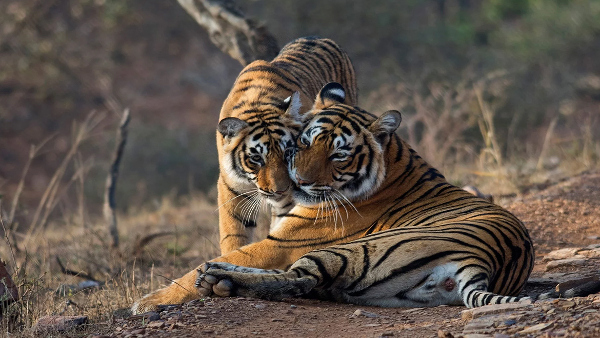
Karnataka is undertaking a fresh assessment of its wild tiger population, with the latest wildlife monitoring exercise drawing attention to the state’s extensive tiger habitats across the Western Ghats. The assessment follows decades of population recovery supported by protected-area management, scientific monitoring and conservation programmes.
The latest officially published All India Tiger Estimation, conducted in 2022, recorded 563 tigers in Karnataka, compared with 524 in 2018. The state ranked second nationally behind Madhya Pradesh, which recorded 785 tigers.
Reports published on October 8, 2026, indicate that preliminary analysis of a new camera-trap survey could place Karnataka’s tiger population above 700. However, the National Tiger Conservation Authority (NTCA) has not released a validated population estimate confirming that figure.
The new assessment is particularly important because Karnataka contains some of India’s most productive tiger habitats, including the connected forests of Bandipur, Nagarahole, Biligiri Ranganatha Temple (BRT), Bhadra and Kali Tiger Reserves.
Karnataka’s Tiger Population Increased from 290 to 563
Karnataka’s tiger population has recorded substantial growth over successive national assessments, reflecting the long-term development of India’s tiger conservation programme.
According to official figures released by the Ministry of Environment, Forest and Climate Change, Karnataka had an estimated 290 tigers in 2006. The number increased to 300 in 2010 and 406 in 2014 before reaching 524 in 2018.
The 2022 assessment recorded 563 tigers, representing an increase of approximately 94% over the 2006 estimate. The results established Karnataka as one of India’s principal tiger conservation states.
The state’s population growth forms part of a wider national recovery. India’s estimated tiger population increased from 1,411 in 2006 to 3,682 in 2022, according to the NTCA.
The national assessment attributed this recovery to sustained habitat protection, scientific population monitoring and coordinated conservation measures implemented by the Union and state governments.
Camera Traps Enable Scientific Identification of Individual Tigers
Modern tiger population assessments rely heavily on camera traps placed along forest trails, animal movement routes and locations regularly used by wildlife.
These remotely activated cameras photograph animals passing through their detection zones, allowing researchers to identify individual tigers through the distinctive stripe patterns on their bodies.
Because each tiger has a unique stripe arrangement, photographs captured at different locations can be compared to establish whether they show the same animal or different individuals.
Researchers combine this information with details about camera locations and detection frequency to estimate tiger abundance across a landscape.
The All India Tiger Estimation uses scientifically established statistical methods to account for animals that may not appear in camera-trap photographs.
This distinction is important because the number of individually photographed tigers is not necessarily identical to the estimated population. A final assessment requires statistical analysis, validation of individual identifications and consideration of sampling coverage.
The NTCA’s 2022 assessment used extensive camera trapping and other ecological survey methods to estimate tiger populations across India’s principal tiger landscapes.
Bandipur and Nagarahole Remain Karnataka’s Strongest Tiger Habitats
Bandipur and Nagarahole Tiger Reserves form the core of Karnataka’s tiger conservation landscape. Both reserves are part of the Nilgiri Biosphere Reserve, which extends across Karnataka, Tamil Nadu and Kerala.
The 2022 All India Tiger Estimation identified Bandipur and Nagarahole among India’s tiger reserves with the highest recorded tiger abundance. Bandipur supported an estimated 150 tigers, while Nagarahole recorded 141.
Together, these two reserves accounted for a substantial proportion of Karnataka’s estimated tiger population. Their forests support important prey species, including spotted deer, sambar, gaur and wild pigs, which contribute to the ecological conditions required by large carnivores.
The surrounding forest landscape also connects with protected areas in neighbouring states, allowing wildlife to disperse across administrative boundaries.
These ecological connections are particularly important for maintaining genetic diversity and supporting the movement of animals between different forest populations.
BRT, Bhadra and Kali Reserves Support Tiger Conservation
Beyond Bandipur and Nagarahole, Karnataka’s BRT, Bhadra and Kali Tiger Reserves contribute to the conservation of the species across different forest landscapes.
BRT Tiger Reserve occupies an important ecological location between the Western and Eastern Ghats. Its forests provide habitat for tigers, elephants, leopards and numerous other species, while supporting wildlife movement through the surrounding landscape.
Bhadra Tiger Reserve protects extensive forest habitats in the central Western Ghats. The reserve forms part of a wider landscape that includes other protected forests and wildlife habitats.
Kali Tiger Reserve, located in Uttara Kannada district, contributes to tiger conservation in the northern Western Ghats. Its forests also support diverse mammal, bird and reptile populations associated with the region’s tropical ecosystems.
The 2022 NTCA report identified potential for increasing tiger numbers in the Kali–Belagavi landscape and the Bhadra–Bhadravathi–Kudremukha region.
These observations indicate that Karnataka’s future tiger conservation efforts must extend beyond its highest-density reserves and address the ecological requirements of surrounding forest landscapes.
Western Ghats Landscape Supports Tiger Movement Across State Boundaries
Karnataka’s tiger population forms part of the wider Western Ghats conservation landscape, which extends through neighbouring Kerala, Tamil Nadu and Goa.
The 2022 All India Tiger Estimation recorded 1,087 tigers across this landscape. Karnataka accounted for 563, followed by Tamil Nadu with 306, Kerala with 213 and Goa with five.
These populations are ecologically connected through forest corridors and adjoining protected areas, allowing tigers to disperse between habitats.
Such movement helps maintain genetic exchange and enables younger animals to establish territories outside areas occupied by established adults.
The NTCA has emphasised the importance of protecting tiger corridors and maintaining ecological connectivity between reserves.
Road development, settlement expansion, habitat fragmentation and other land-use changes can obstruct wildlife movement. Conservation planning must therefore consider the wider landscape rather than treating individual tiger reserves as isolated habitats.
For Karnataka, maintaining these connections remains an important component of long-term tiger conservation.
Rising Tiger Populations Bring New Conservation Challenges
Increasing tiger numbers can reflect effective habitat protection, but high densities also create management challenges in established reserves.
The NTCA’s 2022 assessment observed that the Nagarahole–Bandipur cluster was approaching saturation in terms of tiger density.
As tiger populations increase within suitable habitats, younger animals may disperse into surrounding forests in search of territories. Their movements can occasionally bring them closer to agricultural areas, livestock settlements and human habitation.
The NTCA has identified negative interactions between people and wildlife as an important conservation concern in Karnataka’s tiger landscapes.
The organisation recommends strengthening management capacity in areas where tigers disperse beyond established protected zones. Measures include improved monitoring, rapid response capabilities and support for managing human–wildlife conflict.
Protecting natural prey populations and maintaining functioning forest corridors can also help support tiger populations across wider landscapes.
These measures are important because sustaining a large tiger population requires not only protecting animals within reserves but also maintaining the ecological conditions that support their long-term survival.
Project Tiger Provides the Foundation for Population Recovery
India launched Project Tiger in 1973 to protect declining tiger populations and conserve the forest ecosystems on which they depend.
Over subsequent decades, the programme established a network of tiger reserves supported by habitat management, anti-poaching measures and scientific monitoring.
The National Tiger Conservation Authority provides statutory oversight and coordinates tiger conservation activities with state governments.
The programme has increasingly adopted landscape-level conservation approaches that recognise the importance of wildlife corridors, prey populations and habitats outside designated reserves.
Scientific tiger estimation has become an essential part of this framework. Periodic assessments help authorities identify changes in population distribution, evaluate conservation performance and determine areas requiring additional protection.
Karnataka’s population growth from 290 tigers in 2006 to 563 in 2022 demonstrates the importance of long-term conservation programmes supported by scientific monitoring.
New Tiger Assessment Will Help Guide Karnataka’s Conservation Strategy
A fresh tiger population assessment can provide valuable information about changes in the distribution and abundance of Karnataka’s big cats.
The findings will be particularly important for identifying areas where tiger populations are expanding, habitats approaching ecological limits and forest corridors requiring additional protection.
Camera-trap surveys can also provide information about tiger movement, the distribution of individuals and the presence of animals outside established reserves.
These observations help forest authorities allocate resources for wildlife protection, monitoring and conflict prevention.
The reported possibility of Karnataka’s tiger population exceeding 700 represents an encouraging development, but the figure requires validation through the official estimation process.
The final results will provide a clearer understanding of how the state’s tiger population has changed since the 2022 assessment and how those changes compare with trends across the wider Western Ghats.
Karnataka’s established record of tiger conservation provides a strong foundation for the next phase of wildlife protection. Continued scientific monitoring, habitat management and protection of forest connectivity will help sustain the state’s important tiger populations while supporting the wider recovery of India’s national animal.
References
- National Tiger Conservation Authority (NTCA) and Wildlife Institute of India, 2023. Status of Tigers, Co-predators and Prey in India, 2022. Official national tiger assessment, including Karnataka’s population and Western Ghats landscape analysis.
https://ntca.gov.in/assets/uploads/Reports/AITM/status_of_tiger-copredators-2022.pdf - Ministry of Environment, Forest and Climate Change, Press Information Bureau, July 29, 2023. All India Tiger Estimation 2022: Release of the Detailed Report.
https://www.pib.gov.in/PressReleasePage.aspx?PRID=1943922 - Ministry of Environment, Forest and Climate Change, Press Information Bureau, November 25, 2024. Parliament Question: Increase in Tiger Population. Contains official state-wise tiger population figures from 2006 to 2022.
https://www.pib.gov.in/PressReleaseIframePage.aspx?PRID=2076921&lang=2®=48 - National Tiger Conservation Authority, December 29, 2023. Achievements of National Tiger Conservation Authority During 2023.
https://www.pib.gov.in/PressReleasePage.aspx?PRID=1991620 - Ministry of Environment, Forest and Climate Change, August 2026. Rise in Tiger Numbers: From Crisis to Recovery.
https://www.pib.gov.in/PressReleasePage.aspx?PRID=2290233&lang=1®=22
You may also like
-
Project Cheetah Expands as Veerangana Durgavati Tiger Reserve Becomes Madhya Pradesh’s Third Cheetah Habitat
-
Kashmir Markhor Population Rises to 227 as Kazinag Conservation Efforts Show Results
-
ICAR-CIFRI Pushes Conservation of Indigenous Himalayan Fish for Biodiversity and Livelihood Security
-
Indian-Born Cheetah KJP21 Gives Birth to Five Cubs at Kuno, India’s Cheetah Population Reaches 60
-
ZSI and Mahatma Gandhi University Discover New Earthworm Species in Western Ghats
