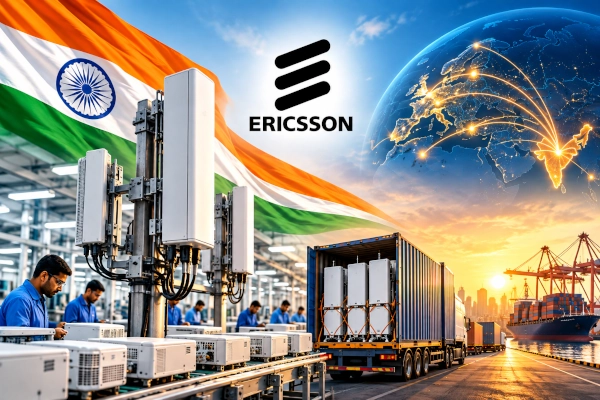
Ericsson has expanded its manufacturing footprint in India, with antennas produced in the country now being exported to Europe and other global markets.
The Swedish telecom equipment company said on October 7, 2026, at India Mobile Congress that more than 15,000 antennas and 25 million components have been produced in India since July 2025 through its growing local ecosystem.
The development marks a shift in India’s role within Ericsson’s global operations, from serving primarily as a large telecom market to becoming an increasingly important base for engineering, component sourcing, manufacturing and exports.
India-Made Antennas Enter Global Supply Chain
Ericsson said the latest milestone builds on its first export-ready antennas manufactured in India in 2025.
The company has since expanded local capabilities across component sourcing, engineering, production and exports, with Indian facilities now serving both domestic and international customers.
According to Ericsson, the antennas are designed for evolving network requirements including 5G Standalone, AI-enabled operations and future network architectures.
The company says advanced antenna systems can improve network coverage and capacity, strengthen uplink performance, use spectrum more efficiently and reduce energy consumption.
More Than 15,000 Antennas Produced in India
Ericsson described the production of more than 15,000 antennas and 25 million components as an important step in building a wider telecom manufacturing ecosystem in India.
Mikael Eriksson, Head of Ericsson Antenna System, said the company is developing an end-to-end antenna ecosystem combining local sourcing and manufacturing with Ericsson’s global engineering capabilities.
This is significant because telecom equipment manufacturing depends on more than final assembly. A deeper ecosystem requires component suppliers, engineering capability, testing, electronics expertise and integration with global production standards.
Expanding these capabilities in India could increase the country’s participation in higher-value segments of the telecom equipment supply chain.
From Make in India to Export from India
Ericsson’s approach increasingly reflects the next phase of Make in India: producing equipment not only for domestic deployment but also for international markets.
At India Mobile Congress 2026, the company highlighted India as a strategic hub for telecommunications innovation and advanced manufacturing. Ericsson’s India operations now include radio equipment, antennas and semiconductor design activities.
Exports to Europe are particularly notable because telecom infrastructure equipment must meet demanding technical, performance and reliability standards.
India’s ability to supply such products to global markets strengthens its position as a manufacturing base for advanced communications hardware rather than only consumer electronics.
India’s 5G Deployment Provides a Large Technology Base
Ericsson has also highlighted India’s rapid 5G expansion as an important advantage as networks evolve towards 5G Advanced and eventually 6G.
According to Ericsson’s Mobility Report, India reached around 95% mid-band 5G population coverage by the end of 2024, placing it among the world’s most extensively deployed mid-band 5G markets.
Mid-band spectrum is important because it provides a balance between coverage and capacity, making it particularly useful for large-scale 5G deployments.
The scale of India’s network rollout provides telecom companies with a large environment in which to deploy, test and optimise new network technologies.
5G Standalone Builds the Foundation for More Programmable Networks
India’s telecom sector is increasingly moving towards 5G Standalone architecture, which does not depend on legacy 4G core infrastructure.
Standalone networks allow operators to use capabilities such as network slicing, programmable connectivity and differentiated service levels.
These capabilities can support specialised applications requiring predictable performance, including industrial automation, connected transport, advanced healthcare, robotics and mission-critical communications.
Ericsson is showcasing several such applications at India Mobile Congress 2026, including network APIs, AI-enabled smart glasses, collaborative robots, mission-critical networks and drone-assisted connectivity.
AI Is Changing What Telecom Networks Need to Deliver
The next major transition is increasingly being shaped by artificial intelligence.
AI applications often require stronger uplink performance because devices may need to continuously transmit video, sensor data or other information for processing at the network edge or in data centres.
Ericsson argues that this will make network architecture increasingly important for applications such as autonomous systems, drones, industrial automation and real-time AI services.
The company is also examining how AI inference can be distributed between devices, telecom networks and data centres. Ericsson says telecom operators could play a larger role because they already operate distributed infrastructure capable of supporting low-latency processing closer to users.
India Builds Semiconductor Design Capability Within Ericsson
India’s role in Ericsson’s technology ecosystem also extends beyond manufacturing.
At India Mobile Congress 2026, the company highlighted its Indian research and engineering capabilities, including semiconductor design work connected with the Ericsson Silicon platform.
ASICs, or application-specific integrated circuits, are specialised chips designed for particular computing or communications functions. They are central to modern radio and network equipment because they can deliver higher performance and greater energy efficiency than general-purpose processors.
Building such capability in India moves the country’s participation in telecom manufacturing further upstream, from assembling equipment towards designing some of the core technologies inside it.
India’s 6G Opportunity Builds on 5G Scale
Ericsson’s assessment that India has an advantage in the transition towards 6G should be understood in the context of the country’s existing network scale.
India’s rapid mid-band deployment, large subscriber base, high data consumption and expanding 5G Standalone infrastructure create a substantial platform on which future network technologies can be tested and deployed.
Ericsson’s IMC 2026 showcase describes 6G as a transition towards pervasive intelligence and deeply integrated connectivity rather than simply another increase in download speeds.
Future networks are expected to combine communications, sensing, AI and edge computing more closely. Preparing for that transition will require advances in radios, antennas, semiconductors, software and network architecture.
Manufacturing and R&D Begin to Converge
The broader significance of Ericsson’s India expansion lies in the combination of manufacturing and research.
India is increasingly producing physical telecom infrastructure while simultaneously contributing engineering talent to semiconductor design, software and next-generation network development.
This convergence is important because countries that participate in both hardware production and technology development capture more value from global supply chains.
For India’s telecom sector, the opportunity therefore extends beyond meeting domestic demand. It includes becoming a source of advanced network equipment and engineering for international markets.
India Moves Deeper Into the Global Telecom Value Chain
Ericsson’s decision to export India-made antennas to Europe and other markets provides another indication that India’s electronics manufacturing base is becoming more sophisticated.
The shift from importing telecom infrastructure to manufacturing radio equipment, antennas and components locally has already reduced part of the sector’s dependence on overseas supply chains.
The next stage will depend on increasing domestic component depth, expanding semiconductor capability and linking Indian engineering more closely with future 5G Advanced and 6G technologies.
Ericsson’s latest manufacturing milestone suggests that this transition is already underway. India is increasingly becoming not only one of the world’s largest telecom markets, but also an engineering and manufacturing centre capable of supplying the networks that will underpin the next generation of global connectivity.
References
- Ericsson — Ericsson scales AI-ready antenna manufacturing and ecosystem in India, October 7, 2026.
- Ericsson — India Mobile Congress 2026: Innovating for India’s Tomorrow, October 7–10, 2026.
- Ericsson — Ericsson showcases what’s next in 5G, AI and innovation at India Mobile Congress 2026, October 7, 2026.
- Ericsson Mobility Report — India 5G mid-band population coverage and regional network deployment data.
- Ericsson — Telco Edge: The Secure Sweet Spot for Edge AI Inference, October 7, 2026.
- Ericsson — Research and technical material on 6G uplink performance and future network architecture.
You may also like
-
India’s Services Activity Rises to Three-Month High in September as Domestic Demand Strengthens
-
India Enters Top 10 Emerging Markets for AI Readiness as Private Investment More Than Triples
-
Starlink Builds India-Specific Security Infrastructure, Awaits Final Clearance for Commercial Launch
-
India’s EV Retail Sales Hit Record 3.33 Lakh Units in September 2026, FADA Says
-
Google Brings Gemini Auto Browse to Chrome in India, Expands AI Assistant to Android
