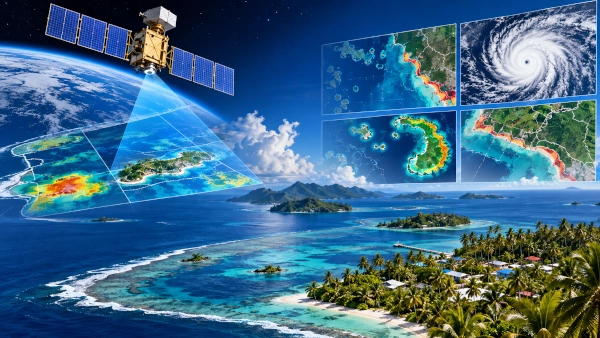
India has offered to share its expertise in coastal resilience, ocean science, Earth observation and space-based climate applications with Pacific Island countries as part of a broader push to strengthen climate adaptation ahead of COP31.
Union Environment, Forest and Climate Change Minister Bhupender Yadav, who is leading the Indian delegation at the UNFCCC Pre-COP31 meetings, made the offer during the Leaders’ Plenary in Fiji on October 6, 2026. The preparatory meetings are being co-hosted by Australia, Fiji and Tuvalu.
India Calls for Balance Between Adaptation and Mitigation
India stressed that global climate action must give equal attention to adaptation, mitigation and the means of implementation.
Bhupender Yadav said the principles of Equity and Common but Differentiated Responsibilities and Respective Capabilities, or CBDR-RC, must remain central to international climate action. India’s position is that countries face different developmental conditions and levels of historical responsibility, making differentiated pathways essential for sustained climate action.
For Pacific Island countries, this issue is especially important because many face severe exposure to sea-level rise, coastal erosion and extreme weather despite contributing relatively little to historical global emissions.
India Offers Coastal Resilience Expertise
India highlighted its own experience in managing a long coastline, island territories and climate-sensitive coastal regions.
The country has developed capabilities in coastal vulnerability assessment, shoreline-change mapping, marine spatial planning and integrated coastal management through specialised institutions working across environment, ocean science and space applications.
These capabilities can help Pacific countries identify vulnerable coastlines, assess climate risks and develop more targeted adaptation strategies.
Space Technology to Support Climate Risk Monitoring
India also offered to share its growing expertise in Earth observation and space-based applications.
The Government said India is using satellite systems for shoreline monitoring, inundation assessment, cyclone and extreme-weather early warning, and climate-risk assessment.
Such technologies can be particularly valuable for Pacific Island states spread across large maritime areas, where ground-based monitoring infrastructure can be difficult and expensive to maintain.
ISRO and Ocean Science Institutions Provide the Technology Base
India’s offer draws on the capabilities of institutions including the Indian Space Research Organisation, National Centre for Sustainable Coastal Management and National Centre for Coastal Research.
Together, these organisations provide expertise in satellite observation, coastal mapping, ocean processes, vulnerability assessment and environmental planning.
This combination allows India to link space-based data with ground-level coastal assessments, creating a more integrated approach to climate resilience.
Blue Economy Cooperation Could Expand Further
The discussions also highlighted the wider potential of the Blue Economy.
Pacific Island countries possess large maritime zones, making fisheries, marine resources, coastal ecosystems and ocean planning central to their economic future.
India has been expanding its own capabilities in ocean science and marine research, creating opportunities for cooperation in sustainable resource management, coastal planning and environmental monitoring.
This can complement existing Indian engagement with Pacific partners in renewable energy, resilient infrastructure, agriculture, information technology and capacity building.
Tuvalu Project Highlights Importance of Local Solutions
Bhupender Yadav referred to his visit to Tuvalu and the Tuvalu Coastal Adaptation Project as an example of how international cooperation can translate into practical climate resilience.
India emphasised that adaptation strategies need to reflect local geography, social conditions and developmental requirements rather than follow a uniform global model.
For low-lying island states, this can involve a combination of coastal engineering, ecosystem protection, early warning systems and land-use planning.
India-Pacific Climate Cooperation Is Broadening
India said it is already working with Pacific partners in areas including health and wellness, renewable energy, resilient infrastructure, early warning systems, agriculture, information technology and capacity building.
Adding space-based climate monitoring and ocean science would deepen that relationship by bringing advanced Indian scientific capabilities into a region facing some of the world’s most immediate climate risks.
The proposal also reflects a wider shift in India’s climate engagement, where technology sharing, indigenous scientific capability and practical implementation are increasingly becoming part of international partnerships.
As COP31 approaches, India’s offer to Pacific partners places coastal resilience, space technology and ocean science at the centre of its climate diplomacy while opening new avenues for long-term scientific cooperation across the Indo-Pacific.
References
- Press Information Bureau, Ministry of Environment, Forest and Climate Change, Government of India, “India Calls for Equal Attention to Adaptation, Mitigation and Means of Implementation at Pre-COP31,” October 6, 2026.
- Ministry of Environment, Forest and Climate Change, Government of India, official release on India’s participation in Pre-COP31, October 2026.
You may also like
-
India and Austria Move to Deepen Security and Strategic Cooperation
-
India and Switzerland Move to Deepen Strategic Science and Technology Partnership
-
Indian and Argentine Armies Complete Joint Himalayan Expedition to Mt Abi Gamin and Mt Kamet
-
Ajit Doval and David Morrison Review India-Canada Security and Law-Enforcement Cooperation
-
India-UAE Exercise Mountain Guardian 2026 Begins at Chaubatia in Uttarakhand
