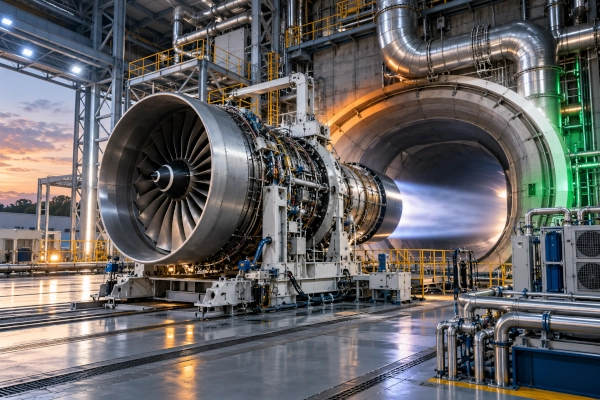
Tata Projects and Canada-based MDS Aero Support Corporation have entered into a strategic partnership to develop advanced aero-engine testing infrastructure in India, bringing together Indian infrastructure engineering capability with specialised global expertise in gas-turbine test systems.
The two companies formalised the collaboration through a Memorandum of Understanding announced on September 28, 2026. The partnership is intended to support India’s expanding aerospace and propulsion ecosystem by creating facilities capable of testing, validating and supporting advanced aero-engine technologies.
Partnership Combines Infrastructure and Engine-Test Expertise
Under the partnership, Tata Projects will lead the infrastructure side of future aero-engine test facilities, while MDS Aero will contribute specialised engine-testing technologies and systems integration.
Tata Projects will be responsible for civil and structural works, mechanical, electrical and plumbing systems, high-air-pressure systems, heating, ventilation and air-conditioning, high-temperature exhaust systems, cooling-water systems and associated site infrastructure.
MDS Aero will provide expertise in the design, engineering, supply, integration, commissioning and lifecycle support of gas-turbine engine test facilities.
This division of responsibilities allows the two companies to combine large-scale infrastructure execution with highly specialised propulsion-testing capability.
Tata Projects Brings Experience From Strategic Test Facilities
Tata Projects already has experience in building complex infrastructure for India’s strategic technology programmes.
Its portfolio includes integrated cryogenic engine and stage-testing infrastructure, semi-cryogenic engine test facilities and tri-sonic wind tunnels. The company has also worked on other mission-critical infrastructure in the space, nuclear and advanced-technology sectors.
This background gives Tata Projects experience in handling facilities that require tight engineering tolerances, specialised utilities and complex integration.
The new partnership extends those capabilities further into aero-engine testing.
MDS Aero Brings Four Decades of Gas-Turbine Test Experience
MDS Aero Support Corporation specialises in test infrastructure for gas-turbine engines and engine components.
Founded in 1985, the company has delivered engine-testing projects in more than 27 countries and works across aviation, defence, marine and industrial gas-turbine applications.
Its solutions cover complete engine test facilities, core-engine testing, compressor and turbine testing, combustion rigs, environmental simulation systems, data-acquisition platforms and specialised test equipment.
MDS systems are used by major engine manufacturers to develop, validate and certify propulsion technologies.
India Already Features in MDS Aero’s Global Portfolio
MDS Aero already has an operational presence in India and maintains a support office in Bengaluru.
According to Tata Projects, MDS is currently serving as the lead technology provider and systems integrator for an advanced twin-cell aero-engine development test facility in India.
That facility is intended to support next-generation military propulsion systems and gives MDS direct experience with India’s emerging propulsion-testing requirements.
The new Tata Projects partnership is therefore an expansion of an existing Indian presence rather than MDS Aero’s first entry into the country.
Advanced Engine Testing Is Critical to Indigenous Propulsion
Developing a modern aero engine requires far more than designing and manufacturing the engine itself.
Each propulsion system must undergo extensive testing to measure thrust, temperature, pressure, vibration, fuel consumption, structural behaviour and performance under different operating conditions.
Test facilities must reproduce demanding environments while collecting large volumes of accurate engineering data.
They must also safely handle very high airflow, exhaust temperatures, fuel systems and mechanical loads.
For this reason, aero-engine test infrastructure is one of the most technically demanding parts of the propulsion-development ecosystem.
Twin-Cell Facilities Can Accelerate Development Programmes
A twin-cell configuration allows multiple test activities to be conducted with greater flexibility than a single-cell facility.
Depending on the design, separate cells can support different engine configurations, development stages or test schedules while sharing selected infrastructure.
This can help reduce development bottlenecks and increase the amount of testing that can be completed during an engine-development programme.
For countries attempting to build advanced indigenous propulsion capability, access to modern test infrastructure can therefore be as important as access to engine-design expertise.
Partnership Comes as India Expands Aerospace Manufacturing
The agreement comes at a time when India is expanding aircraft manufacturing, defence aviation, unmanned systems, space technologies and propulsion-development programmes.
Growth in these sectors is increasing demand for specialised infrastructure capable of supporting engine development, validation, certification and lifecycle testing.
Tata Projects said India’s aerospace sector is entering a new phase in which the supporting infrastructure will become increasingly important alongside aircraft and propulsion technologies themselves.
The partnership with MDS Aero is intended to address part of that infrastructure requirement.
Local Execution Meets Global Technology
One of the central advantages of the collaboration is the combination of local project execution with specialised international technology.
Tata Projects has extensive experience managing large engineering and construction projects in India, including coordination with local suppliers, contractors and regulatory authorities.
MDS Aero brings a narrower but highly specialised capability in designing and integrating gas-turbine test environments.
Together, the companies aim to offer complete solutions rather than requiring customers to separately manage civil construction, utilities, test-cell engineering and systems integration.
Potential Importance for Defence and Civil Aerospace
Advanced aero-engine test infrastructure can support both military and civil aviation programmes.
Military propulsion development requires facilities capable of handling demanding test profiles for fighter aircraft, helicopters, unmanned aircraft and other platforms.
Civil aviation programmes likewise require reliable test environments for certification, durability testing and lifecycle support.
The partnership therefore has potential relevance across a broad range of aerospace applications rather than being limited to one specific engine programme.
India Builds the Infrastructure Behind Future Aero Engines
India’s ambitions in aerospace increasingly depend on domestic capability not only to manufacture aircraft and engines but also to test and validate them independently.
The Tata Projects-MDS Aero partnership addresses that less visible but critical part of the ecosystem.
By combining Indian infrastructure engineering with proven gas-turbine testing technology, the collaboration can help create facilities capable of supporting increasingly complex propulsion programmes within the country.
As India expands its aerospace and defence manufacturing base, such testing infrastructure will form an important part of the technical foundation needed to move from component production towards deeper design, development and validation capability.
References
Tata Projects — “Tata Projects and MDS Aero Support Corporation forge strategic partnership to advance aero-engine testing infrastructure in India,” September 28, 2026.
https://tataprojects.com/press-releases/tata-projects-and-mds-aero-support-corporation-forge-strategic-partnership-to-advance-aero-engine-testing-infrastructure-in-india
MDS Aero Support Corporation — Official company information on gas-turbine engine testing systems and global test-facility capabilities.
MDS | Gas Turbine Engine Solutions
Tata Projects — Integrated Annual Report FY2024-25, including strategic infrastructure capabilities in cryogenic, semi-cryogenic and wind-tunnel testing.
https://tataprojects.com
You may also like
-
India Advances Trade Diplomacy at G20 Ministerial in Milwaukee
-
Kokasa Launches to Build Indigenous Mission-Critical Systems for Su-30MKI, MiG-29 and T-72
-
Flying Wedge Defence Partners With Portugal’s Keydef to Manufacture Kaal Bhairava and YAMA Drones in Europe
-
Armenia Conducts Live-Fire Exercise With Indo-French TRAJAN 155 mm Howitzers Manufactured in India
-
Centre Approves ₹1,176 Crore Six-Lane Bridge Across Teesta River on NH-10 at Sevoke
