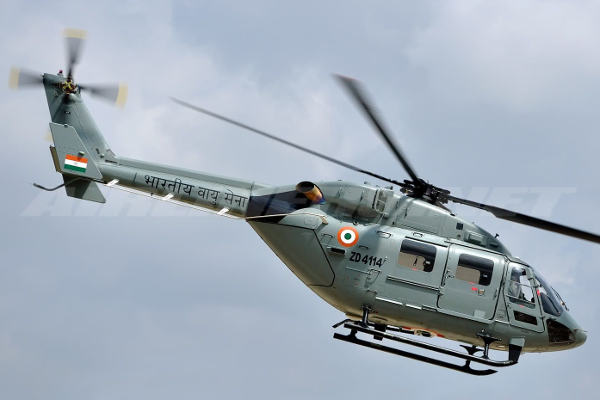
The Indian Army has tested helicopter operations from a stretch of National Highway 911 near Dantour in Rajasthan, using Rudra, Dhruv and Chetak helicopters to demonstrate how road infrastructure can support military aviation when conventional airfields or helipads are unavailable.
The exercise was conducted by the Sapta Shakti Command close to the India-Pakistan International Border and focused on controlled landing and take-off operations from a designated highway section.
NH-911 Used as an Alternative Landing Site
During the drill, Army Aviation crews practised approaches, landings and departures from the highway while ground teams coordinated aircraft movement and supported operations at the temporary landing site.
The exercise was intended to demonstrate the Army’s ability to use alternative operating locations in situations where permanent aviation infrastructure may be unavailable, damaged or unsuitable.
Such capability can improve flexibility during military operations by allowing helicopters to reposition, support ground formations and operate from dispersed locations.
Rudra, Dhruv and Chetak Take Part
The exercise brought together three different helicopter types from the Army Aviation fleet.
The Rudra is the armed variant of the Advanced Light Helicopter and is used for battlefield support, armed reconnaissance and escort missions.
The Dhruv Advanced Light Helicopter performs a wider range of roles including troop transport, logistics, reconnaissance and casualty evacuation.
The Chetak continues to serve in light utility, liaison and support roles, giving the exercise a mix of aircraft with different operating characteristics.
Highway Operations Add Operational Flexibility
Using a national highway as a temporary aviation surface gives the Army another option for dispersing helicopters away from fixed bases.
Permanent airfields and helipads remain the normal operating locations for military aviation, but alternative sites can become important during emergencies or conflict when established infrastructure is congested, damaged or inaccessible.
The exercise therefore focused not on replacing conventional aviation facilities, but on expanding the range of locations from which Army helicopters can operate when required.
Desert Conditions Add to the Challenge
The Dantour area lies in Rajasthan’s western desert region, where high temperatures, dust, strong winds and changing visibility can make helicopter operations demanding.
Landing on a highway also requires precise control because the available operating surface is narrower and less forgiving than a conventional airfield.
The drill therefore tested both pilot handling and the ability of ground teams to prepare, secure and manage a temporary landing area in a challenging environment.
Ground-Air Coordination Is Critical
Highway operations depend on careful coordination between aircrews and personnel on the ground.
Ground teams must secure the area, manage movement, establish communications and ensure that the surface remains suitable for aviation activity.
During the exercise, these procedures were practised alongside the flying operations, allowing Army Aviation personnel to validate the coordination required for temporary landing zones.
Dual-Use Infrastructure Gains Military Relevance
The drill also demonstrated the military value of civilian infrastructure.
National highways are designed primarily for civilian transport, but suitable stretches can provide emergency landing options for rotary-wing aircraft under controlled conditions.
In border regions, where distances between established aviation facilities can be considerable, the ability to use selected road infrastructure can provide additional operational depth.
Army Aviation Strengthens Dispersed Operations Capability
The NH-911 exercise shows how the Indian Army is preparing its aviation units to operate from a wider range of locations.
By conducting highway landings and take-offs with Rudra, Dhruv and Chetak helicopters, the Sapta Shakti Command tested an important element of dispersed aviation operations.
The exercise strengthens readiness by giving pilots and ground personnel practical experience in operating away from permanent airfields and demonstrates how existing infrastructure can support military mobility when circumstances demand greater flexibility.
References
ADG PI – Indian Army — Official communication on highway landing and take-off operations by Rudra, Dhruv and Chetak helicopters of Sapta Shakti Command near Dantour, Rajasthan, September 29, 2026.
United News of India — “Army helicopters operate from NH-911 near Pakistan border in Rajasthan,” September 29, 2026.
Times of India — “Exercise Jai se Vijay: Army Helicopters Turn NH-911 into Military Runway Near Pak Border,” September 30, 2026.
You may also like
-
Indian Coast Guard Seizes 526 Kg of Heroin and Methamphetamine in ₹3,000 Crore Arabian Sea Operation
-
INS Sahyadri and Kulish Join ASEAN Navies for AIME 2026 in Philippines
-
From Kaveri Dry Engine to IAF Fighter Powerplant: What India Must Achieve Next
-
Tejas Mk1A Nears IAF Combat Induction as Final Radar and Missile Integration Tests Approach Completion
-
Indian Navy Targets Historic Induction of 18 Warships in 2026
