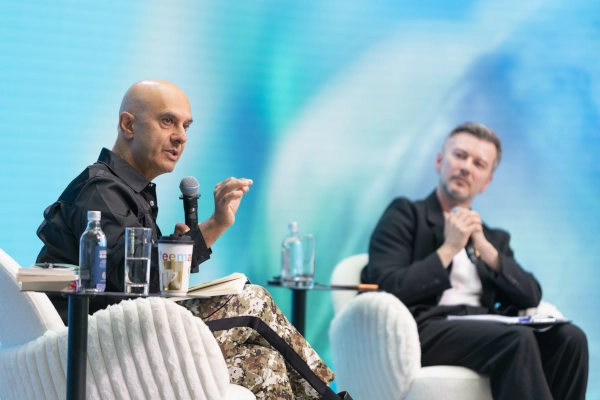
Leadership expert and bestselling author Robin Sharma used his appearance at the Moscow Startup Summit on September 30, 2026, to argue that rapid advances in artificial intelligence are making distinctly human qualities more important, not less relevant.
Speaking with Evgeny Tikhonovich, Editor-in-Chief of RBC Style and host of the Quality of Life programme, Sharma focused on leadership, entrepreneurship, productivity, resilience and the need to preserve human judgement in an increasingly technology-driven world. The discussion took place at SberCity during the two-day Moscow Startup Summit, organised by the Government of Moscow and Sber.
Technology Should Serve People
Sharma introduced a leadership framework built around the acronym H.U.M.A.N., saying that leaders must become more grounded and self-aware as organisations adopt increasingly sophisticated technology.
He described the five elements of the framework as Humility, Unkillable, Mastery, Awake and Nuts. Humility refers to remaining grounded as success grows, while Unkillable represents resilience in uncertain environments. Mastery focuses on creating products and services that break new ground, while Awake refers to mindfulness and self-awareness.
The final element, Nuts, reflects Sharma’s belief that founders and leaders must sometimes pursue ideas that appear unconventional or unrealistic to others. His broader argument was that artificial intelligence should remain a tool that serves human goals rather than replacing the qualities that define effective leadership.
Great Companies Need Many Leaders
Sharma also challenged the idea that successful companies should revolve around one dominant founder surrounded by followers.
He argued that strong organisations are built by developing many capable leaders across different levels of the company. In his view, the best businesses do not depend on one exceptional individual but create an environment in which many employees are encouraged to think, create and take responsibility.
He also warned against cutting corners when hiring. According to Sharma, talent acquisition should be treated as a long-term investment because the quality of the people inside a company has a direct influence on innovation, execution and growth.
Value Creation Should Come Before Revenue
The discussion also turned to the relationship between growth and profit.
Sharma argued that companies should focus first on creating substantially greater value for customers rather than treating financial returns as the primary objective. He said revenue is more sustainable when it follows from strong products, meaningful services and genuine customer value.
He referred to Steve Jobs as an example of a business leader whose focus on product excellence helped create commercial success. Sharma’s broader point was that great companies remain outward-looking and continue improving what they build instead of becoming defensive once they achieve early success.
Lessons From Highly Successful Entrepreneurs
Sharma also shared observations from his work with wealthy entrepreneurs and business leaders.
He described many highly successful founders as unusually resistant to outside opinion and deeply committed to their own vision, even when others dismiss their ideas. He said persistence and self-belief often distinguish those who continue through difficult periods from those who retreat too early.
At the same time, Sharma cautioned that success can become a weakness when leaders become attached to a single formula that worked in the past. He argued that companies can lose momentum when they shift from experimentation and expansion towards protecting earlier achievements.
Some of his comments on the emotional motivations of highly ambitious individuals were presented as personal observations from his experience rather than as universal psychological conclusions.
‘The Robot and the Gardener’ and the Future of Humanity
Sharma also discussed his forthcoming book, The Robot and the Gardener, which is scheduled for publication in 2027.
He explained the title as a metaphor for the balance between technological progress and the deeper qualities of human life. The robot represents the capabilities and promise of technology, while the gardener represents connection to nature, history, mortality and the human experience.
Sharma warned against allowing technological efficiency to weaken meaning, judgement or emotional connection. His message was not against artificial intelligence, but against becoming so dependent on technology that people lose the habits and values that make leadership genuinely human.
Productivity Is Not the Same as Busyness
A major part of Sharma’s session focused on the way founders and executives think about productivity.
He argued that many people confuse constant activity with meaningful output. In his view, a large amount of daily work adds limited value because attention is fragmented across meetings, messages and routine tasks.
Sharma encouraged leaders to concentrate on fewer high-value activities and to create more space for recovery, reflection and creative thinking. He recommended focused work periods, adequate sleep, regular exercise and deliberate limits on digital distraction.
He also suggested taking periodic time away from routine operations to think deeply about direction, priorities and new ideas.
Rest and Recovery Can Improve Performance
Sharma placed particular emphasis on sleep, exercise and personal relationships as factors that directly affect professional performance.
He argued that leaders become more effective when they are physically rested, mentally clear and emotionally grounded. In his view, recovery should not be treated as the opposite of productivity because sustained performance depends on the ability to think clearly and make sound decisions over long periods.
This approach challenges the culture of constant work often associated with startup founders. Sharma instead presented disciplined recovery as part of professional excellence.
Consistency Matters More Than Talent
Sharma also argued that long-term consistency often matters more than natural ability.
He cited basketball player Kobe Bryant as an example of someone who built an advantage through disciplined practice and repeated effort. The lesson, he said, is that sustained commitment compounds over time and can create capabilities that are difficult to match through talent alone.
For entrepreneurs, this means continuing to learn, improving execution and maintaining discipline even after the initial excitement of building a company has passed.
Three Recommendations for Business Founders
Towards the end of the discussion, Sharma offered three broad recommendations for founders.
He advised entrepreneurs to spend time in solitude developing a clear vision for both their business and personal life, to strengthen their inner confidence so they become less dependent on external approval, and to treat physical and mental health as essential rather than secondary.
He also stressed the importance of family, meaningful work and service to others. Reflecting on his own ambitions when he was younger, Sharma said material symbols of success ultimately mattered far less than health, relationships and the satisfaction of building something genuinely valuable.
Moscow Startup Summit Focuses on Technology and Innovation
The Moscow Startup Summit was held on September 29 and 30 at SberCity, with a programme centred on technology entrepreneurship and open innovation.
The 2026 event focused on the transformation of five major sectors through startup-driven technologies: medicine and biotechnology, education and creative industries, agriculture and food production, construction and urban development, and smart devices and robotics.
The summit also featured startup pitches, technology exhibitions, investor and corporate engagement, and an awards programme recognising organisations contributing to the innovation ecosystem. More than 100 Russian and international technology startups participated, ranging from early-stage ventures to companies approaching pre-IPO development.
Human Qualities Gain Importance as AI Advances
Sharma’s central message at the summit was that the rise of artificial intelligence does not reduce the importance of human leadership. Instead, it raises the value of qualities such as judgement, humility, courage, creativity, self-awareness and empathy.
Technology can improve efficiency, analysis and decision-making, but it does not remove the need for leaders who can inspire people, take responsibility and remain grounded during periods of rapid change.
For founders and business leaders, Sharma’s argument was that future success will depend not only on adopting better technology, but also on strengthening the human qualities that technology cannot easily reproduce.
References
Sber Press Office — “Human-Centred Leadership in the Age of AI: Robin Sharma Speaks at Moscow Startup Summit,” September 30, 2026.
Moscow Startup Summit — Official event programme, September 29–30, 2026.
Sberbank — Official corporate information.
You may also like
-
India to Track Challenges Faced by Women Entrepreneurs in New National Business Survey
-
India Updates Vehicle Rules to Strengthen E85 and E100 Flex-Fuel Technology
-
Adani Green Energy Expands Battery Storage to 6.63 GWh at Khavda, Strengthening India’s Renewable Power Infrastructure
-
Manastu Space Secures ₹116 Crore Government Support to Develop Indigenous Green Propulsion Systems
-
GeM’s AABHAR Collection Showcases 294 Indigenous Products, Strengthens Market Access for Indian Artisans
