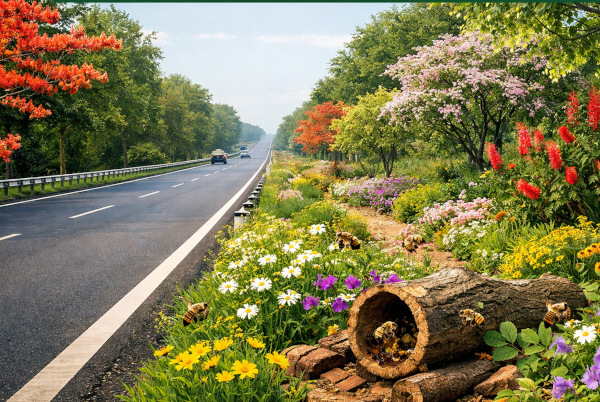
India’s National Highway network has expanded by nearly 61 per cent over the past 12 years, increasing from 91,287 kilometres in March 2014 to 1,46,572 kilometres by March 2026. The expansion has strengthened the country’s primary road transport network while improving connectivity between cities, industrial centres, ports, agricultural markets and previously less accessible regions.
The latest figures highlighted by the government show that the growth has gone beyond simply adding new highway kilometres. India has simultaneously expanded four-lane highways, access-controlled expressways and high-speed corridors while undertaking major upgrades of existing National Highway routes.
National Highways form the principal arterial road network of the country and carry a disproportionately large share of long-distance passenger and freight movement. Their expansion therefore has a direct bearing on travel times, logistics efficiency and the ability of industries and agricultural producers to reach domestic and export markets.
Four-Lane and Wider Highways Expand Rapidly
The transformation of the highway network is particularly visible in the growth of four-lane and wider roads.
Government data released in 2026 shows that the length of four-lane and above National Highways increased from 18,371 kilometres in 2014 to approximately 45,516 kilometres by March 2026.
This shift is important because highway capacity cannot be measured solely through total network length. Upgrading a two-lane highway into a four-lane or six-lane corridor substantially increases the volume of traffic that can move through the route while improving average speeds and reducing congestion.
Many of India’s busiest economic corridors are consequently being progressively widened or replaced by access-controlled roads designed to separate long-distance traffic from local movement.
High-Speed Corridors Become a Larger Part of Road Infrastructure
India has also rapidly expanded its network of access-controlled high-speed corridors and expressways.
Only around 93 kilometres of operational high-speed corridors existed in 2014. By 2026, the operational network had expanded to approximately 3,644 kilometres.
Unlike conventional highways that pass through towns and allow frequent intersections, modern access-controlled corridors are designed with controlled entry and exit points. Grade-separated interchanges, bypasses and restricted roadside access allow vehicles to maintain higher and more consistent speeds.
These corridors are increasingly being developed between major economic centres and freight-generating regions, creating a new layer of long-distance road infrastructure alongside the conventional National Highway system.
Bharatmala Drives Development of Economic Corridors
Bharatmala Pariyojana has been one of the major programmes supporting the expansion and modernisation of India’s National Highway network.
By March 31, 2026, approximately 22,590 kilometres of roads had been completed under Bharatmala. The programme focuses on economic corridors, inter-corridor connectivity, feeder routes, border and international connectivity roads, coastal and port roads and greenfield expressways.
The emphasis on economic corridors reflects a broader change in highway planning. Instead of treating roads primarily as links between individual cities, corridor-based development seeks to connect production centres, industrial clusters, logistics hubs, ports and consumption markets through integrated transport networks.
This approach is also being coordinated with the PM GatiShakti National Master Plan, which brings together planning for roads, railways, ports, airports and other infrastructure.
Highway Expansion Supports Freight and Industrial Connectivity
The increasing scale and capacity of India’s National Highway network has important implications for freight transportation.
Road transport remains central to the movement of manufactured products, agricultural produce, construction materials and consumer goods across India. Congestion, poor road geometry and bottlenecks can increase fuel consumption and extend delivery times, raising logistics costs throughout the supply chain.
Wider highways, bypasses and access-controlled corridors allow commercial vehicles to travel longer distances with fewer interruptions. Improved connectivity also enables manufacturing and logistics facilities to develop farther from major metropolitan centres without losing access to national markets.
Industrial corridors, manufacturing clusters and logistics parks are consequently becoming increasingly dependent on high-capacity road infrastructure.
Rural and Agricultural Markets Gain Better Access
National Highway development also has an impact beyond major urban and industrial centres.
Improved highways and feeder-road connections can shorten travel times between rural production areas and regional markets, cold-storage facilities, food-processing units and transport hubs. This becomes particularly important for perishable agricultural produce, where delays during transportation can contribute to losses.
Highway development in remote and border regions has similarly improved links between communities and larger economic centres while supporting tourism, healthcare access and movement of essential supplies.
The benefits therefore extend beyond the highways themselves as state roads, rural roads and local transport networks connect with the expanding national system.
Greening Becomes Part of Highway Development
As the highway network has expanded, the government has also increased its focus on reducing the environmental impact of road construction and operation.
The Green Highways Policy, introduced in 2015, provides a framework for plantation, transplantation, beautification and maintenance along National Highways. Plantation programmes are intended to reduce dust and air pollution, control soil erosion and create green buffers along highway corridors.
Implementation involves agencies including Self Help Groups, State Forest Departments, Forest Corporations, contractors and private organisations. The National Highways Authority of India has also established mechanisms for monitoring plantation activity through its regional structure.
Satellite-based monitoring is increasingly being used to assess green cover and plantation performance along highway corridors.
Recycled Materials Enter Highway Construction
Another emerging component of India’s highway programme is the greater use of recycled and waste-derived construction materials.
Road projects are increasingly examining the use of materials such as processed construction waste, fly ash and other industrial by-products where technically suitable. Such approaches can reduce demand for conventional raw materials while providing productive uses for waste generated by cities and industries.
Longer-lasting pavements, improved drainage, slope stabilisation and climate-resilient construction techniques are also becoming more important as highways face heavier traffic and increasingly variable weather conditions.
The expansion of the network is therefore being accompanied by efforts to improve the durability and lifecycle performance of road infrastructure.
India’s Road Network Is the World’s Second Largest
India’s overall road network now extends to approximately 63.73 lakh kilometres, making it the second-largest road network in the world.
National Highways account for only a portion of this enormous system, but they constitute its most important long-distance arterial routes. They connect with state highways, district roads, rural roads and urban networks to form the wider transport system used by passengers and freight.
The growth from 91,287 kilometres of National Highways in 2014 to 1,46,572 kilometres by March 2026 represents an addition of more than 55,000 kilometres to this strategic network.
At the same time, the substantial increase in four-lane roads and access-controlled corridors shows that India’s highway transformation is increasingly centred on capacity and quality as well as total length.
A Larger and More Capable National Highway System
India’s highway development over the past decade has created a considerably larger national road backbone. The nearly 61 per cent expansion of the National Highway network has been accompanied by wider roads, new expressways, economic corridors and greater integration with ports, industrial areas and logistics infrastructure.
With 1,46,572 kilometres of National Highways, more than 45,000 kilometres of four-lane and wider routes and a rapidly expanding network of access-controlled corridors, India’s road infrastructure is increasingly being shaped around faster movement, higher capacity and stronger economic connectivity.
The continuing development of these corridors is strengthening the physical infrastructure required for manufacturing, agriculture, logistics, regional connectivity and domestic trade across the country.
References
- Akashvani News — India’s National Highway Network Grows Nearly 61% to Over 1.46 Lakh km Since 2014, September 29, 2026.
https://newsonair.gov.in/indias-national-highway-network-grows-nearly-61-to-over-1-46-lakh-km-since-2014/ - Press Information Bureau, Ministry of Road Transport & Highways — Greening India’s National Highways, September 28, 2026.
https://www.pib.gov.in/PressNoteDetails.aspx?ModuleId=3&NoteId=160214&lang=1®=48 - Press Information Bureau — Ease of Living: Roads and National Highways, June 2026.
https://static.pib.gov.in/WriteReadData/specificdocs/documents/2026/jun/doc2026615893301.pdf - Press Information Bureau, Ministry of Road Transport & Highways — Expansion and Upgradation of National Highways, February 4, 2026.
https://www.pib.gov.in/PressReleasePage.aspx?PRID=2223330&lang=1®=1 - Press Information Bureau, Ministry of Road Transport & Highways — Year End Review 2025, December 30, 2025.
https://www.pib.gov.in/PressReleasePage.aspx?PRID=2209837&lang=1®=6
You may also like
-
Puralink Builds Autonomous Ferret Robot for Underground Pipe Inspection and Mapping
-
ULOOK Develops Space-Based RF Intelligence Platform as It Joins Peak XV Surge 12
-
TDB Backs Multi Nano Sense With ₹37.51 Crore to Build Indigenous Multi-Gas Sensor Platform
-
Textiles Ministry Plans 5,000–10,000 New Exporters as India Expands District-Led Textile Export Push
-
India and Jordan Target US$5 Billion Bilateral Trade by 2030 as Economic Cooperation Expands
