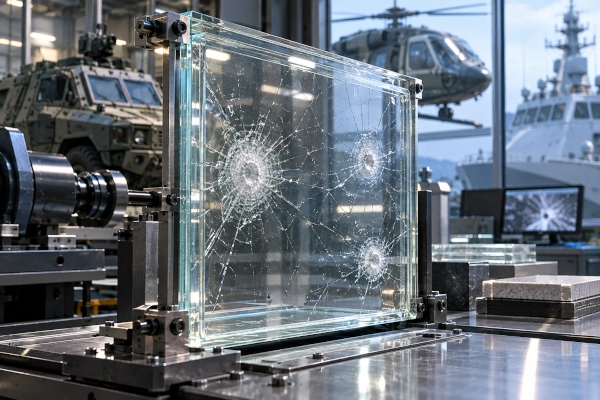
Indian researchers at the CSIR-Central Glass and Ceramic Research Institute are developing a new generation of lighter transparent armour in collaboration with the Defence Research and Development Organisation, targeting military applications where conventional bullet-resistant glass imposes a substantial weight penalty.
The programme is centred on advanced glass-ceramic technology that combines high hardness, transparency and improved ballistic resistance within a thinner structure. CSIR-CGCRI has already demonstrated material capable of stopping AK-47 rounds during initial testing conducted with DRDO, creating a foundation for future transparent armour for military vehicles, aircraft, naval platforms and protected installations.
Glass-Ceramic Armour Targets Lower Weight
Conventional bullet-resistant glass generally relies on multiple laminated layers to absorb and dissipate projectile energy. While effective, such systems can become extremely thick and heavy when designed to withstand higher ballistic threats.
CSIR-CGCRI is pursuing a different materials approach based on glass-ceramics. The institute has developed transparent armour containing nanometre-scale crystals distributed within a specially engineered glass matrix.
The internal nanostructure improves hardness and toughness while allowing the material to remain transparent. By deriving ballistic performance from material engineering rather than relying only on additional thickness, the technology offers a pathway toward lighter protective glazing.
Nanocrystallisation Creates Stronger Transparent Armour
The glass-ceramic material is produced using a process known as nanocrystallisation.
CSIR has stated that crystals measuring approximately 20 to 30 nanometres are formed uniformly within the glass matrix. These extremely small crystalline regions alter the way the material responds to mechanical stress and projectile impact.
The resulting glass-ceramic is designed to resist cracking and absorb ballistic energy more effectively than ordinary glass while maintaining the optical clarity required for transparent armour.
This combination is particularly important because military crews need protection without sacrificing visibility through vehicle windows, helicopter windscreens or observation panels.
Initial Testing Stopped AK-47 Rounds
CSIR-CGCRI has reported successful initial ballistic testing of the material in collaboration with DRDO facilities.
During these trials, the glass-ceramic armour stopped AK-47 rounds fired from a distance of 10 metres. The tests demonstrated the material’s ability to provide meaningful ballistic protection while retaining the weight advantages associated with its advanced structure.
Further testing is intended to evaluate resistance to multiple closely spaced impacts, an important requirement for operational transparent armour. Military protection standards generally require materials to survive repeated projectile strikes without catastrophic failure or complete loss of structural integrity.
DRDO Collaboration Supports Military Qualification
Development of the technology is being carried out with participation from DRDO establishments, including defence laboratories working on materials and platform protection.
The collaboration allows the material to be evaluated against requirements associated with military vehicles, aircraft and naval systems rather than remaining confined to laboratory-scale testing.
Ballistic armour intended for operational use must perform under far more demanding conditions than a laboratory specimen. Apart from stopping projectiles, transparent armour can be required to tolerate vibration, temperature variation, moisture, mechanical loads and prolonged environmental exposure while maintaining optical quality.
DRDO involvement provides the testing and qualification framework needed to move the technology toward defence applications.
Military Vehicles Could Benefit From Lower Armour Weight
Transparent armour is one of the heavier components of many protected military vehicles.
Reducing the mass of ballistic glass can therefore improve overall vehicle performance. Lower weight can increase mobility, reduce stress on engines and suspension systems, improve fuel efficiency and create additional payload capacity for weapons, sensors or communications equipment.
The advantages become particularly important for wheeled and tracked armoured platforms that must balance mobility with increasingly demanding protection requirements.
Lighter transparent armour can also reduce the structural reinforcement required around windows and vision panels, further lowering overall platform weight.
Aircraft and Helicopters Present an Even Greater Weight Challenge
Weight reduction is even more important in aviation.
Every kilogram added to an aircraft affects payload, range, fuel consumption and flight performance. Transparent armour used to protect helicopter cockpits or aircraft crew positions must therefore provide ballistic protection without imposing excessive mass.
Advanced glass-ceramic armour could offer an important advantage by delivering protection through improved material properties rather than simply increasing thickness.
The technology is particularly relevant for military helicopters and special-mission aircraft operating in environments where crews may face small-arms fire.
Naval Platforms Could Also Use the Technology
CSIR has identified naval systems among the potential applications for advanced transparent armour.
Warships, patrol vessels and specialised naval craft can require protected bridge windows and observation areas while still maintaining clear visibility for crews.
A lighter glass-ceramic solution could reduce topside weight and improve the integration of ballistic protection on smaller vessels where mass distribution is particularly important.
The same technology could potentially be adapted for protected control rooms, observation posts and other strategic installations requiring both visibility and ballistic resistance.
Industry Interest Points Toward Commercial Production
The technology has already attracted commercial interest.
CSIR-CGCRI has signed Memoranda of Understanding with several companies as part of efforts to translate the research into industrial-scale manufacturing. Such partnerships are important because producing large transparent armour panels consistently requires specialised furnaces, precision thermal processing, surface finishing and quality-control systems.
Scaling a laboratory-developed glass-ceramic into repeatable defence production is therefore a major engineering step in its own right.
Industry participation can help bridge this gap by converting material science developed within CSIR laboratories into panels suitable for vehicle and aerospace integration.
Advanced Materials Become Increasingly Important to Defence Self-Reliance
India’s defence indigenisation effort increasingly extends beyond complete weapon systems into specialised materials that determine platform performance.
Transparent armour is one such technology. Imported advanced ceramics, specialised glasses and ballistic materials can create dependence even when the larger vehicle or aircraft is manufactured domestically.
Indigenous glass-ceramic armour strengthens the domestic supply chain for a strategically important protection technology while also building expertise that can be applied to civilian security applications.
The programme illustrates how fundamental materials research can translate directly into improvements in mobility, survivability and platform efficiency.
From Heavier Glass to Smarter Materials
The CSIR-CGCRI approach represents a shift away from improving ballistic protection simply by adding more layers of conventional glass.
By engineering the internal structure of the material at the nanometre scale, researchers are seeking to produce transparent armour that is simultaneously thinner, lighter and more resistant to impact.
Successful initial ballistic testing with DRDO demonstrates that the underlying concept has moved beyond theoretical research. Continued qualification, multi-hit testing and industrial scaling can now build on that foundation.
The development strengthens India’s capability in advanced defence materials and creates a domestic pathway toward lighter transparent armour for military vehicles, helicopters, aircraft and naval platforms.
References
Council of Scientific and Industrial Research — CSIR TechConnect 2026, “Clear, Light, and Battle-Ready: Glass-Ceramic Bulletproof Breakthrough”
https://www.csir.res.in/sites/default/files/2026-04/csir-techconnect-2_2026.pdf
CSIR-Central Glass and Ceramic Research Institute — Official Website
https://www.cgcri.res.in/
Defence Research and Development Organisation — Official Website
https://www.drdo.gov.in/
Press Information Bureau — CGCRI Showcases Materials-Led Innovations for Viksit Bharat, September 24, 2026
https://www.pib.gov.in/PressReleasePage.aspx?PRID=2314354
You may also like
-
TakeMe2Space to Launch India’s First Orbital Computing Satellite MOI-1A on October 1, 2026
-
Micronex to Build Semiconductor Lead-Frame Manufacturing Facility at Sanand
-
BonV Aero Supplies 45 Indigenous Logistics Drones to Indian Army Eastern Command
-
HAL and SkyPulse Plan 30-Helicopter Leasing Ecosystem Around Made-in-India Civil Aircraft
-
HAL-Russia Civil Aircraft Cooperation Advances as SJ-100 Manufacturing Plan and IL-114 Localisation
